
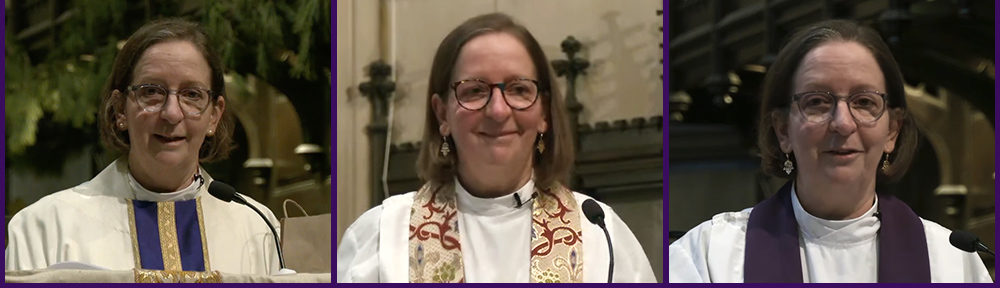
Proper 18B, September 8, 2024. The Very Rev. Pamela L. Werntz
- Proverbs 22:1-2, 8-9, 22-23. Those who are generous are blessed, for they share their bread with the poor.
- James 2:1-10 (11-13) 14-17. Mercy triumphs over judgement.
- Mark 7:24-37. They were astounded beyond measure.
O astonishing God, grant us the strength, the wisdom and the courage to seek always and everywhere after truth, come when it may, and cost what it will.
In my first semester of seminary, I was accepted into a senior seminar taught by Professor Alison Cheek, who was one of the Philadelphia 11. [1] The course had the longest title: “Learning to Teach Small Group Bible Study from a Feminist Perspective.” LTSGBSFP doesn’t make a good acronym, but it sure did help me engage scripture with an unapologetic feminist consciousness. Professor Cheek helped unstop my ears and loosen my tongue! I give thanks to God for her whenever I encounter lessons like the ones we have before us today.
I often hear people who are experiencing abundance expressing gratitude, giving thanks to God and saying to others, “I am so blessed.” But both Proverbs and James make it abundantly clear that the blessing of God is upon those who are generous, who share their bread with people who do not have enough. According to Proverbs, the fact of abundance is not a blessing from God; the blessing from God is the distribution of abundance so that everyone gets enough. The evidence of blessing of God is in the sharing of abundance. And James says that mercy triumphs over judgment every time in the realm of God. Whenever there’s a conflict of biblical values or teachings, and there are often conflicts, ask yourself which teaching is more merciful, which teaching is more generous, and follow that.
Our Gospel lesson is one of my all-time favorites. Just to bring you up to date because it’s been a while since we focused on Mark, the context is that Jesus and his disciples have had an exhausting time traveling all around the Galilee, teaching and healing and casting out demons. Jesus recognized their exhaustion and said, “Come away to a deserted place all by yourselves and rest a while,” but it never happened. They’ve had no rest. This is a story of yet another attempt to get away for a break. But Jesus seems to have gone off on his own – there’s no mention of his disciples.
Jesus headed up to the city of Tyre – out of Israel, up to the coast of Syria. He didn’t want anyone to know he was there. And yet a woman whose little daughter had an unclean spirit heard about him right away and she found him. What follows might be the most extraordinary encounter in the whole Gospel of Mark. She was a Gentile woman. A Syrophoenecian, from a people traditionally condemned in our scripture for their violence, unfair trading practices, and other injustices, and desecration of places deemed holy by Israel. In this story, she came alone. She came to beg Jesus to heal her little daughter. I think of how desperate she must have been to do that. What she represented – this ethnically, racially, culturally, foreign female with a gravely ill, demon possessed daughter – was frightening, forbidden and chaotic. [2] Jesus wasn’t interested.
Perhaps some of you remember that not long before this in the Gospel of Mark, Jairus, a leader in a synagogue had come to Jesus imploring him to heal his daughter. Jesus dropped everything to go with Jairus. But what did Jesus say to the Syrophoenician woman, when she begged him to heal her daughter? What he said was crass, rude, extremely insulting. He didn’t just say no. He said that he was not going to give sustenance to a little dog. He called her little daughter a little dog. In scripture, Gentiles are referred to as dogs: unclean pests and gross scavengers. The term is only used pejoratively in the Bible. In other words, there are no good or even neutral mentions of dogs. For ancient Israelites, dogs were not cute pets. Jesus was calling the little girl a little dog and that means the little girl’s mother was a female dog and you know what the word for a female dog is. It’s a horrible thing for Jesus to say.
Now, I’ve heard people argue that Jesus was just testing her. But I don’t agree and I admire her persistence and her courage. She didn’t walk away weeping, she didn’t go away in silence, ashamed that her request had been rebuked, sorry that she had even asked. Mark says, “But she said, ‘Sir, even the dogs under the table eat the children’s crumbs.’” She insisted that Jesus share what crumbs he had. Her swift retort accomplished the only miraculous healing from a distance in all of the Gospels. Indeed her willingness to respond directly, clearly, forcefully, made her daughter well. Jesus said so. “For that retort,” Jesus said, “the demon has come out of your daughter.” Although she is not named in the Gospel, in church tradition, the mother in this story is called Justa, meaning just or righteous one. Jesus was changed by his encounter with Justa. In contemporary words, Justa was insisting that Black Lives Matter, and Jesus had a change of heart and thinking, which is what repenting is. This is a story of the healing of a daughter and also a story of the healing of Jesus.
I say that because what happened next is baffling for anyone who knows the geography of Syria. Mark writes, “Then [Jesus] returned from the region of Tyre and went by way of Sidon towards the Sea of Galilee, in the region of the Decapolis.” Jesus left Tyre and went 25 miles in the exact opposite direction from the Decapolis. Sidon is 25 miles north and the Decapolis area near the Sea of Galilee is about 90 miles southeast. Some commentaries assume that this is a mistake of Mark’s, that Mark was bad at geography. But since most biblical scholars think that the Gospel of Mark was written in Antioch, which is also in Syria, I don’t think this is a mistake in the Gospel of Mark.
Possibly Jesus was so disoriented by the encounter with this uppity woman, that he temporarily lost his bearings. Or perhaps, he intended to continue heading north, got as far as Sidon and realized that he just had to revisit the Decapolis, where previously he had done an exorcism, putting a legion of demons into a herd of swine and driving them off of a cliff. The frightened people had begged him to leave their region, and so he had. That’s what happened just before the story of the healing of Jairus’ daughter. I wonder if Jesus got 25 miles into his continued journey north and realized that he had to turn around [3] and go back to the people who were so scared of being freed from a legion of demons (or an occupying army) that they wanted him to leave. Maybe it was like people in our day who are scared of being freed from the benefits of white supremacy or of Christian nationalism.
When Mark moves on to tell the story of a man whose ears were blocked and whose tongue was tied, he reports that Jesus said, “Ephphatha,” be opened. I think that the Syrian woman, Justa, had opened Jesus to the possibility that the bread of justice is for everyone. Jesus had been opened and he returned to the Decapolis to pay it forward, to give the frightened people there another try.
When he arrived in the wilderness area of the Decapolis, he fed a great crowd of 4,000 with seven loaves and a few fish, with seven baskets left over. Mark’s earlier story of the feeding in Israel was 5,000 with five loaves and two fish and twelve baskets left over. It’s funny that we never refer to the feeding of the 4,000. I guess the number is somehow less impressive than 5000. You won’t hear it in church next week because our lectionary is going to skip over it. Bishop Fisher of the Diocese of Western Mass. likes to point to this as the first scriptural of church decline! Since Mark sandwiches the retort of the Syrophoenician woman between the two feeding stories, it’s clear that the crumbs of bread she’s referring to are going to be quite filling, more than enough! It’s a banquet where hunger for justice and healing are more than satisfied.[4]
So I wonder, if we might be opened to Justa, to justice, the way Jesus was, the way countless others were. I wonder if, with regard to racism in particular, can we learn to hear more deeply and speak more clearly than before? It might be disorienting. It might mean needing to revisit some territory we thought we’d left behind. We surely are taking the long way to get there, but I believe we’ll get there because we know something about being filled with a just morsel of bread. We know about mercy triumphing over judgment. We know about being astounded at the healing and feeding that is possible when we are fully participating in and sharing the merciful and just realm of God. The blessing is in the sharing.