
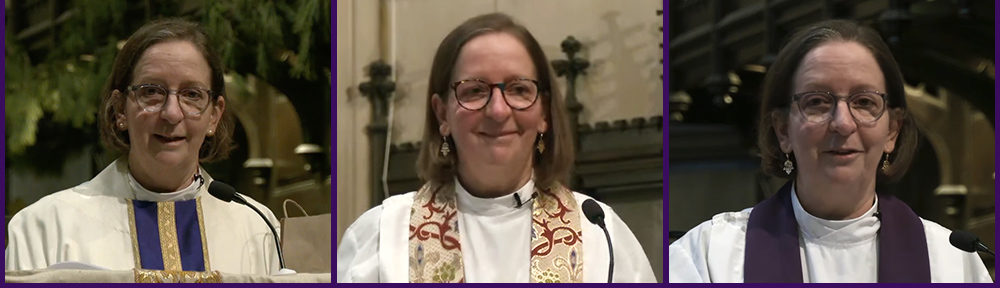
Proper 25B. 27 October 2024. The Very Rev. Pamela L. Werntz
Job 42:1-6, 10-17. Now my eyes see you.
Hebrews 7:23-28. Prevented by death from continuing in office.
Mark 10:46-52. What do you want me to do for you?
O God of our wildest dreams, grant us the strength, the wisdom and the courage to seek always and everywhere after truth, come when it may, and cost what it will.
We are living in a dangerous time right now – a time of high uncertainty and high anxiety, a time of dis-integration, dis-placement, and dis-ease. And our readings have something to say to us because they were written in periods of great dis-integration, dis-placement, and dis-ease, with visions of a better future. This morning, we heard the conclusion of the tale of Job. The Book of Job was probably written in the midst of the Babylonian exile – a time of great calamity for the ancient Israelites. The Psalm appointed for today, that we heard in our motet, is Psalm 126, was probably written about the same time. The Psalmist writes of restoration as if it has already happened: when the Lord restored the fortunes of Zion, then were we like those who dream. Then was our mouth filled with laughter, and our tongue with shouts of joy.” But when Job and this Psalm were written, the restoration hasn’t happened yet. They were writing their vision of shalom. The writer of Job imagines that Job’s eyes are finally opened, and at last, he sees what he was previously unable to perceive –that Divine works of beauty are all around him the whole time. Did it really happen? Were his eyes ever opened?
“Now my eyes see you,” Job says to the Holy One in this vision of the future. “Now my eyes see your beautiful handiwork all around me, in me and through me. Now my suffering is no longer all I can think about!” In the verses that are unfortunately omitted from our lectionary, God accepts the prayers of Job on behalf of his three friends who had completely misunderstood suffering as divine justice. Then the book concludes with how Job and his family lived happily ever after. (Well, as happy as one could be with 6,000 camels. Camels are nasty!) The words of the fairy tale ending are a later addition to the older story and are definitely not the point of being faithful. The oldest ending of this story did not tie things up in a neat bow at all. To read this as a lesson on how to get rich is also to completely misunderstand divine justice. The moral of this unsettling story is about maintaining one’s integrity in the midst of profound suffering, and about the vision of the Holy One as merciful, generous, and unpredictable.
In the portion of the Letter to the Hebrews, we heard that the priesthood of Jesus did not end with his death, which prevented the continuation in office of other priests. The peace and justice work of Jesus, by comparison, is for evermore, eternal, because he lives. The writer of the Letter to the Hebrews is asserting that the delivery of bread and wine and blessing of the priesthood of Jesus are ongoing even in the midst of persecution. I guess that’s true enough, isn’t it? Because here we are – receiving bread and wine and blessing week after week in front of a permanent gesture of welcome and invitation.
In our Gospel lesson from Mark, written at a devastating time in history, we have the last scene before Jesus’ entry into Jerusalem. According to Mark, the folks following Jesus were both amazed and afraid. If our schedule of sequential readings coincided with our liturgical year, next week we would be observing Palm Sunday instead of All Saints’ Day. The story of Bartimaeus is the concluding piece in Mark before Jesus’ passion begins. That’s a signal to us that it was a very important story to Mark. The text says, they came to Jericho and right away Jesus and his disciples and a large crowd were leaving Jericho. We might miss the significance of that, the emphasis on Jericho, but Mark’s audience knew that Jericho was best known as the site that Israel first conquered in their entrance into the promised land. The last time in the Bible that someone was shouting outside the walls of Jericho, the walls came tumbling down! <[1] Then, during the time of Elijah, there was a school of prophets (seers) in Jericho. When the Babylonians captured the city of Jericho, the last reigning king of Judah, Zedekiah, tried to escape. He was captured and his eyes were put out – he was blinded. Jericho is a place heavy with symbolic significance in the vision of the people of God. (Jericho was a place where an abundance of beautiful roses and medicinal plants were grown.)
The contemporary context of this story in Jesus’ time also seems significant to me. Jericho was where Herod the Great had built a resort to take a break from the cold and wet Jerusalem winter weather. Jericho, the city of palms, built near a large spring of fresh water, had become a luxury oasis for the Jerusalem aristocracy, with swimming pools, villas, parks, palaces, music halls, theaters, a racetrack, you name it. And with that kind of luxury, there comes a certain cultivated blindness to others who are suffering. So. Bartimaeus (son of Timaeus) was sitting along the way just outside a resort on the road that went up to Jerusalem, his cloak spread out for receiving whatever his begging might bring in and he heard that Jesus of Nazareth was going by. He began to croak like a raven, saying, “Jesus, Son of David have mercy on me!”
This blind man seems to be able see something about Jesus as a healer. Often when we want to signal that we understand something, we say, “I see.” That means, “I get it.” That’s true in English and it was true in ancient Greek and ancient Hebrew. “Seeing” in ancient times meant the physical ability to distinguish light and dark and recognize people and objects using ones eyes; and it also meant understanding, comprehending, and being able to discern the truth about a situation. Remember Job’s blindness before he proclaimed, “now I see God.” Bartimaeus might have had eyes that didn’t function physically, but when Jesus passed by, he, in fact, could see very well. His vision was very clear in a figurative sense.
The first blind person I ever knew well was the father of my best friend in junior high. Brad Burson had lost his eyesight in an accident that happened when he was 15. He and a friend were playing with a gun that they were sure wasn’t loaded. The friend put the gun up to Brad’s temple and pulled the trigger and a bullet went through his head, severing both of his optic nerves. He miraculously survived the gunshot wound to his head, but lost his eyesight. By the time I met him, he was a Ph.D. nuclear physicist with a law degree. He used to explain that no-one can see atoms – so it doesn’t matter whether a nuclear physicist’s eyes work or not. And no-one can see the law, so it doesn’t matter whether a lawyer’s eyes work or not. He went on to found the American Council of the Blind. This was a man who had suffered a tragic loss. And this was a man who had great vision even though he did not have eyesight. In fact, his vision was so clear that I had a hard time believing he was really blind.
Sometimes sighted people think that, in ancient times, if people were blind, they automatically were beggars, but there are plenty of references in ancient literature to people who were blind and very accomplished. Bartimaeus was blind and a beggar, but one did not necessarily cause the other. Bartimaeus started shouting out that he wants Jesus to have mercy on him and everyone told him to be quiet. And they don’t tell him nicely. A more literal translation
of the Greek would say, “And many kept yelling at him to shut up.”[2] They rebuked him. (One biblical commentary notices the similarity of the Greek word for rebuke and the name Bartimaeus and suggests that his name might literally be, Son of Rebuke.) [3]
I don’t know about you, but I have a hard time speaking up, especially to beg for mercy, even when it’s just the voices in my own head telling me to shut up. It’s very rare that I get loud enough for other people to tell me to shut up. In the few cases where someone else has indicated that they wish I would be quiet, I get so mad or ashamed or whatever, that I often don’t say another word. So Bartimaeus is one of my Bible heroes. Bartimaeus reminds me to shout out, when I need mercy, that is, when I need compassion, kindness, sympathy, understanding for myself or for others. The word mercy here is often how the Hebrew word chesed is translated – chesed is the steadfast love of God experienced and expressed in the covenantal community. Bartimaeus is begging for welcome and restoration to and of the beloved community. [4]
When Jesus stood still and then said, “Call him here,” the crowd called Bartimaeus and said, (in a more literal translation) “Be brave, get up, he’s calling you!” [5] That’s an ironic and surprising thing for the crowd to say, I think, because Bartimaeus has actually already been quite brave. It’s the crowd who has been afraid. So there’s a way in which the crowd is really talking to themselves when they tell Bartimaeus to be brave, projecting, as crowds often do, their own fear onto the guy begging along the way.
Did Bartimaeus’ sight get restored immediately? Did his trust make him well? Are we to understand this metaphorically or literally? (My answers to those questions are both Yes and I don’t know.) Did Bartimaeus regain his vision only to see Jesus crucified a week later? As you may remember, the question I’m always more interested in is not, “did this really happen?” but “is this really happening?” Where in our lives are we in situations in which we could be calling for full restoration in God’s beloved community over the yelling voices (inside or outside of our own heads) that warn us to keep quiet? In what situations are we in the crowd, wanting someone else to shut up because their demands for attention, for mercy, for compassion, for full inclusion are bothering us? What might it mean for each of us to “Be brave, get up, because Jesus is calling,” to throw off our cloaks and spring up! When Jesus says, “Go,” the word is more like “Go lead! Your trust has restored you. Your trust has restored your vision.” Where might trust lead us into greater wellness, restored vision, so that we can spring up as leaders to encourage others to follow Jesus on the way, rather than sitting on the sidelines along the way?
We are going to need the church that we are to be brave in the coming weeks, months, even years. Our wider communities are going to need the church that we are to be brave in the coming weeks, months, even years. I think we can only do that if we stick together, reminding one another that if we want to go far, (and the vision of shalom is far right now), if we want to go far, we must go together. As we continue to breathe and continue push for the vision of well-being, it is love that will make us brave. “Be brave, get up, he’s calling us!”
- Mark Davis in his blog Leftbehindandlovingit.blogspot.com/2012_10_01_archive
- Robert Miller, ed., The Complete Gospels: Annotated Scholars Version (San Francisco: HarperSanFrancisco, 1994), p. 39.
- Mark Davis.
- Ronald J. Allen & Clark M. Williamson, Preaching the Gospels without Blaming the Jews (Louisville: Westminster John Knox Press, 2004), p. 160.
- Miller, p 39.