
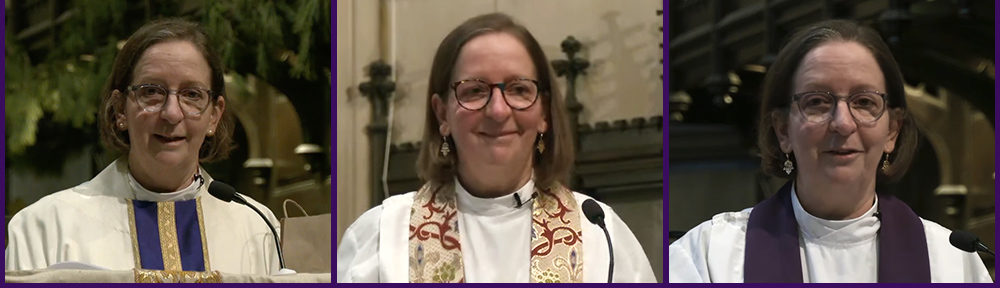
Proper 10C, July 13, 2025. The Very Rev. Pamela L. Werntz
- Amos 7:7-17. The Lord said to me, Go prophesy to my people Israel.,
- Colossians 1:1-14. Grace to you and peace from God.
- Luke 10:25-37. But wanting to justify himself.
O God of mercy, grant us the strength, the wisdom and the courage to seek always and everywhere after truth, come when it may, and cost what it will.
The story called “the good Samaritan” is such an iconic story that one doesn’t have to be a church goer to know it. You don’t have to be a Christian to have heard of it or understand something about it. Hospitals, emergency services, counseling services, hotlines, rules of law about limits of liability, award programs, all get called Good Samaritan. This parable, found only in Luke, might be the most famous parable of them all. And with its fame comes the enormous and crushing weight of Protestant Moral Theology, Sunday School lessons, and a hefty dose of Christian anti-Jewish bias. The preaching challenge for me seems formidable because of what we think we already know about this story, and the guilt that has been wired into most of us about seeing people in life’s various ditches and not doing enough or not doing anything at all to help. In my time as a priest, this bible story has provoked in me more confessions and more defensive attempts at self-justification than any other I can think of.
If we were the kind of parish that had a big projection screen, I would show you a picture of the narrow winding “road” that goes from Jerusalem to Jericho through the Judean wilderness. The path where this story takes place descends about 3300 feet over about 17 miles through what looks like a moonscape of barren mountains. I’ve never seen any desert that’s so hard, so stark, or so unforgiving. The sun is relentless. It’s windy. It’s devoid of vegetation. And it’s notoriously dangerous. People can hide in the caves and the rock crevices and come out of nowhere fast. It is a wild and notorious hideout for bandits. One wonders what kind of idiot would be traveling alone down that road. One wonders what kind of idiot would stand alone in the pulpit thinking there’s a way to open up this story and hear something new. (As it turns out, I am that kind of idiot.)
In the context of the Gospel of Luke, it’s important to know that Jesus and his followers had just been refused hospitality in Samaria. The disciples had eagerly offered to annihilate the inhospitable Samaritans. There were generations of enmity between the ancient Israelites and ancient Samaritans. According to Israelites, Samaritans had shockingly low religious standards regarding cleanliness, customs and rituals and they did not worship in Jerusalem. Samaritans were disgusting to Israelites in Jesus’ time. But Jesus had already admonished his followers for their violent desire to punish the Samaritans for the lack of welcome to a group headed to Jerusalem. Then he offered instructions for what to do when hospitality isn’t offered – simply allow your peace to return to you, depart and wipe the dust off your feet. In other words, don’t carry any of the dirt of rejection or inhospitality with you into the next place you go. But I can imagine that since Jesus’ disciples thought very little of the Samaritans, they were still muttering and grumbling (like we do).
Along came a lawyer, who asked Jesus what way of life is guaranteed to please the Holy One. I don’t believe for a minute that this was a question about life after death. This is a question about life before death. Eternal life means united with all the people of God in the joy of loving God and each other. How does one receive the inheritance of timeless oneness with God? – life that is meaningful, wholesome, fully alive? Jesus responded with this question: “What is written? How do you read it?” (the Greek word in the second question is “how,” not “what”) “How do you interpret the teachings?” Jesus asked. The lawyer rightly cited the ways one will live when one is following the central most command in the Hebrew Bible, which is to listen deeply – to hear – (Sh’ma) to take in fully the Oneness of the Divine. The lawyer replied, you will love with your whole entire self – body, spirit, and mind.
As I often remind you, it’s not a command to love. It actually is a description of what will happen when we listen deeply. In Hebrew the verb “love” is in imperfect tense which means incomplete action (unfinished). In Greek, it is indicative future active. It’s how it will be when we listen to The Holy Oneness. The lawyer also cites Leviticus: “you will love your neighbor as yourself,” (19:18) which is right next to the instruction to treat aliens as if they are citizens – love an alien living in your land as yourself (19:34). The combining of these passages was an established rabbinic practice (not something Jesus or Christianity invented). Jesus’ response “you have given the right answer,” is also a rabbinic phrase. “Do this and you will fully live,” is what Leviticus 18:5 says.
This is not like the Germanic command tone my dad used to take when he would say “You vill do it und you vill like it!” It’s more like, this is what will happen when you listen, and this is the path to life with the Eternal One. Loving, treating others long your path with compassion (neighbor literally means ‘near one’), with what Thomas Merton called “a fierce bonding love.” This is eternal life. The word that gets translated mercy is not pity at all, but compassion. Pity is more of a thought, centered in the head. Compassion is felt in the gut—think sick to your stomach.
So, “Right,” says Jesus. You know what to do. “But where does one draw the line,” asks the lawyer? How far are we supposed to go with this near-one, this neighbor business? When can I feel satisfied that I have done enough? When can I feel justified for not responding? (It’s a reasonable question. I ask it myself several times a day!) And Jesus’ answer is about someone traveling alone through dangerous territory who must have had something worth stealing. Not only was he robbed, but he was left without any clothing that would identify him by class or job or accomplishment or tribe or religion. He’s identifiable only by his victimhood – by what has happened to him – and he is as good as dead, the story goes.
A priest traveled down that road, by chance, saw the victim and passed by on the other side. Likewise, a Levite moved to the other side of the road when he saw the victim. (A Levite was a member of a religious tribe dedicated to serve in the Temple. Levites’ duties included making music, guarding, preparing sacrifices, teaching, and ushering, and so on.) Now contrary to what we might have learned in Sunday School, there’s an instruction in the Talmud that, although there are generally rules to keep priests and Levites undefiled by dead bodies, it is their duty, their obligation, to bury a neglected corpse. In the Mishnah, care for a neglected corpse always takes priority over purity. So there are no rules against caring for a corpse. What’s more of an issue here is that it would be dangerous to stop and help. It could be an ambush. So while Jesus or his followers might be critical of people with religious vocations who don’t do their duty, I wish we wouldn’t jump on that bandwagon with them too quickly. I can tell you, for example, that not a day goes by when someone doesn’t feel disappointed or angry with your own priest for not doing more for someone who is suffering.
The shocker of course, is that right when the hearers are all clucking their tongues at the priest and Levite who are not living up to peoples’ expectations of them, right when the hearers expect to be told that it was an ordinary Israelite who came to the rescue and did the right thing, Jesus says that it was a Samaritan. A Samaritan was the last person on earth that they would expect to help – and the last person on earth from whom they would want to receive help. The idea that a Samaritan would be a hero of a story would be crazy to Jesus’ listeners. “A good Samaritan” would be considered an oxymoron. [1] And of course, the Samaritan didn’t just help. He risked his own safety, treated the wounds with disinfecting wine and healing oil, used his own animal to transport the victim to an inn, paid two days’ wages and promised more when he returned. Jesus’ question and the lawyer’s answer are forms of the Arab proverb “to have a good neighbor you have to be one.” Showing compassion creates nearness where before there was only distance.
In their commentary on the Gospel of Luke, Ben Witherington and Amy-Jill Levine point out that this is a reprise of a famous story from even more ancient times, told in Second Chronicles about a Jewish prophet whose name was Oded. Jesus would have known this story and would have been reminding his listeners about what else is written. The story is that Oded [2] condemned Samaritans for attacking their Judean neighbors and the people of Samaria who heard the condemnation responded by taking care of their enemy captives, clothing them and giving them sandals, providing them with food and drink, and anointing them with oil, carrying all of the feeble ones on donkeys and returning all of them to their families in Jericho. For Christians, this story is an obscure one, buried in the dense middle of the First Testament, the way our Christian Bible is organized. But for Jews, the story is prominent, one of the very last ones told in the Tanakh (the Jewish Bible), which ends with anticipating an end to violence followed by enduring peace. [3]
For Luke, if the question is, “What shall I do to inherit eternal life (the Shalom of God)?” Then the answer is “Go and become a neighbor of the last person on earth you could imagine being near or the last person who would want help from someone like you!” What I hear in this Gospel lesson is that eternal life is inherited not by economic analysis or moral justification but in ethical action, not by judging but in enacting compassion, not by knowing where to draw the line, but in blurring the lines when it comes to giving and receiving gut-level compassion and assistance across divisions. Giving and receiving unbounded mercy is eternal life, is Shalom. Whenever we move closer to the edges of what we are willing to give to or receive from a despised “other,” we move closer to eternal life – closer to being one with the Holy One. According to the Torah, when it comes to manifestations of compassion, it does not matter whether one is an insider or an outsider, someone familiar or strange: the Love of God is indiscriminate, and when we want to participate in that Love of God, which is eternal life, we must give and receive mercy indiscriminately. [4] To paraphrase an idea attributed to the Persian poet Rumi: as you start to walk on the way, the way appears. Clarity doesn’t come before merciful action. Clarity comes from merciful action.
- Amy-Jill Levine & Ben Witherington III, The Gospel of Luke in New Cambridge Bible Commentary series (Cambridge, UK: Cambridge University Press, 2018), p. 287.
- Ibid., p. 293 (for 2 Chronicles 28:8-15.).
- Ibid., 295
- Ibid., 291.