
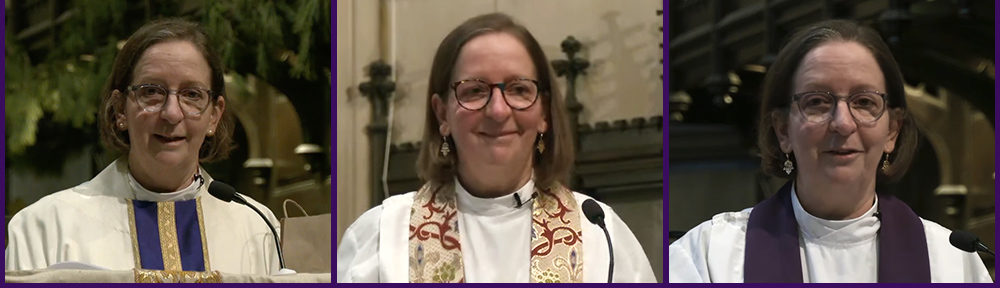
Proper 14C, 10 August 2025. The Rev. Dr. John D. Golenski.
Luke 12:32. Jesus said to his disciples, “Do not be afraid, little flock.”
The very first time I consciously witnessed a death was the day my dog Jet was fatally injured while chasing a car. We called him Jet because he was jet black, a fiercely loyal Cocker Spaniel, whom I had cared for since my parents brought him home in a basket. He was protective of our family in general, but he was truly my dog, patrolling our large yard and garden whenever I went out. Once in a while, when I opened the gate, he would fool me and zip through into the street. For some reason he was convinced that moving car tires posed an existential threat, so he had to chase them away. One summer day when I was eleven, Jet snuck out. I ran after him trying to distract him from the street traffic, but he must have slipped; somehow he was pulled under the moving tire. I watched in horror as the car rolled over him. The driver, a local mother with her infant in the car, ran up to me as Jet limped back to me, collapsed at my feet, and expired.
I was stunned. My mother, who was home, phoned my father to come home. She then carried Jet’s black-haired body to her flower garden. When my father came, they helped me gather some of his favorite toys, his bowl, and his leash. I helped my father dig a small grave, and we buried him among the peonies. We chose a round piece of granite and painted his name on it to mark where he lay. Over the subsequent months, when the occasion arose, my parents would talk with me about the experience—about the inevitability of death, that sometimes someone we love leaves through an accident or a fatal illness. For some months, I would occasionally sit at his grave and talk with him. I came to understand the lesson of finitude, that all life is limited. Years later my mother lost her battle with metastatic cancer and sometime later my father died suddenly on a winter night in a collision with a drunk driver, who had plowed through a stop sign. I heard their voices telling me that loss is inevitable, but it is not the final word.
Not too many years later, in my second year of high school, the United States discovered that the Soviet Union had deployed intercontinental missiles with nuclear war heads in Cuba. For several weeks in October 1962, the world held its breath as John Kennedy and Nikita Khrushchev found their way to a non-violent resolution of the crisis. Coincidentally, I had been pursuing some independent reading about nuclear war, especially about what happened in Japan in 1945 after the bombing of Hiroshima and Nagasaki. Our school librarian, who wondered out loud why I was interested in such “ugly” topics, supplied most of the books I requested. I couldn’t explain to her that I was working my way through the utter terror generated by detailed descriptions of the horror wrought by one bomb. I also began reading about the impact of bombing civilian populations in Europe in the early years of World War II. There seems no limit to the horrific inventiveness of human weapons.
Somehow, following the emotional steps laid out by my parents, I learned to calm my fear and face the simple reality that death is not optional. The only mysteries are when and how, not whether. I came to have faith, long before ever I arrived at belief, that the Creator holds us each and all as a mother holds her child. Death cannot, will not, be the final word.
As we slug our way through the apocalyptic parables and teachings of Jesus in this journey section of Luke’s Gospel this month, we will experience the fear and ambivalence of the early Christian communities as they gradually realized that the Messianic fulfillment would not be what or when they imagined. The God whose name we should not utter was not about to invade with avenging armies and save them from the bad guys. They had experienced, just a few years before the composition of this Gospel, the utter destruction of Jerusalem as only the Romans could do.
The community which produced this Gospel, named for Paul’s companion Luke, was wrestling with their hope for resolution, retribution, and restoration. Just as the whispered inner voices of my parents guided me in my first encounters with loss and grief, so in the Lukan text we hear the voices of divine messengers saying to Zechariah, “Fear not, Elizabeth will bear you a child,” and speaking to Mary of Nazareth, “Fear not, you will bear a child who is the Messiah.” So here in the midst of the journey Jesus says to us, “Do not be afraid, little ones”. Be dressed for action and have your lamps lit, for the realm of God is coming.