
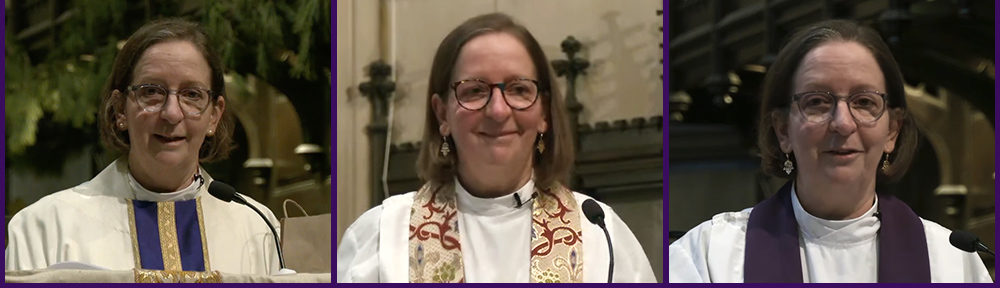
Easter 6C, May 25, 2025. The Very Rev. Pamela L. Werntz
- Acts 16:9-15. Come and stay at my home.
- Revelation 21:10, 22-22:5. I saw no temple in the city, for its temple is the Lord God.
- John 14:23-29. We will come to them and make our home with them.
O God of love, grant us the strength, the wisdom and the courage to seek always and everywhere after truth, come when it may, and cost what it will.
Many of you know that early on Tuesday mornings, every other month, a group gathers on Zoom to ponder together the Gospel passage coming up on the following Sunday; and when the vestry meets, we do the same thing. This past Tuesday, we discussed our Gospel lesson for today. If you’re anything like these early-morning or evening skeptics, and if they are representative of the parish (my guess is that they are), some of you just heard that Gospel reading as comforting: loving words about a deeper peace than the world can ever give. Even though Jesus was leaving (in fact, about to be arrested and crucified), he promised that the spirit of his words (The Word) would be with them; his peace would be with them. They did not need to be afraid; they were going to be cared for and defended by the spirit of God, Who is Love.
If you’re anything like the early-morning or evening skeptics, some of you just heard that Gospel reading as having a sharp edge: as sounding harsh, too conditional, too sexist with regard to the language used to refer to God. You heard the exclusivity of a Christocentric theology and felt the weight of the centuries of a Church trying to teach about unconditional love while placing all sorts of conditions on believing and belonging. Could a Church founded on the ethic of Love have been more mean-spirited throughout history and even today? Never mind; let’s not challenge it.
And if you’re anything like the early-morning or evening skeptics of this parish, some of you didn’t hear the Gospel reading just now because you were sleepy or pre-occupied with other things! That’s one of the reasons, in our Bible study conversations, we listen to the passage being read three times, each time by a different person. I find that, even when I am paying attention, I notice something that I hadn’t noticed before when I hear a reading in another voice. A couple of us heard the passage read six times by six different voices!
I’ll confess to you that the first time this passage was read early on Tuesday morning, I felt familiar irritation about the sexist language for God and irritation at the edge this reading has, which I think has to do with the competitive rhetoric the early Church adopted when it felt threatened. Even the earliest gatherings of Jesus followers couldn’t seem to take in Jesus’ peace. They couldn’t or didn’t hear Jesus’ words about not being troubled or afraid. When this passage got read the first time, for example, I didn’t even notice the part where Jesus says, “Peace I leave with you, my own peace I give to you.” That was a sign for me of how guarded I was: in fact, how troubled I am about the rhetoric of the Church and how much harm it does. I didn’t even hear the promise of peace, or the reassurance of spirit of holiness, an Advocate, a Defender, who Jesus says will teach us everything we need to know and remind us of everything he said.
Just before this passage, another Judas (not Iscariot) asked Jesus how he would be revealed to his followers. Jesus responded: “Those who love me will keep my word, and my Father will love them, and we will come to them and make our home with them.” I’ll tell you, I don’t think often about God or Jesus making a home with me. It occurs to me to think of church or temple as a House of God, as God’s home, but not to think of my home as God’s home. I mean, we give thanks before meals and say our prayers ; and I’ve got walls of bookshelves full of what my family calls “God books”, but God’s home? The mere idea makes me want to go home right now and clean!
Jesus is saying, those who love him will live it out by loving one another; and God and Jesus will stay beside them. That’s the literal translation of home: a place for staying beside. It actually doesn’t have as much to do with a house –-the rooms, the bookshelves, the kitchen, or the bathroom. (So it turns out that cleanliness is not necessarily next to godliness.) It has to do with a place for staying beside. It is conditional, but not so much as in prerequisite, but conditional as in a state of readiness. If we show our love by living in mutual, right relationship, by engaging in justice with compassion, by caring for one another, God’s home is made in us: we are at home in God. What Jesus is trying to tell his followers, according to Gail O’Day’s commentary, is that an ongoing relationship with Jesus does not require his physical presence, but on the presence of the love of God in the life of the community. And the love of God is present whenever those who love Jesus serve one another, humbly washing the muck off one another’s feet. [1]
I do love the idea in today’s gospel of Jesus and God as homemakers. How rare it is to hear someone (of any gender) describe their work as homemaking these days. I often hear work at home or stay-at-home-parent, but not homemaker. In the Gospel of John, in the midst of a very complex set of ideas, in a very long farewell discourse, here is the relatively simple idea of Jesus with God desiring to be homemakers in us.
As I reflected on homemaking, I couldn’t get this song out of my head . I had heard my friend Evan Thayer sing it in a sermon almost 30 years ago; and it has stayed with me. I’m going to sing to you, in spite of my scratchy allergy voice.
Softly and tenderly Jesus is calling,
Calling for you and for me.
See, on the portals He’s waiting and watching,
Watching for you and for me.
Come home, come home,
You who are weary, come home.
The disciples had been asking Jesus a lot of questions, endless questions in response to his seemingly-endless farewell instructions that they are to serve one another so that they will love one another. Interestingly enough, they didn’t say directly: “How can we serve one another? It’s too hard.” Instead, they asked:
Lord, where are you going? Why can we not follow you now? Lord, we do not know where you are going, so how can we know the way? Lord, show us God; how can we know God? Lord, how is it that you will reveal yourself and God to us?
Jesus’ answer to that last question is that when they love one another, he and God make a home in them. Referring to God and himself, “We will come to them and make our home with them.” I think it’s such a startling and lovely idea. There’s so much in Christian discourse about our making our home in God: sometimes it’s a house of worship that is referred to as the house of God; sometimes it’s some kind of never-never land heaven where God lives. Here Jesus is explaining that God’s home is not a building – not a house, a church, or a temple; and it’s not a place on earth or a place in heaven. God’s home, Jesus’ home, is made in those whose actions are loving and merciful.
Why should we tarry when Jesus is pleading,
Pleading for you and for me?
Why should we linger and heed not His mercies,
Mercies for you and for me?
Come home, come home,
You who are weary, come home.
I wonder, could we recommit ourselves to creating space so that God can make a home in us? Or if we know that God has already made a home in us, I wonder if we can we add on? Can we give God some more room? Imagine that the “You” in the refrain of the hymn that I’ve been singing to you has a capital Y and refers to God. Imagine that the Holy One is the Weary One, longing for a place of compassion, mercy, and peace. (Now I’m well aware that this is not what the hymn composer, Will Thompson, intended. I am taking considerable creative license, I know. And maybe the last line of the refrain needs to get changed from “sinner” to something else: how about Creator? Imagine God homemaking in you. The bigger the love, the more room in the home! For many of us, it’s something of a fixer-upper, but I feel sure that God can see the potential and will be able to use whatever space we offer.
Jesus’ promise is that we don’t have to figure this out alone or need to know everything there is to know. The spirit of the Holy One will be our advocate, our defender, the spirit that will teach us what we need to know and remind us of the essence of what Jesus taught. The spirit of the Holy One will nudge us, tutor us, come alongside, and challenge us to remember that actions born of love and not fear, are what God wants for God’s people. Love, not fear, is what will allow God to make the most generous home out of our lives, a home of compassion, mercy, and peace.
Come home, come home,
You who are weary, come home.
Earnestly, tenderly, we all are calling,
Calling, Creator, come home!
- Gail O’Day, “John,” pp. 749-53 in vol. 5 of The New Interpreter’s Bible Commentary (Nashville: Abington, 1995).