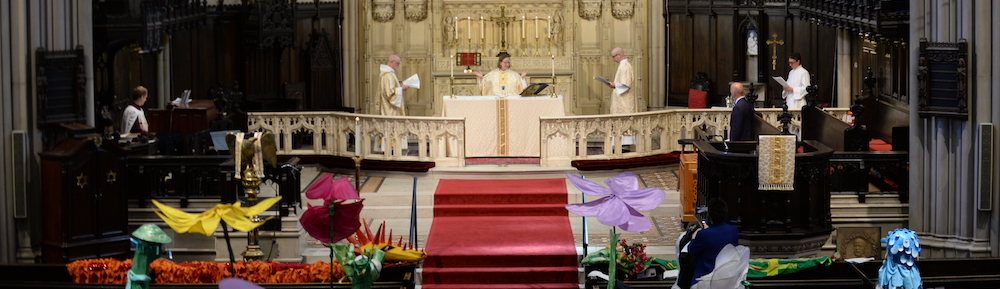
Come home!

Easter 6C, May 25, 2025.  The Very Rev. Pamela L. Werntz

  • Acts 16:9-15. Come and stay at my home.
  • Revelation 21:10, 22-22:5. I saw no temple in the city, for its temple is the Lord God.
  • John 14:23-29. We will come to them and make our home with them.

O God of love, grant us the strength, the wisdom and the courage to seek always and everywhere after truth, come when it may, and cost what it will.


Many of you know that early on Tuesday mornings, every other month, a group gathers on Zoom to ponder together the Gospel passage coming up on the following Sunday; and when the vestry meets, we do the same thing. This past Tuesday, we discussed our Gospel lesson for today.  If you’re anything like these early-morning or evening skeptics, and if they are representative of the parish (my guess is that they are), some of you just heard that Gospel reading as comforting: loving words about a deeper peace than the world can ever give. Even though Jesus was leaving (in fact, about to be arrested and crucified), he promised that the spirit of his words (The Word) would be with them; his peace would be with them.  They did not need to be afraid; they were going to be cared for and defended by the spirit of God, Who is Love.  Continue reading

Preparing for Easter

Lent 1C, March 9, 2025.  The Very Rev. Pamela L. Werntz

Deuteronomy 26:1-11. Now I bring the first of the fruit of the ground that you, O Lord, have given me.
Romans 10:8b-13. The word is near you, on your lips and in your heart.
Luke 4:1-13. It is written…it is written…it is said.

O God of hope, grant us the strength, the wisdom and the courage to seek always and everywhere after truth, come when it may, and cost what it will.


I’m feeling relieved that it’s finally Lent. We’ve had a longer wait than usual because this year Easter is almost as late as it can ever be, but the calendar hasn’t been the only thing making these last weeks feel unbearably long. While I’ve waited, I’ve felt keenly aware of our need for penitence and healing, for a quarantine of almsgiving, prayer, fasting, and meditating on Holy Scripture. I’ve felt our need to get right with God, in the midst of the socio-economic collapse and exiles of all kinds that are happening in our world.
We have before us this morning five lessons from Deuteronomy, the fifth book of the Torah, also known as the Pentateuch, the Five Books of Moses. You might be tempted to look at your bulletin right now and wonder where the other four lessons are. They’re hard to see because they’re not labelled. One was our first reading today was from Deuteronomy. The other four lessons from Deuteronomy are embedded in Romans and Luke. Our Biblical literacy as Christians would improve greatly if we understood more about the first five books of the Bible because Paul and other early Jesus followers likely knew the Torah by heart.
The word Deuteronomy means second law, and that means reaffirmation of the pact or the covenant between the Holy One and the holy people. Deuteronomy is the reinterpretation or recapitulation of the Exodus story and forty years of sojourning in the wilderness. In Hebrew, the book is known as Devarim, which means words, because it is a series of speeches, sermons, if you will, written to persuade people in the late First Temple period and the Babylonian exile period to stay true to the Holy One in the midst of severe trials and tribulations. Hebrew Bible translator Robert Alter refers to Devarim as a great “rhetorical enterprise,” which took the narrative texts of Exodus (and Leviticus and Numbers) and restated them in words and ideas that people experiencing socio-economic collapse and exile could understand. [<a href=”#refs”><strong>1</strong></a>] Deuteronomy is a preacherly project – a series of orations delivered to remind people once again of the steadfast faith of the Holy One, and of the deadening and deadly repercussions of forgetting just who and Whose they are. Deuteronomy is a collection of sermons to help people make connections between their traditional teachings and their contemporary contexts.
In our first reading we hear Deuteronomy’s instructions for when (or whenever) the Holy One has given rest from one’s enemies. It doesn’t indicate how long the rest must be, but it’s long enough to harvest first fruits. The instructions are to show thanks to God by giving the first fruits of the people’s productivity to God through the priest. Deuteronomy 26 describes a liturgy of thanksgiving and gives the words to say. Say this: “we know that we have come from people who were aliens and slaves. The Holy One heard our cries and saw our afflictions and led us out of that hard place to a delightful place and so therefore we share our bounty in celebration with others who are resident aliens, that is strangers and foreigners living in our land.”

In our second reading, the Apostle Paul was writing to the Jesus followers in Rome. He reminds the congregation “The word is near you – on your lips and in your heart.” “The word” here means the Torah in the broadest sense. The word of God. The recipients know the rest. It’s Deuteronomy 30:11-14, which continues: “It’s not too hard or baffling for you, nor is it beyond reach or too far away. It is not in heaven that you should say, ‘who will go up to heaven for us and get it for us so that we may hear it and observe it?’ Neither is it beyond the sea so that you should say, ‘who will cross to the other side of the sea for us, and get it for us so that we may hear it and observe it.’ No, the word is very near to you; it is in your mouth and in your heart for you to observe.” What’s surprising about this passage in Deuteronomy is its universality. Paul upholds the idea of universality with his insistence that there is no distinction between Jew and Greek; the same Holy One is the Holy One of all and is generous to all who call on the Holy One. The Word of God is not just for a few people – it’s accessible to and the responsibility of all of the people.[2] The capacity to love is in all hearts – we are born with it. The capacity to speak blessings is in all mouths. The end of that passage in Deuteronomy that Paul alludes to is in the voice of Moses: “Look, I have set before you life and death, blessings and curses. Choose life. Choose love.” The Apostle Paul was urging what Jesus urged, which was what Moses urged. Even in the midst of socio-economic collapse and exile, choose life; choose love.

And then we have three teachings from Deuteronomy cited by Jesus in his conversation with the slanderer or the accuser (also known as the devil) when Jesus had gone into the wilderness following his inaugural immersion in the Jordan River. The word that gets translated “led” as in, “A spirit of holiness led Jesus into the wilderness” is not in past tense, not a completed action, but ongoing action. A spirit of holiness did not just drop Jesus off at the edge of the wilderness and wish him good luck. And there’s no definite article here – it’s not The Holy Spirit as the title of a character; it’s a spirit of holiness that filled Jesus to the brim and was leading him in the wilderness.

That’s good because Luke says that the devil tempted him for 40 days, not just on the 40th day. The slanderer or accuser was crafting biblical arguments in order to make a deal with Jesus. Speak this stone into bread, the devil said. You’re starving, Jesus, and surely God wouldn’t object to your having a little bread. You don’t have any regular ingredients, and only the little people bake their own bread anyway. [<a href=”#refs”><strong>3</strong></a>]Surely you can satisfy your own hunger. Jesus’ response quotes Deuteronomy 8:3: “One does not live by bread alone, but by every word that comes from the mouth of the Lord.” That Deuteronomy sermon goes on: “Know then in your heart that as a parent instructs a child, so the Lord your God instructs. Therefore, keep the commandments of God, by walking in God’s ways and by revering God, for your God is bringing you into a good land where there will be plenty of food for you and plenty to share with friends and strangers.”

The slanderer’s next move is to ask, “But what about Rome? He says, “The Roman Empire has been given to me. I’ll give it to you if you worship me.” I wonder who gave the Roman Empire to the devil? Was it the people who ceded their power because of their fear? Jesus’ response is from Deuteronomy 6:13: “The Holy One your God, you shall revere and you shall serve and by God’s name alone you shall swear.” In other words, pay no allegiance to an empire. This passage is right after the watchword of Jesus’ faith, the Sh’ma: “Listen deeply, O god-strugglers, the Holy One is our God, the Holy One alone, and you are going to love the Holy

One your God with all your heart and with all your soul and with all your very muchness. Keep these words that I am commanding you today in your heart. Recite them to your children and talk about them when you are at home and when you are away, when you lie down and when you rise. Bind them as a sign on your hand, fix them as an emblem on your forehead and write them on the doorposts of your house and on your gates so you will never forget them.”

Then the slanderer pulls out a line from a hymn (Psalm 92:1-12) about being protected from harm by angels by way of encouraging Jesus to jump off the pinnacle of the temple. Jesus’ response is to pick up close to where he left off in his last response from Deuteronomy 6:16: “Do not put the Lord your God to the test” In other words, don’t set up challenges for the Holy One, as in, if you do this thing for me, O Love Divine, and then I’ll do the next right thing.” Don’t do that. “You must diligently keep the commandments of the Holy One your God and the decrees and the statutes that the Holy One has commanded you. Do what is right and good in the sight of the Holy One so that it may go well with you.”

People of Emmanuel, I urge you to accept the invitation to the observance of a holy Lent. The whole idea of Lent is to deepen our awareness of the closeness of the Holy One – of the Divine, on our lips and in our hearts, and to get right with God. Lent is a time to strip away whatever separates us from our deepest knowledge of Love — in ourselves, in our parish, in our communities, and in the world around us – indeed, in total strangers and even enemies. The season of Lent invites and implores us to make a journey from a world that was into a world that is becoming. This journey will require commitment, adaptability, and the willingness to receive and give help.” This journey will get us ready for the terrifying and exciting Easter story!

What might you do with a handful or even an armful of a spirit of holiness today? How might you prepare for Easter by being more hungry, by acknowledging where (wherever) you are powerless without God’s help, and taking a break from bargaining with the Holy One. This Lent, fast from whatever is keeping you stuck in a narrow place. Pray in a way you’ve never prayed before. Perhaps take a break from cynicism or despair. Perhaps step away from resentment for a season. Fast from control, from irritation, from anger or shame, from worry or struggle. You can break your fast on Sundays – bring all of those difficult feelings to church, confess them and take in the assurance of absolution. Give away more money or time than you can afford for the relief and benefit of those who are poorer than you. And finally, read some scripture, preferably not by yourself but with other people –join our Tuesday morning or Thursday evening Bible study groups, or one of the language study groups. Or just listen to some sermons or other teachings about scripture!

Begin this Lent to get in better shape for the hope of the blessing of the Easter proclamation that Love is more powerful than any sin; Love is more powerful than even death. Stop doing whatever is keeping you feeling separate from The Great Love. Do whatever you can this Lent to get ready for going more fully, more whole-heartedly, into the place where your deep joy will meet the world’s deep need, which is the place where the gates of heaven are always wide open. You’ll enjoy Easter more if you’ve done some preparation. I guarantee.

  1.  Robert Alter, p.869.
  2.  Torah: A Modern Commentary (New York: Union of American Hebrew Congregations) p. 1542.
  3. I heard Martin Smith, formerly SSJE, say this in a sermon one time and have never forgotten it.
  4.  Martha Hickman’s Healing after Loss: daily meditations for working through grief.