
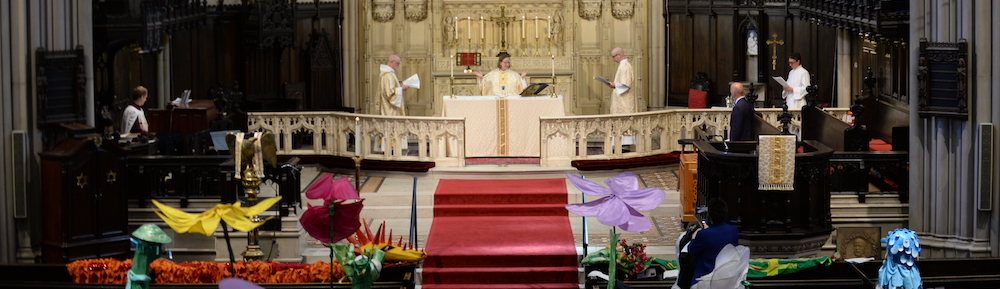
Please, God, ….

Proper 26B. 3 November 2024. The Very Rev. Pamela L. Werntz

Isaiah 25:6-9.  The disgrace of [God’s] people [God] will take away from all the earth.
Revelation 21:1-6a. See I am making all things new.
Mark 12:28-34. You are not far from the realm of God.

O God of our salvation, grant us the strength, the wisdom and the courage to seek always and everywhere after truth, come when it may, and cost what it will.


This morning we are observing the great Feast of All Saints’ Day. But I have to tell you that rather than reading the assigned reading from the Gospel of John for All Saints, about the raising of Lazarus, I have substituted the Gospel lesson appointed for this Sunday, which is the lesson Bob just read from the Gospel of Mark. I did this because we are not just remembering and celebrating all the saints of the Church, that great cloud of witnesses, known or unknown, and honoring the souls of those dear to us who have died since last All Saints Day. We are also on the eve of Election Day eve (erev erev Election Day) and it feels to me like we are on the precipice of what feels to me might be like an abyss. but we can’t see what’s immediately ahead of us. This past Thursday morning, our next-door neighbor created a great cloud of unknowing that enveloped the fronts of the houses of his immediate neighbors while he tested out his new dry ice fog-making machine for Halloween. The front of our house was completely in a thick blanket of fog while the back of our house was all clear. I thought, “huh! That’s a metaphor!” We couldn’t see ahead, we could only what was behind us!

You might know that polls suggest that more than half of voters have already voted or expect to vote before election day. Slightly less than half of voters are very worried about post-election violence and about misconduct among election officials. Those worries seem to be evenly spread among Democrats, Republicans, and Independents. [1] So if you are very worried, you have a lot of company. That’s some good news. And slightly more than half are not very worried. That might be good news, or they might just not be paying attention! In any case, the way forward is in progress but we just can’t see it yet.

We hear from two prophets this morning, from Isaiah in the late 8th century BCE, and from John the Divine near the end of the 1st century CE with very similar visions, set in texts like mighty oratorios, singing about visions of peace for all peoples, for all nations. Walter Brueggemann writes that for Isaiah, a welcome feast of rich food and fine wine is already coming into being in a place where healing and emancipation happen. Death, in this passage, means not just the end of life, but stands for whatever limits or diminishes well-being and prevents communion with our neighbors or with God, who is also known as Love. In Isaiah’s radical vision of complete transformation, Bruggeman says, “Biblical faith…is not a mode of holding on or staying in control. It is rather an act of yielding in the present…to the assurances given for [Love’s future where the] disgrace of being helpless, powerless, and exploited; the shame of being stepped on…all will be overcome.” [2

What is clear for Isaiah and John the Divine, as well as for us right now, is that we have to wait. On that day, when the Holy One will remove and destroy the shroud of shame and the pall of mourning, and swallow up the pall that covers all the nations, it will be said, “this is the Holy One for whom we have waited.” That word “wait” can also be translated “trust” and get this: the root of the word has to do with twisting in tension. This is not about idly passing the time, trying to distract ourselves. It’s not passive; it’s active. This waiting is actively stretching. What kind of stretching? The kind that happens when we are loving our neighbors, with all our hearts, with all our souls, with all our understanding, and with all of our very muchness. (That’s how my Hebrew teacher liked to translate strength or might.)

Here’s something to notice about our Gospel lesson in Mark. Jesus is in the temple precinct a few days before his arrest and in the middle of considerable conflict and disagreement. Some people are mad enough or afraid enough to wish he were dead, and he will be dead before the week is over. In the midst of this, a Biblical scholar, a scribe, heard the priests arguing with Jesus about the lawfulness of paying taxes to the emperor, and about marriage in the resurrection. You probably know that, according to Mark, Jesus got asked a lot of questions and if he answered at all, he usually responded with another question or a mystifying parable. Rarely did he give a clear and direct answer. His disciples rarely understood what he was talking about. But in the middle of a big crowd, a scribe asked Jesus, “which is the first commandment of all?” And Jesus answered the question directly, maybe for the only time in Mark: “The first is, ‘Hear, O god-wrestler [that’s what Israel means] the Holy Name is our God, the Holy Name is one.” “Shema y’srael, Adonai elohenu, Adonai echad.” Hear. Listen deeply. Understand. That is the first and greatest command. That is the starting point for all other commands. “Hear” is an imperative. What comes next is a verb that is indicative of the future. When you hear, when you listen deeply, you will love. It’s what will happen when you listen very carefully. You’re going to be loving the Divine and you’re going to be loving your neighbor with all your heart, with all your person, with all your understanding, and with all your very-muchness. The command is to listen and the loving will follow. It’s not theoretical. It requires muscles that are loosened by stretching.

Another noteworthy thing in this lesson from the Gospel of Mark is that the scribe and Jesus are demonstrating mutual regard. The scribe calls Jesus’ response to his question right. And in response to the scribe’s affirmation, Jesus calls the scribe “wise” and adds that he is very near to the realm of God. It is a reprise of what Jesus started saying in the beginning of this Gospel: “The time is fulfilled, and the kingdom of God has come near. Turn around, change your ways and lean into the good news.” The kind of listening that leads to loving is much more important than all offerings and sacrifices made to and for the Holy One. I also want to make sure you hear what Jesus did not say. In the midst of the crowd in the temple precinct, Jesus did not say, “above all, keep safe; stay pure; keep clean; be holy; say your prayers.” He did not say, “first and foremost, figure out who is and who is not worthy of your consideration and care.” First and foremost, hear that the Holy is our God and the Holy is One. I wonder who told this story after Jesus’ death. Was it the disciples? Was it the scribe? Was it other witnesses? In the months and years after folks experienced Jesus’ resurrection, who remembered the command to listen? To hear?

Perhaps it was easy to remember because the Shema is prayed in every Jewish liturgy and in daily prayer. Perhaps it is the first commandment and most frequent prayer precisely because it is so difficult to do. In order to listen, in order to hear the Oneness of the Holy, we have to be still to remember that God is God and we are not God. We have to pause from talking to God or to ourselves or talking to others and get really quiet. I’m aware of the irony of speaking about the value of silence. I also know from experience that some have a greater capacity for silence than others. If it’s hard for you, start with a minute and work your way up. In an era where trumpets of advertising and misinformation blare from every device, silence requires practice and discipline. It’s a stretch while we wait for whatever happens next. While we listen and wait for whatever happens next we will love as fiercely as we are able. And I believe that Loving will make us real. Loving will make us brave. And Loving will make a way where there is no way, because it always has. That’s what I can see clearly looking out my back door! 

As a post-script to this sermon, here’s something to keep in mind if you are a praying person, or a praying person by proxy! (That means that you are close to a praying person.) It’s a poem by a retired United Methodist minister named Steve Garnaas-Holmes, who writes daily reflections. Martha Tucker sent this poem to me last week and I wanted you all to hear it. It’s called, “Please, God…”

We plead for God to intervene,
even “just this once…”
But I don’t think that’s how God works;
the Holocaust would have been a good time to do so.
No, God doesn’t stop the tyrant,
or nudge the car on the icy road.
God’s not a Big Guy with a magic finger
he [sic] deploys now and then (but not always).
God is the Love at the heart of all being,
as constant as gravity, infinitely attentive,
and can’t be more present or active than right now.
When we ask for God’s help,
what we mean is to align ourselves
with the great power of God’s grace already at work.
Like musicians in perfect tune,
we create harmonies, notes that sound
though none of us is producing them.
Our harmony with God creates an energy field
that does indeed change things.
In troubled times it takes great concentration
to align ourselves with grace instead of force,
with love instead of fear.
We begin by allowing ourselves to be loved,
along with the rest of creation,
and then we fall into that love,
and let that love flow through us into the world.
I think that’s what we mean when we pray,
“Please, God…”


  1.  Zachary Karabell writing on Thursday, October 31, 2024 for edgyoptimist@substack.com
  2. Walter Brueggemann, Isaiah 1-39, (Louisville: Westminster John Knox Press, 1998), pp. 199-20.



A Stolen Beam

November 19, 2024

This fall, the Episcopal City Mission is offering “A Stolen Beam,” a series of meetings addressing reparations in Christian and Jewish faith traditions. Led by facilitators Steven Bonsey, former Canon Pastor at the Cathedral Church of St. Paul, Boston,  and Constance Holmes, the meetings will end in mid-December 2024 and we’ll report on our participation and what we learned from the series in this column.

The course was originally developed by members of the Reparations Committee of the Jewish Community of Amherst, MA. They explain the influence of the Stolen Beam debate on their efforts:

*The name “Stolen Beam” is a reference to a Talmudic debate about the right thing to do when we discover that the house in which we live was built with stolen materials, “a stolen beam.” One rabbi argues that the entire house must be torn down and the beam returned. Another argues that it makes no sense to destroy the home, yet some form of acknowledgment and compensation is owed to the owners of the beam.”

The city of Amherst has been working on a reparations plan since 2021. The final report of the African Heritage Reparations Assembly (AHRA) was issued in September 2023. For more on the activities that led to the presentation of the report, see “Reparations Revisited: Where Are We Now in Amherst?”

–Mary Beth Clack, Mary Blocher, Cindy Coldren, Pat Krol, Liz Levin
–Published in This Week @Emmanuel Church November 27, 2024

Blessing When the World is Ending

Proper 28B. 17 November 2024. The Very Rev. Pamela L. Werntz

1 Samuel 1:4-20.  I am a woman deeply troubled.
Hebrews 10:11-25. Let us consider how to provoke one another to love and good deeds.
Mark 13:1-8. This is but the beginning of the birthpangs.

O God of enduring and eternal Love, grant us the strength, the wisdom and the courage to seek always and everywhere after truth, come when it may, and cost what it will.


We are nearing the end of our liturgical year. This is the last we’ll hear from the Gospel of Mark for another three years. It’s highly ironic to me to pray the beautiful words of the opening collect about scripture – to read, mark, learn and inwardly digest – on a day when our appointed Gospel lesson is the beginning of the apocalypse in Mark. Episcopalians generally don’t like dwelling on the fact that we have apocalyptic scripture. We don’t know what to make of it and we’d rather not have to try. 

But this week, and this year, the Gospel lesson seems teed up to address our current dystopian circumstances. In today’s Gospel reading we hear a part of a speech – a kind of farewell speech – that Mark reports Jesus delivering in the last few days of his life. Like Jacob and Moses and King David before him, Mark’s Jesus gave his hearers instructions for how to live – how to go on, facing whatever comes their way, after he’s gone. And he’s instructing his followers about how to respond in the midst of catastrophic endings. Although his prediction that not one stone would be left upon another at the great temple in Jerusalem was something of an exaggeration, life as they knew it surely came to an end when Jesus died. And life as they knew it surely came to an end when the Romans sacked Jerusalem in response to the Jewish uprising in what we call 70 CE. 

 Perhaps wondering how best to prepare, Peter, James, John and Andrew interrogated Jesus privately about when the end would come and what the signs of the end would be. I hear them longing for certainty. As is so often the case, Jesus’ response does not answer their questions. He seems to be saying again, without so many words, that they’re asking the wrong questions. Jesus seems to be much more about questioning the answers than he is about answering the questions of his followers in the Gospel of Mark! Instead, he says, “see that no one leads you astray by using my name.” Astray from what? Well my guess is astray from the feeding and freeing work that they are called to be doing: casting out polluted spirits and restoring health, widely proclaiming and enacting the love of God, and building up the beloved community. Don’t be led astray from provoking one another to love and good deeds as the author of Hebrews writes. Don’t be led astray from loving your neighbors. Don’t let wars and rumors of wars, earthquakes in various places or famines disturb or startle you and keep you from loving one another and loving God. 

The fascinating thing to me about this speech is that Jesus uses the metaphor of childbirth here. That’s a metaphor that really resonates with me! Jesus talks of the labor of birthing. I have to say I take great issue with the translation of a word “odeen” in Greek that means intense and unavoidable suffering, severe distress, and even death into the word “pang” that sounds like a twinge or stitch or a sting. Jesus is saying the pain is going to be bone-splitting agony. Jesus was not really addressing why labor hurts, just that it does – that it’s one of the signs of change –of a new life struggling to be born – about to be delivered through a process of extreme suffering. And let’s be clear, back then and even now, birth is very risky for both the mother and the baby. Survival is uncertain. His stated purpose in his farewell speech is to reduce emotional anxiety. Jesus’ followers are not to be alarmed. The pain is normal. It most assuredly does not feel good – and that can lead to fear. But “do not be alarmed” is Jesus’ refrain. Pay attention, keep alert, use your eyes and ears – and don’t worry. You have what you need. You know what you need to know. He’s like a birth coach! Keep breathing, he says.

People will come along and try to convince you that you don’t really have to behave lovingly toward “those” people. Voices will try to persuade you that the message of love is thin and facile, the opposite of mighty, that good deeds are too small to make a difference, or that unethical behavior is now justified. Keep your hearts and minds in the love of God and of one another, even in the midst of catastrophes, violence and great suffering, Jesus’ followers are to continue to live in love knowing that love is always more powerful than death. Jesus’ followers are to remember that anytime scripture is cited to defend behavior that’s not motivated by the law of love, something is seriously wrong.

We know that Jesus is talking about love because of the part of Mark’s Gospel just before the farewell speech begins. The wise scribe says it and Jesus affirms it. I’ll tell it to you – but I know that you already know it: “Hear, O Israel (or translated differently, “Listen deeply you god-strugglers”): Listen, O my wrestling people: the [name which is too sacred to pronounce] is our God, the [Holy Name] alone; (and when you listen deeply) you are going to love the Holy Name your God with all your heart, and with all your life force, and with all your mind, and with all your very muchness. (When you do that) you are going to love your neighbor as your self.” That’s it. That’s all you need to know. Indeed, that’s all we need to know.

And with that knowledge, we have the ability to do something great today – every single one of us, whether you are worshiping with us on-line or you’re sitting in the pews. If you’ve already done something great this morning, fantastic, you probably still have time to do another great thing. If you are alert – if you use your eyes and your ears and you pay attention, the Holy One will provide an opportunity to put aside your worry or your fear of war or rumors of war, of earthquakes in various places, and of famine, to go with only the clothes on your back, yes, empty-handed, open-handed, and to share who you are, and what you have, and what you know about the love of God, using words only if necessary. You can let your life speak, as the Quaker saying goes.

In his parting words, Jesus is making it clear that whenever the stones come tumbling down, it’s not the end with a capital E; it’s an opportunity for transformation. So, in the words of the writer of Hebrews, “Let us consider how to provoke one another to love and good deeds, not neglecting to meet together…but encouraging one another, all the more.” According to Jesus, God does not invite us into abundant life by urging us to play it safe. [1] Do not be alarmed – love one another. I’m not talking about feelings. I’m talking about enacting compassion and kindness, gentleness and patience, leaning into the disarming power of love that is mightier than death. I mean enacting this love with annoying members of your own family, with your friends, with acquaintances, with complete strangers, with other drivers or commuters (I see you, Boston), even with those who wish you harm.

Perhaps you saw the piece in the Boston Globe on Friday by novelist and essayist, Cara Hoffman, writing about how to respond to authoritarian rule. [2] She wrote, “When the state fails or turns against us, penalizing us, denying us resources, restriction our speech and freedom of movement, and attacking the weakest among us, all we have is each other: our bravery, our competence, our delight, our anger, our refusal to back down or see another harmed.” She was writing about a neighborhood of Athens where she lives, but I immediately thought of Emmanuel Church and our long history of subverting the dominant paradigms through radical hospitality and advocacy, through sanctuary, through extravagant engagement with the arts. I thought of the steady stream of generosity that flows in and out from this place.

Howard Thurman wrote about how to respond to turbulent times, wisely and bravely saying, “there is no need to fear evil. There is every need to understand what it does, how it operates in the world, what it draws upon to sustain itself…the real target of evil is to corrupt the spirit of [hu]man[s] and to give to [their] soul[s] the contagion of inner disintegration.” Thurman concludes: ”To drink in the beauty that is within reach, to clothe one’s life in simple deeds of kindness, to keep alive a sensitiveness to the movement of the Spirit of God in the quietness of the human heart and in the working of the human mind – this is as always the ultimate answer to the great deception.”[3]

Our primary concern is being and becoming more and more living testimony to the Gospel, which is to say, food for those who are hungry, water for those who are thirsty, healing for those who are ailing, release for those who are captive, welcome for those who are alien, and reparation for those who have been wronged. Christianity has been formed and reformed in times of intense distress, when what seems like weakness becomes the very thing that strengthens us to go where the Love is and to be the people and the place where Love is. What we do matters. I’m going to close with a prayer from Jan Richardson, called “Blessing When the World is Ending”.  [4]

Look, the world is always
ending somewhere.
Somewhere the sun
has come crashing down.
Somewhere it has gone
completely dark.
Somewhere it has ended
with the gun, the knife, the fist.
Somewhere it has ended
with the slammed door,
the shattered hope.
Somewhere it has ended
with the utter quiet
that follows the news
from the phone, the television,
the hospital room.
Somewhere it has ended
with a tenderness
that will break your heart.
But, listen, this blessing means
to be anything but morose.
It has not come to cause despair.
It is simply here because
there is nothing a blessing
is better suited for than an ending,
nothing that cries out more
for a blessing than when a world
is falling apart.
This blessing will not fix you,
will not mend you,
will not give you false comfort;
it will not talk to you
about one door opening
when another one closes.
It will simply sit itself beside you
among the shards
and gently turn your face
toward the direction
from which the light
will come, gathering itself
about you as the world begins again.


  1.  Thanks to Bob Eldan at http://preachingtip.com
  2. The Boston Globe, November 15, 2024.
  3. Howard Thurman, “Life Goes On,” in Meditations of the Heart (Boston: Beacon Press, 1953), p. 109-10.
  4. Jan Richardson, “Blessing When the World is Ending”, Circle of Grace: A Book of Blessings for the Seasons. Orlando FL: Wanton Gospeller Press, 2015.

Bible Study

Last Friday I stayed for common cathedral’s Bible study after Boston Warm. I’ve been a bit hesitant to join Bible study because of some negative associations it brings up for me about my own religious upbringing, but lately I’ve been trying to approach it with a new perspective. I decided to look at the Bible study group as a way to not only continue to spend time with this community and practice therapeutic communication skills, but also as a sort of assessment time to learn about the spiritual perspectives and themes that community members are currently dealing with. Continue reading

Talent Show

I am feeling excited for common cathedral‘s talent show this week, although a bit nervous to see how it goes, since there are many unknowns: whether or not everyone who signed up will show up, how big the audience will be, if the tech that people need for their acts will work or malfunction, and any other number of things I can’t predict. I am trying to practice flexibility and trust myself to respond to whatever comes. Continue reading

Welcome our new Drama Therapy intern!

Mary Schwabenland

Hello! I am Mary, the new Drama Therapy intern at common cathedral / Emmanuel Church. I am a few weeks into the internship now and have really been enjoying getting to know the community members. One of my goals for this internship is to aid community members in the creation of meaningful expressive art experiences and projects.  The first of which is our upcoming talent-show fundraiser, which was the idea of a long-time community member. We have about 14 sign-ups of varying talent acts, and I am very excited to see what everyone brings.

Continue reading

Love is enough.

Proper 27B. 10 November 2024. The Very Rev. Pamela L. Werntz

Ruth 3:1-5; 4:13-17.   I need to seek security for you.
Hebrews 9:24-28. Not to deal with sin, but to save those who are eagerly waiting for him.
Mark 12:38-44. She … has put in everything she had.

O God of love, grant us the wisdom, the strength, and the courage to seek always and everywhere after truth, come when it may and cost what it will.


Well the fog that I spoke about last Sunday cleared for a bit and what we could see was a shattering loss for nearly half of our country. It wasn’t just an election lost, but a particular vision of the future lost that now we’re going to have to figure out how to enact in other ways, but only after we create some space for grief, and acknowledge our fears. For some it will take longer than others, but we will stick together.

On Wednesday morning, I drove into the city and realized when I arrived at the church that I had forgotten my office key. When I finally got in and pulled up my computer screen, the message I saw said, “insufficient memory.” I said to the computer, “You’ve got that right!” And it’s not just about my own memory, it seems like half the world. And then on Thursday morning, my sorrow became very particular when I learned about a devastating personal and parish loss in the death of Jim Bartlett, who has contributed mightily to the well-being of this parish in the last 15+ years in many ways, but particularly as a vestry member and on the finance commission, and with his beloved wife, Hanna, as an advisor and supporter of my ministry among you at Emmanuel Church. He loved Emmanuel Church so much. And I am reminded of what another important mentor taught me: when we are grieving or in pain, stay close to the scriptures. And for Christians, I’d say, stay close to Jesus.

The Gospel lesson that we just heard is a very familiar story about the woman who put two copper coins, approximately enough money to buy one meal, in the offering in the temple. It’s a story many of us learned in Church School. People know it by the title, “the widow’s mite” (mite meaning a tiny little bit). It’s a nice story for little children who are learning about mite boxes and putting coins in offering plates. I’m aware that when the story gets told about Jesus commending the woman for giving everything she had, especially during pledge stewardship season (probably no coincidence, by the way), many of us adults kind of seize up inside. We kind of brace ourselves for what’s coming next.

But you can relax (a little) because I’m keenly aware of Jesus’ stern warning at the beginning of this Gospel reading to educated religious folks “who like to walk around in long robes, and to be greeted with respect in the marketplaces, and to have the best seats in the places of worship and places of honor at banquets — [who] devour widows’ houses and for the sake of appearance say long prayers. They will receive the greater condemnation,” because they are the ones that should know better than to exploit poor people. They are the ones with memory of the law that insists on providing for poor people. 

There’s scholarly debate about whether Jesus really approved of the kind of giving he outlined in verse 44. It’s not at all certain whether the widow is modeling generosity in a way that should be admired, or Jesus is illustrating what a victim of religiosity run amok looks like. [1] This story appears in the context of a larger passage about Jesus’ teaching against excessive piety – so clergy should beware when we take this particular story out of context and use it to promote sacrificial giving at stewardship time. It’s possible Jesus is making an observation about the impoverished widow who has been exploited by some religious leaders to give what she needed to live on and he’s not praising her as much as he is condemning wealthy people who scorn the offerings of those who are poor. There are other ancient rabbinic teachings about asserting the dignity of the offerings of people who are poor.

In any case, it is completely wrong to hear this reading and assume an anti-Jewish or even anti-Temple agenda, because the scribes who exploit widows are described as being in marketplaces and banquets, not in the Temple. Furthermore, Jewish New Testament scholar Amy-Jill Levine points out that Jesus did nothing to stop the woman from offering everything she had – she was doing exactly what Jesus has instructed the rich young man to do a little while back. Levine calls this a story about how even the poorest woman could make a meaningful contribution, and says that for Christian preachers to turn this into condemnation of the Temple is just wrong. [2] So I’m in tricky territory here, and fool that I am, I’m going to press on a bit (or a mite) about sacrificial giving because I think it demonstrates great dignity. You can take everything I say with a big fat grain of salt since I’m the one wearing the long robe, and I teach about this at my own risk of greater condemnation!

It seems to me that many things that seem impossible to do as individuals, like giving everything one has to live on, are possible in a community of faith like Emmanuel Church. It’s possible in a parish like this, for example, to aim for what William Temple, one-time Archbishop of Canterbury, called “the fullest possible development of individual personality in the widest and deepest possible fellowship.” [3] In this parish, as a parish, it is possible to whole-heartedly give everything we’ve got. And we not only do it, we survive and even thrive! There are times when we give everything we have in terms of effort and energy – when we try as hard as we can; when we work as hard as we can. There are times when our ability to exert effort or our capacity to work is very strong. Yes, but what about times when we hardly have any energy left? Times when we are nearly out of steam? Times when we are close to exhausted? It might feel like what we have left to offer in terms of effort is very small – a very little bit – and it’s a huge stretch and still we offer it on behalf of others. I see it every day, and I see a long history of this kind of gift of effort and energy on behalf of others at and through Emmanuel Church.

This parish gives whole-heartedly everything we have when it comes to time. There are occasions when we have plenty of time for what is needed, and giving some of that time, even a lot of that time, is really no big deal, because we have it to give. And there are times when we don’t have much time at all, when there’s really no slack in our schedule, and the time we are able to give looks puny in comparison to what other parishes are giving – and, as small as it is, it’s more than we can afford and still we offer it. We offer everything we have on behalf of others. I know that we’ve done this throughout our history.

And we whole-heartedly give everything we have, and we survive and even thrive, when it comes to money. Some of you know that the predictions that Emmanuel Church would not survive began before we ever really started. This church was planted “so far out of town” we had to assert our belonging in our name, “Emmanuel Church in the City of Boston.” People said nobody would want to go to church so far out of town, and vendors claimed “it’s not really in the City of Boston” so they could charge us extra for deliveries. There are times when we have had plenty of money for what is needed and giving some of our money is easy. And there are times when we don’t have much money at all, and what we have to offer is a very little bit – and it’s really more than we can afford and still we give it on behalf of others. I’ve seen Emmanuel do this as a parish throughout our history.

I was wondering the other day about what compels us to make offerings on behalf of others, when all we have is a very little bit. What moves us to give all we’ve got for someone else? For a community? I’ll tell you, I do not think it’s ever duty or guilt that moves us to give all. I think it’s love. Love is what persuades people to make sacrifices for others. I imagine love being behind the widow’s gift in our Gospel story. And then I thought about what 1st John says about God. “Those who live in love, live in God because God is love.” “God is Love.” As our former Presiding Bishop, Michael Curry, says again and again, “if it’s not about love, it’s not about God.” That’s why I often encourage exchanging the word Love for the word God in our praying or singing or reading. I also encourage exchanging the word Love for the word Blood (when blood is used as a metaphor for life poured out in love). Today in our communion hymn, I’ve also substituted the word Love for Christ so as not to malign other spiritual paths that I believe are every bit as holy as our Way, our Truth, and our Life.

For those of us who are not so sure what God is or whether God exists, I encourage us to talk about listening deeply to Love and Loving Love with our whole heart and our whole mind, and loving our neighbors as ourselves. We can talk about believing in Love. We can imagine and even experience the almighty and immortal power of Love. We can with confidence assert that Love is creative, redemptive and inspirational. We can affirm that Love is liberating, saving, sustaining and comforting. We can offer to Love a sacrifice of thanksgiving. Perhaps we can understand more deeply that the Holy Name is both an eternal entity and an eternal action into which we are called, invited to tap; into which we are beckoned, encouraged to participate more and more fully and deeply. My experience is that Love grows when we trust in it. Love grows whenever we give everything we’ve got to give on behalf of others. And when we make those offerings that seem small in comparison to others, but they are all we have, the offerings are large in Love’s eyes; and the offerings become the hands and feet, the arms and legs of almighty Love in the world. Our offerings become Love redistributed. Biblical Love is so much about action and not so much about feeling. Loving, or as one of my seminary professors would have said, “godding” is an incomplete, ongoing action. It’s not about surviving. It’s about thriving.

When we welcome people into this building, into this community, into this parish, we offer extraordinary and extravagant welcome into our way of loving (or godding) — that incomplete, ongoing action. We are offering extraordinary and extravagant worship with worship leaders who are giving everything we’ve got to live on — prayers, readers, singers, players. As a parish, we are offering all we’ve got to live on. Can we find room for one more 12-step group that needs a welcoming and safe place to meet? Can we share our beautiful garden with someone sleeping on a cardboard box? Can we also be a center for musicians and artists and provide a home for Bach cantatas to live and breathe on Sunday mornings? Can we provide daytime hospitality and overnight accommodations for people who have physical and mental illnesses, or who are suffering from the scourge of addiction, who have been discarded by our government? Can we house a synagogue – not just as renters but in a covenanted relationship? Can we welcome to a weekly luncheon GLBT seniors whose lives depend on re-building beloved community? Can we create intentional housing communities that enrich their neighborhoods and their parishes? Can we find meaningful ways to engage in the work of reparations? Can we as a parish give away more than a tithe of our much-needed income to others and thrive? Can we give all that we have to live on and thrive? Can we have sufficient memory? Yes, we can and we must. We are doing it, and we will continue to do it, together, with Love’s help, cost what it will. As we’ll hear, and sing, later in today’s final cantata chorale: Es ist genung.


  1. Michael A. Turton.  “There is no support for historicity in this pericope.” Historical Commentary on the Gospel of Mark.
  2. Amy-Jill Levine, The Misunderstood Jew: The Church and the Scandal of the Jewish Jesus (New York: Harper Collins Publisher, 2007), pp. 149-157.
  3.  Excerpted by Richard H. Schmidt in Glorious Companions: Five Centuries of Anglican Spirituality (Grand Rapids: William B. Eerdmans Publishing Company, 2002), p. 264. William Temple’s feast day is Nov. 6.

Be joyful in Love, all you peoples!

Easter 7B, 123 May 2024. The Very Rev. Pamela L. Werntz

  • Acts 1:15-17.  The crowd numbered about one hundred..
  • 1 John 5:9-13.  So that you may know that you have eternal life.
  • John 17:6-19. So that they may have my joy made complete in themselves.

O God of our complete joy, grant us the strength, the wisdom and the courage to seek always and everywhere after truth, come when it may and cost what it will.


In the church year, we are now as deep into the Easter Season as we can go. We have just passed the Feast of the Ascension, which is a Principal Feast Day in the Episcopal Church, but a celebration that is perhaps a little embarrassing for many progressive Christians. I mean, it’s a little embarrassing to commemorate a day when, according to the writer of Luke and Acts, a full forty days after he was raised from the dead, Jesus opened their minds to the scriptures and gave his final blessing. He then was lifted up off of the ground, and a cloud took him out of his disciples’ sight. But as my friend Brother James Koester, the Superior at St. John the Evangelist across the river in Cambridge, recently wrote: [1]

The Ascension is not rocket science, and it loses its power if we reduce it to a literal description….Instead, the Ascension is about the mystery of Christ’s present reality: risen, ascended, and glorified. This not only shall be ours one day but it is ours today. Continue reading

Fruit That Will Last

Easter 6B, 5 May 2024. The Very Rev. Pamela L. Werntz

  • Acts 10:44-48.  Can anyone withhold the water for baptizing these people who have received the Holy Spirit just as we have?
  • 1 John 5:1-6.  The Spirit is the truth.
  • John 15:9-17. I appointed you to go and bear fruit, fruit that will last.

O God of grace, grant us the wisdom, the strength and the courage to seek always and everywhere after truth, come when it may, and cost what it will.


You know, it’s still Easter, in the Church’s 50-day season for praising God and reveling in God’s grace so abundantly given, which transforms the horror of the crucifixion into the power of the Risen Lord. We’re still in that Great Fifty Days of celebration. I don’t know about you, but apart from worship at Emmanuel, often the details of my life and the details of the world weigh me down. I feel weighed-down by what looks like too much to do and not enough time, too much need and not enough resources being directed to the right places, news of people at war and of militaristic aggression at home and abroad, layer upon layers of damage done by white supremacy, corruption and famine, climate change, all kinds of oppression, and on and on. It all seems to conspire to keep me from reveling in the abiding love of God for more than a few hours on a Sunday. Today’s Gospel makes it clear to me that abiding in love and bearing fruit are part of the same thing: of reveling in God’s unearned and abundant grace. How can we celebrate Good News when we get so weighed down by bad news? Continue reading

Bear witness to the goodness of Love!

Easter 3B, 14 April 2024. The Very Rev. Pamela L. Werntz

  • Acts 3: 12-19.  You Israelites.
  • 1 John 3: 1-7.  We should be called children of God, and that is what we are.
  • Luke 24: 36b-48. And the psalms must be fulfilled.

God of hope, grant us the wisdom, the strength and the courage to seek always and everywhere after truth, come when it may, and cost what it will.


The Gospel of Luke is often viewed as kinder and gentler than the Gospel of John, when it comes to anti-Jewish or anti-Judean rhetoric about the life and death of Jesus. Written for Gentile audiences, Luke’s rhetoric seeks to prove Jesus as one who can stand up to and prevail against other Gentile deities or semi-deities, including Caesar. Luke insists that every claim made by Caesar was also true of Jesus, and even more so: miraculously born, son of God, Savior, God from God, Redeemer, Liberator, Prince of Peace.  Continue reading