
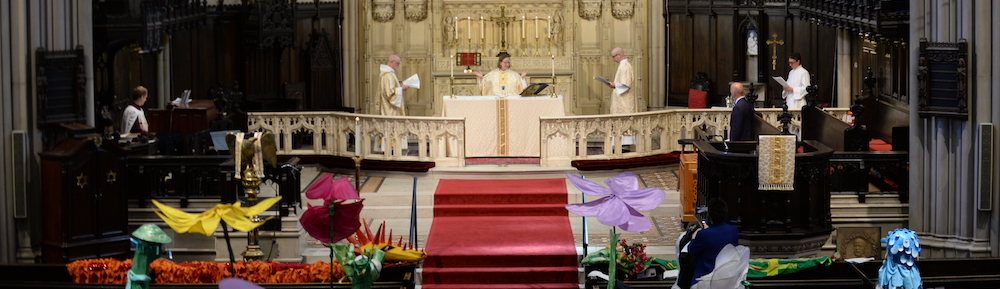
Risen

Easter 2C, April 27, 2025.  The Very Rev. Pamela L. Werntz

Acts 5:27-32. Jesus, whom you had killed by hanging him on a tree.
Revelation 1:4-8. To him who loves us and freed us from our sins by his blood.
John 20:19-31. Peace to you…peace to you…peace to you.

O God of love, grant us the wisdom, the strength and the courage to seek always and everywhere after truth, come when it may, and cost what it will.


Blessed are you who come to church on the Sunday after Easter, in spite of a trifecta of truly terrible theological ideas that get repeated every single year on this day, no matter what.  The first is from Luke the Evangelist in the Acts of the Apostles, where Peter accuses the high priests of having Jesus executed.  The second is from John the Divine in Revelation, that Jesus’ death was a blood sacrifice required for atonement with God. And the third is from John the Evangelist disparaging doubt. We will hear some good and comforting news today from the prophet Isaiah, but you’ll have to wait to hear it until after communion. These are four texts (the first three from the New or Second Testament, and then the text from Isaiah in the Old or First Testament) that do not support the fallacious idea that the God of the Old Testament is a God of wrath and the God of the New Testament is a God of love. I cannot say often enough that the God of Jesus is the God of Israel, and there is plenty of love from God in the First Testament and plenty of wrath in the Second Testament, but Christians tend not to hear or read scriptures in a way that facilitates our comprehension. Continue reading

Appreciating Superpowers

Another common art production in the books: the Easter Play was a huge success. I am so proud of all my cast members for their hard work. I think the most gratifying part was not the performance itself, but the process:  getting to see everyone become more comfortable being expressive and dramatic, and seeing the unique ways in which they each related to their characters. I did a “talkback” after the play, where I asked each cast member to share something they had learned from the experience.  It was beautiful to hear everyone’s unique take-aways. Whether it was about sharing a message of stopping violence, appreciating small joys, embracing skepticism, making oneself heard, or having faith, it seems as if everyone got what they needed out of it.  That’s the whole point of drama therapy: that people will project the healing experience they need into the dramatic work. Continue reading

Happy Easter!

This week is our Easter Play! Woohoo! It has been such an honor to lead its rehearsal sessions and watch these cast members bloom into dedicated actors. I am sure the performance will be a hit; but regardless of the outcome, I am immensely proud of all of them for showing up, investing their beautiful creative energy, and humoring my weird, drama-therapy, acting exercises. Continue reading

Thoughts of Reparations in Lent

April 15, 2025

“Repairer of the breach,” they shall call you, “Restorer of ruined dwellings.” Isaiah 58: 9–10, 12

Reparation is not a task or a moment; it is a process and a movement. As the prophet Isaiah and at least one diocesan mission statement make more clear, reparation, and its sibling “restoration”, line the path which leads from remembrance to reconciliation and, I would add, redemption. No matter recent, lawless chaos and profuse oppression, I believe that it is important to remember that this path persists and we have made a covenant to labor on.

As stated in the Diocese of Washington’s commission on reparations mission: “It [reparations] involves a process to remember, repair, restore, and reconcile historical and continuing wrongs against humanity that can never be singularly reducible to monetary terms, but must include a substantial investment and surrender of resources.

”This reminds me of another covenant we are in the midst of, namely to keep a holy Lent, to engage in the process of prayer, fasting and almsgiving that we might deepen our relationship with God and offer compassion and mercy to one another in more profound ways.

Not only might the process of engaging Lent be reparative of self and soul, it also might lead us to a new understanding of how we might become repairers of the breach and restorers of ruined dwellings.

For me the agents of repair and restoration are mercy and compassion. They are the compass which identifies brokenness and the glue which joins jagged edge to jagged edge.

Goodness knows jagged, shattered edges surround us in this wilderness. And I believe there is another agent which assists us in finding the courage and hope to even tackle the work of reparation and restoration when we have almost given up on grace…almost. It is memory.

Remembering is the agent which precedes restoration and reparation, catalyzes and inspires us toward action.

In my own quest I am remembering Bishop Budde’s sermon at the National Cathedral on January 21, 2025, when she courageously reminded the newly inaugurated president of his and our mandate to be merciful. In that reminder I felt some, albeit thin, thread of grace reenter political discourse repairing frayed hope.

Remembering, summoning our life stories of mercy and justice, is the first step toward the grace of redemption.

Remembering can be as a light which shines on possibility in the face of what seems impossible.

Remembering called us into the wilderness and will sustain us in our summoning of mercy and compassion, in our beloved communal work toward reparation and restoration.

Remember that you are dust and to dust you shall return. It is in returning, re turning, that we know God’s whole and perfect grace.

— The Rev. Dr. Martha Tucker

Rehearsing Our Easter Play

Over the past couple weeks, our Easter Play rehearsals have taken on a new rhythm.  It’s been such a joy to watch the group grow more connected—to each other and to the characters they’re embodying.

We’ve been starting each session with playful physical warm-ups to get everyone moving and loosened up. Prompts like “walk as if you’re being chased by bees” or “walk in slow motion” usually get a few laughs, but they also help folks get out of their heads and into their bodies. From there, we transition into “walk as your character,” which invites people to begin stepping into their roles in a physical, intuitive way. Continue reading