
“Open Circle: Jewish and Christian Thought and Practice”

May 27, 2024

A wonderful series of talks,“Jewish and Christian Thought and Practice: Face to Face and Side by Side,” was offered last fall and winter. Sponsored by Hebrew College Open Circle Learning and hosted by Rabbi Michael Shire of Central Reform Temple, the series explored several topics with Christian faith leaders in the Boston area. Session 6 was devoted to reparations. Rabbi Michael Shire introduced the session and moderated the question-and-answer segment. Our Reverend Pam Werntz was also a speaker.

Rabbi Michael explained the difference between two temple offerings in Jewish teaching and practice. The “hatat,” a sin offering, is made by individuals for damage to other individuals. The “asham,” a specific offering, is given when wrong has been done to others and the harm is done to a people. Asham is “more of a national shame that comes upon us by what we have done or not done.” Rabbi Michael’s remarks included salient examples from the Hebrew Bible about the need for both kinds of repair.

Reverend Pam spoke first about personal reparations (her 2023 sabbatical was devoted to discovering the story of her ancestors and their connection to enslavement in Maryland). Pam then focused on Christian notions of reparations, and specific Episcopalian notions and practices of reparations. She gave examples of Church rituals, prayers, and teachings (the “Great Commandment” and scriptural writings in the Second Testament). We seek and serve the spirit of redemption in all persons and we also pray for restoration and social justice, which is a moral obligation for Episcopalians. Pam’s remarks highlighted the importance of learning that repairing and restoring relationships is work related to justice. Lastly, she spoke about the need to engage in material reparations as part of Emmanuel Church’s commitment to the work in all its forms. Continue reading

The Facts of Life

Pentecost, 19 May 2024. The Very Rev. Pamela L. Werntz

  • Acts 2:1-21.  All were amazed and perplexed, saying to one another, “What does this mean?” But others sneered and said, “They are filled with new wine.”.
  • Romans 8:22-27.  For in hope we were saved. Now hope that is seen is not hope. For who hopes for what is seen?
  • John 15: 26-27, 16:4b-15. You also are to testify.

O God, the eternal flame, grant us the strength, the wisdom and the courage to seek always and everywhere after truth, come when it may, and cost what it will.


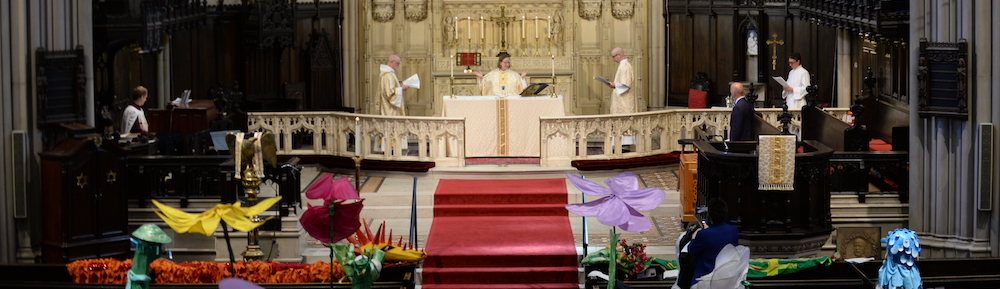
Happy Pentecost! It doesn’t have quite the same ring to it as Merry Christmas or Happy Easter, does it? I don’t know why that is, but for Episcopalians anyway, Pentecost just hasn’t caught on like the birth story or the life-after-death story. Maybe it’s because Pentecost is a story about breath and wind, about inspiration that is intoxicating, about passion that burns. It’s hard to come up with a mascot like Santa Claus or the Easter Bunny for those things! It’s hard to talk about the power of breath and wind, of inspiration and passion, about fire in the belly, for those of us socialized to sit quietly, sing softly, and not call attention to ourselves or our faith. But I would argue that one way to talk about Pentecost is to talk about the facts of life. Continue reading

Our Diocese’s Report on Slavery and Its Legacy

May 14, 2024

The Diocese of Massachusetts Toolkit for Reparations has a new resource. As of
March 2024, their list of sources includes “And You Will Know the Truth, and the Truth Will Make You Free: A Historical Framework (1620-1840) for Understanding How the Episcopal Diocese of Massachusetts Benefits Todayfrom Chattel Slavery and Its Legacy.”

This report, written by Alden Fossett, a postulant for ordination to the priesthood and Master of Divinity student at Berkeley Divinity School at Yale, was released by the Subcommittee on Reparations of DioMass’s Racial Justice Commission.

The focus of the report is on the “12 Church of England parishes founded in Massachusetts before the American Revolution and the sources of wealth that funded their construction, as well as industries that funded the expansion of the Diocese of Massachusetts during the 19th century.” It complements the earlier history, “The Episcopal Church and Slavery: A Historical Narrative,” written by the Subcommittee on Reparations in November 2021. Continue reading

Bearing Witness

May 6, 2024

“Bearing Witness: Museums and Places Amplifying Black History”

On May 1, 2024 , the Boston Athenaeum invited all to join in a conversation about museums as “trusted spaces of memory and education.” The panel, moderated by historian Byron Rushing, included Kyera Singleton, Director of the Royall House and Slave Quarters, and Christian Walkes, Director of Education at the Museum of African American History.

Hosted at the African Meeting House (Boston), the discussion focused on “the intersection of collective memory and museums, delving into the profound role and responsibility of being stewards of historic sites…[navigating] the intricate dynamics of preserving and presenting history to diverse audiences.” At a time when museums are rethinking their educational roles, we learned about these two local sites, and how they are focused on the “history and legacy of slavery and racial injustice and how we might imagine a more just world.”

In greeting and thanking Byron after the talks, we brought him an artifact from our Emmanuel history, a copy of the article about our 1995 series, “Power Shifts,” in which he spoke about wielding power for the betterment of all concerned. (Emmanuel News 1995: v. 1, no. 1) We had a moment to remember his ongoing engagement with racial justice over the years and it was wonderful to share some time with him.

–Mary Beth Clack, Mary Blocher, Cindy Coldren, Pat Krol, Liz Levin
–Published in This Week @Emmanuel Church May 6, 2024