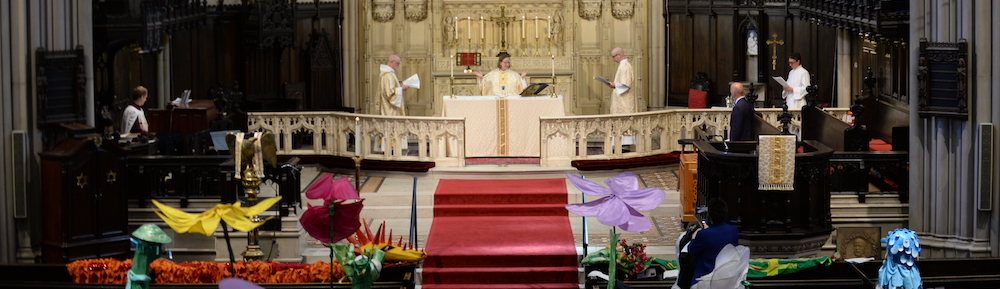
Epiphany 7C. 23 February 2025. The Very Rev. Pamela L. Werntz
Genesis 45:3-11, 15. And he kissed all his brothers and wept upon them.
1 Corinthians 15:35-38, 42-50. Someone will ask, “How are the dead raised?”
Luke 6:27-38. A good measure, pressed down, shaken together, running over will be put into your lap.
O Most Merciful and Compassionate, grant us the strength, the wisdom and the courage to seek always and everywhere after truth, come when it may, and cost what it will.
During this season of Epiphany, our First Testament lessons have been from the Writings and the Prophets: Nehemiah, Isaiah, Jeremiah, and Malachi. Suddenly and unexpectedly, a lesson falls into our laps from Genesis about the long-lost Joseph encountering his brothers in Pharaoh’s court in Egypt. I want to make sure you know the backstory just in case you didn’t have at least a half a dozen years of Sunday School when you were growing up!
Here’s a quick synopsis of about a dozen chapters of Genesis: Joseph was the 11th of 12 sons of Jacob (aka Israel). Jacob had his last two sons with Rachel, who died in childbirth delivering Benjamin. The legend goes that Joseph was Jacob’s favorite, and his brothers were insanely jealous of their father’s favoritism and Joseph’s dreams of superiority. When Joseph was 17, his brothers, who couldn’t take it anymore, decided to kill him. Then they changed their minds and threw him into a pit instead. He got pulled out by some passersby, who sold him into slavery. The brothers tore up Joseph’s ornamented tunic, a special gift from their father, put blood of a goat on it, and told Jacob that his beloved son must have been devoured. [1] He was devastated. Joseph ended up in Egypt, where he was enslaved in a wealthy household and then jailed by the jealous master whose wife lusted after him. While in jail, Joseph interpreted the dreams of fellow prisoners and so gained the attention and then the trust of Pharaoh, who made him the second-most-powerful person in Egypt, in charge of the empire’s food supplies through a severe famine.
Meanwhile, Joseph’s brothers, who were starving in the land of Canaan, learned that there was plenty to eat in Egypt; so they headed there to beg for food. They didn’t recognize Joseph when they met with him, but he knew them. He gave them sacks of food, but hid a golden cup in youngest brother Benjamin’s sack. He then accused Benjamin of theft and threatened to imprison him. When the brothers begged to be imprisoned in Benjamin’s place, Joseph revealed who he really was. High drama! That’s where our story this morning picks up.
What’s missing in our reading is the beautiful verse in which Joseph and Benjamin wept on each other’s necks in a poignant acknowledgement that the injury inflicted by the older brothers was not just to Joseph and Jacob, but also to Benjamin. The two sons of Rachel then weep over the other ten brothers. There is no righteous retribution, vindictiveness, or Schadenfreude at their desperate circumstances, even though, surely, they had it coming. There is a promise of mercy, compassion, material restoration, and care with a strong sense of divine providence turning decades of tragedy into a future of dignity and grace. Walter Brueggemann describes Joseph’s work as reinterpreting the past, redefining the present, and reimagining the future. [2]
In the light of this story from Genesis, I can see that Jesus was teaching Torah in Luke’s Sermon on the Plain. When I look through Luke’s particular lens at Torah and Gospel, I can see that he views the Good News as the healing power of relationship with the Divine, the healing power that flowed out of Jesus, to reinterpret the past, redefine the present, and reimagine the future. But Jesus’ teachings here are hard; the challenges are huge. Even if we agree with the ideas and the ideals of loving our enemies, putting that into practice takes a lifetime of work. Often in conversation about these teachings, there’s a quick move to the extremes: what about the oligarchs? What about the President? Going to the extremes is a way of avoiding looking at our own spheres of influence. Closer to home we might ask: what about someone who is in an abusive or exploitative relationship? No! What then? Are we to be passive or complacent? How do we reckon with evil without indulging it? Surely we should not tolerate intolerance! Jesus’ answers have to do with responding restoratively rather than retributively. Restoring what? Restoring dignity. Jesus asserts the healing power of restoring dignity in undignified circumstances. Jesus has no tolerance for public shaming or humiliation, and he knew that violence never ends violence. Only creative non-violence will do that. Hatred will never overcome hatred; only love will do that. (That’s a teaching from the Buddha, by the way.) Similarly, Jesus lays out a path of non-violent, dignified responses to injuries that affirms self-worth and the worth of the other, even if the path is completely obscured by the fog of cultural differences, language, and time.
It’s hard for me to think of a teaching of Jesus that requires greater translation across culture, time, and language than the one about turning the other cheek if someone strikes you. The word that gets translated strike describes the act of slapping someone with an open hand. The backhand slap was typically done in the context of humiliation or mockery, used to shame someone in a public setting. The Greek dictionary says, “It was considered a grave insult, reflecting a deep level of contempt or disdain.” [3]
I was far along into my theological education when I had the opportunity to see the great Walter Wink demonstrate this teaching from Jesus, and it made an indelible impression on my heart. He demonstrated the motion of backhanding someone on the right cheek (with his right hand) like someone with greater power would do to someone with less power. When the victim offered the other cheek, the only slap possible was to cup the person’s cheek, which was a gesture of affection. The move of offering the other check is physically, literally, disarming. It is an elegant response that asserts the dignity of both the perpetrator and the victim. Likewise, giving one’s shirt to someone who has just taken one’s coat is a non-violent way to demonstrate the dignity of nakedness and the indignity of injustice. In an honor-and-shame culture, nakedness brings shame on the one who sees, not on the one who lacks cover.
Although these are not teachings about being doormats for Jesus, what if we cannot manage to love our enemies? What do we do when loving is too hard or too dangerous? Remember, when the task is overwhelming and seems impossible, it means that the first step is too big; and so we need to break it down into smaller steps. One move is to step outside of what Pádraig Ó Tuama calls, “the energy of enmity,” which keeps us trapped or stuck, cornered or cowering. [4] Buddhist teachers Robert Thurman and Sharon Salzburg have said that, for them, the first step toward non-hatred is to become aware of how it feels to be scared and angry inside of oneself but not todiscount or ignore the injury. If you’re like me, lately, you’ve had opportunities to feel scared or angry every day.
A next step is to cultivate a desire to not be stuck there: a desire to heal. Non-hate is the beginning of the journey. If you’re like me, you also have opportunities to step out of that narrow place of desire for revenge and into a place of mercy and compassion. If you’re looking for an example of what I mean, the Bishop of Washington, Marianne Edgar Budde, recently gave a master class on speaking truth to power in a most loving way, both in her sermon at the prayer service the day after the Inauguration and in subsequent interviews. (If you haven’t yet seen and heard Bishop Budde, then listening to her is a good next step.)
The idea of non-hate being the beginning of a journey toward love connects for me to Jesus’ command to be merciful. The verb can also be translated: become. Become merciful like the Holy One, who is merciful. Be in relationship with divine mercy for yourself and for others, along the Way. Do not judge, and you will not be judged by the Holy One. Do not condemn, and you will not be condemned by the Holy One. Perhaps you hear the echo, “Forgive us our sins as we forgive those who sin against us,” from the way Jesus taught his followers to pray. I don’t know about you, but I’m always hoping that God will forgive us our sins better than we forgive those who sin against us, because Christians in general are not that good at it yet.
Another step toward non-hate, and this is very important, is to refrain from considering or declaring that our enemies are somehow less than or other than human. Violence toward others cannot be justified by dehumanizing them, even if they are behaving in depraved and terrible ways. And for me, it’s important to understand that we are capable of the most depraved and terrible things that we deplore in our enemies, which is one reason “We repent of the evil that enslaves us, the evil we have done, and the evil done on our behalf.”
What I want to suggest about the prohibition of judging and condemning is that there is an important distinction to me between judging and condemning people and judging and condemning behaviors. Even as I say this, I’m aware of how “Love the sinner, hate the sin” has been used against queer people like me. Nevertheless, even as Jesus says don’t judge, he is clearly judging against violent behaviors of all kinds. Also, according to Luke, Jesus responded in mercy and compassion to the criminal on the cross near him who believed that he deserved his own death sentence. I’m sure that responding to one’s enemies with grace and mercy will and does change us for the better; responding with grace and mercy heals us and the world. When we can loose whatever grip righteous indignation has on us, when we stop consuming the poison of resentment and hatred, it’s like an abundance of grace, so much that it generously runs over like a gift falling into our laps!
I want to close by saying something about our lesson from First Corinthians. I just love Paul’s words of assurance that someone is going to ask, how are the dead raised? With what kind of body do they come? In other words, how exactly does resurrection work? “Fool!” he practically shouts. Listen up, Emmanuelites! Resurrection looks like: “They buried us but they did not know we were seeds.” Resurrection looks like twelve brothers reunited and forgiven. like mercy and compassion, like suffering with, like remembering and asserting one’s own dignity in the face of mistreatment, like respecting the dignity of every human being, and for Christians, like seeking and serving Christ in all persons, even when you cannot discern any evidence of the Christ. It looks like restorative rather than retributive justice, reinterpreting the past, redefining the present, and reimagining the future. It looks like using our power to heal, like a strong sense of divine providence turning decades of tragedy into a future of dignity and grace. It looks like Love that is stronger than death. Without that love, whatever we do is worth nothing, our opening collect today acknowledges. Take that Word of God seriously. I am begging you.
- Robert Alter’s translation in his The Hebrew Bible: A Translation with Commentary (NY: Norton, 2019).
- Walter Brueggemann, Genesis in Interpretation, Vol. 1 (Atlanta: John Knox Press, 1982), p.347.
- “Strike” in Strong’s Exhaustive Concordance.
- https://onbeing.org/programs/sharon-salzberg-robert-thurman-love-your-enemies-really?