
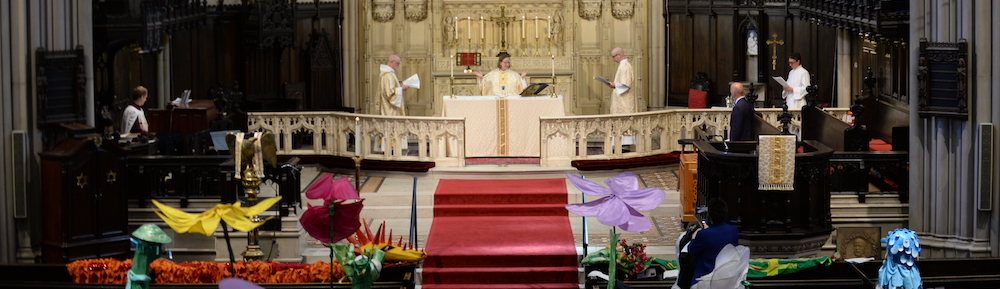
Behave as if it were true!

Easter 3C, May 4, 2025.  The Very Rev. Pamela L. Werntz

Acts 9:1-6(7-20). “Go, for he is an instrument whom I have chosen.”
Revelation 5:11-14. And the four living creatures said, “Amen!”
John 21:1-19 . Come and have breakfast.

O God of resurrection, grant us the wisdom, the strength and the courage to seek always and everywhere after truth, come when it may, and cost what it will.


We are well on our way into the Great Fifty Days of Easter, the extended Feast of the Resurrection. I love that the Church calendar gives 40 days for Lent, but 50 days for Easter because Easter is harder. Lent is easier for many of us – we know our need for increased focus on penitence, discipline, prayer, study, and our need for mercy. Many of you tell me that Lent is your favorite church season. On the other hand, a season of increased focus on resurrection (on rising from the dead) trips people up, especially when the news of what’s going on in the world is so bad. (I’ll tell you something; it was bad for the earliest Jesus followers, too.) Continue reading

Risen

Easter 2C, April 27, 2025.  The Very Rev. Pamela L. Werntz

Acts 5:27-32. Jesus, whom you had killed by hanging him on a tree.
Revelation 1:4-8. To him who loves us and freed us from our sins by his blood.
John 20:19-31. Peace to you…peace to you…peace to you.

O God of love, grant us the wisdom, the strength and the courage to seek always and everywhere after truth, come when it may, and cost what it will.


Blessed are you who come to church on the Sunday after Easter, in spite of a trifecta of truly terrible theological ideas that get repeated every single year on this day, no matter what.  The first is from Luke the Evangelist in the Acts of the Apostles, where Peter accuses the high priests of having Jesus executed.  The second is from John the Divine in Revelation, the idea that Jesus’ death was a blood sacrifice required for atonement with God.  The third is the disparagement of doubt from John the Evangelist. We will hear some good and comforting news today from the prophet Isaiah, but you’ll have to wait to hear it until after communion. These four texts (the first three from the New or Second Testament, and then the text from Isaiah in the Old or First Testament) do not support the fallacious idea that the God of the Old Testament is a God of wrath and the God of the New Testament is a God of love. I cannot say often enough that the God of Jesus is the God of Israel. There is plenty of love from God in the First Testament and plenty of wrath in the Second Testament, but Christians tend not to hear or read scriptures in a way that facilitates our comprehension. Continue reading

Handle with prayer!

Christmas 1C, 29 December 2024. The Very Rev. Pamela L. Werntz

  • Isaiah 61:10 – 62:3. I will greatly rejoice in the LORD.
  • Galatians 3:23-25, 4:4-7. So you are no longer a slave but a child, and if a child then also an heir, through God.
  • John 1:1-18. No one has ever seen God. It is God the only Son, who is close to the Father’s heart, who has made him known.

O God of love, grant us the strength, the wisdom and the courage to seek always and everywhere after truth, come when it may, and cost what it will.


Our lectionary, which assigns the prologue to the Gospel of John for the first Sunday in Christmas, baffles me. Since we’re in a Gospel of Luke year, why not the story of the presentation of Jesus as an infant in the Temple eight days after he was born? The answer, I guess, is that story will be read on February 2, which is the Feast of the Presentation. Continue reading

Be joyful in Love, all you peoples!

Easter 7B, 123 May 2024. The Very Rev. Pamela L. Werntz

  • Acts 1:15-17.  The crowd numbered about one hundred..
  • 1 John 5:9-13.  So that you may know that you have eternal life.
  • John 17:6-19. So that they may have my joy made complete in themselves.

O God of our complete joy, grant us the strength, the wisdom and the courage to seek always and everywhere after truth, come when it may and cost what it will.


In the church year, we are now as deep into the Easter Season as we can go. We have just passed the Feast of the Ascension, which is a Principal Feast Day in the Episcopal Church, but a celebration that is perhaps a little embarrassing for many progressive Christians. I mean, it’s a little embarrassing to commemorate a day when, according to the writer of Luke and Acts, a full forty days after he was raised from the dead, Jesus opened their minds to the scriptures and gave his final blessing. He then was lifted up off of the ground, and a cloud took him out of his disciples’ sight. But as my friend Brother James Koester, the Superior at St. John the Evangelist across the river in Cambridge, recently wrote: [1]

The Ascension is not rocket science, and it loses its power if we reduce it to a literal description….Instead, the Ascension is about the mystery of Christ’s present reality: risen, ascended, and glorified. This not only shall be ours one day but it is ours today. Continue reading

Not Insurrection, but Resurrection

Lent 3B, 3 March 2024. The Very Rev. Pamela L. Werntz

  • Exodus 20:1-17.  I AM
  • 1 Corinthians 1:18-25.  Christ, the power of God, and the wisdom of God.
  • John 2:13-22. They believed the scripture and the word that Jesus had spoken.

O God of Love, may we have the wisdom, the strength, and the courage to seek always and everywhere after truth, come when it may and cost what it will.


Sometimes when I sit down to work on a sermon, I get tripped up by the first few words of a reading and fall into a deep exegetical hole! This week the words were “The passover of the Jews was near.” Why get stuck on that, you might wonder. Well, I’m going to tell you. It’s because Passover is probably not a good translation of the Hebrew word Pesach or the Greek word Pascha. There’s a long history of rabbis arguing about the etymology of Pesach, which can mean skipping over or hopping over or even limping over. There is, however, an even older meaning: to have compassion for or to make a sacrifice of mercy. [1] So we might understand that, according to the Gospel of John, very early in Jesus’ ministry, he made a pilgrimage up to Jerusalem to observe the festival celebrating God’s compassion or mercy, a Festival of Freedom from Oppression. In Jesus’ time, the Romans had taken the place of the Babylonians, who had taken the place of the Egyptians as the oppressors. Continue reading

The work of Christmas begins.

Baptism of Our Lord,  8 Jan. 2023.  The Very Rev. Pamela L. Werntz

  • Isaiah 42:1-9.  I am the Lord, I have called you in righteousness, I have taken you by the hand.
  • Acts 10:34-43. Anyone who…does what is right is acceptable to [God].
  • Matthew 3:13-17.  Let it go for now, for it is proper for us to fulfill all righteousness.

O God, manifest in us the strength, the wisdom and the courage to seek always and everywhere after truth, come when it may, and cost what it will.


Today is the day in the church calendar called The Feast of the Baptism of Our Lord. We are two days past the Feast of the Epiphany with its dramatic story of the Magi following a star with their extravagant gifts in hand. In the biblical narrative, we have advanced a generation from Jesus’ infancy to his mature adulthood. It feels too fast! I want to say, “Wait, go back!” So we have, in our first hymn and in our cantata for today; but otherwise, we are pressing ahead. Continue reading

Rejoice with the angels!

Proper 19C.  11 September 2022. The Very Rev. Pamela L. Werntz

Jeremiah 4:11-12, 22-28. It will be said a hot wind comes from me…toward my poor people.
1 Timothy 1:12-17. But I received mercy.
Luke 15:1-10. This fellow welcomes sinners and eats with them.

O God our help and our home, grant us the strength, the wisdom and the courage to seek always and everywhere after truth, come when it may, and cost what it will.


Hello! I’m so glad to see you. I’ve missed you! This morning I want to invite you to reflect with me about sinning and repenting. How’s that for my first sermon out of the gate after vacation? You may know that in our lectionary cycle of readings, the pairing of the First Testament reading with the Gospel is random during Ordinary Time. That is, we hear large segments of Hebrew scripture, scheduled without consideration of the Gospel appointments. So the pairing of Jeremiah and Luke is coincidental. Today, we also hear Psalm 14 and a reading from 1 Timothy. In seminary, preachers are admonished to stick with one lesson in our sermons, but I just can’t do it. I hear the readings in conversation with each other, even if they weren’t designed to be, and in conversation with us, even though they didn’t anticipate us.  Continue reading

The Harvest of Righteousness

Advent 2C.  19 December 2021. The Rev. Pamela L. Werntz

Baruch 5:1-9 Take off the garment of sorrow and affliction and put on the robe of righteousness.
Phillipians 1:31-11. And this is my prayer, that your love may overflow more and more with knowledge and full insight to help you to determine what is best, so that in the day of Christ you may be pure and blameless, having produced the harvest of righteousness that comes through Jesus Christ for the glory and praise of God
Luke 3:1-6 All flesh shall see the salvation of God.

God all merciful and all compassionate, grant us the wisdom, the strength, and the courage to seek always and everywhere after truth, come when it may and cost what it will.


As I said last week, Advent is a season for communal and institutional reflection and repentance, for collective atonement and reparations. Our readings for this second Sunday in Advent are so full and big with calls for repentance and reparations; it is almost as if they are pregnant with possibility. The prophet Baruch and the evangelist Luke are both reminding their hearers about the words of the prophet Isaiah. And Luke draws a picture of John the Baptist that is just like the prophet Jeremiah, consecrated before he was born, and just like Elijah by the Jordan in the wilderness. Luke also has already explained that John’s work was so closely related to Jesus’s work, their purposes were so akin to one another, that it was as if they must have known one another before they were even born. Continue reading

Peace at the Last

Proper 27B.  7 November 2021. The Rev. Pamela L. Werntz

Ruth 3:1-5; 4:13-17. I need to seek security for you.
Hebrews 9:24-28. Not to deal with sin, but to save those who are eagerly waiting for him.
Mark 12:38-44.  She…has put in everything she had.

O God of Peace, grant us the strength, the wisdom and the courage to seek always and everywhere after truth, come when it may, and cost what it will.


Being within the Octave or eight days of November 1, we are observing the celebration of All Saints’ Day today. Eight is a sacred number in Judaism, Christianity, and Islam. In our sacred texts, eight represents a fullness of time, more than complete, a time for new life and new beginning, entrance into the eternal. In Islam, there are eight gates to heaven. The Arabic numeral 8 on its side stands for infinity. For Christians, there are traditionally eight sides on a baptismal font recalling the Torah command to circumcise on the eighth day, the Torah command to observe the feast of Passover, and the Gospel account of the resurrection of Jesus on the eighth day. Today we are sacramentally full to the brim. Liturgically, our cup is overflowing with Jane Harte’s baptism and with our celebration of Holy Eucharist. Our Great Thanksgiving will memorialize and honor those on the heart of our parish who have died since All Saints’ Day in 2020, and the beautiful Ruehr requiem will commemorate Ruth Ann Richwine Ruehr and all who died in 2020. Continue reading

Pharisees

Proper 22B.  3 October 2021. The Rev. Pamela L. Werntz

Job 1:1, 2:1-10. Do you still persist in your integrity?
Hebrews 1:1-4, 2:5-12. Someone has testified somewhere.
Mark 10:2-16.  Receive the kingdom of God as a little child.

O God of the Pharisees, grant us the strength, the wisdom and the courage to seek always and everywhere after truth, come when it may, and cost what it will.


So how about those readings? One of the things that my clergy colleagues and I often do when we see each other in the week before particularly troublesome readings is ask one another, “Are you preaching on Sunday?” And if the answer is no, the response is, “lucky!” If the answer is yes, the follow up question is, “What are you going to do with those readings?” I usually keep this to myself, but I’ll confess to you that I actually feel lucky to engage and even debate challenging scripture texts. I think of the ways that People of the Book turn to one another for perspective, guidance, sympathy, insight, and sometimes in the form of an argument. It’s not always respectful, but I think we all know that it’s supposed to be. Continue reading