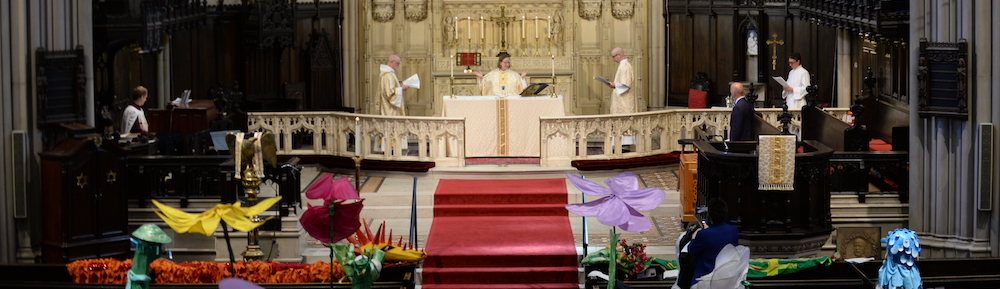
Advent 1C, 1 December 2024. The Very Rev. Pamela L. Werntz
Jeremiah 33:14-16. Justice and righteousness in the land.
1 Thessalonians 3:9-13. May the Lord make you increase and abound in love for one another and for all.
Luke 21:25-36. Then he told them a parable.
O unsettling God: grant us the wisdom, the strength, and the courage to seek always and everywhere after truth, come when it may and cost what it will.
Whether we are ready or not, it’s time to wake up. Rise and shine! With the advent of a new church year our liturgy changes colors, music, and prayers to mark this season of communal preparation and repentance. Our Gospel readings also mark a change; we’ll hear mostly from Luke in Year C. Last year’s Gospel of Mark was terse and spare prose, covering the most basic facts of the ministry and teaching of Jesus and telling the circumstances of his death. The language of Luke is expansive and poetic, dramatically and outwardly focused, mission-oriented. Ironically, we begin each liturgical year with Jesus teaching about the end of the world as it is known. This is no coincidence. All the Gospels were written through the lens of the crucifixion and the experience of Love more powerful than death, the ending of one world and the longing for a new world, where the compassion, mercy, and peace of God would reign once and for all: all time and all people.
The writer of Luke reminds Jesus’ followers that, along the way to the reign of the glory of God, there will be confusion among the nations because of the roaring of the sea and waves. The powers of the heavens will be shaken, and people will get the wind knocked out of them with fear and foreboding. (This sounds ripped from the headlines.) Jesus says when you see these things happening, don’t hunker down or hide; stand tall and raise your heads because your redemption (that is, the revaluation of your dignity) is drawing near! This is a pep talk: heads up! Be on your guard that your hearts are not weighed down with the worries of this life, so you have the strength to avoid the turmoil and to stand facing the Son of Man (for us that is Jesus), the one who came to demonstrate the love of God, not in word or speech, but in truth and action.
And then Luke’s story goes that Jesus told them a parable. Unlike other parables, this one is so short that, if anyone’s mind wandered for a minute, they missed it entirely. It always reminds me of a scene from one of my family’s favorite movies: Joe versus the Volcano, an early Tom Hanks and Meg Ryan romantic comedy, in which Meg Ryan plays the three female-lead roles. Tom Hanks plays Joe Banks, who is on a spiritual journey away from a colorless, loveless existence. In one scene, one of Meg Ryan’s characters, Angelica Graynamore, has driven Joe to the hills outside of Los Angeles the night before he embarks on a sea voyage to an island where he will offer his life for the good of the islanders. At a scenic overlook, they see millions of twinkling lights of the city. It looks and feels to the earnest Joe Banks, as if the stars have fallen or the world has been turned upside down. After several moments of quiet, Angelica asks, “Would you like to hear one of my poems?” “Sure,” Joe relies.
Long ago
the delicate tangles of his hair
covered the emptiness of my hand.
After a moment of silence, Angelica asks a puzzled Joe, “Would you like to hear it again?” That’s what I think of when I read the part of this Gospel passage from Luke that says, “Then Jesus told them a parable.” “Look at the fig tree and all the trees; as soon as they sprout leaves you can see for yourselves and know that summer is already near.” I imagine Jesus looking at his earnest audience, in a long pause that did not get recorded in the Gospel narrative, and then asking, “Would you like to hear it again?”
What sense can we make of this one-sentence parable? I think an interpretive clue comes from how the parable is placed in the Gospel of Luke, which is extraordinarily symmetrical in the way it is constructed. The writer of Luke is employing the finest rhetorical devices in this composition. The narrative, the sayings, the miracles, and the parables are all told in a writerly version of synchronized swimming! You have to map it out and stand back to see how it works. Fortunately for me, I have a friend who did that once on yards of butcher paper!
This shortest parable, the parable of the fig tree, is the last one in Luke, at the end of Jesus’ life. It is balanced and illuminated by Luke’s first parable, which is the parable of the sower. By contrast, the parable of the sower is long, and its story covers an expanse of time, whole seasons of planting, growing, and reaping. At the beginning of Jesus’ ministry, there is plenty of time; at the end, time collapses. In the parable of the fig tree there is no expanse of time. There is only the present moment: right now. There is a way in which Jesus is teaching about not getting so preoccupied with what did or didn’t happen, or what might happen, that one misses the power of what one can know in the present moment. New life is very near right now, within reach.
Advent is all about calling our attention to the power of the present moment. Advent is a season of repentance, but not the Lenten repentance of wallowing in regret for our sins, personal piety, or private salvation. Advent’s sacramental purpose is about effecting corporate accountability and modifying communal behavior. The Advent calls for change and promises of redemption are directed to communities, institutions, societies, and nations. Likewise, our liturgical changes are designed to be unsettling, agitating, and provocative to the whole community. Perhaps more than any other time in the church year, our Advent work is to offer affliction for the most comfortable as we work to change, so that we can better provide comfort for those who are most afflicted.
The power of the present moment can too easily be given up or given away in at least three ways: one is to live in the past, blame the past, or feel guilty about the past. But regretting our past is about as effective as regretting gravity. We can (and should) learn from the past, but wishing that our past were different or that it still existed is a way to give up the power of the present moment, the now. Another way of giving up now is to live in the future. This is not to say that we shouldn’t have visions, goals, hope, or imagination. But spending our now wishing rather than taking action, or spending our present moments worrying, feeling anxious or afraid, will rob us of our powerful now so fast we won’t know where it went. And the last way we give up now is to try. Trying is not doing; if we try to pick up a binder, nothing happens.
This Advent see if you can eliminate your use of the word try when it comes to what you are talking about doing. When you hear yourself say try, stop and listen deeply to yourself, because you probably have just said in a very polite way that you are not doing it yet, or that you probably won’t do it. Know that if you say you’ll try to do something, you have just let yourself know (and now anyone else that is in this room) that you haven’t made a commitment to do it. Telling truth about that will give you back your now.
So whenever we want to engage in transformative action, start. Do a small piece of it. Then be glad when you say, “We are changing X (whatever it is).” Maybe it’s not as much as we’d like, but it’s more than before. Listen to the powerful difference between saying that Emmanuel Church is trying to witness to God’s mercy and justice and Emmanuel Church is witnessing to God’s mercy and justice. We are feeding and housing people who need physical nourishment and shelter, while providing food and a safe haven for all kinds of people who are spiritually hungry and in need of spiritual shelter. We are digging deep for the spiritual and material resources to be the change we want to see in the City of Boston.
Today, we heard Jesus tell his hearers what to do whenever it seems like the world is getting turned upside down. When confusion and fear are colluding to reduce us to passivity and despair, knocking the wind right out of us, we are not to squander our energy, create distance or indulge our anxieties. We are to stand up, raise our heads, and know that redemption, the revaluation of human dignity, is near. We are to look at what is right in front of us right now. Truly I tell you that a generation did not pass away until all things had taken place, and this generation will not pass away until all things have taken place either. As John Crossan and Marcus Borg have written, the Biblical idea of end times: “Is not about some mass immigration from a doomed world to a blessed heaven. Rather, it is about the end of…war and violence, injustice and oppression. It is about the earth’s transformation, not about its devastation. It is about a world of justice and peace.” [2]
What did you read on the front page of the newspaper this morning or see on the news last night about distress among nations? Of people fainting from fear and foreboding of what is coming upon the world? How are confusion, fear, and foreboding happening in our nation, in our city, on the other side of your desk in your office, in school, at home, in your extended families, or even in this room? Where is the drama of giving up the power of now playing out in our relationships, institutions, or bodies? And what redemption or re-valuation might be near right now? What would it take for us to stand up and raise our heads? [3] As Lee Pelton of The Boston Foundation said last week, “Where we see a wrong, we seek to right it; where we see a hurt, we seek to soothe it; and where we see a broken heart, we seek to mend it. This is not the time to rest. It is a time to be restless…in this pursuit of what is right and just.”
It’s been said that no tree looks more dead than a fig tree in the Palestine winter. Imagine noticing little leaves sprouting out of buds on the branches, tiny hopeful signs of growth , of change, of new life. Jesus seems to be saying that in the middle of whatever is turning the world upside down, pick your heads up, look for, see, and be the signs of hope that are right in plain sight, right now. Christian hope, according to Jurgen Moltman, is not an “opium of the beyond;” rather it is, “The divine power that makes us alive in this world.” It’s not a hope that things will return to the way that they were, that the past will be different, or even that a bad thing will never happen in the future. It’s hope that right now, Love (another word for God) is redeeming and revaluing what seems dead, shameful, worthless, wasted, or hopeless in us and through us, in here and out there. Advent is a season of change and hope that right now Love can do that. Raise your heads and see that right now Love is making a way where there is no way. Raise your heads and see that right now Love is very near. As we will hear, and then sing together, in the final chorale of today’s cantata: “No eye has ever perceived, no ear has ever heard such joy as our happiness, io, io, eternally in dulci jubilo!” May it be so.
- 1 John 3:18.
- Borg and Crossan, The First Christmas: What the Gospels Really Teach About Jesus’s Birth (New York: HarperOne, 2007), p. 240.
- Thanks to Bill Dols for this line of questioning in The Bible Workbench 17:1.