
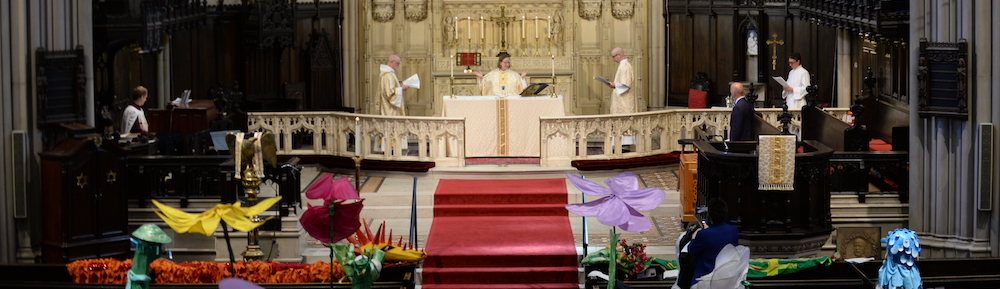
The abundance is all around us.

Epiphany 5C, 9 February 2025. The Very Rev. Pamela L. Werntz

Isaiah 6:1-8 [9-13]. Keep listening but do not comprehend.
1 Corinthians 15:1-11. Last of all, as to one untimely born, he appeared also to me.
Luke 5:1-11. Put out into the deep water.

O God of the deep, grant us the strength, the wisdom and the courage to seek always and everywhere after truth, come when it may, and cost what it will.


Our Gospel lesson for this week is the story about the day when Simon, James, and John decided to walk away from their night jobs, the day they decided to leave everything to follow Jesus, according to Luke. Just before this, Luke tells us that Jesus went down to Capernaum, a town on the shore of the lake of Gennesaret (also known as the Sea of Galilee), where he had been teaching. Jesus had exorcised an unclean spirit from among the people, and he had healed Simon’s mother-in-law by rebuking her high fever! He had been healing all kinds of diseases by laying his hands on sick people. Large crowds had begun to follow him wherever he went. In fact, even when he went to an isolated place to get away for a bit, Luke tells us that the crowds came looking for him; and when they got to him, they tried to keep him from leaving them.

One time, Luke says, Jesus was standing along the shore, and the crowd was pressing in on him. They were desperate to hear what he had to say, hungry for the word of God. Do you remember what he was teaching? He was proclaiming God’s favor for those who were poor, pardon for those imprisoned, and freedom for those who were oppressed. So we can be sure that this crowd was full of people who were hungry and bone-tired, distressed and diseased, and down and out. The story goes that Jesus climbed into a boat to get space between himself and the pressing crowd, then he taught for a while a little way out from the shore. He’d used Simon’s boat as a platform, a wobbly stage, while Simon and the others were washing their nets. I imagine that Simon, having worked all night and caught nothing. was hungry and tired, too.  When Jesus finished teaching, rather than thanking Simon and sending him home for a meal and a rest, he instructed him to put out again into the deep and let down the nets for a catch (the same nets that had just been put away).

Now this is a crazy idea on at least two levels. The first is that the fishermen have just come back in, presumably having tried everything during the night to catch fish. (Nighttime is when fishing happens there because in the daytime the fish can see and avoid the nets). They’ve just washed their nets. Going back out is a lot of work, and fishing in the daytime on Lake Gennesaret is just dumb. The next level of craziness is the idea of going into the deep, because the deep represents chaos. Put out into the deep, the chaos, Jesus is saying, in broad daylight, where everyone can see how foolish you are.

Simon Peter does not refuse, but he does signal his characteristic reluctance to believe that Jesus knows what he’s talking about. They then catch more fish than they can handle in a classic case of “Be careful what you wish for.” Exhaustion, chaos, and frightful excess – enough to sink a boat. I can just see Jesus smiling and saying, “You weren’t expecting that, were you?” But if exhaustion, chaos, and excess are what happen when we let Jesus instruct us on how to do our jobs, many of us would (and do) demur. No wonder Peter responds, “Go away from me because I am sinful. I don’t deserve or have any idea what to do with this kind of abundance.” Jesus’ response is: “No worries, I’ll show you.”

And then, according to Luke, Simon Peter and the sons of Zebedee James and John, left everything to follow Jesus. I don’t know about you, but I find considerable irony in their walking away after their most miraculous catch of all time. I can imagine walking away from a failing business, when there’s nothing left to lose. I actually have walked away from a position in a company that was doing immoral work, more than once. But this is a story of walking away from winning a jackpot catch of fish, that salted and preserved, would have provided sustenance for family and friends with more to export. In Luke, Jesus doesn’t say, “Follow me”; he says, “From now on you’ll be catching people”; and they left everything and followed him.

You know, the story of this catch is told as a post-resurrection story in the Gospel of John. Some New Testament scholars postulate that either Luke took a well-known post-resurrection story and placed it toward the beginning of his narrative; or John took a well-known beginning story and placed it at the end of his narrative to signal new beginning. This debate reminds me that none of us can really ever know what happened, or what any of it meant before the disciples experienced the radical and abundant new life given to them in the years after Jesus’ crucifixion. Every experience got remembered and reinterpreted, told and written down after their experiences of resurrection, in some cases generations after. Once Jesus’ followers experienced the radical and abundant new life given to them after Jesus’ crucifixion it changed everything!. Everyone who had a Gospel story to tell told the details differently. As you know, I love the theological elbow room that gets created by those kinds of differences.

The question for me is always, what does scripture have to say to us that might make a difference in the way we enact love in our lives? (Enacting love is a Biblical understanding of doing justice.) What might we learn today to apply to our own lives, as individuals and as a parish? How might this scripture help us to better live the words we pray? Here’s some advice that I’ve gleaned from this Gospel lesson in Luke. You may have heard it before, but since it’s my advice, I think it’s worth repeating! It’s advice I follow, and I highly recommend it to you.

  1. Let Jesus use your boat, that is, your livelihood, primary resource, mode of transportation, shelter from the storm, and sanctuary. Let Jesus use your boat to proclaim and enact God’s favor for those who are poor, freedom for those who are imprisoned or oppressed, healing and recovery for those who are diseased. Let Jesus use your boats even and maybe especially when you think that you know more than Jesus does about what’s realistic in your context, what’s sensible, or what’s possible (and what is not) when it comes to alleviating suffering.
  2. Whenever you feel as though you’ve been laboring in vain, get back out there and go deeper into the chaos; do something foolish in plain sight for the love of Jesus Christ. I often repeat a story that Bishop Barbara Harris told me about when as a recently ordained priest she went to see an important mentor of hers. She sat down in his office and said, “I am sick to death of teaching white people about racism. I’m done. I’m not doing it any more.” And he said to her, “You’re not done. You’re never going to be done. Get back out there.” I think about that every time I feel tired of teaching people (out there) about sexism, heterosexism, transphobia, or the case for reparations in the church. I also think about it when people who do not have the privilege or access to power I have challenge me to examine and check my own biases and assumptions, complicities and complacencies, or small views about what is possible. But the most important thing about this Gospel advice is, don’t go alone and do observe Sabbath. Then get back out there, taking a witness, being a witness. Gospel ministry is collaborative; go deep.
  3. Remember that when and whenever you/we experience abundance, there’s a catch!.  (Get it?) There’s always a catch, and here it is. We are obligated to share the abundance. When we experience abundance, we are called to gather people around us, people who need relief from hunger, disease, imprisonment, or oppression; and show them the abundance of grace. When Simon Peter, James, and John walked away from their business after a haul of fish that threatened to sink their boats, what do you think happened to all that fish? I bet it fed that big crowd on the shore and then some. In the version of this story in John’s Gospel, when the miraculous catch had been hauled in, Jesus asked three times “Simon Peter, do you love me?” And three times Simon Peter answered, “Yes, Lord”. Each time, Jesus replied, “Feed my lambs. Tend my sheep. Feed my sheep.” It doesn’t get any clearer than that.

 Based on my own experience, I don’t think there is a reason any of us could give that would persuade the Source of All Being that we can’t share more of our abundance or enact more love. The Bible is chock-full of stories of the Almighty calling on the least-qualified people to enact Love’s impractical or impossible work: to sing impossible songs ,pray impossible prayers, and walk impossible paths. We heard three such stories this morning. Isaiah is a man of unclean lips living among a people who have unclean lips. Paul says, “He is the least of the apostles, unfit to be called an apostle, because he persecuted the church of God.” Simon Peter says, “Go away from me, Lord, for I am a sinful person.” Moving beyond our reluctance and making those connections, we are called to invite people to experience the abundance of God’s grace in this community. The abundance is all around us. 


[8]

Fruit That Will Last

Easter 6B, 5 May 2024. The Very Rev. Pamela L. Werntz

  • Acts 10:44-48.  Can anyone withhold the water for baptizing these people who have received the Holy Spirit just as we have?
  • 1 John 5:1-6.  The Spirit is the truth.
  • John 15:9-17. I appointed you to go and bear fruit, fruit that will last.

O God of grace, grant us the wisdom, the strength and the courage to seek always and everywhere after truth, come when it may, and cost what it will.


You know, it’s still Easter, in the Church’s 50-day season for praising God and reveling in God’s grace so abundantly given, which transforms the horror of the crucifixion into the power of the Risen Lord. We’re still in that Great Fifty Days of celebration. I don’t know about you, but apart from worship at Emmanuel, often the details of my life and the details of the world weigh me down. I feel weighed-down by what looks like too much to do and not enough time, too much need and not enough resources being directed to the right places, news of people at war and of militaristic aggression at home and abroad, layer upon layers of damage done by white supremacy, corruption and famine, climate change, all kinds of oppression, and on and on. It all seems to conspire to keep me from reveling in the abiding love of God for more than a few hours on a Sunday. Today’s Gospel makes it clear to me that abiding in love and bearing fruit are part of the same thing: of reveling in God’s unearned and abundant grace. How can we celebrate Good News when we get so weighed down by bad news? Continue reading

Don’t skip the verses!

Proper 11B, 21 July 2024. The Very Rev. Pamela L. Werntz

  • 2 Samuel 7:1-14a. I have not lived in a house since the day I brought up the people of Israel from Egypt to this day.
  • Ephesians 2:11-22.  He came and proclaimed peace to you who were far off and peace to those who were near.
  • Mark 6:30-34, 53-56. You give them something to eat.

O God of compassion, grant us the strength, the wisdom and the courage to seek always and everywhere after truth, come when it may, and cost what it will.


I hope you noticed that our Gospel portion for this morning is missing quite a few verses, nineteen to be exact; and then it acts like nothing happened. These verses, in my view, are essential to the story, so I’m chagrined that they never get read in church, not next week or any week. They are the Gospel of Mark’s particular version of Jesus telling the weary twelve, who were anticipating a needed rest, to use the five loaves and two fish that they had between them to feed to a crowd of 5,000. After dinner they got back in the boat without Jesus, who had gone up the mountain to pray. Then early the next morning, straining against an adverse wind, they saw Jesus walking on the water. Jesus intended to pass them by, Mark writes, but he saw their terror and told them not to be afraid. When he got in the boat with them, the wind ceased. They were astounded; indeed, they did not understand about the loaves, for their hearts were hardened. In other words, Jesus has just walked on water and calmed a storm, but the disciples are still grumbling about the loaves. Continue reading

The story isn’t finished.

Christmas 1B, 31 December 2023. The Rev. Pamela L. Werntz

  • Isaiah 61:10-62:3. You shall be called by a new name that the mouth of the Lord will give.
  • Galatians 3:23-25, 4:4-7. So you are no longer a slave but a child, and if a child then also an heir, through God.
  • John 1:1-18. No one has ever seen God.

O God of our sacred story, grant us the strength, the wisdom and the courage to seek always and everywhere after truth, come when it may, and cost what it will.


First a poem by Irish theologian Padraig O Tuama, called “Narrative Theology #1”.  [1]

And I said to him
Are there answers to all of this?
And he said
The answer is in a story
and the story is being told.

And I said
But there is so much pain
And she answered, plainly,
Pain will happen.

Then I said
Will I ever find meaning?
And they said
You will find meaning
Where you give meaning.

The answer is in the story
And the story isn’t finished.
Continue reading

Both Host & Guest

Proper 6A, 18 June 2023. The Very Rev. Pamela L. Werntz

  • Genesis 18:1-15 (21:1-7). When he saw them, he ran from the tent entrance to meet them.
  • Romans 5:1-8. Because God’s love has been poured into our hearts.
  • Matthew 9:35-10:8 (9-23). When he saw the crowds, he had compassion for them, because they were harassed and helpless….The harvest is plentiful but the laborers are few.

O God of the harvest, may we have the wisdom, the strength, and the courage to seek always and everywhere after truth – come when it may and cost what it will.


It’s rare that I can resist the urge to speak about all three of our appointed scripture lessons, and today is no exception! Today we have a vivid scene from the Torah of three men who visited Abraham and Sarah and conveyed a divine message that made Sarah laugh to herself, and not quietly. Today in Paul’s writing to Jesus’ followers in Rome, we hear his confidence that suffering can produce endurance, endurance can produce character, character can produce hope, and hope does not make us ashamed, because God’s love has been poured into the hearts of Jesus’ followers through the gift of a spirit of holiness. It’s not that we don’t get disappointed. It’s that we need not be ashamed because God’s spirit is with us. It’s really not about disappointment. Paul is saying don’t be ashamed to hope when you have love in your heart. Today we have the Gospel of Matthew’s account of when twelve disciples became twelve apostles, and the traveling instructions Jesus gave to them. How can I not mention all of these lessons? I mean, really. Continue reading

Resurrection is art and protest.

Easter 4A, 30 April 2023. The Very Rev. Pamela L. Werntz

  • Acts 2:42-47.  Awe came upon everyone.
  • 1 Peter 2:19-25. So that, free from sins, we might live for righteousness.
  • John 10:1-10.  I came that they…

O God of abundant life, may we have the wisdom, the strength, and the courage to seek always and everywhere after truth, come when it may and cost what it will.


We are nearly halfway through the fifty days of Easter. Have you been looking for the art of resurrection? Have you seen any signs? I think of Ralph Ellison, who wrote, “I recognize no dichotomy between art and protest.” [1] Looking for the art of resurrection seems like a form of protest to me. The art of figuring out how to turn sorrow into joy seems like a form of peaceful protest! That is the work that speaks to Jesus’ primary teaching, which was about answering the question, “Is there life before death?” If the answer to that question is, “Yes,” how do we access its abundance? Abundant life for all is Jesus’ stated mission in the Gospel of John, in the portion we have before us, which reminds us that in the shadow of the cross, a most painful and humiliating death, we are not to forget the promise of God with us: Emmanuel. Continue reading

Depth Perception

Lent 4A, 19 March 2023. The Very Rev. Pamela L. Werntz

  • 1 Samuel 16:1-13. The Lord said to Samuel, “How long will you grieve over Saul?”
  • Ephesians 5:8-14.Rise from the dead, and Christ will shine on you.
  • John 9:1-13, 28-38.  So that God’s works might be revealed in him, we must work the works of [the One] who sent me while it is day; night is coming when no one can work.

O God of Love, grant us the strength, the wisdom, and the courage to seek always and everywhere after truth, come when it may, and cost what it will.


Today’s lessons hold special power for me; they were the appointed readings for a pivotal moment in seminary, when I was learning to grapple with difficult Biblical texts (as it turns out, most Biblical texts are difficult if we’re taking them seriously). They were the appointed readings for my first Sunday as your priest, 15 years ago, when I asked our head usher Steve Babcock to pass out red pencils with the bulletins. I’ll get back to that in a moment. Then three years ago, these were the readings on the first Sunday of the pandemic shutdown, when my wife Joy live-streamed the service on Facebook using her phone. And here they are again, in this strange time being called post-pandemic, but certainly not post-COVID. Continue reading

Workin’ on a World

Lent 2A, 5 March 2023. The Very Rev. Pamela L. Werntz

  • Genesis 12:1-4a. Go from your country and your kindred and your father’s house.
  • Romans 4:1-5, 13-17. Blessed are those whose iniquities are forgiven, and whose sins are covered.
  • John 3:1-17. How can these things be?

O God of grace, grant us the strength, the wisdom, and the courage to seek always and everywhere after truth, come when it may, and cost what it will.


Some Sundays are harder than others to give thanks and praise to God in response to the scripture readings; don’t you think? Perhaps you have an experience similar to mine of knowing these lessons from a standpoint of in-versus-out, us-versus-them, or ours-and-not-yours. Perhaps you’ve heard these lessons as being about tests of who measures up because of what they think or don’t think. If not, just wait for the end of today’s cantata! All this makes people flee religious practice, and for good reason.  As many of you know, rather than skipping over or speeding through scripture that is offensive, off-putting, or terrifying, my Bible teachers taught me that even the worst passages will bear fruit if I slow down and wonder what they have to say to me. It takes some practice (and some nerve) to learn to go from fight or flight to rest and digest. Continue reading

Need

Lent 1A, 26 Feb. 2023. The Very Rev. Pamela L. Werntz

  • Genesis 2:15-17, 3:1-7. You will not die.
  • Romans 5:12-21. But where sin increased, grace abounded all the more.
  • Matthew 4:1-11. Away with you, Satan!

O God all gracious and all merciful, grant us the strength, the wisdom and the courage to seek always and everywhere after truth, come when it may, and cost what it will.


We have just crossed the threshold into the season of Lent in the Church, for period of forty days, not including Sundays (hence our special reception after our service today)! The forty days are set aside for Christians to examine our estrangement from the grace and mercy of the Holy One and to return to right relationship with God and one another. Although each person is called on to do their own Lenten practice, as a congregation we come together for mutual support and encouragement as we go through a this period of intensified self-examination with a call to increased generosity in almsgiving, praying, fasting, and studying scripture. Continue reading

How shall we live?

Epiphany 5A, 5 Feb. 2023. The Very Rev. Pamela L. Werntz

  • Isaiah 58:1-12. You will be called the repairer of the breach, the restorer of streets to live in.
  • 1 Corinthians 2:1-16. Those who are spiritual discern all things.
  • Matthew 5:13-20. Do not think that I have come to abolish the law or the prophets.

O God of mercy, salt and light, grant us the strength, the wisdom and the courage to seek always and everywhere after truth, come when it may, and cost what it will.


As tempting as it is to preach about salt and light, I am so struck by Jesus’ teaching that he has not come to abolish the law (that is, Torah) or the prophets (that is Isaiah and the others). Jesus says, “I have come not to abolish but to fulfill. For truly I tell you, until heaven and earth pass away [which, by the way, has not happened yet], not one letter, not one stroke of a letter, will pass from the law.” Just last week a visitor was marveling at the fact that a parish and a synagogue share this sacred space as well as sharing teaching, pastoral care, and outreach. The person said, “But Jews are waiting for the Messiah, right? And Christians believe the Messiah has already come.” I replied that Jews are waiting for the first coming and Christians are waiting for the second coming. We’re all waiting and wondering how (and whether) we will recognize the Messiah. Meanwhile, at 15 Newbury Street, we’re doing what we can to repair the world, which we all agree is in desperate need of healing. [1] Continue reading