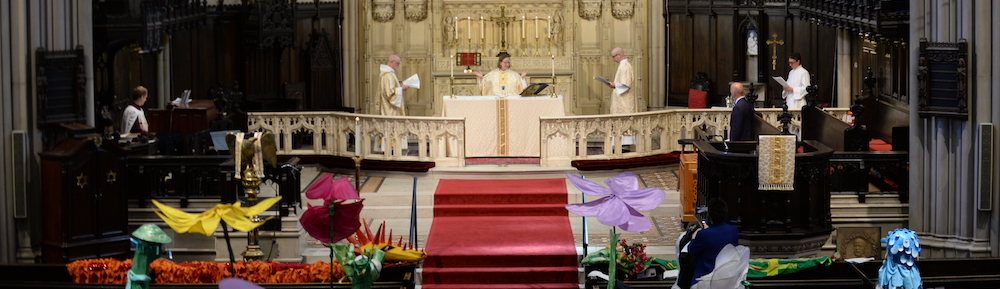
We are all one.

Proper 12C, July 27, 2025.  The Very Rev. Pamela L. Werntz

Acts 11:1-18. The spirit told me…not to make a distinction between them and us.
Revelation 21:1-6. I am making all things new…to the thirsty I will give water as a gift.
John 13:31-35. I give you a new commandment, [in order] that you love one another.

O God of all, grant us the wisdom, the strength and the courage to seek always and everywhere after truth, come when it may, and cost what it will.


We are celebrating the baptism of Bodie Richard Coulon this morning, so we’ll all be invited to review what our Church teaches about baptism and we’ll be invited to renew our own baptismal vows. Today is a great day for a baptism because our scripture lessons describe beautiful visions of well-being. 

The book of Acts says that while Peter was in a trance of prayer, he had a life-changing dream that revealed to him that there is no distinction between “them” and “us.” In other words, he came to understand that when it comes to the redeeming urge or work of the Holy One, (also known as Jesus Christ for Christians), there is no Jew or Gentile, no free or slave, no male and female, no gender binary; no insiders and outsiders, all people are one. While there are always those in the center and those on the margins, those with more power and those with less, those of us who have and use more than our fair share of the world’s resources and those who do not have their basic needs met, we are all one. Peter realized that he should not be hindering the work of God by deciding who is inside and who is outside of God’s reach. Here’s where Christians often get tripped up, deciding what is godly and what is not. The measure of godliness is love. As our former Presiding Bishop Michael Curry is fond of saying, “if it’s not about love, it’s not about God.” Of course it gets complicated, but that’s where we start. If it looks like there are competing interests that all have to do with love, we might need to enlarge or expand our view. We might need to look at the situation from 30,000 feet where differences between us become imperceptible, because we are all one.

The Revelation to John of Patmos also came through meditation, during which he experienced a vision of the Divine, setting right everything the Roman Empire was getting completely wrong. Exiled on the Island of Patmos, John visualized the Holy One at home among mortals — the Eternal dwelling secure among them. John saw grief and weeping and pain ending – his own and his people’s — and everyone who is thirsty having enough to drink. Sometimes I think that our own vision of the realm of God is limited, constrained by our own lack of thirst for water from the spring of the water of life. John of Patmos’ vision was of God with us (which is what Emmanuel means) – and, building on Peter’s insight, “us” means everyone. There is no them. We are all one.

The Gospel of John envisions a time when Jesus’ followers are known by and known for their love. These few verses are sandwiched between a hard place of Judas leaving to arrange for Jesus’ arrest, and a rock (Peter) whom Jesus predicts will deny even knowing him three times before the rooster signals the dawn. The glory and love Jesus is talking about are set right in the midst of the most painful betrayal and agonizing denial described in all of Christian scripture.

What do glory and love mean here in this dreadful spot? The root of the word “glory” (dox – as in doxology) means appearance as in manifestation. Doxology is language of manifestation. [2] Our word paradox means different from or in contrast to (para) how something seems or appears (dox).

Orthodox means right or correct appearance or manifestation. So the beginning of our Gospel lesson could be translated, “Now the Son of Humanity has appeared and God has appeared in him. If God has been made manifest in him, Gods-very-self will also appear in him and will appear in him right away.” Glorification is an appearance or manifestation of the Holy One in this case, here in the midst of the worst scenario imaginable to Jesus’ followers. 

There are other translation issues. “Children,” Jesus says. (The word “little” isn’t there in the Greek–just children – maybe in the sense of tender and naïve, not fully matured or wizened?) “I am with you only a little,” Jesus says. He says, “You will look for me, and where I am going you cannot come.” In the verse just following our reading, Jesus clarifies – you can’t follow me now, but you will follow afterwards – so it’s sad, but not permanently sad.

Then John the Evangelist’s account has Jesus talking about how he has previously said something to “the Judayoi” – rendered “Jews” in our NRSV. (That has become permanently sad, because, of course they were all Jews. I say permanently sad because our scripture translations continue to incite violence against Jews.) Judayoi here could either be translated Judeans (in contrast with Galileans) or understood as anachronistic and antithetical to Jesus’ life and witness. For our reading today, I translated it “people” to distinguish between Jesus’ public preaching and his teaching in this intimate setting the evening he was arrested. Whenever I encounter this passage, I trip over the line about “a new commandment, that you love one another.” And I always think, that’s not a new commandment. The Torah teaches that we must love our neighbors as ourselves and we must provide tangible care for the strangers or aliens in our midst. Why is loving being called a new commandment? My answer is, it’s not. 

The command here is not “to love one another.” A closer translation is, “A new command I am giving to you in order that you may love one another, just as I loved you in order that or so that you may love one another.” The word “should” is another  translator’s opinion. The new commandment that Jesus has given in the portion just before this reading is to wash one another’s feet. Serve one another, care for one another. Get your hands dirty – risk contamination, risk becoming unclean in service to one another. As far as I know, the command to wash one another’s feet, assuming a posture of kindness, of presence, of service, behaving as if we are all servants of one another, is a new command. There are Torah instructions to wash one’s own hands and feet. There is customary hospitality to offer water and a place to wash, and when available, servants to help. But Jesus takes a towel and kneels down and washes his followers’ feet and then tells them to do that for one another. Wash the muck off of one another’s feet. That’s the new commandment. 

The purpose is to demonstrate your love for one another. Just as I have loved you, in order that you have love for one another. This is how people will know that you’re Jesus followers – when you demonstrate your presence, your kindness, your service for one another. Jesus says, “in order that, or so that, you love one another” three times. That’s how we know he really means it. It also means it probably wasn’t happening. If it had been happening, there wouldn’t be any need to write it down and to emphasize it by saying it three times. I mean, no one says three times “I’m giving you this new mop so that you will wash the floor” if the floor is already washed, right? And of course, it’s hard enough to do this for our family and friends. Jesus teaches that we must perform humble acts of presence, kindness and service for our enemies as well. Jesus has just washed the feet of the one who would betray him and the one who would deny even knowing him.

There are times in the history of Christianity when Christians have been known for our works of presence, kindness, and service. There are times when Emmanuel Church is and has been known for our works of presence, kindness, and service. But building a beloved and beloving

community doesn’t happen without intentionality and work, especially in difficult times. Listen to Tertullian’s description of church practice in the good old days of the early second century of the common era: “On the monthly day… each puts in a small donation; but … only if he [or she] be able: for there is no compulsion; all is voluntary. These gifts are…piety’s deposit fund. For [funds] are not taken thence and spent on feasts, and drinking-bouts, and eating-houses, but to support and bury poor people, to supply the wants of [those] destitute of means and parents, and of old persons confined now to the house; such, too, as have suffered shipwreck; and if there happen to be any [slaving] in the mines, or banished,…or shut up in the prisons…. it is mainly the deeds of a love so noble that lead many to put a brand upon us. [“Christian” was a derogatory name.] See, they say, how they love one another, …they… do not hesitate to share …earthly goods with one another. All things are common among us but our wives. [it really says that]…. Whatever it costs, our outlay in the name of piety is gain, since with the good things of the feast we benefit th[ose who are] needy.” Tertullian didn’t quite get the lack of distinction between us and them (which can be encouraging for us!), but he beautifully described what it means to act like a Jesus follower. His vision is true to my experience when we are functioning well. 

When we are functioning well, we are actively engaged in behaviors that are encouraging those who are afraid, nourishing those who are hungry, healing those who are suffering, forgiving those who are guilty, redeeming those who have been undervalued, freeing those who are stuck or imprisoned, inspiring those who are dispirited, protecting those who are most vulnerable, reviving those who are tired. When we are functioning well, our service is mutually beneficial; we are both giving and receiving, and we are trustworthy people in a trustworthy community. [4] The work of Christian community, as Brother Curtis Almquist has said, is the three-step work of moving from “judgment of others to compassion for others to identification with others.” When we are functioning well, we are practicing radical empathy as our flag outside says. When we are functioning well, we are all one.

You know, baptism is a ritual of identification with others, others who are not necessarily of our own choosing, a bigger community than our own families and friends. Baptism is not only for or about the person being baptized; it’s for and about the whole church represented by this gathering today. This morning Bodie’s baptism means he will be identified as Christian, and as he grows up, I pray that he will join in the work of serving others as well as appreciatively receiving the service of others as gifts and signs of love. I pray that love will always animate his life. I pray that whenever he finds himself between a hard place and a rock, in the midst of betrayals or failures, ignorances or misunderstandings, he will have a community of people who will help him to turn away from cynicism, sarcasm, and fear, and move toward authentic and deeply respectful relationship with the Divine and with others. I pray that love will always show him that we are all one.


  1. Galatians 3:28.
  2. Leftbehindandlovingit.blogspot.com, April 18, 2016.
  3.  Tertullian, Apologeticus, Ch. XXXIX (http://www.ccel.org/ccel/schaff/anf03.toc.html#P253_53158)
  4.  Jesse A. Zink, Faithful, Creative, Hopeful (New York: Church Publishing, 2024), p.162.

Keeping Sabbath

Proper 4B, 14 April 2024. The Very Rev. Pamela L. Werntz

  • 1 Samuel 3:1-20.  The word of the Lord was rare in those days; visions were not widespread.
  • 2 Corinthians 4:5-12.  We have this treasure in clay jars…so that the life of Jesus may also be made visible in our bodies…in our mortal flesh.
  • Mark 2:23 – 3:6. The Sabbath was made for humankind, and not humankind for the Sabbath.

O God of our delight, grant us the strength, the wisdom and the courage to seek always and everywhere after truth, come when it may, and cost what it will.


This morning, we heard the stirring reading of the call of Samuel with the fantastic introduction that back in the really olden days (prior to 1000 BCE), the word of the Lord was rare, and the ability to see clearly was not widespread! That assessment was from the perspective of hundreds of years later in the 7th or 6th century BCE! Three thousand or so years ago, people of the Holy One were going through a time of immense societal change, spiritual desolation, religious corruption, and great political danger.” [1] Eli the priest and his sons were responsible for guarding the Ark of the Covenant and its holy oracle.  Eli’s sons were violent and Eli was unable to control or improve their behavior.
Continue reading

Fruit That Will Last

Easter 6B, 5 May 2024. The Very Rev. Pamela L. Werntz

  • Acts 10:44-48.  Can anyone withhold the water for baptizing these people who have received the Holy Spirit just as we have?
  • 1 John 5:1-6.  The Spirit is the truth.
  • John 15:9-17. I appointed you to go and bear fruit, fruit that will last.

O God of grace, grant us the wisdom, the strength and the courage to seek always and everywhere after truth, come when it may, and cost what it will.


You know, it’s still Easter, in the Church’s 50-day season for praising God and reveling in God’s grace so abundantly given, which transforms the horror of the crucifixion into the power of the Risen Lord. We’re still in that Great Fifty Days of celebration. I don’t know about you, but apart from worship at Emmanuel, often the details of my life and the details of the world weigh me down. I feel weighed-down by what looks like too much to do and not enough time, too much need and not enough resources being directed to the right places, news of people at war and of militaristic aggression at home and abroad, layer upon layers of damage done by white supremacy, corruption and famine, climate change, all kinds of oppression, and on and on. It all seems to conspire to keep me from reveling in the abiding love of God for more than a few hours on a Sunday. Today’s Gospel makes it clear to me that abiding in love and bearing fruit are part of the same thing: of reveling in God’s unearned and abundant grace. How can we celebrate Good News when we get so weighed down by bad news? Continue reading

Drive like it!

Last Sunday after the Epiphany, Year B, 11 February 2024. The Rev. Pamela L. Werntz

  • 2 Kings 2:1-12. Tell me what I may do for you, before I am taken from you.” Elisha said, “Please let me inherit a double share of your spirit.”
  • 1 Corinthians 4:3-6. For it is the God who said, “Let light shine out of darkness,” who has shone in our hearts to give the light of the knowledge of the glory of God in the face of Jesus Christ.
  • Mark 9:2-10. He did not know what to say for they were terrified.

O God of revelation, grant us the wisdom, the strength and the courage to seek always and everywhere after truth, come when it may, and cost what it will.


This past week I had an unusually high number of harrowing experiences as I was navigating the streets in and around Boston. Last Tuesday, two cars crashed right in front of me on the Mass Pike; and on Thursday a car I was riding in nearly got T-boned by a distracted driver. I witnessed pedestrians nearly getting hit in crosswalks by drivers running red lights, bicyclists riding against traffic and traffic signs, aggressive tailgating, erratic lane changing, and gridlocked intersections. It seems to me that drivers have gotten so much worse in the last few years. I googled the worst drivers in the country and was shocked by the results; it’s very bad news. Boston is not even in the top-twenty cities with the worst drivers; we are not even close; we’re not even competitive! Continue reading

Love at the End

Easter 6A, 14 May 2023. The Very Rev. Pamela L. Werntz

  • Acts 17:22-31. For we too are [God’s] offspring.
  • 1 Peter 3:13-22. Always be ready to make… an accounting for the hope that is in you.
  • John 14:15-21. If you love me, you will keep my commandments.

O God of Love, may we have the wisdom, the strength, and the courage to seek always and everywhere after truth, come when it may and cost what it will.


When I graduated from college and moved to Northern Virginia, I started looking around for a church. Just as I’d always had a toothbrush for oral hygiene, I’d always had a church for spiritual hygiene. I grew up in the church; and I went to church through college (it was a church within walking distance). My big college rebellion, when it came to practicing faith, was not to quit attending, but to become an Episcopalian! Although my dad was an ordained minister in the United Church of Christ, his ecumenical and mostly non-parochial work meant that’d I’d grown up as something of a religious mutt – a mix of UCC, Lutheran, and Presbyterian for worship, Roman Catholic for school, and vacations with the Episcopalians. In my early twenties I had a car, making my reach considerably wider, so I went church shopping for an Episcopal parish. Continue reading

The Anxious Class

Proper 21C, 25 September 2022.  The Very Rev. Pamela L. Werntz

Jeremiah 32:1-3a, 6-15. Houses and fields and vineyards shall again be bought in this land.
1 Timothy 6:11-19. As for those who…are rich, command them to do good, to be rich in good works, generous, and ready to share.
Luke 16:19-31. They have Moses and the prophets; they should listen to them.

O God of peace, grant us the strength, the wisdom and the courage to seek always and everywhere after truth, come when it may, and cost what it will.


Partly by chance and partly by design, in the last two weeks, I’ve pondered and discussed our Gospel lesson for today with more than three dozen people, lay people and clergy. In the last two weeks, I’ve also deliberated with our Boston Harbor Deanery assembly about how to distribute some of what has fallen from the tables of the rich to people who lack adequate food, clothing, and shelter; and I’ve visited a dozen women in prison at South Bay, which requires driving through the encampments of destitute people at Melnea Cass and Mass. Ave..The story of the rich man and Lazarus has been very alive and present for me, right in my face. I’m aware that this is a story of great hope, of Good News, for anyone who is at the gates begging, but a story that sounds harsh and unforgiving, that it stirs up fear, shame, and defensiveness in many of us who have more-than-adequate food, clothing, and shelter. Continue reading

Unbounded Mercy

Proper 10C.  10 July 2022, The Rev. Pamela L. Werntz.

Amos 7:7-17. The Lord said to me, “Go prophesy to my people Israel.”
Colossians 1:1-14. Grace to you and peace from God.
Luke 10:25-37. But wanting to justify himself…

O God of mercy, grant us the strength, the wisdom and the courage to seek always and everywhere after truth, come when it may, and cost what it will.


This parable called The Good Samaritan, found only in Luke, might be the most famous parable of them all. One doesn’t have to be a church goer to have heard of it and understand something about it. Hospitals, emergency services, counseling services, laws about liability limits, and award programs, all get called Good Samaritan. With its fame comes the enormous, sometimes crushing, weight of Protestant moral theology and Sunday-school lessons, both with a hefty dose of Christian anti-Jewish bias. The preaching challenge for me seems formidable because of what we all think we already know about this story and the guilt that has been wired into most of us about seeing people who have been beaten and robbed, lying in life’s various ditches, and not doing enough, or anything at all, to help. In my time as a priest, this story has provoked more confessions and more attempts at self-justification than any other I know. It reminds me of something bell hooks said, which feels like the essence of my vocation: [1]

I am often struck by the dangerous narcissism fostered by spiritual rhetoric that pays so much attention to individual self-improvement and so little to the practice of love within the context of community.

Continue reading

Saving Space for Outsiders

Lent 3B, March 7, 2021.  The Rev. Pamela L. Werntz


Exodus 20:1-17.
I AM.
1 Corinthians 1:18-25. Christ the power of God and the wisdom of God.
John 2:13-22. They believed the scripture and the word that Jesus had spoken.

O God of Love, may we have the wisdom, the strength, and the courage to seek always and everywhere after truth – come when it may and cost what it will.


My three-year-old granddaughter asks a version of the universal question of why, which effectively blocks the response, “Because I said so,” or “because that’s the rule.” Instead of asking why, she asks, “What will happen; what will happen” if I do this thing that you’ve told me not to do? What will happen if a kid on the playground doesn’t do what they’re supposed to do; what will happen? What will happen; what will happen? She’s learning about rules, expected behaviors, desired outcomes, and consequences. Sometimes we don’t know the answer; sometimes there is a range of possibilities. This is frustrating to her; she wants to be know; she wants us to be sure of the consequences. On this Third Sunday in Lent, we have lessons about the consequences of being God’s people, of not loving Loving, of proclaiming Christ crucified, and of fidelity to Jesus.
Continue reading

The Marks of Love

Third Sunday in Lent, Year B, March 4, 2018; The Rev. Pamela L. Werntz

Exodus 20:1-17 Remember the sabbath day and keep it holy.
1 Corinthians 1:18-25 Christ crucified, a stumbling block to Jews and foolishness to Gentiles.
John 2:13-22 He was speaking of the temple of his body.

O mysterious God, may we have the wisdom, the strength, and the courage to seek always and everywhere after truth – come when it may and cost what it will.

Many of you know that one of my life projects is increasing Biblical literacy, so I’m always on the lookout for books and articles that are accessible to people who are interested in learning about our sacred texts. Episcopal priest Lauren Winner has recently written a slim volume in the new Episcopal Church teaching series, called A Word to Live By, about engaging scripture with curiosity and confidence. It’s less than a hundred pages, less than $10, and it’s fantastic. In her introduction Winner invites readers of Biblical literature to “expect to be delighted. Expect to be discomfited… .[and] expect to be puzzled… .because the Bible is opaque, and puzzlement means you’re paying attention to, rather than filtering out, the opaque bits.” [1]
Continue reading

Accounting for Hope

Sixth Sunday of Easter Year A, May 21, 2017; The Rev. Pamela L. Werntz

Acts 17:22-31 In [God] we live and move and have our being.
1 Peter 3:13-22 Always be ready to make… an accounting for the hope that is in you.
John 14:15-21 If you love me you will keep my commandments.

O God of Love, may we have the wisdom, the strength, and the courage to seek always and everywhere after truth – come when it may and cost what it will.

Signs of endings are all around us – the end of the school year, the end of another wonderful cantata season, graduations and completions of all kinds are markers on the chronological timelines of our lives. And yet, in our Gospel reading for this morning, chronological time seems to have come nearly to a stop and time seems to be folding:  past, present and future are not so clearly marked.  It’s taken from what is called Jesus’ “Farewell Discourse.” Jesus’ valedictory speech comprises a full one-fifth of the whole Gospel of John, and takes place in the evening before Jesus’ nighttime arrest. This portion of Jesus’ parting words remind me of the instructions that my mother used to leave when I was in high school before my parents went away for a trip (and I always feared that they would leave us orphaned). I am the oldest child, so the list was accompanied by my mom’s admonition for me to use my best judgment. Okay, fine, I would think, I will, but do you know my brothers and my sister? Continue reading