
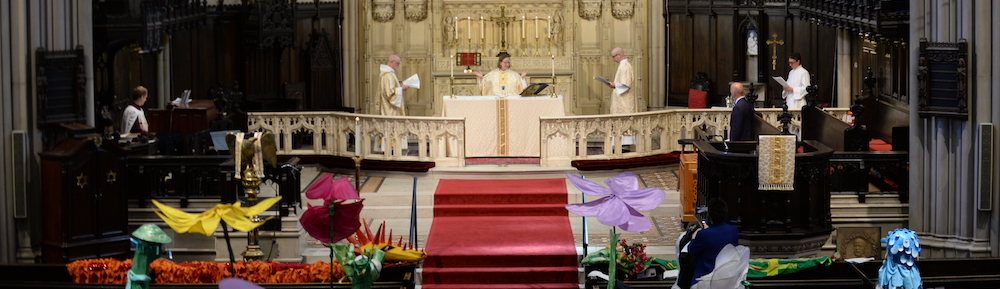
Proper 21B. 29 September 2024. The Very Rev. Pamela L. Werntz
Esther 7:1-6,9-10; 9:20-22. Days for sending gifts of food to one another and presents to the poor.
James 5:13-20. Are any among you suffering? They should pray. Are any cheerful? They should sing songs of praise.
Mark 9:38-50. Have salt in yourselves, and be at peace with one another.
O God of beauty, grant us the strength, the wisdom and the courage to seek always and everywhere after truth, come when it may, and cost what it will.
So I will get to our hell-fire Gospel lesson in a minute, but not before I say something about Queen Esther: beautiful, brave, patient, and smart, who used her position and gifts, and risked her own life on behalf of her people. This mighty woman’s name appears more times than any other woman in the Bible, and she speaks more than any named women except for Judith. She is the ideal against which Herodius was compared (in the Christian testament of the Bible) and was found to have utterly missed the mark when a king, intoxicated by wine and the beauty of a woman, offered to do anything she wanted. Queen Herodius coached her daughter to ask for the murder of John the Baptist. Queen Esther asked that she and all of her people be saved from a scheduled massacre. Esther’s courage, compassion, and integrity and the quality of her leadership changed her wartorn world and brought peace.
Esther is a great leader to have in mind when we hear this reading from the Gospel of Mark. You might recall the disciples have just been arguing amongst themselves about who is greater. Jesus has said, whoever wants to be first must be the servant of all. Now a random person has been casting out demons in Jesus’ name. Someone who isn’t even one of Jesus’ group of followers, is casting out demons in his name; and they think, that’s gotta stop. John tells Jesus, “You can’t let just anybody use your good name as their authority. You’ve got to have some standards Jesus!”
And Jesus’ response? He says, don’t stop him; whoever is not against us is for us. Once again, it’s opposite day with Jesus in Mark. (later, Matthew 12:30 has Jesus say the more familiar, “Whoever is not for me is against me.”) But according to Mark, it’s whoever is not against us is for us! Here it’s not about tests of identification or criteria for membership. The disciples may still not get it, but Jesus has actually learned something from his encounter with the Syro-Phoenician woman. He has learned that God’s healing grace is bigger, deeper, and wider than previously thought . Don’t try to place restrictions on it, or on people who are delivering it. If demons are being cast out in Jesus’ name, if people are being healed in his name, if hungry and thirsty people are being offered food and drink in his name, it’s all good. Anyone working for just distribution of resources and liberation from oppression is on the same side. Invariably this raises the question, what about people who really are against us? That question must have come up for the Gospel of Matthew’s community because Jesus says, “Love your enemies and pray for those who persecute you.” That’s a hard one.
But back to the Gospel of Mark. Right away, without missing a beat, Jesus reminds his disciples that they need others; they depend on those with whom they minister for the basic necessities of life. Boy, that’s also hard one isn’t it? “Whoever gives you a cup of water to drink because you carry the name of the Anointed (the Christ), I swear to you, such a person certainly won’t go unrewarded!” Whoever assists you will be honored in God’s name. Here’s a lesson for any of you who’d prefer to not be on the receiving end of help from people whom you are trying to help! I know you’re out there, because I know myself and how uncomfortable I get when someone I am trying to help wants to offer me help. Jesus is teaching here about mutual ministry. Jesus is teaching here about the realm of God.
Then Jesus admonishes them by saying, “Don’t you put stumbling blocks in the way of beginner seekers.” (That’s what little ones means in the Gospels. It could be a reference to the one casting out demons or a reference to the ones offering water; that’s not clear.) In other words, don’t scandalize people who are doing good deeds even if they are not following Jesus the way you are or you think they should. Don’t try to stop someone who is offering to care for you when you think you don’t need their help. One of the things that people who like to give often forget is that giving and receiving are as connected as breathing in and breathing out. It’s quite deadly to do one without the other for very long.
This reading from Mark suggests just how highly we should regard a relationship with the Holy One. Jesus uses pretty strong language, indeed radical language, to say that if any part of us blocks our right-relationship with the Divine, get rid of it; it’s not worth it. It’s clear to me that the examples Jesus gives about getting rid of a body part that causes someone to trip someone else up are not to be taken literally. Judaism never advocated self harm, and Jesus’ followers did not practice it either. Jesus is using hyperbolic language to assert that whatever gets in the way of a relationship with God, let it go. It would be better to live into the realm of God without some part of ourselves, than to live in the burning trash heap outside of the city walls, a garbage dump place called Gehenna, here translated as hell. By the way, you might think, based on the pop culture notions of Christianity (assisted by our lectionary), that hell is a pretty big issue for Jesus or a pretty big issue in the New Testament. It’s not; there’s really not that much talk about Gehenna. Gehenna was a real valley outside the city of Jerusalem, where rubbish was gathered and burned; it was a metaphor for separation from God. Most of the thought and talk of hell by Christians was developed in the imaginations of later Christians after the New Testament was written. Remember that the Apostle Paul, argues eloquently that nothing whatsoever can separate us from the love of God.
Then we hear Jesus reminding his followers about salt. Everyone will be salted with fire. (Other ancient manuscript copies of Mark say that everyone will be salted with salt.) Salt is good, and this fire is testing, refining fire. Salt is good, but if salt has lost its saltiness, how can it season? Have salt within yourselves (in this tasteless world), and keep peace in one another. That’s one of my favorite lines in the Gospel of Mark. Have salt within yourselves, Jesus said. I can think of at least eight reasons that salt would be a good thing to have within ourselves. I’ve recited these before; maybe you remember them? Here they are:
- In Jesus’ time salt was used as currency, as a form of money. Salt and salary come from the same root.
- Salt has healing qualities.
- Salt has preservative qualities.
- Salt has seasoning qualities; it enhances flavor.
- Salt has cleansing or purifying qualities.
- Salt was considered to be a portent against evil forces. People still throw salt over their left shoulder to keep the devil at bay.
- Salt was a sign of permanence. Eating salt with someone in Biblical times meant you were bound to them in loyalty, in a covenant of friendship.
- Salt thrown into a kiln when pots are being fired will change and beautify the surfaces of the vessels in ways that are unpredictable and can’t be completely controlled.
Whether Jesus was thinking of just one, several, or all of these reasons, what he was saying was have value within yourselves and everyone else. Keep peace with one another.
In the realm of God (or Love) everyone will be salted with fire. In the realm of Love, everyone will be subject to refinement with unpredictable and uncontrolled beauty! Have salt in yourselves, and keep peace with one another. Notice that Jesus is saying to the group, have value in yourselves, plural. You are all valuable, he is reminding them, those of you in the in group, and those outside the group, all. Remember that; hold on to it; have value in yourselves, have healing and preservative qualities, have the spice of life in yourselves, have cleansing and protective qualities, have distinctive character,, and keep peace with one another. Keeping peace means more than just keeping one’s mouth shut. Take your lead from brave Queen Esther, who bravely spoke out on behalf of herself and her people.
Keeping peace, shalom, is much deeper, more profound than keeping quiet. Keeping peace is definitely not at the expense of valuing oneself or one’s community. And it’s not valuing oneself or one’s community so much that we cannot work for peace. It’s both/and, as we like to say. It’s carrying the tension of knowing that each one is so beautiful and so valuable, this community is so beautiful and so valuable, that conflicts that arise must be resolved. Being at peace is not about avoiding conflicts, it’s about resolving conflicts that inevitably arise in community and between communities. What I hear Jesus saying is: in the realm of God everyone is beautiful in unpredictable ways. Seek and you will find that beauty hiding in plain sight.
I was thinking about this on Friday when I signed my name to a public statement confessing the sin of racism and calling for atonement, repair, and reconciliation from predominantly white churches in metropolitan Boston. Faith leaders were signing as individuals, not on behalf of our congregations, but it’s easy enough to find out for whom I am working. The lead organizers, The Rev. Kevin Peterson and the Rev. John Gibbons, told us that we were doing something that had never been done: an interfaith group of white faith leaders signing a confession and call, witnessed by an interfaith group of black faith leaders. Will it stir up conflict? Yes, it already has. Will it make a big difference or a little difference? I don’t know yet, but for me, it was the right thing to do. For me, it was a step forward in building and repairing relationships that will be essential to engaging more deeply in the work of reparations in the City, of holding the salt and passing the peace. I urge you to also take steps forward in the work of building and repairing relationships in the City of Boston and beyond.