The Green Book Tour: Some Highlights

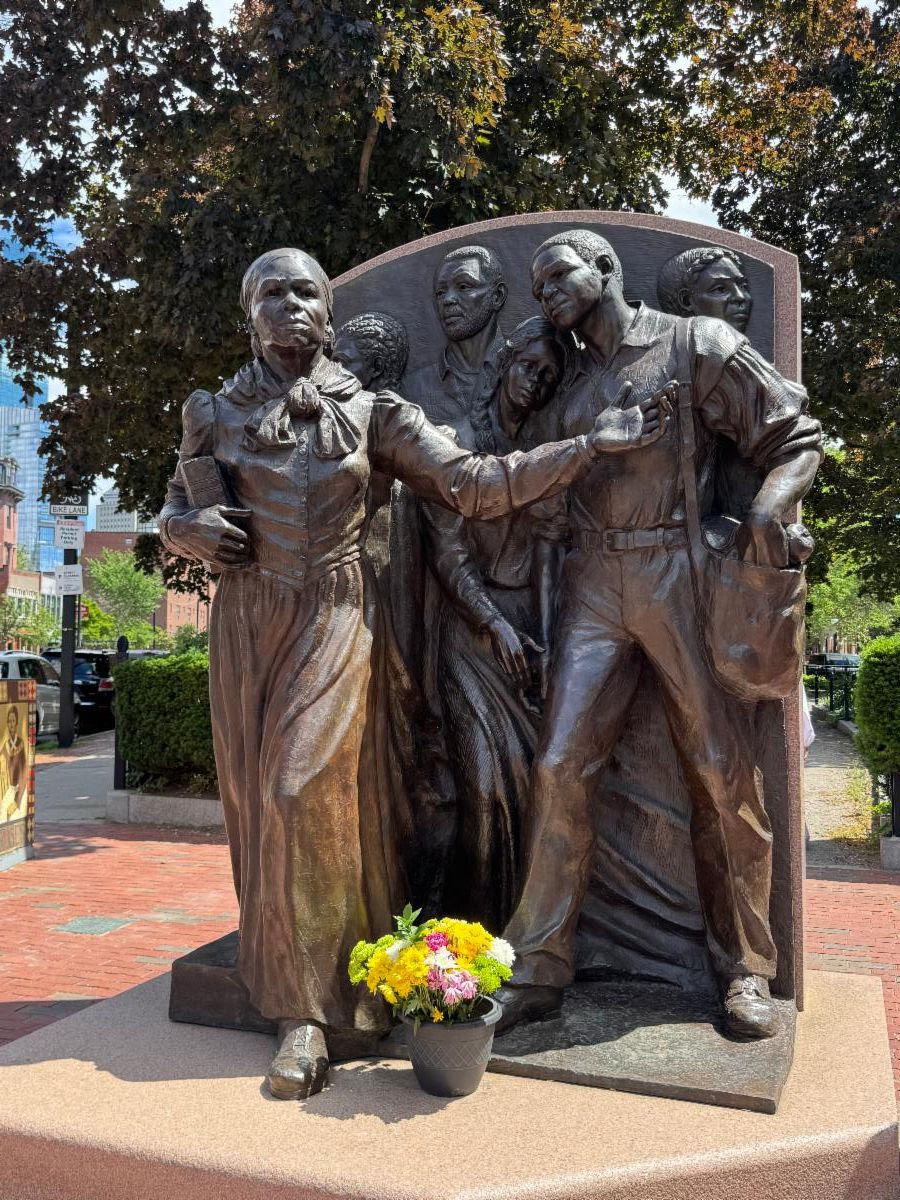
Fern Cunningham’s sculpture Step on Board shows aboltionist Harriet Ross Tubman with a Bible under her arm.

On June 20th, 2026, I joined The Green Book Tour led by Byron Rushing and the Rev. June Cooper.  The Negro Motorist Green Book, published between 1936 and 1966 as a guidebook for African American roadtrippers, became known as simply The Green Book..

On this sunny but windy day we all met outside of the Union United Methodist Church (originally a Congregational Church) on Columbus Avenue in Boston. There were about a dozen of us in addition to the leaders of the tour. Both Byron and June have a depth of knowledge about the South End of Boston and the history of the businesses which were advertised in The Green Book. These businesses, including hotels, were either Black-owned or served Negroes. Charlie’s Sandwich Shoppe on Columbus Ave. is still operating. It was originally owned by a Greek family and was advertised in The Green Book.

The Harriet Tubman House on Holyoke Street offered rooms to Black women who were either in school or working in Boston and would not have been able to rent in the area otherwise. Very near to this location we visited the Harriet Tubman Park with its two sculptures, one of which honors Harriet Tubman herself. The other sculpture sported a traffic cone on its top; evidence of a visit by the Tartan Army, which had visited Boston from Glasgow for the World Cup.

This area attracted many jazz musicians during the height of the Jazz Age. Of the many clubs once open there were two that were Black-owned establishments: Wally’s Café (originally Wally’s Paradise located across the street from its present location) and Estelle’s,  which is now a condominium building at 888 Columbus Ave.. The Hi-Hat at the corner of Mass. Ave. and Columbus Ave., which burned down after the Second World War, was replaced by a settlement house. It is now modern housing (apartments and/or condominiums). The Columbus Avenue African Methodist Episcopal Zion (AMEZ) Church on the corner of Columbus Avenue and Northampton Street was originally a synagogue. Where one would usually see a rose window, it has a Mogen David or Jewish Star.

Our tour ended at Slade’s, where we had lunch and chatted amongst ourselves. It was a beautiful day for a long walk in Boston.

–Mary Beth Clack, Mary Blocher, Cindy Coldren, Pat Krol, Liz Levin

Wake up! Rise up!

Easter 4C, May 11, 2025.  The Very Rev. Pamela L. Werntz

Acts 9:36-43. He gave her his hand and helped her up.
Revelation 7:9-17. He will guide them to springs of the water of life.
John 10:22-30. It was winter.

O God of life, grant us the strength, the wisdom and the courage to seek always and everywhere after truth, come when it may, and cost what it will.


During Eastertide, our lectionary offers no lessons from the First Testament. The effect, I think, is to overemphasize a break between Jesus’ followers and Jesus’ religious heritage. Instead, we have passages from the Acts of the Apostles’ romantic accounts of the beginnings of Christianity, written toward the end of the first century about “the good old days.” Today it’s Peter raising Dorcas from the dead with a line that is almost exactly the same as what Jesus said to raise Jairus’ daughter from the dead: arise or wake up, come alive! In other words, Peter was ministering just like Jesus. I love line, “he gave her his hand and helped her up.” Continue reading

Behave as if it were true!

Easter 3C, May 4, 2025.  The Very Rev. Pamela L. Werntz

Acts 9:1-6(7-20). “Go, for he is an instrument whom I have chosen.”
Revelation 5:11-14. And the four living creatures said, “Amen!”
John 21:1-19 . Come and have breakfast.

O God of resurrection, grant us the wisdom, the strength and the courage to seek always and everywhere after truth, come when it may, and cost what it will.


We are well on our way into the Great Fifty Days of Easter, the extended Feast of the Resurrection. I love that the Church calendar gives 40 days for Lent, but 50 days for Easter because Easter is harder. Lent is easier for many of us – we know our need for increased focus on penitence, discipline, prayer, study, and our need for mercy. Many of you tell me that Lent is your favorite church season. On the other hand, a season of increased focus on resurrection (on rising from the dead) trips people up, especially when the news of what’s going on in the world is so bad. (I’ll tell you something; it was bad for the earliest Jesus followers, too.) Continue reading

Resist!

Presentation in the Temple. 2 February 2025. The Very Rev. Pamela L. Werntz

Malachi 3:1-4. He is like a refiner’s fire….Who can stand when he appears? (Anna can.)
Hebrews 2:14-18. Free those who all their lives were held in slavery by the fear of death.
Luke 2:22-40. There was also a prophet, Anna.

O God of the prophets, grant us the strength, the wisdom and the courage to seek always and everywhere after truth, come when it may, and cost what it will.


In the last few weeks our Gospel lessons have told the stories of the pre-adolescent Jesus getting separated from his parents, his baptism as an adult at the Jordan River, the wedding at Cana, and his spirit-filled preaching to the synagogue in Nazareth. Now we are back in the temple in Jerusalem with a story about the infant Jesus. Someone at our Tuesday-morning Bible study compared this haphazard storytelling to what happens at reunions, when stories tumble around without much concern about chronology or other logical order among people who have known one another for a long time. That kind of storytelling is much less about exact facts and much more about meaning making, right? Such stories are told to weave and strengthen the fabric of the community. Even when they’re fantastical and told out of order, we take them seriously. Indeed, Episcopalians take the scriptures too seriously to take them literally. May I just take a moment to remind us all that none of our Holy Scriptures were written by or about white people?

If this fourth Sunday after the Epiphany were not occurring on February 2, we would hear about how, after Jesus’ amazing preaching in Nazareth he declared God’s mercy on foreigners, which made so many people angry that they wanted to throw him off a cliff; but he slipped away. (I am not making this up.) But because February 2 is the fortieth day after Christmas, the Church observes the Feast of the Presentation of Jesus in the Temple, which the Gospel of Luke tells us occurred, as required, when Mary and Joseph took their infant into the Temple in Jerusalem to dedicate him to God and to celebrate his mother’s return to purity. There actually is no known requirement or even custom of presenting an infant in the temple. There was a rite of purification for a mother after delivering a baby, marking what my former seminary professor Andrew McGowan calls the return from the liminal space, the border between life and death. Giving birth has always been one of the most dangerous things a woman does; that was true then and it’s still true now.

Luke tells a beautiful story of Mary and Joseph presenting their infant son to God and the responses of Simeon and Anna, who have been looking for, praying for the consolation of Israel, in other words, the restoration of dignity and peace to God’s people.

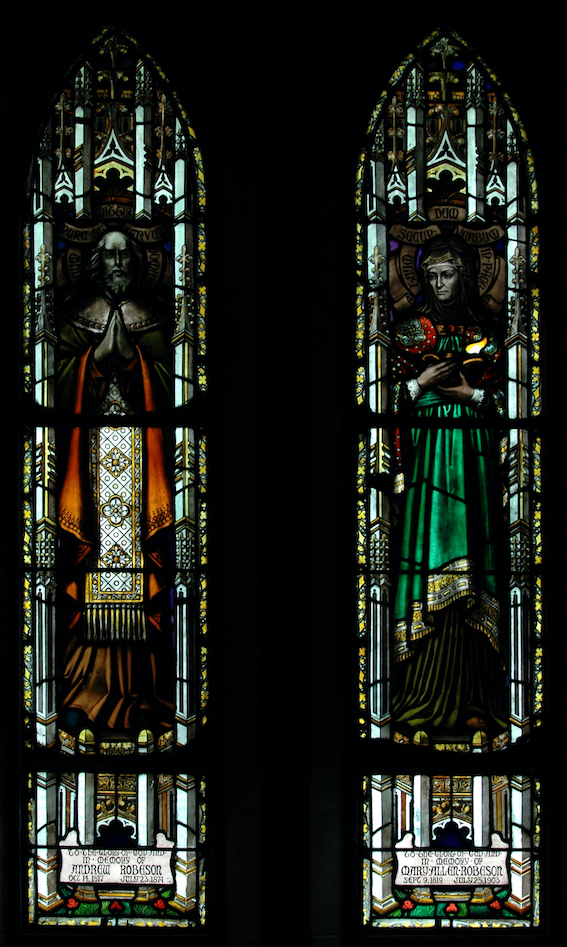
Our lancet windows of Simeon & Anna by Harry Eldridge Goodhue were given in 1905 by Alice Robeson Van Rensselaer. Photo by JG Bullitt.

The Gospel of Luke provides us one of the most beloved hymn texts in Christian history, the Nunc Dimittis or the Song of Simeon. It has been sung as part of daily evening-prayer services since at least the 4th century. The Song of Simeon has its grounding in the words of consolation and comfort in the book of Isaiah, written many centuries before,  when restoration and redemption were also sorely needed. Simeon sings a song of praise to God and then a song of blessing upon the young family. It’s a curious blessing, though, not one that I would want for my baby. It’s a blessing that predicts that the child is destined to create conflict and violence. If I had my baby in my arms and someone offered that blessing, I think I might turn away.

That’s when Anna the Prophet takes over. Luke makes sure that we know that she is a prophet before we know her marital status or her advanced age. Like Miriam of the Exodus in the wilderness, Deborah of Ephraim, Hulda of Jerusalem, or Mariann of Washington, D.C., Anna of the Temple was divinely inspired to see and bravely speak truth about both what is, and what is possible. Anna is the only woman in the New Testament who is named a prophet. The name Anna means grace or favor. (It’s the Greek version of the Hebrew name Hannah.) Luke’s emphasis is on her character and devotion. Unlike Simeon, her words aren’t recorded, but are described as praising the Holy One and speaking about Jesus to all who were looking for the redemption of Jerusalem, a city that was sorely oppressed by the brutality of the Roman Empire.

Anna was from the Tribe of Asher. That makes her “the only Jewish character in the New Testament who is said to belong not to one of the southern tribes of Judah or Benjamin, or the priestly tribe of Levi, but to one of the northern tribes of Israel.” [1] Asher was the eighth son of Jacob, and Asher means lucky, bearer of good fortune or salvation. Why did Luke include those details? Surely Anna was long gone by the time Luke was writing his Gospel three generations after the death of Jesus. Why were these details important to Luke’s audience at the end of the first century? Why do we need to know that Anna believed that Jesus would be the redemption of Jerusalem? Could we not just take Simeon’s word for it? Luke apparently did not think the presentation story was complete with just Simeon. It’s possible that Simeon represented the inhabitants of Judah and Anna, the Tribe of Asher, who represented exiles in the diaspora and hoped for return, reunion. [2] Luke’s first-century community of Jesus followers was in the diaspora in the north,  probably Syria or Turkey.

With both Simeon and Anna, the story includes male and female, inhabitants of the land and the exiled, the northern and the southern tribes of Israel, who are being restored in Jesus to be a light to all of the nations, which is another way of saying a light to the Gentiles. You might not know that “Judaism generally taught that salvation was for all people, not only for Jews.” [3] There’s another thing that Anna represents, in contrast to Simeon. Upon seeing the infant Jesus, Simeon’s song announced his dismissal in peace. Anna’s response is that she began to praise God and spread the word about the child to all who were looking for the redemption of Jerusalem, which means city of peace. Not only was Anna a prophet; she was the earliest New Testament evangelist. Her spreading the word of Jesus at the beginning of Luke’s Gospel is one bookend, and the other is the evangelism of Mary Magdalene and the other women who witnessed the empty tomb at the end of the Gospel. 

So Simeon saw the infant Jesus and retired, but Anna got back to work. She might have been old in age, but she was young in hope. [4] Apparently she didn’t waste any time on folks who were not looking for restoration or redemption. She spread the word to those who were looking. The good news about her words not being recorded is that it leaves room for our imagination about what she said. That kind of holy imagination used to read between the lines in the Bible is called midrash.

If you were going to use your holy imagination to read between the lines in this story, what do you think Anna said? What would you say if you were Anna? What would you say about Jesus to people who seem to be searching for restoration or redemption, looking for respect for the dignity of every human being, for liberation from oppression? What words of hope do you have for people looking for relief and reconciliation, for a city of peace, for a world of peace? Could you point them, even bring them, to a place where their dignity would be respected? If you were a person searching for restoration or redemption, what would you hope someone like Anna would say to you about Jesus? What words or signs would give you hope for peace in this city, or in this world, or even in your heart? Richard Rohr wrote, “People who sincerely search will touch upon the same truth in every age and culture. The direction is always toward more love and union – in ever widening circles.” [5]

You know, restoration and redemption were not just needed in the time of the prophet Anna; they are sorely needed now. The dignity of every human being is not yet universally respected. By including the story of Anna the Prophet, hearers of Luke’s Gospels learn that it is never too late see a sign of hope, nor to start spreading the word of hope. None of us is too old to be young in hope,  too far gone to be reunited with the Love of God, nor too old to shine the light of Christ in dim places.

Rabbi Shire and I were talking with folks from the parish and the synagogue about building up our moral courage in the year ahead to resist whatever is unjust, untruthful, or unloving. I mentioned our individual and shared resources of attention, prayer, time, money, and being in community with one another. When I finished that list, Rabbi Shire added that observing Sabbath is a form of resistance, not only about refraining from productivity, but experiencing refreshment and delight. Oh, we are so fortunate to have Rabbi Shire as our Rabbi-in-Residence. And I’m reminded of a poem by author and illustrator Loryn Brantz, which my daughter Sarah shared with me. 

In a time of hate
Love is an act of resistance.
In a time of fear
Faith is an act of resistance.
In a time of misinformation
Education is an act of resistance.
In a time of poor leadership
Community is an act of resistance.
In a time like this
Joy is an act of resistance.
Resist. Resist. Resist. 


  1. Richard Bauckham, Gospel Women: Studies of the Named Women in the Gospels, (Grand Rapids: Wm. B. Eerdmans Publishing,  2002), p. 77.
  2. Ibid., pp. 77-107.
  3. A.J. Levine’s note in the Jewish Annotated New Testament (New York: Oxford Press, 2011), p. 102-3.
  4. Thanks to Edith Dean for this phrase in All of the Women of the Bible (HarperSanFrancisco, 1955), p. 174
  5. https://cac.org/daily-meditations/widening-circles-2018-08-12/


[8]

Our souls tell out.

Advent 4C, 22 December 2024. The Very Rev. Pamela L. Werntz

Micah 5:2-5a. And he shall be the one of peace.
Hebrews 10:5-10. In burnt offerings and sin offerings you have taken no pleasure.
Luke 1:39-56. Blessed is she who believed.

O God of she who believed, grant us the strength, the wisdom and the courage to seek always and everywhere after truth, come when it may, and cost what it will.


I have always loved Mary, the mother of Jesus, the Godbearer, more than it seems a good Protestant girl should. It is Mary who draws me to the catholicity of the Episcopal Church. I’ve never understood her to be meek or mild, and I don’t know how anyone who reads Biblical accounts of her could understand her that way either. I don’t know how anyone who hears the words of the Magnificat, which are taken from the Song of Hannah in the Book of Samuel, could hear anything but a religious and political manifesto sung to overthrow tyrants and systems of oppression. Some years ago, the Rev. Nancy Rockwell, wrote an essay entitled, “No More Lying about Mary,” which captured what I have always believed about Mary: she was brave, and she was strong.

Rockwell writes, “God chose a spunky woman” to be the mother of Jesus. She points out that nothing in the text indicates Mary’s age or sexual status, just just that she is not married and has not previously delivered a child. Here’s her description: [1

Mary is unmarried when the angel comes. The angel’s invitation and her independent decision tell us Mary does not need permission of clergy –or her parents-– to become pregnant. Mary, wanted by God, according to the angel, for her bold, independent, adventuresome spirit, decides to bear a holy child – for a bold agenda: to bring the mighty down from their thrones; to scatter the proud in the imagination of their hearts, to fill the hungry with good things and send the rich empty away. This is Mary: well-spoken, wise, gritty. Traveling alone, like every prophet before her, she sets out on her …journey, to [her kinswoman] Elizabeth’s house, to declare her agenda. There will be more journeys: to Bethlehem; to Egypt and back [according to Matthew], to Jerusalem [at least several time until Jesus was]…crucified.

After Jesus’ death, according to Christian history, Mary traveled northwest to Ephesus, where she lived out the rest of her days, in a city well-known for the professional leadership of women.

 It seems to me that Mary’s courage doesn’t imply an absence of fear. I imagine that she left Nazareth and headed for the hills driven first by a desire to get out of town and to check in with Elizabeth, whom the angel Gabriel had said was also unexpectedly pregnant. Perhaps this was before Mary was convinced that any of the news she had was good. Perhaps she wasn’t sure any of her news was good until she was greeted with joy and declared blessed by Elizabeth: “Blessed is she who believed that there would be a fulfillment of what was spoken to her by the Lord.” Notice the circularity of the manifesto:  the poor will become rich, and the rich will become poor. “Where is the good news in that?” the rich might wonder. Well, as soon as one becomes poor, the blessings start to flow again. The description is not of a particular cataclysmic event or end, but of the circle of life. I’ve experienced this firsthand. Perhaps you have too.

This most fantastic story is of the only two pregnant prophets to have a scene in the whole Bible, and with uninterrupted dialogue! Joseph wasn’t there, and Zechariah had lost his ability to speak. Reflecting on the scene this past week as I worked on this sermon, I felt stirred to retell a story from my young adulthood.

Back in the early 1990’s, I was beginning the difficult and frightening process of coming out of the closet…as a church lady who felt called to the priesthood. Coming out as a Lesbian, even in the hostile territory south of the Mason-Dixon line, was much easier than coming out as someone imagining ordination in the Episcopal Church. Most of my straight church friends and queer unchurched friends thought I was insane. Looking back on that struggle, however, all of it seems easier than coming out of the closet as someone who has had mystical experiences, sleeping and waking.  I have never wanted people to think of me as the religious nut that I probably (okay, actually) am. Perhaps some of you have suspected it all along, but I am always reluctant to offer evidence from the pulpit.

My journey from Vice President of Human Resources for a large corporation based in Virginia to seminarian at Episcopal Divinity School in Massachusetts included some real danger and sizable emotional and financial cost. I risked everything, although I’m glad to say that I didn’t lose everything, I did lose a lot. I’m still paying for it; and I’m still benefiting from it. The love and support of other people made it possible, but what really propelled me forward during those early years was a series of vivid dreams. They were so compelling that I wrote them down; I studied them, analyzed them in therapy, and prayed with them. That’s not really the religious nut part. The things I had dreamed, however, started appearing in my waking life. Scenes and activities in my dreams that I had understood as symbolic, metaphorical but not real, started actually happening in the months and few years that followed.  I kept that mostly to myself. As I settled into life in Massachusetts, the memories of the dreams stayed with me.

In one of the dreams, I had returned to St. John the Baptist Roman Catholic parish school run by Franciscans in Joliet, Illinois, which my brother and I had attended for four years of elementary education. Back then, it wasn’t just my status as a Protestant that kept me from having a turn serving at the altar at daily Mass; Catholic girls were not allowed either. But in my dream, a guide encouraged me to journey into the sacristy and then to the altar. The invitation was thrilling, and I accepted with great joy. Then I was told that the whole improbable journey to being permitted to stand at the altar was powered by the surprise discovery of a spring of living water, a source of energy deep within, underneath the structure (the building); and I was invited to walk downstairs to see that wellspring. I awoke with a renewed sense of wonder and courage, well-being and thanksgiving.

Almost fifteen years after I had that dream, in 2007, when I had been a priest for just a few years, I traveled to Palestine and Israel with a group from Parish of the Epiphany in Winchester. Part of the pilgrimage included a stop at The Church of the Visitation at Ein Karem, in the Judean hill country. There in the courtyard is a stunning sculpture of Elizabeth greeting Mary, arms outstretched, with their pregnant bellies nearly touching. Behind the statue is a wall covered with ceramic plaques painted with the opening words of the Magnificat: “My soul magnifies the Lord, my spirit rejoices in God my Savior”, in more than thirty languages, which makes it abundantly clear that this song applies and belongs to everyone, to the whole world.

The Church of the Visitation stands on the site traditionally identified as the location of the home of Elizabeth and Zechariah. There are Byzantine ruins of a chapel there and subsequent buildings, which have crumbled through the centuries. In 1937 the Franciscans built on top of the ruins in order to preserve the remains of previous chapels found there. When I walked into the chapel, a guide invited me to walk down several flights of stairs to see an ancient wellspring. It was the very wellspring I had seen in my dream so many years earlier. I really don’t have words to describe my shock at seeing it. I was overwhelmed and thrilled by the holy mystery of the fulfillment of what had been shown to me in a dream.

In Luke’s story of this pair of pregnant prophets, I have always heard a story of allowing God’s blessing in difficult situations, of claiming “the privilege of doing hard things,” as one vestry member has called it. I have experienced this Gospel story as giving us an example of how we might be inspired, filled with a spirit of holiness, and how our souls might enlarge or magnify the view of God in the blessed and the stressed situations of our own lives. In this story, each of us is given words to say, “Blessed is she who believed that there would be a fulfillment of what was spoken to her by the Lord,” and in our own languages to repeat whenever we receive an untimely blessing: “My soul magnifies the Lord, and my spirit rejoices in God my Savior.”  I also hear this as a story of coming out, as acknowledging having received inspiration and  blessing, not only bearing it, but sharing it: telling it out loud. It occurs to me even more deeply that in gestating and giving birth to inspiration, we are called to more than a private experience. We are called also to a form of coming out.

One of the things I’ve learned, as I reflect back on the movement for LGBTQ rights and recognition over the last decades, is that what has made all of the difference is individuals telling their stories: coming out. I believe the Episcopal Church, indeed Emmanuel Church, each one of you (whether you are here for the first time or the umpteenth time) could grow stronger and strengthen others by coming out as who and Whose you are, more and more. The song of Mary applies and belongs to everyone. And as anyone who has come out about anything knows, coming out isn’t ever a one-and-done. Once you come out, staying out becomes a lifetime practice of coming out over and over and over again.

Perhaps you remember the beautiful words of the 13th-century prophet and mystic Meister Eckhart, who wrote this:

What good is it to me
if this eternal birth of the divine Son
takes place unceasingly
but does not take place within myself?

And,
what good is it to me
if Mary is full of grace
and if I am not also full of grace?
What good is it to me
for the Creator to give birth to [a] Son
if I do not also give birth to him
in my time and my culture?

This, then, is the fullness of time:
When the Son of God
is begotten in us. 

I want to add, ‘This, then, is the fullness of time: when our souls tell out the greatness of the Lord.”


  1. The Rev. Nancy Rockwell, “No More Lying about Mary:,  http://www.patheos.com/blogs/biteintheapple/no-more-lying-about-mary.

 

Reparations

Proper 21B. 29 September 2024. The Very Rev. Pamela L. Werntz

Esther 7:1-6,9-10; 9:20-22. Days for sending gifts of food to one another and presents to the poor.
James 5:13-20. Are any among you suffering? They should pray. Are any cheerful? They should sing songs of praise.
Mark 9:38-50. Have salt in yourselves, and be at peace with one another.

O God of beauty, grant us the strength, the wisdom and the courage to seek always and everywhere after truth, come when it may, and cost what it will.


So I will get to our hell-fire Gospel lesson in a minute, but not before I say something about Queen Esther: beautiful, brave, patient, and smart, who used her position and gifts, and risked her own life on behalf of her people. This mighty woman’s name appears more times than any other woman in the Bible, and she speaks more than any named women except for Judith. She is the ideal against which Herodius was compared  (in the Christian testament of the Bible) and was found to have utterly missed the mark when a king, intoxicated by wine and the beauty of a woman, offered to do anything she wanted. Queen Herodius coached her daughter to ask for the murder of John the Baptist. Queen Esther asked that she and all of her people be saved from a scheduled massacre. Esther’s courage, compassion, and integrity and the quality of her leadership changed her wartorn world and brought peace. 

 Esther is a great leader to have in mind when we hear this reading from the Gospel of Mark. You might recall the disciples have just been arguing amongst themselves about who is greater. Jesus has said, whoever wants to be first must be the servant of all. Now a random person has been casting out demons in Jesus’ name. Someone who isn’t even one of Jesus’ group of followers, is casting out demons in his name; and they think, that’s gotta stop. John tells Jesus, “You can’t let just anybody use your good name as their authority. You’ve got to have some standards Jesus!”

And Jesus’ response? He says, don’t stop him; whoever is not against us is for us. Once again, it’s opposite day with Jesus in Mark. (later, Matthew 12:30 has Jesus say the more familiar, “Whoever is not for me is against me.”) But according to Mark, it’s whoever is not against us is for us! Here it’s not about tests of identification or criteria for membership. The disciples may still not get it, but Jesus has actually learned something from his encounter with the Syro-Phoenician woman. He has learned that God’s healing grace is bigger, deeper, and wider than previously thought . Don’t try to place restrictions on it, or on people who are delivering it. If demons are being cast out in Jesus’ name, if people are being healed in his name, if hungry and thirsty people are being offered food and drink in his name, it’s all good. Anyone working for just distribution of resources and liberation from oppression is on the same side. Invariably this raises the question, what about people who really are against us? That question must have come up for the Gospel of Matthew’s community because Jesus says, “Love your enemies and pray for those who persecute you.” That’s a hard one.

But back to the Gospel of Mark. Right away, without missing a beat, Jesus reminds his disciples that they need others; they depend on those with whom they minister for the basic necessities of life. Boy, that’s also hard one isn’t it? “Whoever gives you a cup of water to drink because you carry the name of the Anointed (the Christ), I swear to you, such a person certainly won’t go unrewarded!” Whoever assists you will be honored in God’s name. Here’s a lesson for any of you who’d prefer to not be on the receiving end of help from people whom you are trying to help! I know you’re out there, because I know myself and how uncomfortable I get when someone I am trying to help wants to offer me help. Jesus is teaching here about mutual ministry. Jesus is teaching here about the realm of God.

Then Jesus admonishes them by saying, “Don’t you put stumbling blocks in the way of beginner seekers.” (That’s what little ones means in the Gospels. It could be a reference to the one casting out demons or a reference to the ones offering water; that’s not clear.) In other words, don’t scandalize people who are doing good deeds even if they are not following Jesus the way you are or you think they should. Don’t try to stop someone who is offering to care for you when you think you don’t need their help. One of the things that people who like to give often forget is that giving and receiving are as connected as breathing in and breathing out. It’s quite deadly to do one without the other for very long. 

This reading from Mark suggests just how highly we should regard a relationship with the Holy One. Jesus uses pretty strong language, indeed radical language, to say that if any part of us blocks our right-relationship with the Divine, get rid of it; it’s not worth it. It’s clear to me that the examples Jesus gives about getting rid of a body part that causes someone to trip someone else up are not to be taken literally. Judaism never advocated self harm, and Jesus’ followers did not practice it either. Jesus is using hyperbolic language to assert that whatever gets in the way of a relationship with God, let it go. It would be better to live into the realm of God without some part of ourselves, than to live in the burning trash heap outside of the city walls, a garbage dump place called Gehenna, here translated as hell. By the way, you might think, based on the pop culture notions of Christianity (assisted by our lectionary), that hell is a pretty big issue for Jesus or a pretty big issue in the New Testament. It’s not; there’s really not that much talk about Gehenna. Gehenna was a real valley outside the city of Jerusalem, where rubbish was gathered and burned; it was a metaphor for separation from God. Most of the thought and talk of hell by Christians was developed in the imaginations of later Christians after the New Testament was written. Remember that the Apostle Paul, argues eloquently that nothing whatsoever can separate us from the love of God. 

Then we hear Jesus reminding his followers about salt. Everyone will be salted with fire. (Other ancient manuscript copies of Mark say that everyone will be salted with salt.) Salt is good, and this fire is testing, refining fire. Salt is good, but if salt has lost its saltiness, how can it season? Have salt within yourselves (in this tasteless world), and keep peace in one another. That’s one of my favorite lines in the Gospel of Mark. Have salt within yourselves, Jesus said. I can think of at least eight reasons that salt would be a good thing to have within ourselves. I’ve recited these before; maybe you remember them? Here they are:

  • In Jesus’ time salt was used as currency, as a form of money.  Salt and salary come from the same root.
  • Salt has healing qualities.
  • Salt has preservative qualities. 
  • Salt has seasoning qualities; it enhances flavor.
  • Salt has cleansing or purifying qualities.
  • Salt was considered to be a portent against evil forces. People still throw salt over their left shoulder to keep the devil at bay.
  • Salt was a sign of permanence.  Eating salt with someone in Biblical times meant you were bound to them in loyalty, in a covenant of friendship.
  • Salt thrown into a kiln when pots are being fired will change and beautify the surfaces of the vessels in ways that are unpredictable and can’t be completely controlled.

Whether Jesus was thinking of just one, several, or all of these reasons, what he was saying was have value within yourselves and everyone else. Keep peace with one another. 

In the realm of God (or Love) everyone will be salted with fire. In the realm of Love, everyone will be subject to refinement with unpredictable and uncontrolled beauty! Have salt in yourselves, and keep peace with one another. Notice that Jesus is saying to the group, have value in yourselves,  plural. You are all valuable, he is reminding them, those of you in the in group, and those outside the group, all. Remember that; hold on to it; have value in yourselves, have healing and preservative qualities, have the spice of life in yourselves, have cleansing and protective qualities, have distinctive character,, and keep peace with one another. Keeping peace means more than just keeping one’s mouth shut. Take your lead from brave Queen Esther, who bravely spoke out on behalf of herself and her people. 

Keeping peace, shalom, is much deeper, more profound than keeping quiet. Keeping peace is definitely not at the expense of valuing oneself or one’s community. And it’s not valuing oneself or one’s community so much that we cannot work for peace. It’s both/and, as we like to say. It’s carrying the tension of knowing that each one is so beautiful and so valuable, this community is so beautiful and so valuable, that conflicts that arise must be resolved. Being at peace is not about avoiding conflicts, it’s about resolving conflicts that inevitably arise in community and between communities. What I hear Jesus saying is: in the realm of God everyone is beautiful in unpredictable ways. Seek and you will find that beauty hiding in plain sight.

I was thinking about this on Friday when I signed my name to a public statement confessing the sin of racism and calling for atonement, repair, and reconciliation from predominantly white churches in metropolitan Boston. Faith leaders were signing as individuals, not on behalf of our congregations, but it’s easy enough to find out for whom I am working. The lead organizers, The Rev. Kevin Peterson and the Rev. John Gibbons, told us that we were doing something that had never been done:  an interfaith group of white faith leaders signing a confession and call, witnessed by an interfaith group of black faith leaders. Will it stir up conflict? Yes, it already has. Will it make a big difference or a little difference? I don’t know yet, but for me, it was the right thing to do. For me, it was a step forward in building and repairing relationships that will be essential to engaging more deeply in the work of reparations in the City, of holding the salt and passing the peace. I urge you to also take steps forward in the work of building and repairing relationships in the City of Boston and beyond.


In the Middle of Resurrected Life

Easter B, 31 March 2024. The Very Rev. Pamela L. Werntz

  • Isaiah 25: 6-9.  Then the Lord God will wipe away the tears from all faces, and the disgrace of God’s people will be taken away from all the earth, for the Lord has spoken.
  • 1 Corinthians 15: 1-11.  Also you are being saved.
  • Mark 16: 1-8. So they went out and fled from the tomb, for terror and amazement had seized them; and they said nothing to anyone, for they were afraid. 

O God of life, grant us the strength, the wisdom and the courage to seek always and everywhere after truth, come when it may, and cost what it will.


Hello! If you love being at Emmanuel on Easter Sunday, whether in person or on livestream, I’m so glad you’re here. I’m also glad you’re here even if you’re not sure you made the right choice this morning. Of all the days to come to church, I think Easter Sunday might be the most likely day to convince you that church is really not for you:  the service is long; the stories are unbelievable. Maybe the resplendent flowers make your nose itch, our puppets seem strange and ridiculous, or the hymns are not light enough to lift your heavy hearts. I get it; I see you. You might love the cantata this morning; it has all the feels. Continue reading

Pauli Murray’s Legacy

Following Emmanuel’s July 2023 dedication of the Pauli Murray statue that graces our pulpit, we have some related news from her niece, Rosita Stevens-Holsey, and officially, from the U.S. Mint. The Reverend Dr, Pauli Murray Quarter was released on January 2, 2024 as one of the new set of American Women Quarters. The design and significance of the coin are described here.

Another of our pulpit statues is dedicated to the Rev. Dr. Suzanne Hiatt, who was greatly influenced by Murray.

We have also learned that a Pauli Murray scholarship is continuing apace. A recent collection has been published, To Speak a Defiant Word: Sermons and Speeches on Justice and Transformation. Edited by Anthony B. Pinn, this work builds on Pinn’s previous research and includes sermons, lectures, and speeches.

Lastly, of interest to us is the growing list of recipients of the annual Pauli Murray Book Prize for the best book in Black intellectual history. Sponsored by the African American Intellectual History Society, and first awarded in 2018, the list of recipients includes authors writing on Black history, Black internationalism and environmental Justice, and Black politics and activism. The winners also write a series of posts on the Society’s blog, Black Perspectives which is a global forum for news and public scholarship.

–Mary Beth Clack, Cindy Coldren, Pat Krol
–Published in This Week @Emmanuel Church Jan. 3, 2024

Believe it or not!

Proper 8A, 2 July 2023. The Very Rev. Pamela L. Werntz

  • Genesis 22:1-14. The Lord will provide.
  • Romans 6:12-23. Present your members to God as instruments of righteousness.
  • Matthew 10:40-42. And whoever gives even a cup of cold water to one of these little ones in the name of a disciple—truly I tell you, none of these will lose their reward.

O God of love, grant us the wisdom, the strength, and the courage to seek always and everywhere after truth, come when it may, and cost what it will.


Our Gospel passage from Matthew is from the conclusion of Jesus’ instructions to his disciples, made apostles (by being sent out). It’s about welcome, about radical hospitality, that is, Biblical hospitality, Torah hospitality. Jesus’ message in Matthew is that impressive religious experiences like exorcisms and miracles are great but, “What counts [more than anything] is the cup of cold water given to a thirsty person,” especially a thirsty person who has no privilege or power to demand it. [1] Jesus was sending folks out to spread the news of God’s love and assuring them that when people welcome them, they are welcoming Jesus, which means that they are welcoming the Holy One. I would love to preach a sermon about welcome this morning. Continue reading

You are set free from your ailment.

11th Sunday after Pentecost, Proper 17C, August 21, 2022; The Rev. Dr. John D. Golenski

Luke 13:12.  When Jesus saw her, he called her over and said, “Woman, you are set free from your ailment.”


In our Gospel portion today, the authors of Luke describe an encounter between a woman living with long-term consequences of something like Guillain–Barré Syndrome, multiple sclerosis, Parkinson’s Disease, or tuberculosis of the spine.  As so often happens in the Gospel stories, when a diseased, wounded, or psychically-damaged person encounters Jesus, a profound healing results.  These accounts of Jesus’s cures, however, are not selectively recounted in the Gospel just to convince us that Jesus is divine.  Usually, there is a message or lesson embedded in the account of the healing. Continue reading