
Resist!

Presentation in the Temple. 2 February 2025. The Very Rev. Pamela L. Werntz

Malachi 3:1-4. He is like a refiner’s fire….Who can stand when he appears? (Anna can.)
Hebrews 2:14-18. Free those who all their lives were held in slavery by the fear of death.
Luke 2:22-40. There was also a prophet, Anna.

O God of the prophets, grant us the strength, the wisdom and the courage to seek always and everywhere after truth, come when it may, and cost what it will.


In the last few weeks our Gospel lessons have told the stories of the pre-adolescent Jesus getting separated from his parents, his baptism as an adult at the Jordan River, the wedding at Cana, and his spirit-filled preaching to the synagogue in Nazareth. Now we are back in the temple in Jerusalem with a story about the infant Jesus. Someone at our Tuesday-morning Bible study compared this haphazard storytelling to what happens at reunions, when stories tumble around without much concern about chronology or other logical order among people who have known one another for a long time. That kind of storytelling is much less about exact facts and much more about meaning making, right? Such stories are told to weave and strengthen the fabric of the community. Even when they’re fantastical and told out of order, we take them seriously. Indeed, Episcopalians take the scriptures too seriously to take them literally. May I just take a moment to remind us all that none of our Holy Scriptures were written by or about white people?

If this fourth Sunday after the Epiphany were not occurring on February 2, we would hear about how, after Jesus’ amazing preaching in Nazareth he declared God’s mercy on foreigners, which made so many people angry that they wanted to throw him off a cliff; but he slipped away. (I am not making this up.) But because February 2 is the fortieth day after Christmas, the Church observes the Feast of the Presentation of Jesus in the Temple, which the Gospel of Luke tells us occurred, as required, when Mary and Joseph took their infant into the Temple in Jerusalem to dedicate him to God and to celebrate his mother’s return to purity. There actually is no known requirement or even custom of presenting an infant in the temple. There was a rite of purification for a mother after delivering a baby, marking what my former seminary professor Andrew McGowan calls the return from the liminal space, the border between life and death. Giving birth has always been one of the most dangerous things a woman does; that was true then and it’s still true now.

Luke tells a beautiful story of Mary and Joseph presenting their infant son to God and the responses of Simeon and Anna, who have been looking for, praying for the consolation of Israel, in other words, the restoration of dignity and peace to God’s people.
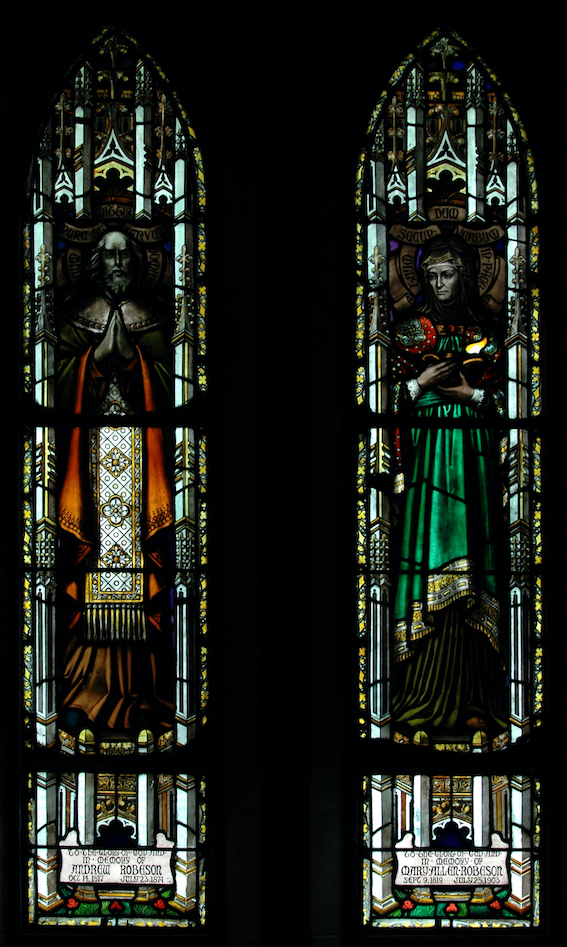
Our lancet windows of Simeon & Anna by Harry Eldridge Goodhue were given in 1905 by Alice Robeson Van Rensselaer. Photo by JG Bullitt.

The Gospel of Luke provides us one of the most beloved hymn texts in Christian history, the Nunc Dimittis or the Song of Simeon. It has been sung as part of daily evening-prayer services since at least the 4th century. The Song of Simeon has its grounding in the words of consolation and comfort in the book of Isaiah, written many centuries before,  when restoration and redemption were also sorely needed. Simeon sings a song of praise to God and then a song of blessing upon the young family. It’s a curious blessing, though, not one that I would want for my baby. It’s a blessing that predicts that the child is destined to create conflict and violence. If I had my baby in my arms and someone offered that blessing, I think I might turn away.

That’s when Anna the Prophet takes over. Luke makes sure that we know that she is a prophet before we know her marital status or her advanced age. Like Miriam of the Exodus in the wilderness, Deborah of Ephraim, Hulda of Jerusalem, or Mariann of Washington, D.C., Anna of the Temple was divinely inspired to see and bravely speak truth about both what is, and what is possible. Anna is the only woman in the New Testament who is named a prophet. The name Anna means grace or favor. (It’s the Greek version of the Hebrew name Hannah.) Luke’s emphasis is on her character and devotion. Unlike Simeon, her words aren’t recorded, but are described as praising the Holy One and speaking about Jesus to all who were looking for the redemption of Jerusalem, a city that was sorely oppressed by the brutality of the Roman Empire.

Anna was from the Tribe of Asher. That makes her “the only Jewish character in the New Testament who is said to belong not to one of the southern tribes of Judah or Benjamin, or the priestly tribe of Levi, but to one of the northern tribes of Israel.” [1] Asher was the eighth son of Jacob, and Asher means lucky, bearer of good fortune or salvation. Why did Luke include those details? Surely Anna was long gone by the time Luke was writing his Gospel three generations after the death of Jesus. Why were these details important to Luke’s audience at the end of the first century? Why do we need to know that Anna believed that Jesus would be the redemption of Jerusalem? Could we not just take Simeon’s word for it? Luke apparently did not think the presentation story was complete with just Simeon. It’s possible that Simeon represented the inhabitants of Judah and Anna, the Tribe of Asher, who represented exiles in the diaspora and hoped for return, reunion. [2] Luke’s first-century community of Jesus followers was in the diaspora in the north,  probably Syria or Turkey.

With both Simeon and Anna, the story includes male and female, inhabitants of the land and the exiled, the northern and the southern tribes of Israel, who are being restored in Jesus to be a light to all of the nations, which is another way of saying a light to the Gentiles. You might not know that “Judaism generally taught that salvation was for all people, not only for Jews.” [3] There’s another thing that Anna represents, in contrast to Simeon. Upon seeing the infant Jesus, Simeon’s song announced his dismissal in peace. Anna’s response is that she began to praise God and spread the word about the child to all who were looking for the redemption of Jerusalem, which means city of peace. Not only was Anna a prophet; she was the earliest New Testament evangelist. Her spreading the word of Jesus at the beginning of Luke’s Gospel is one bookend, and the other is the evangelism of Mary Magdalene and the other women who witnessed the empty tomb at the end of the Gospel. 

So Simeon saw the infant Jesus and retired, but Anna got back to work. She might have been old in age, but she was young in hope. [4] Apparently she didn’t waste any time on folks who were not looking for restoration or redemption. She spread the word to those who were looking. The good news about her words not being recorded is that it leaves room for our imagination about what she said. That kind of holy imagination used to read between the lines in the Bible is called midrash.

If you were going to use your holy imagination to read between the lines in this story, what do you think Anna said? What would you say if you were Anna? What would you say about Jesus to people who seem to be searching for restoration or redemption, looking for respect for the dignity of every human being, for liberation from oppression? What words of hope do you have for people looking for relief and reconciliation, for a city of peace, for a world of peace? Could you point them, even bring them, to a place where their dignity would be respected? If you were a person searching for restoration or redemption, what would you hope someone like Anna would say to you about Jesus? What words or signs would give you hope for peace in this city, or in this world, or even in your heart? Richard Rohr wrote, “People who sincerely search will touch upon the same truth in every age and culture. The direction is always toward more love and union – in ever widening circles.” [5]

You know, restoration and redemption were not just needed in the time of the prophet Anna; they are sorely needed now. The dignity of every human being is not yet universally respected. By including the story of Anna the Prophet, hearers of Luke’s Gospels learn that it is never too late see a sign of hope, nor to start spreading the word of hope. None of us is too old to be young in hope,  too far gone to be reunited with the Love of God, nor too old to shine the light of Christ in dim places.

Rabbi Shire and I were talking with folks from the parish and the synagogue about building up our moral courage in the year ahead to resist whatever is unjust, untruthful, or unloving. I mentioned our individual and shared resources of attention, prayer, time, money, and being in community with one another. When I finished that list, Rabbi Shire added that observing Sabbath is a form of resistance, not only about refraining from productivity, but experiencing refreshment and delight. Oh, we are so fortunate to have Rabbi Shire as our Rabbi-in-Residence. And I’m reminded of a poem by author and illustrator Loryn Brantz, which my daughter Sarah shared with me. 

In a time of hate
Love is an act of resistance.
In a time of fear
Faith is an act of resistance.
In a time of misinformation
Education is an act of resistance.
In a time of poor leadership
Community is an act of resistance.
In a time like this
Joy is an act of resistance.
Resist. Resist. Resist. 


  1. Richard Bauckham, Gospel Women: Studies of the Named Women in the Gospels, (Grand Rapids: Wm. B. Eerdmans Publishing,  2002), p. 77.
  2. Ibid., pp. 77-107.
  3. A.J. Levine’s note in the Jewish Annotated New Testament (New York: Oxford Press, 2011), p. 102-3.
  4. Thanks to Edith Dean for this phrase in All of the Women of the Bible (HarperSanFrancisco, 1955), p. 174
  5. https://cac.org/daily-meditations/widening-circles-2018-08-12/


[8]

Rejoice!

Advent 3C, 15 December 2024. The Very Rev. Pamela L. Werntz

Zephaniah 3:14-20. I will change their shame into praise.
Philippians 4:4-7. Let your gentleness be known to everyone.
Luke 3:7-18. What then should we do?

O God of the prophets, grant us the strength, the wisdom and the courage to seek always and everywhere after truth, come when it may, and cost what it will.


We are careening toward Christmas on this Gaudéte Sunday of Advent (Gaudete is Latin for the imperative plural rejoice.), but we haven’t heard any biblical readings about peaceful preparation for the birth of the infant Jesus. It’s been more about leveling the landscape and reorganizing the society, and less about receiving blankets or swaddling clothes. Our ancient narratives describe nations at war, raging seas, devastation, and disaster with plenty of blame to go around. The people are anxious and afraid; they are struggling. Just to be clear, we are talking about 28 centuries of struggle. The people Zephaniah was addressing were struggling in about 625 BCE. The people the apostle Paul and the evangelist Luke were addressing were struggling in the latter half of the first century of the Common Era. And the people I’m addressing right now are struggling at the end of the first quarter of the 21st century.

Here’s what Zephaniah, son of African descent, says: There is good news in the midst of devastation and disaster, in the midst of the indignities that have been cause for shame and reproach, that have caused hands to grow weak with fear and despair. Zephaniah laments the corruption and injustice rampant in the city of God. The covenant of living in Love has been violated and the religious leadership is implicated once again. (Some things truly do not change.) Zephaniah tells his hearers that in the midst of injustice and oppression, disaster and shame, uncertainty and fear, is the Holy One: very near is a vigorous and mighty One, Who is right now rejoicing over the people with gladness, exulting and singing loudly, and renewing the people in Love. The word here rendered renewing is better translated engraving, as a metal artist might inscribe a mark of belonging or a beautiful design. [1]. It can also be translated plough, as a farmer might cut a furrow for planting seeds. Listening to the Holy One will cause the people to be marked and prepared, opened up for Love. Zephaniah announces that Judgment Day is cancelled;  it has become Non-judgment Day. Rejoice because you are being inscribed and opened up for Love. So I wonder about the engravings or furrowings among us as the people of Emmanuel, where in the middle of the chaos, the Holy One is surely opening up new lines for Love among us. Gaudéte!

Our passage from Philippians this morning doesn’t give us the context for the writing, but the whole letter of Paul to the Jesus-followers in Philippi, was written from his prison cell (probably in Ephesus), where he was awaiting trial and a possible death sentence. He was writing to a faith community with a turbulent past, to people who had more than their share of pain. His instruction to rejoice and to not worry, then, is particularly striking and poignant to me, because he is taking a full accounting of fear and grief, of his own and theirs, of past and future. The rejoicing that Paul is encouraging is defiance, according to theologian Karl Barth. In Philippians, Paul’s joy is a defiant Nevertheless! that he sets against the Philippians’ fears that things are getting worse and not better. [2] Rejoice, Paul writes, because of the unnumbered blessings you have already received. Claiming joy is a radical and subversive form of resistance to all that colludes to oppress. I urge you to take some time today to rejoice in the blessings of your life so far. Gaudéte!

In the Gospel reading from Luke. John the Baptist is yelling out at the people who came to be baptized by him, “You viper hatchlings!” [3]. Did anyone get whiplash from today’s Gospel reading, which went from John the Baptist using a metaphor to call the people treacherous and venomous, characterized by deceit and hypocrisy, to the narrator’s best storytelling voice concluding, “With many other exhortations John the Baptist proclaimed the good news to the people.” That always makes me think, “Boy, if that’s the good news, I’d hate to hear the bad news.”

And yet, my virtual colleague Mark Davis writes in his Greek translation blog that there is plenty of good news here. We just don’t hear it, because we are conditioned to fear this language. John the Baptist talks about the wrath to come, but he does not call it God’s wrath. John’s idea of offspring of adders evokes the inherited, generational nature of broken relationships, of injustice and oppression. John is naming reasons they have come to seek the baptism of repentance. They have been participating in systems of oppression, exploitation, and extortion; and they want to stop. They have been complacent in economies that work to make rich people happy and make everyone else afraid; and that must come to an end. John is declaring that whatever tempts us to behave badly toward one another must be separated from the clean grain, the nutritious bits, the good fruit, whether it is physical, financial, or spiritual. Davis notes “There is nothing necessarily violent about a farmer cutting down a barren or soured tree and burning it, particularly if it might cross-pollenate and contaminate good fruit-bearing trees. This is a way of protecting the good trees and ensuring good fruit.” [4]

And what does good fruit mean? “What should we do?” the crowds asked. “What should we do?” the tax collectors asked. “What should we do?” the soldiers asked. John said,

Share your clothing and your food. If you have only a little, share a little. If you have a lot, share a lot. Do not take more than your portion; curb your greed and your fear that you won’t have enough. Do not extort money by shakedowns or false accusations to increase your wages. Exercise restraint. Stop victimizing people to leverage your own power by sucking up to people who have more power.

People, this is not rocket surgery, as my wife Joy loves to say. The good news is that they all wanted to be baptized or immersed in repentance. They wanted to bear good fruit! Gaudéte!

We know that Luke’s community wanted to be immersed by Jesus in a spirit of holiness and fire because the Gospel got written and widely shared. I hear the word fire as fire in the belly, energy and enthusiasm for caring for one another, especially for those who were most vulnerable. That is what being immersed in a holy spirit and fire means. What about us? What should we do? What should clergy do? What about librarians, musicians, artists, writers, office workers, teachers, and retirees?  For all of John’s fiery talk, notice he doesn’t tell even tax collectors and soldiers to quit their jobs and join him permanently in the wilderness. John had different advice for different people in varying circumstances, and he expected them to return home by a different way, transformed; and so should we.

I want to tell you a story of Emmanuel Church, which a few of you witnessed, but many of you probably haven’t heard before. Back in the olden days of my time as your priest, early-Tuesday-morning Bible study took place in person at 15 Newbury Street. It was an odd-numbered month (we continue to meet in odd months) and the weather was very chilly, so my guess is late November or early March. Six or seven of us had finished our conversation when someone knocked on the door of the Emmanuel Room. It was a man who was wearing summer clothes with no jacket. I immediately sized him up as someone who had probably just been released from incarceration. If you don’t have family or friends to bring you clothing, you leave prison with the clothes you were wearing when you arrived, no matter what the season. It’s so awful and shameful. The man asked if Emmanuel had a thrift shop with clothing. I shook my head sadly and said, unfortunately we don’t. Meanwhile, Betsy Bunn was also sizing him up and without skipping a beat she just took her jacket off and gave it to the man. It was a perfect fit. He thanked her profusely. I looked at her, awestruck. She said, “I have more than one coat.” I want you to know that there are countless similar stories of generosity, resilience, and well-being that emanate from the many communities who call 15 Newbury Street home, communities where belonging is the way to helping each other grow in generosity, resilience, and well-being. Gaudéte!

You may have noticed our collect for the day pleading for speedy delivery of grace and mercy to help and deliver us. I am here to tell you that the grace of God, the compassion and mercy of God, are already all around us. We are soaking in the bountiful blessings of God. We have cause to rejoice. It is up to us to speedily honor these blessings with gratitude and to speedily respond in kind by sharing our resources and extending the mercy and compassion of God in our every interaction. If that seems daunting because of your circumstances, just start with the people you encounter between now and noon! If that seems too easy, then see how far you can get into this day or this week, and report back! Gaudéte!

  1. Charash can mean keep still or silent. The NRSV translation of renew makes no sense to me at all, but I might not know enough to understand.
  2.  Karl Barth in his commentary, The Epistle to the Philippians, found at www.goodreads.com/quotes.
  3. Sarah Ruden’s translation in The Gospels: a New Translation (New York: Modern Library, 2021), p. 174.
  4. D. Mark Davis, posting for the third Sunday in Advent to his blog www.leftbehindandlovingit.blogspot.com on Sunday, December 8, 2024.


On the Fear of Stepping into Ourselves

All year long, I have navigated resistance that seems to get heavier by the day, at times feels like depression; shape-shifts as needs be; takes on oh-so-many elusive forms; mutters in my ear that I can’t do it, that I shouldn’t do it, and even questions what is the point of doing it; finds excuses, blames others, drains me of all willpower to go forth. Resistance!

Continue reading

Seventeenth Sunday after Pentecost

Seventeenth Sunday after Pentecost (19B), Sept 16, 2018; The Rev. Susan Ackley

Isaiah 50:4-9a The Lord God has given me
the tongue of a teacher…
James 3:1-12 Not many of you should become teachers…
Mark 8:27-38 Jesus went on with his disciples to the villages of Caesarea Philippi…

Here we are back in the sanctuary.

A change of location for our worship as we move from the long, narrow space in the Lindsey Chapel back to this BIG wide open space.  Banners visible up in the choir loft. The Emmanuel Land window. All this resonant air just waiting to be charged by sounds of the Schutz, Byrd, and Bach.
Continue reading