
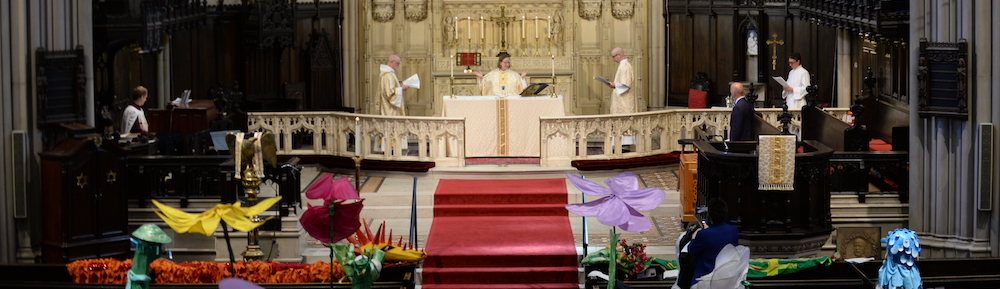
Epiphany 3C, 26 January 2025. The Very Rev. Pamela L. Werntz
Nehemiah 8:1-3, 5-6, 8-10. Do not be grieved; the joy of the Lord is your strength.
1 Corinthians 12:12-31a. We were all made to drink of one spirit.
Luke 4:14-21. Today this scripture has been fulfilled in your hearing.
O God of love, grant us the strength, the wisdom and the courage to seek always and everywhere after truth, come when it may, and cost what it will.
It’s been a week, hasn’t it? I’ll remind you of what we do when times are terrible, frightening, angering, sorrowful: we stick together and we stay close to the scriptures. They were written in times of deep distress, and they are our guiding lights. I’m talking about the actual scriptures, the first and second testaments of our Bible, which testify to loving our neighbors as ourselves.
Today we hear Luke’s story of the beginning of Jesus’ ministry. The four Gospel writers were very careful about how they began their accounts of the beginning of Jesus’ ministry. They all agreed that Jesus’ public ministry began after John the Baptist was arrested by Herod. Like siblings, each Gospel writer’s account about where and how Jesus’ public ministry began is different. Mark tells of Jesus exorcising an unclean spirit in the synagogue in Capernaum. Matthew’s first story of Jesus’ ministry is about a large body of teaching, which he addressed to the crowds on a mountain. John’s story of his ministry begins with the water-to-wine extravaganza at the wedding in Cana. And Luke tells about Jesus’ visit to his home synagogue in Nazareth.
Jesus, Luke says, was filled with a spirit of holiness, the same spirit of holiness that would fill his followers after his death. Luke says that it was Jesus’ custom to attend synagogue on the Sabbath. When the scriptures were handed to him, he read Isaiah’s proclamation of freedom: freedom from hunger, illness and disability, poverty, prison, debt, freedom and all kinds of oppression. It’s more of a mash-up than a direct quote from Isaiah, but certainly the spirit of Isaiah is as Jesus reports. Isaiah was proclaiming the end of the Babylonian exile. According to Luke, Jesus was proclaiming that his ministry, too, was going to be about liberation, about freedom. At the core of his ministry was (and still is) a powerful ethic of love, of compassion and mercy, forgiveness and reconciliation, nonviolence and well-being, shalom. It is the same ethic that is at the heart of the Torah, the Prophets, and the Writings. I usually don’t think of myself as a conspiracy theorist, but I do believe that all good things come from Love, which is another name for God. My conspiracy theory is that Love is the Way, the only Way.
It’s interesting to me to think about this in light of Nehemiah’s story of the return of the Hebrew people from exile and slavery in Babylon. Having returned to Jerusalem, they have gathered at the eastern gate of the city, where the water flowed from a spring. Nehemiah says they wept when they heard the word of the Holy One. They wept, the water flowed from the springs in their eyes, perhaps because they realized how far from free they had been in Babylon. Perhaps they realized how far from free they still were even though they were back in familiar territory. Perhaps they wept for all that had been lost. And the religious leaders – Ezra, Nehemiah, and the Levites – respond to their mourning with an instruction to celebrate!
Don’t mourn, celebrate, because rejoicing in the Holy One is the source of your strength. This day is sacred. You are God’s sacred people. Don’t mourn over the past. (You know, stop hoping for a better past.) Go eat and drink, and share what you have with whoever has nothing prepared.
Now, you might have noticed that verses 4 and 7 are missing from our reading from Nehemiah this morning. Maybe you even guessed that I would tell you, because I usually do! Those two verses contain long lists of names. Perhaps they’re left out in deference to lesson readers everywhere, but I wish they hadn’t been omitted. Verse 4 lists the names of the people who stood with Ezra as he read the sacred text. Nehemiah says that Ezra was standing with eleven others on a wooden platform, which had been made for the purpose. He was standing with his leadership team. [1] And then in verse 7 is a list of thirteen additional people who were there to help the congregation to understand the sacred text, because it was hard to understand. [2] Let’s not miss the idea that the scripture has always been challenging to understand and that Ezra had a very large leadership team helping to proclaim freedom from oppression!
It’s interesting to me to think about freedom in light of Paul’s teaching about the body of Christ. As members of the body, he says, Christians are not free to disregard the value of another part of Christ’s body, or member, even if that member is weak or seems less important. Every part is important, Paul says. The eye must not say to the hand, “I have no need of you.” The ear must not say, “Because I am not an eye, I do not belong to the body.”
The reason that Paul was writing about this to the people in the church in Corinth was that they were arguing with each other about who was most important. We know that in the olden days, sometimes people in churches didn’t like each other, didn’t respect one another’s opinions or sufficiently regard one another’s dignity. In the olden days, sometimes people who were a part of the church behaved very badly toward one another. (Can you imagine?) In the early church, some people thought that other people shouldn’t be members of the church, or sometimes people felt that they themselves didn’t belong or didn’t really fit in! Paul was trying to teach them that everyone is important, and everyone belongs, even members who are weaker, less honored, or less respected than others. Paul was giving a pep talk about what it means to be a part of a team: one body with many members with a variety of gifts, who have great need of one another, despite ideas to the contrary.
Paul was using the metaphor of a body to say that some parts are more noticeable or may seem more important than others, but every part is important. Every part deserves compassion and respect. Think for a moment about what compassion and respect mean. Now think for a moment about what you would say if I went around the room and asked each one of you what you think of as the strongest part of your body, and what the weakest part or the least-likable part of your body is. Think for a moment about what you might do differently if you started treating the weakest or least-likable part of your body with more compassion and respect. Maybe it’s your hair, belly, upper body, legs, nose, teeth, hands, or feet? I feel certain that each one of us has at least one body part that could use more compassion and respect.
Now think of Emmanuel Church as a body with lots of parts. Think for a moment about what you would say if I went around the room and asked each one of you who you think are the most honored, popular, or influential Emmanuelites and who are the least honored, popular, or influential? Think for a moment about how much stronger our body at Emmanuel would be if we treated the least honored, popular, or influential members with greater respect. Maybe when you thought about it, you thought to yourself, “Actually I think I’m one of the least honored, popular, or influential Emmanuelites.” Maybe you thought, “I’m not sure I’m even considered an Emmanuelite.” (Well I can tell you that you are today by virtue of your presence with us this morning, whether you are here physically or virtually, because that’s how it is around here.) Think for a moment about how much stronger our body at Emmanuel Church would be if you treated yourself and everyone else with greater compassion and respect, and if everyone else treated you with greater compassion and respect.
I think starting with yourself and your parish community is what is called practicing religion. Emmanuel Church is where we practice greater self- and communal compassion and respect so we can do it out there. Even if you are already a very compassionate and respectful person, I guarantee that you can do something today that is even more compassionate and respectful than usual. Even if, and maybe especially if, you’re feeling a little cranky, less than comfortable, or nervous, you too can do something that is compassionate and respectful. Maybe it’s toward someone in your immediate family, someone who you don’t usually think about or try to avoid, someone you love but don’t agree with or understand, or someone you don’t even know and may never see again. So what does that have to do with freedom? Well, if a body is at odds with itself, it is not free. If a stomach is grumbling, for example, or an ear is aching, the whole body suffers. If people in the church are grumbling or aching, the whole community suffers. When we’re suffering, we’re not free to pay attention to the needs of others, to help get other people free.
I want to interject something about focus because when the news is as overwhelming as it has been lately, it’s tempting to give into despair or to just tune out and shut down. One antidote is to pick one issue to focus on and to act on it; take a step in the direction of advocacy and support. If the first step is too hard, break it down into smaller steps.
Helping get other people free is our job as Christians, because Christians are the body of Christ. If, as Luke says, Jesus Christ was filled with a spirit of holiness to fulfill the scriptures, to set people free, then, as the body of Christ filled with the same spirit, we Christians have inherited the same responsibility. We have the same call, invitation, and challenge to express the compassion and respectfulness that are manifestations of true holiness. Today we have opened the scriptures that proclaim freedom: freedom from hunger, illness, disability, poverty, prison, debt, harassment, and all kinds of oppression. Today we are called to rejoice in the source of our strength and share what we have with those who have no provisions for a celebration. Today let’s do what we can to make sure that this scripture is fulfilled in our hearing. Not just in the distant past and not in some unforeseeable future. Today, let’s see how it could be more so among us.
- Mattithiah, Shema, Anaiah, Uriah, Hilkiah, and Maaseiah on his right hand; and Pedaiah, Mishael, Malchijah, Hashum, Hash-baddanah, Zechariah, and Meshullam on his left hand
- Jeshua, Bani, Sherebiah, Jamin, Akkub, Shabbethai, Hodiah, Maaseiah, Kelita, Azariah, Jozabad, Hanan, and Pelaiah