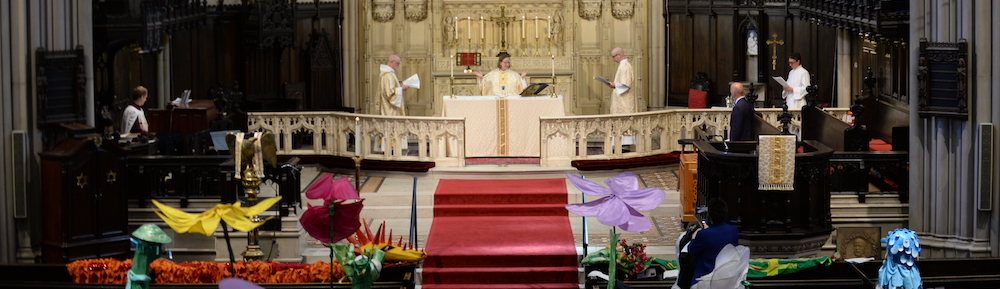
We are all one.

Proper 5C, May 18, 2025.  The Very Rev. Pamela L. Werntz

Acts 11:1-18. The spirit told me…not to make a distinction between them and us.
Revelation 21:1-6. I am making all things new…to the thirsty I will give water as a gift.
John 13:31-35. I give you a new commandment, [in order] that you love one another.

O God of all, grant us the wisdom, the strength and the courage to seek always and everywhere after truth, come when it may, and cost what it will.


We are celebrating the baptism of Bodie Richard Coulon this morning, so we’ll all be invited to review what our Church teaches about baptism and we’ll be invited to renew our own baptismal vows. Today is a great day for a baptism because our scripture lessons describe beautiful visions of well-being.  Continue reading

Shehecheyanu Redux

See also our rector’s 2013 sermon of the same title.

Epiphany, Last Sunday.  2 March 2025.  The Very Rev. Pamela L. Werntz

Exodus 34:29-35. The skin of his face was shining and they were afraid to come near him.
2 Corinthians 3:12-4:12. Since then, we have such a hope, we act with great boldness.
Luke 9:28-43a. And all were astounded by the greatness of God.

O God of faithfulness, grant us the strength, the wisdom and the courage to seek always and everywhere after truth, come when it may, and cost what it will.


One of the many benefits for me of sharing the pulpit of Emmanuel Church with a rabbi-in-residence and with an Ark of the Covenant in my peripheral view is that it continues to challenge and change the way I encounter Holy Scripture and the prayers and hymns of the Episcopal Church. My sensitivity to the need for corrective lenses in the Church is heightened. My desire to preach against the ways that the Christian Church has promoted supersessionist theology continues to rise. Christian supersessionism is very much like racism as far as I am concerned.   It’s systemic, oppressive, often internalized, hard for many Christians to see, and always wrong. It distorts our vision and damages our souls. 

I especially need to call this out on a day when we welcome a child with dual citizenship in the realm of God, as both a son of Israel and a member of the Body of Christ. Levi and his older sister and brother all have two spiritual passports in the realm of God; they are full citizens of both Judaism and Christianity. How is it possible? I don’t exactly know, but I do know that with God anything born of love is possible. And I know that at Emmanuel Church we have a long history of experiencing glorious impossibilities.

And so on this day on which we mark the end of the Epiphany season with stories of the transfiguration of Jesus, in light of the stories of Moses’ shining countenance, I’m drawn to preach about the Apostle Paul and his words to the Church in Corinth, because our passage today sounds as if Paul was dismissing Moses and the Israelites as old news (and he was). It sounds as if Paul was preaching the newness and better-ness of Christianity (but he wasn’t quite doing that). I have to tell you (or remind you) that Paul was not a Christian. [1] While he recruited Gentiles to follow Jesus, as a Jew through and through, he was arguing with people within his own tradition for openness and inclusivity in the realm of God, . Furthermore, neither Paul nor Jesus was inventing the ideas of openness and inclusivity. To varying degrees both of them were declaring stretched boundaries and widened gates for belonging and beloving as people of God, using the Law and the Prophets as their scriptural foundations. The Apostle Paul and the Evangelist Luke were asserting continuity and expansion of belonging and beloving in encouraging people to follow the Jesus Way.  Looking back on Paul’s arguments with corrective lenses, however, it becomes clear that he was arguing about who was out and who was in as he contended that the glory of Moses was dimming and the glory of Jesus was brightening.

Paul was reacting to rivals, whom he derisively called super-apostles, who were insisting that to be faithful to Jesus required being faithful to Torah. The Rev. Dr. Dan Joslyn-Siemiatkoski, Director of the Center for Christian-Jewish Learning at Boston College, wrote the other day that although this was an intramural argument within Judaism, it was “aimed towards Gentile Jesus believers, [and] it quickly becomes an argument that can and does fuel anti-Jewish perspective.” [2] Dan argues that this reading should not be included in the Lectionary at all. I think he’s right. We should go back to using the Episcopal Church Lectionary assignment for this Sunday, which calls for 1 Corinthians 12:27-13:13, Paul’s treatise on the primacy of love.

I know that there are those who dislike Paul, and they have good reasons. I used to dislike him, but now I like him enough to want to argue with him rather than just discount him. My seminary professor and Jewish New Testament scholar Larry Wills taught me to use a different interpretive framework or lens to know and appreciate Paul. The new framework or lens getting developed over the last several decades takes into account all of what Paul wrote (that we still have in scripture). It’s a much broader approach than the one that excludes the things that don’t fit in a more traditional Protestant Reformation framework. 

I would like to persuade you that Paul was not a phony, ignorant, or a liar, although I admit he was a bit of a jerk. I would like to persuade you that we don’t need to imagine that he was hating and rejecting himself or his tradition even as he challenged his rival apostles within it. He was a great writer, and he had a passion for welcoming folks into the beloved community by proclaiming that the God of Israel’s mercy and grace extended to all nations, i.e. all Gentiles.

The context for our passage from 2 Corinthians is this. Having founded the community of Jesus followers in the city of Corinth, Paul moved on to gather similar communities in other cities. After he was gone, some super-apostles came to Corinth and insisted that, in order to truly be people of the God of Israel, the Gentile men had to be circumcised and the Gentile people had to follow halakhah, or Jewish dietary laws and other established faithful practices. The thing is, Paul’s audience in Corinth was made up of Gentiles. He was arguing that the Torah does not apply to Gentiles. In his letter to the church in Rome, he wrote: “Do we then render Torah void? God forbid! On the contrary, we uphold the Torah!”  Torah is so much deeper and wider than our English word law.  Torah is a way of being, created before the world (as in, “In the beginning was the Word, and the Word was with God, and the Word was God.”) Torah is the Word, the way of being, given to Jews.

So if all of this is true (and I believe it is), what does any of it have to do with us? Well, according to Paul, God’s mercy and grace extend to people even if they aren’t Jews. This is good news, great news actually! Interest in openness and inclusiveness has its roots in the Hebrew Bible and is continued in the Christian Testament. We bear witness to openness and inclusiveness at Emmanuel Church with scripture, tradition, and reason as our foundation, and with the authority that comes from engaging with the Holy One, Who is always doing a new thing.

New covenant doesn’t nullify any previous covenants from the standpoint of the God of Israel.  God was offering new covenants to God’s people throughout ancient history: the new covenant of Noah, the new covenant of Abraham, the new covenant with Moses and the people in the wilderness, the new covenant with David, the new covenant written on the hearts of the people described by the prophet Jeremiah, the new covenant proclaimed by Jesus. In her book entitled Paul was Not a Christian, Jewish New Testament scholar Pamela Eisenbaum asks the rhetorical question: “Has Jesus’ act of faith rendered the covenant between God and Israel meaningless? God forbid! On the contrary, we who are members of Israel are fulfilling the prophesies of Torah by acknowledging God’s redemption of the whole world.” [3]

Here’s what I notice about the story of Moses veiling his face and about Paul’s interpretation. Moses was radiant, brilliant, dazzling, terrifyingly luminous because of his encounters with the Divine. Since the people were afraid, he he veiled his face to avoid frightening them when he talked to them. The scripture tells us that Moses, plagued by doubt and anxiety, had sought the Divine Presence and positively glowed after his encounter. with God.   According to Paul, Moses had good intentions; but in trying to protect people from their fears, he obscured something essential: the reflection of the glory of God. According to Paul, being shielded from the reflection of the glory of God hardened the people’s minds. That’s an interesting idea. Paul was encouraging his audience to be bold and to shine with the glory of God. The Church has been wrong in making this an anti-Jewish message. The story of the transfiguration in our Gospel today, written decades after Paul’s letters, reveals and upholds that Jesus’ closest companions saw Moses, Elijah, and Jesus in relational community. Sadly, our English translation willfully obscures the word exodus when Jesus was talking with Moses and Elijah about his departure, which he was about to accomplish in Jerusalem. Jesus was speaking with them about his forthcoming exodus, i.e. liberation from slavery and journey through the wilderness to a land of well-being, a land of the well cared for.

We are all called to boldly shine with the glory of God when we encounter the power of love in community. Shining can be so much more difficult than lamenting, especially when times are tough. To express beauty and joyfulness in the midst of so much anxiety and sadness in the world is brave and hopeful. It’s not a denial of suffering, but a nevertheless gladness to be alive, gratefulness to have survived to this point. It doesn’t negate any of the sorrows prior to this day or the sorrows felt by other people. It’s bold to say it,  to pray it, to radiate with it, and not to hide it. It seems like a most fitting way to end this sermon: giving thanks to God for the joy of this gathering. If you know the Shehecheyanu, say it with me! Baruch atta Adonai eloheinu melech ha’olam, she-hecheyanu v’ki-yemanu v’higianu lazman hazeh. Blessed are you Holy One, sovereign of the universe, Who has kept us in life and sustained us and brought us to this time.


  1.  Pamela Eisenbaum, Paul was Not a Christian: The Original Message of a Misunderstood Apostle (HarperCollins, 2009).
  2. Dan Joslyn-Siemiatkoski.  https://www.facebook.com/dan.joslynsiemiatkoski
  3. Eisenbaum, op. cit., electronic book edition (no page numbers).

Rejoice!

Advent 3C, 15 December 2024. The Very Rev. Pamela L. Werntz

Zephaniah 3:14-20. I will change their shame into praise.
Philippians 4:4-7. Let your gentleness be known to everyone.
Luke 3:7-18. What then should we do?

O God of the prophets, grant us the strength, the wisdom and the courage to seek always and everywhere after truth, come when it may, and cost what it will.


We are careening toward Christmas on this Gaudéte Sunday of Advent (Gaudete is Latin for the imperative plural rejoice.), but we haven’t heard any biblical readings about peaceful preparation for the birth of the infant Jesus. It’s been more about leveling the landscape and reorganizing the society, and less about receiving blankets or swaddling clothes. Our ancient narratives describe nations at war, raging seas, devastation, and disaster with plenty of blame to go around. The people are anxious and afraid; they are struggling. Just to be clear, we are talking about 28 centuries of struggle. The people Zephaniah was addressing were struggling in about 625 BCE. The people the apostle Paul and the evangelist Luke were addressing were struggling in the latter half of the first century of the Common Era. And the people I’m addressing right now are struggling at the end of the first quarter of the 21st century.

Here’s what Zephaniah, son of African descent, says: There is good news in the midst of devastation and disaster, in the midst of the indignities that have been cause for shame and reproach, that have caused hands to grow weak with fear and despair. Zephaniah laments the corruption and injustice rampant in the city of God. The covenant of living in Love has been violated and the religious leadership is implicated once again. (Some things truly do not change.) Zephaniah tells his hearers that in the midst of injustice and oppression, disaster and shame, uncertainty and fear, is the Holy One: very near is a vigorous and mighty One, Who is right now rejoicing over the people with gladness, exulting and singing loudly, and renewing the people in Love. The word here rendered renewing is better translated engraving, as a metal artist might inscribe a mark of belonging or a beautiful design. [1]. It can also be translated plough, as a farmer might cut a furrow for planting seeds. Listening to the Holy One will cause the people to be marked and prepared, opened up for Love. Zephaniah announces that Judgment Day is cancelled;  it has become Non-judgment Day. Rejoice because you are being inscribed and opened up for Love. So I wonder about the engravings or furrowings among us as the people of Emmanuel, where in the middle of the chaos, the Holy One is surely opening up new lines for Love among us. Gaudéte!

Our passage from Philippians this morning doesn’t give us the context for the writing, but the whole letter of Paul to the Jesus-followers in Philippi, was written from his prison cell (probably in Ephesus), where he was awaiting trial and a possible death sentence. He was writing to a faith community with a turbulent past, to people who had more than their share of pain. His instruction to rejoice and to not worry, then, is particularly striking and poignant to me, because he is taking a full accounting of fear and grief, of his own and theirs, of past and future. The rejoicing that Paul is encouraging is defiance, according to theologian Karl Barth. In Philippians, Paul’s joy is a defiant Nevertheless! that he sets against the Philippians’ fears that things are getting worse and not better. [2] Rejoice, Paul writes, because of the unnumbered blessings you have already received. Claiming joy is a radical and subversive form of resistance to all that colludes to oppress. I urge you to take some time today to rejoice in the blessings of your life so far. Gaudéte!

In the Gospel reading from Luke. John the Baptist is yelling out at the people who came to be baptized by him, “You viper hatchlings!” [3]. Did anyone get whiplash from today’s Gospel reading, which went from John the Baptist using a metaphor to call the people treacherous and venomous, characterized by deceit and hypocrisy, to the narrator’s best storytelling voice concluding, “With many other exhortations John the Baptist proclaimed the good news to the people.” That always makes me think, “Boy, if that’s the good news, I’d hate to hear the bad news.”

And yet, my virtual colleague Mark Davis writes in his Greek translation blog that there is plenty of good news here. We just don’t hear it, because we are conditioned to fear this language. John the Baptist talks about the wrath to come, but he does not call it God’s wrath. John’s idea of offspring of adders evokes the inherited, generational nature of broken relationships, of injustice and oppression. John is naming reasons they have come to seek the baptism of repentance. They have been participating in systems of oppression, exploitation, and extortion; and they want to stop. They have been complacent in economies that work to make rich people happy and make everyone else afraid; and that must come to an end. John is declaring that whatever tempts us to behave badly toward one another must be separated from the clean grain, the nutritious bits, the good fruit, whether it is physical, financial, or spiritual. Davis notes “There is nothing necessarily violent about a farmer cutting down a barren or soured tree and burning it, particularly if it might cross-pollenate and contaminate good fruit-bearing trees. This is a way of protecting the good trees and ensuring good fruit.” [4]

And what does good fruit mean? “What should we do?” the crowds asked. “What should we do?” the tax collectors asked. “What should we do?” the soldiers asked. John said,

Share your clothing and your food. If you have only a little, share a little. If you have a lot, share a lot. Do not take more than your portion; curb your greed and your fear that you won’t have enough. Do not extort money by shakedowns or false accusations to increase your wages. Exercise restraint. Stop victimizing people to leverage your own power by sucking up to people who have more power.

People, this is not rocket surgery, as my wife Joy loves to say. The good news is that they all wanted to be baptized or immersed in repentance. They wanted to bear good fruit! Gaudéte!

We know that Luke’s community wanted to be immersed by Jesus in a spirit of holiness and fire because the Gospel got written and widely shared. I hear the word fire as fire in the belly, energy and enthusiasm for caring for one another, especially for those who were most vulnerable. That is what being immersed in a holy spirit and fire means. What about us? What should we do? What should clergy do? What about librarians, musicians, artists, writers, office workers, teachers, and retirees?  For all of John’s fiery talk, notice he doesn’t tell even tax collectors and soldiers to quit their jobs and join him permanently in the wilderness. John had different advice for different people in varying circumstances, and he expected them to return home by a different way, transformed; and so should we.

I want to tell you a story of Emmanuel Church, which a few of you witnessed, but many of you probably haven’t heard before. Back in the olden days of my time as your priest, early-Tuesday-morning Bible study took place in person at 15 Newbury Street. It was an odd-numbered month (we continue to meet in odd months) and the weather was very chilly, so my guess is late November or early March. Six or seven of us had finished our conversation when someone knocked on the door of the Emmanuel Room. It was a man who was wearing summer clothes with no jacket. I immediately sized him up as someone who had probably just been released from incarceration. If you don’t have family or friends to bring you clothing, you leave prison with the clothes you were wearing when you arrived, no matter what the season. It’s so awful and shameful. The man asked if Emmanuel had a thrift shop with clothing. I shook my head sadly and said, unfortunately we don’t. Meanwhile, Betsy Bunn was also sizing him up and without skipping a beat she just took her jacket off and gave it to the man. It was a perfect fit. He thanked her profusely. I looked at her, awestruck. She said, “I have more than one coat.” I want you to know that there are countless similar stories of generosity, resilience, and well-being that emanate from the many communities who call 15 Newbury Street home, communities where belonging is the way to helping each other grow in generosity, resilience, and well-being. Gaudéte!

You may have noticed our collect for the day pleading for speedy delivery of grace and mercy to help and deliver us. I am here to tell you that the grace of God, the compassion and mercy of God, are already all around us. We are soaking in the bountiful blessings of God. We have cause to rejoice. It is up to us to speedily honor these blessings with gratitude and to speedily respond in kind by sharing our resources and extending the mercy and compassion of God in our every interaction. If that seems daunting because of your circumstances, just start with the people you encounter between now and noon! If that seems too easy, then see how far you can get into this day or this week, and report back! Gaudéte!

  1. Charash can mean keep still or silent. The NRSV translation of renew makes no sense to me at all, but I might not know enough to understand.
  2.  Karl Barth in his commentary, The Epistle to the Philippians, found at www.goodreads.com/quotes.
  3. Sarah Ruden’s translation in The Gospels: a New Translation (New York: Modern Library, 2021), p. 174.
  4. D. Mark Davis, posting for the third Sunday in Advent to his blog www.leftbehindandlovingit.blogspot.com on Sunday, December 8, 2024.


With the Depths of Our Hearts

Advent 2C, 8 December 2024. The Very Rev. Pamela L. Werntz

Baruch 5:1-9. Put on the robe of righteousness that comes from God.
Philippians 1:1-11. And this is my prayer, that your love may overflow more and more with knowledge and full insight to help you to determine what is best.
Luke 3:1-6. Prepare the way of the Lord.

O disturbing God, grant us the strength, the wisdom and the courage to seek always and everywhere after truth, come when it may, and cost what it will.


This Advent, like most every Advent, I find myself wishing for some pre-holiday quiet;  but John the Baptist is always loud. It’s hard to get a sense of just what kind of loud he is from the first six verses of Luke, Chapter 3, when, in many of our heads, the prophet Isaiah’s words are accompanied by beautiful music from Handel’s Messiah. But in verse seven, which we will hear next week, John the Baptist shouts to folks who have come out to be baptized by him (mind you, they have come to receive the very baptism of repentance that he was calling for), and he yells at them, “You brood of vipers! Who warned you to flee from the wrath to come? Bear fruits worthy of repentance. If you don’t, you are like a tree that is cut down and thrown into the fire.” John the Baptist is loud, and he’s in a very bad mood. He’s wild-eyed and hopping mad. H is not the patron saint of sitting quietly sipping cocoa through a peppermint stick for a straw, dreaming of a white Christmas.

And so, liturgically, we are deliberately setting the context for our celebration of the Nativity in two weeks and two days, not with quiet reflection, but with disturbing visions from the Gospel of Luke. We began last week looking through Luke’s lens at the brink of the Passion. This week and next week we look back a little further at John the Baptist. Luke draws a picture of him as a cousin to Jesus. Perhaps they were blood relatives, but none of the other Gospels mention it; and I don’t think Luke is trying to portray a familial connection. I think, for Luke, John’s and Jesus’ work were closely related, their purposes were so akin to one another, that it was as if they had known one another since before they were even born. 

Luke’s audience would have immediately recognized John the Baptist as a prophet who was using words from Isaiah. And Luke’s audience would have immediately recognized him as a prophet just like Jeremiah. Both consecrated before birth, they predicted judgment at the end of the age, proclaimed God’s saving grace, and announced that God’s new covenant was available to everyone who repented. The books of Isaiah and Jeremiah are set in the contexts of specific points in history with references to the reigns of particular kings. So Luke dates the moment of this story of John the Baptist: It was in the fifteenth year of the domination of Emperor Tiberius, when the notoriously cruel Pontius Pilate was governor of Judea,  treasonous and insecure Herod ruled Galilee, Herod’s rival and brother Philip ruled Ituraea and Trachonitis, and Lysanias ruled Abilene. If that’s not enough, Luke adds to the context the corrupt and complicit high priesthood of the retired Annas and his son-in-law Caiaphas. Into this period of deepest despair a word of God came to John, son of Zechariah.

A word of God came to John in the wilderness (not the word; there’s no definite article here). Notably, a word of God didn’t come to anyone on the Who’s Who list of rulers of government or temple, but to John, out in the middle of nowhere in the year 26 or 27 CE . Isaiah heard a word of God in something like 738 BCE, which the compiler of the book of Isaiah put on a scroll more than a century after that, a word that Luke recorded two generations after John’s ministry, a word coming to us nearly two millennia later! Here is a word of God for all people for all time.

John was in a particular middle of nowhere at the mighty Jordan River; and he was in every place that is wilderness. Wilderness is the place of formation for God’s people, a place of disorganization and dispute, of loss and grief, of surprising beauty and even intermittent joy, of vulnerability and dependence on God (in other words, a long spiritual journey). Here is a word of God for our particular place on our particular spiritual journey. Here is a word of God for all people for all time in all places, all kinds of nobodies in all kinds of nowheres,  all flesh.

Rather than being a claim in the literal meaning of the term, that all flesh will see the salvation of God, this word of hope is echoed in a voice in every situation of despair. Commentator Mark Davis writes, “Its meaning may lie not so much in how it is fulfilled in any given moment in time, but in how true it is in every moment in time.”[1] A word of hope, a word of love is always and eternally being spoken by the Holy One. A word of hope, a word of love, is without limits to those who can hear.

It seems to me that being able to hear a word of hope, a word of love, has to do with immersing ourselves in repentance. Baptism is about immersion. The words baptize and immerse are synonymous in the New Testament. What does it mean to immerse ourselves in repentance, to bathe in repentance? It means to change. Repentance is not about being sincerely sorry, regretful or ashamed. Repentance is about changing thinking, direction, and action:  returning to God, returning from alienation to reintegration, from estrangement to reconciliation with God, remembering our citizenship in the realm of God. What does it mean to immerse ourselves in repentance for the forgiveness of sin? Forgiveness of sin here literally means to divorce sin, to send sin away. It means to give ourselves and others a future. It means freeing ourselves and freeing others to move forward in a new direction toward God, which is the direction of Love. It’s not easy, and we need help (a lot of help), but the cost of not doing it is so much greater than the cost of immersing ourselves in repentance, and turning again toward Love. 

If you’ve heard me preach before, you know I’m drawn to the practice of weaving together strands of theology, scripture, liturgy, and parish ministry in ways that provoke and motivate us to live out our mission in the world. I recently read about Gus Speth, an environmental lawyer who co-founded the Natural Resources Defense Council. Speth has said he used to think the most pressing environmental problems were the loss of biodiversity, the collapse of ecosystems, and climate change. He thought 30 years of good science could address and even solve those problems. Now he believes the most pressing environmental problems are selfishness, greed, and apathy; and to deal with those, he says, we need a spiritual and cultural transformation. Scientific methods don’t know how to address that, but people of faith do. Our scriptures and ethical teachings know about cultivating community where people learn to practice loving others, even complete strangers, to give with an open hand rather than grasp with a clenched fist, and to cultivate empathic and compassionate actions. 

A few weeks ago I mentioned novelist and essayist Cara Hoffman. Her latest piece in the New York Times yesterday responds to the voices of people who want to flee this country rather than live under the coming administration. She cautions that she knows from her own experience that it’s nearly impossible to live somewhere in the world where the US doesn’t have influence, positive or negative. Also, the far right is on the rise in many parts of the world. Hoffman’s advice is, “Don’t let the politics of fear displace you. It’s much more important to find your compatriots and to create a life worth living, no matter where that is…imagining what it is [you] want instead of reacting to what [you] fear.” That is the message of the whole Gospel. That is what we are doing here this morning, imagining what it is we want instead of reacting to what we fear, and not just imagining, but enacting. We are building a beloved community right now.

In light of our scripture, this compels me to ask, what repentance, what particular change, are we being called to on this December morning? What repentance for forgiveness of sin might we be immersed in today? What direct ways or level paths are we being called to prepare? What needs to be cleared or smoothed out so that all flesh will see the salvation of God? What joy can be a quiet subversion in the face of despair? This Advent, let us once again immerse ourselves in repentance, change our direction, and head again towards Love. Let us immerse ourselves because we have work to do. We have work to do to bear fruits worthy of repentance. Once again, the final chorale of today’s cantata sums it up beautifully, so I’m paraphrasing: we will succeed if (and whenever) we believe (and behave) in Love from and with the depths of our hearts.


  1.  D. Mark Davis, “All Flesh Shall See the Salvation of God,”  Left Behind and Loving It, 1 Dec. 2024.

Help, like an atheist!

Lent 4B, 10 March 2024. The Very Rev. Pamela L. Werntz

  • Numbers 21: 4-9.  Look at the serpent of bronze and live.
  • Ephesians 2: 1-10.  For by grace you have been saved.
  • John 3: 14-21.  For God loved the world like this.

O God of love, may we have the wisdom, the strength, and the courage to seek always and everywhere after truth – come when it may and cost what it will.


The historical and contemporary misunderstandings and mistreatments of our Gospel lesson this morning are almost too much for me to bear. I knew when Deacon Bob read this passage to you this morning, many of you would start shutting down, going other places in your heads, perhaps leaving the building in your imagination. He had asked me if I wanted to make any edits to what he would read, but frankly I didn’t know where to begin. There are so many edits I want to make, and I’m not sure any amount of editing could solve all the problems in this passage. So perhaps I can bring your imagination back into the building with this First Nations Version rendering of John 3:14-2, a dynamic equivalence translation, which was published a few years ago. That’s a fancy way of saying that it’s a translation focused on retelling the dynamics of the story, not attempting a word-for-word translation of the original. The context for this scene is that Nicodemus, a religious leader in Jerusalem has come to Jesus in the night to learn more about him and his ministry. I’ve made a few more edits to it, so I want you to notice whether and how you respond differently when you hear the Gospel story this way: [1] Continue reading

Blessing for the Brokenhearted

Lent 1B, 18 February 2024. The Rev. Pamela L. Werntz

  • Genesis 9:8-17. I will remember my covenant.
  • 1 Peter 3:18-22. He was put to death in the flesh, but made alive in the spirit.
  • Mark 1:9-15. And the Spirit immediately drove him out into the wilderness.

O God of the spirit, grant us the wisdom, the strength and the courage to seek always and everywhere after truth, come when it may, and cost what it will.


We have entered the season of Lent in our liturgical year. For those of you who are newish to Emmanuel, I want you to know that, in my view, this is the season that most closely aligns with the spirituality and the ethos of Emmanuel Church. We see the sin in the world; that is, we see so many ways in which the mark of Love is missed. (The Biblical definition of sin is missing the mark.) We know our need for mercy. “We acknowledge and bewail our manifold sins and wickedness, which we [and others] have from time to time most grievously have committed,” as the Rite 1 Confession goes. The season of Lent, a time for self-examination and repentance, feels made for us. And you know that’s good, because it’s not fair for extroverts to get all of the holidays! Continue reading

Say I love you, too.

Epiphany 1B, 7 January 2024. The Rev. Pamela L. Werntz

  • Genesis 1:1-5. Beginning.
  • Acts 19:1-7. We have not even heard that there is a holy spirit.
  • Mark 1:4-11. He will baptize you with the [sic] holy spirit.

O God of beginning again, may we have the wisdom, the strength, and the courage to seek always and everywhere after truth – come when it may and cost what it will.


Today is the day that the Church celebrates the Baptism of Our Lord. Jesus’ baptism is considered the beginning of his ministry; and so we have three scripture readings before us today that speak of new beginnings. “In the beginning,” goes our first reading from the first book of the Bible. “In the beginning God created” are the first words of Genesis, the first words of the Torah.  Actually in Hebrew they say something more like, “When God began shaping.” There is no completed action. Rather, there is a strong sense of ongoing, incomplete shaping. Continue reading

Love is the way.

Epiphany 2A, 15 Jan. 2023.  The Very Rev. Pamela L. Werntz

  • Isaiah 49:1-7. I will give you as a light to the nations, that my salvation may reach to the end of the earth.
  • 1 Corinthians 1:1-9. God is faithful.
  • John 1:29-41. Here is the Lamb of God who takes away the sin of the world.

O God, manifest in us the strength, the wisdom and the courage to seek always and everywhere after truth, come when it may, and cost what it will.


Last week in our Gospel lesson, we heard Matthew’s version of Jesus’ baptism at the Jordan River. According to Matthew, the voice that Jesus heard was an inside-out rather than an outside-in voice. Matthew was describing the bat kol, the voice of the Divine, which sounds like the voice of a little girl, or the daughter of a voice, an echo. Matthew mentions that the heavens opened up to Jesus and a spirit of holiness landed on him like a dove and he heard the voice of the Divine, the bat kol, saying, “This is my son, the beloved, with whom I am well pleased.” Matthew does not describe this as a voice heard by any of the others who were there. Continue reading

The realm of heaven has come near.

Advent 2A:  Dec. 4, 2022.  The Very Rev. Pamela L. Werntz.

Isaiah 11:1-10.  With the breath of his lips he shall kill the wicked. (That’s some powerful bad breath!)
Romans 15:4-13. On behalf of the truth of God.
Matthew 3:1-12.  He will baptize you with the Holy Spirit and fire.

O God, hope of the prophets, grant us the strength, the wisdom and the courage to seek always and everywhere after truth, come when it may, and cost what it will.


For our Second Sunday of Advent this year, our scripture lessons begin with the second half of a beautiful oracle or poem in Isaiah. Maybe the first half is omitted from our lesson because it is not as charming as the second half. The first half describes how the mighty have fallen like tall trees in a forest that has been clear cut. It’s a wasteland. There are only stumps left where there had been a beautiful forest. The context is the collapse of the Assyrian occupying military, which was itself in control as the result of the total failure of the dynasty of King David, which had utterly miscarried its obligations to care for those who were most vulnerable and weak: aliens, widows, orphans, and other impoverished people. The government of the people of God had neglected its duties to be morally responsible for doing no wrong, no violence, to the neediest people. Continue reading

Blessing for All

Proper 24C. Oct. 16, 2022.  The Very Rev. Pamela L. Werntz.

Jeremiah 31:27-24. I will put my law within them, and I will write it on their hearts. And I will be to them for a god and they will be to me for a people.
2 Timothy 3:13-4:5. Be persistent whether the time is favorable or unfavorable.
Luke 18:1-8. Pray always and [do] not…lose heart.

O God of hope, grant us the strength, the wisdom and the courage to seek always and everywhere after truth, come when it may, and cost what it will.


We have three challenging readings from scripture before us this morning; I would like to preach a full sermon on each of them. So much is going on here; it makes my head feel as if it might explode because I have so many things to say to you. I’m wondering, do you have a few hours? Probably not;  besides, I want to get to Genevieve’s baptism, so I’ll summarize. Continue reading