Bishop Mariann Budde on Seeking Repair

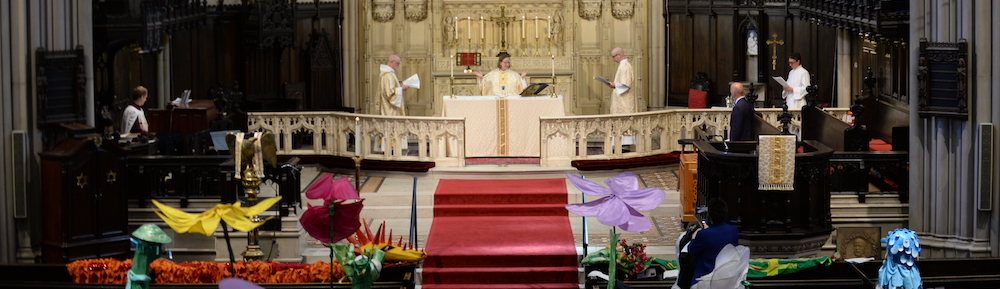
A Service Toward Repentance was offered at the Washington National Cathedral on January 24, 2025, to honor and advance the work done on reparations by the Episcopal Diocese of Washington. The liturgy included truth-telling, reckoning, and repentance for the harms done within the Diocese to the Black community from the enslavement era through the present.

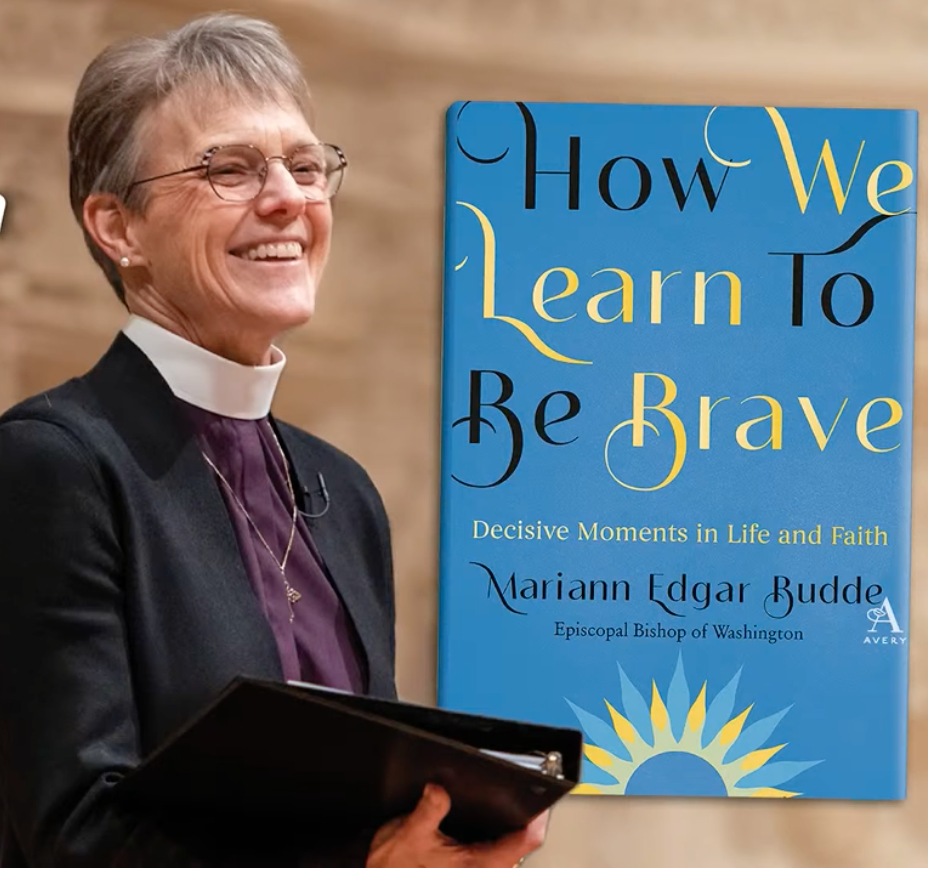
The Rt. Rev. Mariann Budde

Bishop Mariann Edgar Budde’s sermon included her incisive comments about what she learned at the Summit on Truth-telling and Reparation held last September at the Virginia Theological Seminary.

In her book, How We Learn to Be Brave (New York: Avery/Penguin Random House, 2023), Bishop Budde writes about being inspired by people of faith facing decisive moments in life. Among her cloud of witnesses are The Rev. Canon Kelly Brown Douglas, Presiding Bishop Michael Curry, Dr. Howard Thurman, The Rev. Dr. Pauli Murray, The Rev. Dr. Martin Luther King Jr., and Thurgood Marshall.

July 15, 2025 –Mary Beth Clack, Mary Blocher, Cindy Coldren, Pat Krol, Liz Levin.

Rejoice!

Advent 3C, 15 December 2024. The Very Rev. Pamela L. Werntz

Zephaniah 3:14-20. I will change their shame into praise.
Philippians 4:4-7. Let your gentleness be known to everyone.
Luke 3:7-18. What then should we do?

O God of the prophets, grant us the strength, the wisdom and the courage to seek always and everywhere after truth, come when it may, and cost what it will.


We are careening toward Christmas on this Gaudéte Sunday of Advent (Gaudete is Latin for the imperative plural rejoice.), but we haven’t heard any biblical readings about peaceful preparation for the birth of the infant Jesus. It’s been more about leveling the landscape and reorganizing the society, and less about receiving blankets or swaddling clothes. Our ancient narratives describe nations at war, raging seas, devastation, and disaster with plenty of blame to go around. The people are anxious and afraid; they are struggling. Just to be clear, we are talking about 28 centuries of struggle. The people Zephaniah was addressing were struggling in about 625 BCE. The people the apostle Paul and the evangelist Luke were addressing were struggling in the latter half of the first century of the Common Era. And the people I’m addressing right now are struggling at the end of the first quarter of the 21st century.

Here’s what Zephaniah, son of African descent, says: There is good news in the midst of devastation and disaster, in the midst of the indignities that have been cause for shame and reproach, that have caused hands to grow weak with fear and despair. Zephaniah laments the corruption and injustice rampant in the city of God. The covenant of living in Love has been violated and the religious leadership is implicated once again. (Some things truly do not change.) Zephaniah tells his hearers that in the midst of injustice and oppression, disaster and shame, uncertainty and fear, is the Holy One: very near is a vigorous and mighty One, Who is right now rejoicing over the people with gladness, exulting and singing loudly, and renewing the people in Love. The word here rendered renewing is better translated engraving, as a metal artist might inscribe a mark of belonging or a beautiful design. [1]. It can also be translated plough, as a farmer might cut a furrow for planting seeds. Listening to the Holy One will cause the people to be marked and prepared, opened up for Love. Zephaniah announces that Judgment Day is cancelled;  it has become Non-judgment Day. Rejoice because you are being inscribed and opened up for Love. So I wonder about the engravings or furrowings among us as the people of Emmanuel, where in the middle of the chaos, the Holy One is surely opening up new lines for Love among us. Gaudéte!

Our passage from Philippians this morning doesn’t give us the context for the writing, but the whole letter of Paul to the Jesus-followers in Philippi, was written from his prison cell (probably in Ephesus), where he was awaiting trial and a possible death sentence. He was writing to a faith community with a turbulent past, to people who had more than their share of pain. His instruction to rejoice and to not worry, then, is particularly striking and poignant to me, because he is taking a full accounting of fear and grief, of his own and theirs, of past and future. The rejoicing that Paul is encouraging is defiance, according to theologian Karl Barth. In Philippians, Paul’s joy is a defiant Nevertheless! that he sets against the Philippians’ fears that things are getting worse and not better. [2] Rejoice, Paul writes, because of the unnumbered blessings you have already received. Claiming joy is a radical and subversive form of resistance to all that colludes to oppress. I urge you to take some time today to rejoice in the blessings of your life so far. Gaudéte!

In the Gospel reading from Luke. John the Baptist is yelling out at the people who came to be baptized by him, “You viper hatchlings!” [3]. Did anyone get whiplash from today’s Gospel reading, which went from John the Baptist using a metaphor to call the people treacherous and venomous, characterized by deceit and hypocrisy, to the narrator’s best storytelling voice concluding, “With many other exhortations John the Baptist proclaimed the good news to the people.” That always makes me think, “Boy, if that’s the good news, I’d hate to hear the bad news.”

And yet, my virtual colleague Mark Davis writes in his Greek translation blog that there is plenty of good news here. We just don’t hear it, because we are conditioned to fear this language. John the Baptist talks about the wrath to come, but he does not call it God’s wrath. John’s idea of offspring of adders evokes the inherited, generational nature of broken relationships, of injustice and oppression. John is naming reasons they have come to seek the baptism of repentance. They have been participating in systems of oppression, exploitation, and extortion; and they want to stop. They have been complacent in economies that work to make rich people happy and make everyone else afraid; and that must come to an end. John is declaring that whatever tempts us to behave badly toward one another must be separated from the clean grain, the nutritious bits, the good fruit, whether it is physical, financial, or spiritual. Davis notes “There is nothing necessarily violent about a farmer cutting down a barren or soured tree and burning it, particularly if it might cross-pollenate and contaminate good fruit-bearing trees. This is a way of protecting the good trees and ensuring good fruit.” [4]

And what does good fruit mean? “What should we do?” the crowds asked. “What should we do?” the tax collectors asked. “What should we do?” the soldiers asked. John said,

Share your clothing and your food. If you have only a little, share a little. If you have a lot, share a lot. Do not take more than your portion; curb your greed and your fear that you won’t have enough. Do not extort money by shakedowns or false accusations to increase your wages. Exercise restraint. Stop victimizing people to leverage your own power by sucking up to people who have more power.

People, this is not rocket surgery, as my wife Joy loves to say. The good news is that they all wanted to be baptized or immersed in repentance. They wanted to bear good fruit! Gaudéte!

We know that Luke’s community wanted to be immersed by Jesus in a spirit of holiness and fire because the Gospel got written and widely shared. I hear the word fire as fire in the belly, energy and enthusiasm for caring for one another, especially for those who were most vulnerable. That is what being immersed in a holy spirit and fire means. What about us? What should we do? What should clergy do? What about librarians, musicians, artists, writers, office workers, teachers, and retirees?  For all of John’s fiery talk, notice he doesn’t tell even tax collectors and soldiers to quit their jobs and join him permanently in the wilderness. John had different advice for different people in varying circumstances, and he expected them to return home by a different way, transformed; and so should we.

I want to tell you a story of Emmanuel Church, which a few of you witnessed, but many of you probably haven’t heard before. Back in the olden days of my time as your priest, early-Tuesday-morning Bible study took place in person at 15 Newbury Street. It was an odd-numbered month (we continue to meet in odd months) and the weather was very chilly, so my guess is late November or early March. Six or seven of us had finished our conversation when someone knocked on the door of the Emmanuel Room. It was a man who was wearing summer clothes with no jacket. I immediately sized him up as someone who had probably just been released from incarceration. If you don’t have family or friends to bring you clothing, you leave prison with the clothes you were wearing when you arrived, no matter what the season. It’s so awful and shameful. The man asked if Emmanuel had a thrift shop with clothing. I shook my head sadly and said, unfortunately we don’t. Meanwhile, Betsy Bunn was also sizing him up and without skipping a beat she just took her jacket off and gave it to the man. It was a perfect fit. He thanked her profusely. I looked at her, awestruck. She said, “I have more than one coat.” I want you to know that there are countless similar stories of generosity, resilience, and well-being that emanate from the many communities who call 15 Newbury Street home, communities where belonging is the way to helping each other grow in generosity, resilience, and well-being. Gaudéte!

You may have noticed our collect for the day pleading for speedy delivery of grace and mercy to help and deliver us. I am here to tell you that the grace of God, the compassion and mercy of God, are already all around us. We are soaking in the bountiful blessings of God. We have cause to rejoice. It is up to us to speedily honor these blessings with gratitude and to speedily respond in kind by sharing our resources and extending the mercy and compassion of God in our every interaction. If that seems daunting because of your circumstances, just start with the people you encounter between now and noon! If that seems too easy, then see how far you can get into this day or this week, and report back! Gaudéte!

  1. Charash can mean keep still or silent. The NRSV translation of renew makes no sense to me at all, but I might not know enough to understand.
  2.  Karl Barth in his commentary, The Epistle to the Philippians, found at www.goodreads.com/quotes.
  3. Sarah Ruden’s translation in The Gospels: a New Translation (New York: Modern Library, 2021), p. 174.
  4. D. Mark Davis, posting for the third Sunday in Advent to his blog www.leftbehindandlovingit.blogspot.com on Sunday, December 8, 2024.


With the Depths of Our Hearts

Advent 2C, 8 December 2024. The Very Rev. Pamela L. Werntz

Baruch 5:1-9. Put on the robe of righteousness that comes from God.
Philippians 1:1-11. And this is my prayer, that your love may overflow more and more with knowledge and full insight to help you to determine what is best.
Luke 3:1-6. Prepare the way of the Lord.

O disturbing God, grant us the strength, the wisdom and the courage to seek always and everywhere after truth, come when it may, and cost what it will.


This Advent, like most every Advent, I find myself wishing for some pre-holiday quiet;  but John the Baptist is always loud. It’s hard to get a sense of just what kind of loud he is from the first six verses of Luke, Chapter 3, when, in many of our heads, the prophet Isaiah’s words are accompanied by beautiful music from Handel’s Messiah. But in verse seven, which we will hear next week, John the Baptist shouts to folks who have come out to be baptized by him (mind you, they have come to receive the very baptism of repentance that he was calling for), and he yells at them, “You brood of vipers! Who warned you to flee from the wrath to come? Bear fruits worthy of repentance. If you don’t, you are like a tree that is cut down and thrown into the fire.” John the Baptist is loud, and he’s in a very bad mood. He’s wild-eyed and hopping mad. H is not the patron saint of sitting quietly sipping cocoa through a peppermint stick for a straw, dreaming of a white Christmas.

And so, liturgically, we are deliberately setting the context for our celebration of the Nativity in two weeks and two days, not with quiet reflection, but with disturbing visions from the Gospel of Luke. We began last week looking through Luke’s lens at the brink of the Passion. This week and next week we look back a little further at John the Baptist. Luke draws a picture of him as a cousin to Jesus. Perhaps they were blood relatives, but none of the other Gospels mention it; and I don’t think Luke is trying to portray a familial connection. I think, for Luke, John’s and Jesus’ work were closely related, their purposes were so akin to one another, that it was as if they had known one another since before they were even born. 

Luke’s audience would have immediately recognized John the Baptist as a prophet who was using words from Isaiah. And Luke’s audience would have immediately recognized him as a prophet just like Jeremiah. Both consecrated before birth, they predicted judgment at the end of the age, proclaimed God’s saving grace, and announced that God’s new covenant was available to everyone who repented. The books of Isaiah and Jeremiah are set in the contexts of specific points in history with references to the reigns of particular kings. So Luke dates the moment of this story of John the Baptist: It was in the fifteenth year of the domination of Emperor Tiberius, when the notoriously cruel Pontius Pilate was governor of Judea,  treasonous and insecure Herod ruled Galilee, Herod’s rival and brother Philip ruled Ituraea and Trachonitis, and Lysanias ruled Abilene. If that’s not enough, Luke adds to the context the corrupt and complicit high priesthood of the retired Annas and his son-in-law Caiaphas. Into this period of deepest despair a word of God came to John, son of Zechariah.

A word of God came to John in the wilderness (not the word; there’s no definite article here). Notably, a word of God didn’t come to anyone on the Who’s Who list of rulers of government or temple, but to John, out in the middle of nowhere in the year 26 or 27 CE . Isaiah heard a word of God in something like 738 BCE, which the compiler of the book of Isaiah put on a scroll more than a century after that, a word that Luke recorded two generations after John’s ministry, a word coming to us nearly two millennia later! Here is a word of God for all people for all time.

John was in a particular middle of nowhere at the mighty Jordan River; and he was in every place that is wilderness. Wilderness is the place of formation for God’s people, a place of disorganization and dispute, of loss and grief, of surprising beauty and even intermittent joy, of vulnerability and dependence on God (in other words, a long spiritual journey). Here is a word of God for our particular place on our particular spiritual journey. Here is a word of God for all people for all time in all places, all kinds of nobodies in all kinds of nowheres,  all flesh.

Rather than being a claim in the literal meaning of the term, that all flesh will see the salvation of God, this word of hope is echoed in a voice in every situation of despair. Commentator Mark Davis writes, “Its meaning may lie not so much in how it is fulfilled in any given moment in time, but in how true it is in every moment in time.”[1] A word of hope, a word of love is always and eternally being spoken by the Holy One. A word of hope, a word of love, is without limits to those who can hear.

It seems to me that being able to hear a word of hope, a word of love, has to do with immersing ourselves in repentance. Baptism is about immersion. The words baptize and immerse are synonymous in the New Testament. What does it mean to immerse ourselves in repentance, to bathe in repentance? It means to change. Repentance is not about being sincerely sorry, regretful or ashamed. Repentance is about changing thinking, direction, and action:  returning to God, returning from alienation to reintegration, from estrangement to reconciliation with God, remembering our citizenship in the realm of God. What does it mean to immerse ourselves in repentance for the forgiveness of sin? Forgiveness of sin here literally means to divorce sin, to send sin away. It means to give ourselves and others a future. It means freeing ourselves and freeing others to move forward in a new direction toward God, which is the direction of Love. It’s not easy, and we need help (a lot of help), but the cost of not doing it is so much greater than the cost of immersing ourselves in repentance, and turning again toward Love. 

If you’ve heard me preach before, you know I’m drawn to the practice of weaving together strands of theology, scripture, liturgy, and parish ministry in ways that provoke and motivate us to live out our mission in the world. I recently read about Gus Speth, an environmental lawyer who co-founded the Natural Resources Defense Council. Speth has said he used to think the most pressing environmental problems were the loss of biodiversity, the collapse of ecosystems, and climate change. He thought 30 years of good science could address and even solve those problems. Now he believes the most pressing environmental problems are selfishness, greed, and apathy; and to deal with those, he says, we need a spiritual and cultural transformation. Scientific methods don’t know how to address that, but people of faith do. Our scriptures and ethical teachings know about cultivating community where people learn to practice loving others, even complete strangers, to give with an open hand rather than grasp with a clenched fist, and to cultivate empathic and compassionate actions. 

A few weeks ago I mentioned novelist and essayist Cara Hoffman. Her latest piece in the New York Times yesterday responds to the voices of people who want to flee this country rather than live under the coming administration. She cautions that she knows from her own experience that it’s nearly impossible to live somewhere in the world where the US doesn’t have influence, positive or negative. Also, the far right is on the rise in many parts of the world. Hoffman’s advice is, “Don’t let the politics of fear displace you. It’s much more important to find your compatriots and to create a life worth living, no matter where that is…imagining what it is [you] want instead of reacting to what [you] fear.” That is the message of the whole Gospel. That is what we are doing here this morning, imagining what it is we want instead of reacting to what we fear, and not just imagining, but enacting. We are building a beloved community right now.

In light of our scripture, this compels me to ask, what repentance, what particular change, are we being called to on this December morning? What repentance for forgiveness of sin might we be immersed in today? What direct ways or level paths are we being called to prepare? What needs to be cleared or smoothed out so that all flesh will see the salvation of God? What joy can be a quiet subversion in the face of despair? This Advent, let us once again immerse ourselves in repentance, change our direction, and head again towards Love. Let us immerse ourselves because we have work to do. We have work to do to bear fruits worthy of repentance. Once again, the final chorale of today’s cantata sums it up beautifully, so I’m paraphrasing: we will succeed if (and whenever) we believe (and behave) in Love from and with the depths of our hearts.


  1.  D. Mark Davis, “All Flesh Shall See the Salvation of God,”  Left Behind and Loving It, 1 Dec. 2024.

Would you like to hear it again?

Advent 1C, 1 December 2024. The Very Rev. Pamela L. Werntz

Jeremiah 33:14-16. Justice and righteousness in the land.
1 Thessalonians 3:9-13. May the Lord make you increase and abound in love for one another and for all.
Luke 21:25-36. Then he told them a parable.

O unsettling God: grant us the wisdom, the strength, and the courage to seek always and everywhere after truth, come when it may and cost what it will.


Whether we are ready or not, it’s time to wake up. Rise and shine! With the advent of a new church year our liturgy changes colors, music, and prayers to mark this season of communal preparation and repentance. Our Gospel readings also mark a change; we’ll hear mostly from Luke in Year C. Last year’s Gospel of Mark was terse and spare prose, covering the most basic facts of the ministry and teaching of Jesus and telling the circumstances of his death. The language of Luke is expansive and poetic, dramatically and outwardly focused, mission-oriented. Ironically, we begin each liturgical year with Jesus teaching about the end of the world as it is known. This is no coincidence. All the Gospels were written through the lens of the crucifixion and the experience of Love more powerful than death, the ending of one world and the longing for a new world, where the compassion, mercy, and peace of God would reign once and for all: all time and all people.

The writer of Luke reminds Jesus’ followers that, along the way to the reign of the glory of God, there will be confusion among the nations because of the roaring of the sea and waves. The powers of the heavens will be shaken, and people will get the wind knocked out of them with fear and foreboding. (This sounds ripped from the headlines.) Jesus says when you see these things happening, don’t hunker down or hide; stand tall and raise your heads because your redemption  (that is, the revaluation of your dignity) is drawing near! This is a pep talk: heads up! Be on your guard that your hearts are not weighed down with the worries of this life, so you have the strength to avoid the turmoil and to stand facing the Son of Man (for us that is Jesus), the one who came to demonstrate the love of God, not in word or speech, but in truth and action.

And then Luke’s story goes that Jesus told them a parable. Unlike other parables, this one is so short that, if anyone’s mind wandered for a minute, they missed it entirely. It always reminds me of a scene from one of my family’s favorite movies: Joe versus the Volcano, an early Tom Hanks and Meg Ryan romantic comedy, in which Meg Ryan plays the three female-lead roles. Tom Hanks plays Joe Banks, who is on a spiritual journey away from a colorless, loveless existence. In one scene, one of Meg Ryan’s characters, Angelica Graynamore, has driven Joe to the hills outside of Los Angeles the night before he embarks on a sea voyage to an island where he will offer his life for the good of the islanders. At a scenic overlook, they see millions of twinkling lights of the city. It looks and feels to the earnest Joe Banks, as if the stars have fallen or the world has been turned upside down. After several moments of quiet, Angelica asks, “Would you like to hear one of my poems?” “Sure,” Joe relies.

Long ago
the delicate tangles of his hair
covered the emptiness of my hand.

After a moment of silence, Angelica asks a puzzled Joe, “Would you like to hear it again?” That’s what I think of when I read the part of this Gospel passage from Luke that says, “Then Jesus told them a parable.” “Look at the fig tree and all the trees; as soon as they sprout leaves you can see for yourselves and know that summer is already near.”  I imagine Jesus looking at his earnest audience, in a long pause that did not get recorded in the Gospel narrative, and then asking, “Would you like to hear it again?”

What sense can we make of this one-sentence parable? I think an interpretive clue comes from how the parable is placed in the Gospel of Luke, which is extraordinarily symmetrical in the way it is constructed. The writer of Luke is employing the finest rhetorical devices in this composition. The narrative, the sayings, the miracles, and the parables are all told in a writerly version of synchronized swimming! You have to map it out and stand back to see how it works. Fortunately for me, I have a friend who did that once on yards of butcher paper!

This shortest parable, the parable of the fig tree, is the last one in Luke, at the end of Jesus’ life. It is balanced and illuminated by Luke’s first parable, which is the parable of the sower. By contrast, the parable of the sower is long, and its story covers an expanse of time, whole seasons of planting, growing, and reaping. At the beginning of Jesus’ ministry, there is plenty of time; at the end, time collapses. In the parable of the fig tree there is no expanse of time. There is only the present moment: right now. There is a way in which Jesus is teaching about not getting so preoccupied with what did or didn’t happen, or what might happen, that one misses the power of what one can know in the present moment. New life is very near right now, within reach.

Advent is all about calling our attention to the power of the present moment. Advent is a season of repentance, but not the Lenten repentance of wallowing in regret for our sins, personal piety, or private salvation. Advent’s sacramental purpose is about effecting corporate accountability and modifying communal behavior. The Advent calls for change and promises of redemption are directed to communities, institutions, societies, and nations. Likewise, our liturgical changes are designed to be unsettling, agitating, and provocative to the whole community. Perhaps more than any other time in the church year, our Advent work is to offer affliction for the most comfortable as we work to change, so that we can better provide comfort for those who are most afflicted.

The power of the present moment can too easily be given up or given away in at least three ways: one is to live in the past, blame the past, or feel guilty about the past. But regretting our past is about as effective as regretting gravity. We can (and should) learn from the past, but wishing that our past were different or that it still existed is a way to give up the power of the present moment, the now. Another way of giving up now is to live in the future. This is not to say that we shouldn’t have visions, goals, hope, or imagination. But spending our now wishing rather than taking action, or spending our present moments worrying, feeling anxious or afraid, will rob us of our powerful now so fast we won’t know where it went. And the last way we give up now is to try. Trying is not doing; if we try to pick up a binder, nothing happens.

This Advent see if you can eliminate your use of the word try when it comes to what you are talking about doing. When you hear yourself say try, stop and listen deeply to yourself, because you probably have just said in a very polite way that you are not doing it yet, or that you probably won’t do it. Know that if you say you’ll try to do something, you have just let yourself know (and now anyone else that is in this room) that you haven’t made a commitment to do it. Telling truth about that will give you back your now.

So whenever we want to engage in transformative action, start. Do a small piece of it. Then be glad when you say, “We are changing X (whatever it is).” Maybe it’s not as much as we’d like, but it’s more than before. Listen to the powerful difference between saying that Emmanuel Church is trying to witness to God’s mercy and justice and Emmanuel Church is witnessing to God’s mercy and justice. We are feeding and housing people who need physical nourishment and shelter, while providing food and a safe haven for all kinds of people who are spiritually hungry and in need of spiritual shelter. We are digging deep for the spiritual and material resources to be the change we want to see in the City of Boston.

Today, we heard Jesus tell his hearers what to do whenever it seems like the world is getting turned upside down. When confusion and fear are colluding to reduce us to passivity and despair, knocking the wind right out of us, we are not to squander our energy, create distance or indulge our anxieties. We are to stand up, raise our heads, and know that redemption, the revaluation of human dignity, is near. We are to look at what is right in front of us right now. Truly I tell you that a generation did not pass away until all things had taken place, and this generation will not pass away until all things have taken place either. As John Crossan and Marcus Borg have written, the Biblical idea of end times: “Is not about some mass immigration from a doomed world to a blessed heaven. Rather, it is about the end of…war and violence, injustice and oppression. It is about the earth’s transformation, not about its devastation. It is about a world of justice and peace.” [2]

What did you read on the front page of the newspaper this morning or see on the news last night about distress among nations? Of people fainting from fear and foreboding of what is coming upon the world? How are confusion, fear, and foreboding happening in our nation, in our city, on the other side of your desk in your office, in school, at home, in your extended families, or even in this room? Where is the drama of giving up the power of now playing out in our relationships, institutions, or bodies? And what redemption or re-valuation might be near right now? What would it take for us to stand up and raise our heads? [3]  As Lee Pelton of The Boston Foundation said last week, “Where we see a wrong, we seek to right it; where we see a hurt, we seek to soothe it; and where we see a broken heart, we seek to mend it. This is not the time to rest. It is a time to be restless…in this pursuit of what is right and just.”

It’s been said that no tree looks more dead than a fig tree in the Palestine winter. Imagine noticing little leaves sprouting out of buds on the branches, tiny hopeful signs of growth , of change, of new life. Jesus seems to be saying that in the middle of whatever is turning the world upside down, pick your heads up, look for, see, and be the signs of hope that are right in plain sight, right now. Christian hope, according to Jurgen Moltman, is not an “opium of the beyond;” rather it is, “The divine power that makes us alive in this world.” It’s not a hope that things will return to the way that they were, that the past will be different, or even that a bad thing will never happen in the future. It’s hope that right now, Love (another word for God) is redeeming and revaluing what seems dead, shameful, worthless, wasted, or hopeless in us and through us, in here and out there. Advent is a season of change and hope that right now Love can do that. Raise your heads and see that right now Love is making a way where there is no way. Raise your heads and see that right now Love is very near. As we will hear, and then sing together, in the final chorale of today’s cantata: “No eye has ever perceived, no ear has ever heard such joy as our happiness, io, io, eternally in dulci jubilo!” May it be so.


  1. 1 John 3:18.
  2.  Borg and Crossan, The First Christmas: What the Gospels Really Teach About Jesus’s Birth (New York: HarperOne, 2007), p. 240.
  3.  Thanks to Bill Dols for this line of questioning in The Bible Workbench 17:1.

Blessing for the Brokenhearted

Lent 1B, 18 February 2024. The Rev. Pamela L. Werntz

  • Genesis 9:8-17. I will remember my covenant.
  • 1 Peter 3:18-22. He was put to death in the flesh, but made alive in the spirit.
  • Mark 1:9-15. And the Spirit immediately drove him out into the wilderness.

O God of the spirit, grant us the wisdom, the strength and the courage to seek always and everywhere after truth, come when it may, and cost what it will.


We have entered the season of Lent in our liturgical year. For those of you who are newish to Emmanuel, I want you to know that, in my view, this is the season that most closely aligns with the spirituality and the ethos of Emmanuel Church. We see the sin in the world; that is, we see so many ways in which the mark of Love is missed. (The Biblical definition of sin is missing the mark.) We know our need for mercy. “We acknowledge and bewail our manifold sins and wickedness, which we [and others] have from time to time most grievously have committed,” as the Rite 1 Confession goes. The season of Lent, a time for self-examination and repentance, feels made for us. And you know that’s good, because it’s not fair for extroverts to get all of the holidays! Continue reading

How Sorrow Turns to Joy

Easter 3A, 23 April 2023. The Very Rev. Pamela L. Werntz

  • Acts 2:14a, 36-47. For the promise is for you, for your children, and for all who are far away.
  • 1 Peter 1:17-23.  Love one another deeply (or constantly) from the heart.
  • Luke 24:13-35. Were not our hearts burning within us?

O God of our aching and burning hearts, may we have the wisdom, the strength, and the courage to seek always and everywhere after truth, come when it may and cost what it will.


In today’s Gospel portion, we heard the Easter story of two on the road to Emmaus – one named Cleopas and the other is unnamed, which allows me to understand that the other was a woman. It’s a beautiful account of the art of resurrection, about how, even when we doubt it, we don’t understand it, we can’t imagine it, and we certainly are not looking for it, we might come to recognize that the Risen Lord can be walking along with us when we are overcome with grief and deeply afraid. The Risen Lord can be right in front of us without our knowing it. The Risen Lord can be in the midst of us when we share our food. Before I go further down this Road to Emmaus, however, I must go back to our first reading from the Acts of the Apostles. Continue reading

Need

Lent 1A, 26 Feb. 2023. The Very Rev. Pamela L. Werntz

  • Genesis 2:15-17, 3:1-7. You will not die.
  • Romans 5:12-21. But where sin increased, grace abounded all the more.
  • Matthew 4:1-11. Away with you, Satan!

O God all gracious and all merciful, grant us the strength, the wisdom and the courage to seek always and everywhere after truth, come when it may, and cost what it will.


We have just crossed the threshold into the season of Lent in the Church, for period of forty days, not including Sundays (hence our special reception after our service today)! The forty days are set aside for Christians to examine our estrangement from the grace and mercy of the Holy One and to return to right relationship with God and one another. Although each person is called on to do their own Lenten practice, as a congregation we come together for mutual support and encouragement as we go through a this period of intensified self-examination with a call to increased generosity in almsgiving, praying, fasting, and studying scripture. Continue reading

The realm of heaven has come near.

Advent 2A:  Dec. 4, 2022.  The Very Rev. Pamela L. Werntz.

Isaiah 11:1-10.  With the breath of his lips he shall kill the wicked. (That’s some powerful bad breath!)
Romans 15:4-13. On behalf of the truth of God.
Matthew 3:1-12.  He will baptize you with the Holy Spirit and fire.

O God, hope of the prophets, grant us the strength, the wisdom and the courage to seek always and everywhere after truth, come when it may, and cost what it will.


For our Second Sunday of Advent this year, our scripture lessons begin with the second half of a beautiful oracle or poem in Isaiah. Maybe the first half is omitted from our lesson because it is not as charming as the second half. The first half describes how the mighty have fallen like tall trees in a forest that has been clear cut. It’s a wasteland. There are only stumps left where there had been a beautiful forest. The context is the collapse of the Assyrian occupying military, which was itself in control as the result of the total failure of the dynasty of King David, which had utterly miscarried its obligations to care for those who were most vulnerable and weak: aliens, widows, orphans, and other impoverished people. The government of the people of God had neglected its duties to be morally responsible for doing no wrong, no violence, to the neediest people. Continue reading

A Parish Where Love Lives

Proper 26C, 30 October 2022.  The Very Rev. Pamela L. Werntz

Habakkuk 1:1-2:4Write the vision; make it plain so that a runner can see it.”
2 Thessalonians 1:1-4,11-12. The love of everyone of you for one another is increasing.
Luke 19:1-10. The Son of Man came to seek out and save the lost.

O God of mercy, grant us the strength, the wisdom and the courage to seek always and everywhere after truth, come when it may, and cost what it will.


The short and powerful book of Habakkuk the Prophet begins with a title: The oracle that the prophet saw. The Hebrew word for oracle can also be understood as burden: the burden that Habakkuk saw. What Habakkuk saw clearly was indeed a great burden: violence everywhere, and God seemed not to see the degradation of justice and the utter devastation of well-being, of shalom. Habakkuk had two complaints, which could be ripped from our own headlines: 1) God has done nothing to stop the violence so far, and 2) it’s about to get worse. In this book, the voice of God is heard, but it’s not particularly good news. Essentially, God’s response is that the violence is due to the greed of the people and their failure to recognize the voice of the Holy One, Who pleads for loving, pleads for people to respect themselves and others. Habakkuk understands the violence as the Holy One’s punishing response. I understand violence as an entirely predictable consequence of greed, arrogance, and fear, which breaks the heart of the Divine. To the question of how can God let this suffering and devastation happen, I ask, how can people let this suffering and devastation happen?  Continue reading

Letting Our Hearts Speak

Advent 4C.  19 December 2021. The Rev. Pamela L. Werntz

Micah 5:2-5a He shall be the one of peace.
Hebrews 10:5-10. I have come to do your will, O God.
Luke 1:39-56 From generation to generation.

O God of “she who believed”, grant us the strength, the wisdom and the courage to seek always and everywhere after truth, come when it may, and cost what it will.


Our Gospel reading this morning depicts an amazing scene, rare in its proclamation in the church but much celebrated in art and music. It’s an extended dialogue between two loving women in the Biblical narrative (only Ruth and Naomi have similar prominence). Here is a story of two pregnant prophets, one a crone and one a maiden, whose lives have been turned upside-down, and who sensed that the children they carried were prophets also and would someday and forever turn other lives right-side up. Here are two pregnant prophets pronouncing blessing and singing a version of an old song, Hannah’s song from 1 Samuel, about the glorious impossibility of how God works and what God has done. Continue reading