
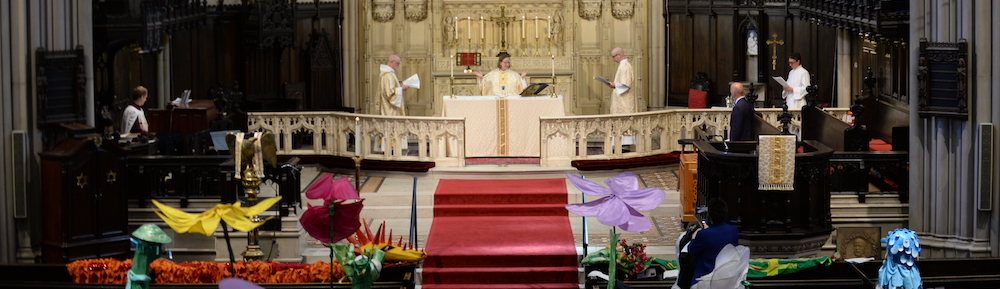
More so Among us

Epiphany 3C, 26 January 2025. The Very Rev. Pamela L. Werntz

Nehemiah 8:1-3, 5-6, 8-10. Do not be grieved; the joy of the Lord is your strength.
1 Corinthians 12:12-31a. We were all made to drink of one spirit.
Luke 4:14-21. Today this scripture has been fulfilled in your hearing.

O God of love, grant us the strength, the wisdom and the courage to seek always and everywhere after truth, come when it may, and cost what it will.


It’s been a week, hasn’t it? I’ll remind you of what we do when times are terrible, frightening, angering, sorrowful: we stick together and we stay close to the scriptures. They were written in times of deep distress, and they are our guiding lights. I’m talking about the actual scriptures, the first and second testaments of our Bible, which testify to loving our neighbors as ourselves.

Today we hear Luke’s story of the beginning of Jesus’ ministry. The four Gospel writers were very careful about how they began their accounts of the beginning of Jesus’ ministry. They all agreed that Jesus’ public ministry began after John the Baptist was arrested by Herod. Like siblings, each Gospel writer’s account about where and how Jesus’ public ministry began is different.  Mark tells of Jesus exorcising an unclean spirit in the synagogue in Capernaum. Matthew’s first story of Jesus’ ministry is about a large body of teaching, which he addressed to the crowds on a mountain. John’s story of his ministry begins with the water-to-wine extravaganza at the wedding in Cana. And Luke tells about Jesus’ visit to his home synagogue in Nazareth.

Jesus, Luke says, was filled with a spirit of holiness, the same spirit of holiness that would fill his followers after his death. Luke says that it was Jesus’ custom to attend synagogue on the Sabbath. When the scriptures were handed to him, he read Isaiah’s proclamation of freedom: freedom from hunger, illness and disability, poverty, prison, debt, freedom and all kinds of oppression. It’s more of a mash-up than a direct quote from Isaiah, but certainly the spirit of Isaiah is as Jesus reports. Isaiah was proclaiming the end of the Babylonian exile. According to Luke, Jesus was proclaiming that his ministry, too, was going to be about liberation, about freedom. At the core of his ministry was (and still is) a powerful ethic of love, of compassion and mercy, forgiveness and reconciliation, nonviolence and well-being, shalom. It is the same ethic that is at the heart of the Torah, the Prophets, and the Writings. I usually don’t think of myself as a conspiracy theorist, but I do believe that all good things come from Love, which is another name for God. My conspiracy theory is that Love is the Way, the only Way.

It’s interesting to me to think about this in light of Nehemiah’s story of the return of the Hebrew people from exile and slavery in Babylon. Having returned to Jerusalem, they have gathered at the eastern gate of the city, where the water flowed from a spring. Nehemiah says they wept when they heard the word of the Holy One. They wept, the water flowed from the springs in their eyes, perhaps because they realized how far from free they had been in Babylon. Perhaps they realized how far from free they still were even though they were back in familiar territory. Perhaps they wept for all that had been lost. And the religious leaders – Ezra, Nehemiah, and the Levites – respond to their mourning with an instruction to celebrate!

Don’t mourn, celebrate, because rejoicing in the Holy One is the source of your strength. This day is sacred. You are God’s sacred people. Don’t mourn over the past. (You know, stop hoping for a better past.) Go eat and drink, and share what you have with whoever has nothing prepared.

Now, you might have noticed that verses 4 and 7 are missing from our reading from Nehemiah this morning. Maybe you even guessed that I would tell you, because I usually do! Those two verses contain long lists of names. Perhaps they’re left out in deference to lesson readers everywhere, but I wish they hadn’t been omitted. Verse 4 lists the names of the people who stood with Ezra as he read the sacred text. Nehemiah says that Ezra was standing with eleven others on a wooden platform, which had been made for the purpose. He was standing with his leadership team.  [1] And then in verse 7 is a list of thirteen additional people who were there to help the congregation to understand the sacred text, because it was hard to understand.  [2] Let’s not miss the idea that the scripture has always been challenging to understand and that Ezra had a very large leadership team helping to proclaim freedom from oppression!

It’s interesting to me to think about freedom in light of Paul’s teaching about the body of Christ. As members of the body, he says, Christians are not free to disregard the value of another part of Christ’s body, or member, even if that member is weak or seems less important. Every part is important, Paul says. The eye must not say to the hand, “I have no need of you.” The ear must not say, “Because I am not an eye, I do not belong to the body.” 

The reason that Paul was writing about this to the people in the church in Corinth was that they were arguing with each other about who was most important. We know that in the olden days, sometimes people in churches didn’t like each other, didn’t respect one another’s opinions or sufficiently regard one another’s dignity. In the olden days, sometimes people who were a part of the church behaved very badly toward one another. (Can you imagine?) In the early church, some people thought that other people shouldn’t be members of the church, or sometimes people felt that they themselves didn’t belong or didn’t really fit in! Paul was trying to teach them that everyone is important, and everyone belongs, even members who are weaker, less honored, or less respected than others. Paul was giving a pep talk about what it means to be a part of a team:  one body with many members with a variety of gifts, who have great need of one another, despite ideas to the contrary.

Paul was using the metaphor of a body to say that some parts are more noticeable or may seem more important than others, but every part is important. Every part deserves compassion and respect. Think for a moment about what compassion and respect mean. Now think for a moment about what you would say if I went around the room and asked each one of you what you think of as the strongest part of your body, and what the weakest part or the least-likable part of your body is. Think for a moment about what you might do differently if you started treating the weakest or least-likable part of your body with more compassion and respect. Maybe it’s your hair, belly, upper body, legs, nose, teeth, hands, or feet? I feel certain that each one of us has at least one body part that could use more compassion and respect.

 Now think of Emmanuel Church as a body with lots of parts. Think for a moment about what you would say if I went around the room and asked each one of you who you think are the most honored, popular, or influential Emmanuelites and who are the least honored, popular, or influential? Think for a moment about how much stronger our body at Emmanuel would be if we treated the least honored, popular, or influential members with greater respect. Maybe when you thought about it, you thought to yourself, “Actually I think I’m one of the least honored, popular, or influential Emmanuelites.” Maybe you thought, “I’m not sure I’m even considered an Emmanuelite.”  (Well I can tell you that you are today by virtue of your presence with us this morning, whether you are here physically or virtually, because that’s how it is around here.) Think for a moment about how much stronger our body at Emmanuel Church would be if you treated yourself and everyone else with greater compassion and respect, and if everyone else treated you with greater compassion and respect. 

I think starting with yourself and your parish community is what is called practicing religion. Emmanuel Church is where we practice greater self- and communal compassion and respect so we can do it out there. Even if you are already a very compassionate and respectful person, I guarantee that you can do something today that is even more compassionate and respectful than usual. Even if, and maybe especially if, you’re feeling a little cranky, less than comfortable, or nervous, you too can do something that is compassionate and respectful. Maybe it’s toward someone in your immediate family, someone who you don’t usually think about or try to avoid, someone you love but don’t agree with or understand, or someone you don’t even know and may never see again. So what does that have to do with freedom? Well, if a body is at odds with itself, it is not free. If a stomach is grumbling, for example, or an ear is aching, the whole body suffers. If people in the church are grumbling or aching, the whole community suffers. When we’re suffering, we’re not free to pay attention to the needs of others, to help get other people free.

I want to interject something about focus because when the news is as overwhelming as it has been lately, it’s tempting to give into despair or to just tune out and shut down. One antidote is to pick one issue to focus on and to act on it; take a step in the direction of advocacy and support. If the first step is too hard, break it down into smaller steps.

Helping get other people free is our job as Christians, because Christians are the body of Christ. If, as Luke says, Jesus Christ was filled with a spirit of holiness to fulfill the scriptures, to set people free, then, as the body of Christ filled with the same spirit, we Christians have inherited the same responsibility. We have the same call, invitation, and challenge to express the compassion and respectfulness that are manifestations of true holiness. Today we have opened the scriptures that proclaim freedom: freedom from hunger, illness, disability, poverty, prison, debt, harassment, and all kinds of oppression. Today we are called to rejoice in the source of our strength and share what we have with those who have no provisions for a celebration. Today let’s do what we can to make sure that this scripture is fulfilled in our hearing. Not just in the distant past and not in some unforeseeable future. Today, let’s see how it could be more so among us.


  1.  Mattithiah, Shema, Anaiah, Uriah, Hilkiah, and Maaseiah on his right hand; and Pedaiah, Mishael, Malchijah, Hashum, Hash-baddanah, Zechariah, and Meshullam on his left hand
  2.  Jeshua, Bani, Sherebiah, Jamin, Akkub, Shabbethai, Hodiah, Maaseiah, Kelita, Azariah, Jozabad, Hanan, and Pelaiah


The Better Portion

Proper 11C. 17 July 2022.  The Rev. Pamela L. Werntz

Amos 8:1-12. Hear this, you that trample on the needy, and bring to ruin the poor of the land.
Colossians 1:15-29. For this I toil and struggle with all the energy that he powerfully inspires within me.
Luke 10:38-42 The better portion.

O God beyond our perceiving, grant us the strength, the wisdom and the courage to seek always and everywhere after truth, come when it may, and cost what it will.


It might just be because it’s hot and I’m getting close to vacation, so I’m a little grumpier than usual; but I looked at our readings for today earlier this week and thought to myself, “I don’t really want to say thanks be to God or praise be to you, Lord Christ to any of these three!” 

Amos, of course, is responding to the ancient command of the Divine: “If you see something, say something.” What he saw was the shocking evils of a flourishing urban elite exploiting people and extracting resources in a way that was impoverishing the whole country. Amos saw that military might, extravagant wealth, and shallow piety would result in utter devastation if those in power did not repent and return to the Holy One, to the Mosaic Law of love for neighbor, which meant (and still means) the just distribution of resources. The word of hope in Amos, which our lectionary doesn’t include, is that the time will come when those who plow shall overtake those who reap, when those who plant the vineyards will enjoy the fruit of their labor. Continue reading

The Discipline of Love

Easter 2C, 24 April 2022.  The Rev. Pamela L. Werntz

Acts 5:27-32. Jesus, whom you had killed by hanging him on a tree.
Revelation 1:4-8. To him who loves us and freed us from our sins by his blood.
John 20:19-31. Peace be to you.…I send you….Receive the spirit of holiness.

O God of inspiration, grant us the wisdom, the strength and the courage to seek always and everywhere after truth, come when it may, and cost what it will.


Our lectionary in Eastertide turns away from readings from the First Testament and toward the Acts of the Apostles, volume two of the Gospel of Luke. This makes a lot of sense because Acts of the Apostles contains the stories of what Jesus’ followers did after Jesus’ execution, how they were inspired with a spirit of holiness to carry on lives dedicated to Jesus’ ministry marked by justice and right-relationship, by compassion, mercy, and peace. Although the book is more romance than history (in the way we think of history), the stories show that experiences of the resurrection in the early church are not as much about theological or philosophical ideas, but about the consequential actions of being in relationship with the Divine in public practice. Jesus and then the apostles were teaching about calling people to make choices that would shape the well-being of the larger community by their living in greater fidelity with God and one another in the midst of the oppression of an occupying army.  Continue reading

Entering the Gates of Holy Week

Palm Sunday C, 10 April 2022.  The Rev. Pamela L. Werntz

Isaiah 50:4-9a. It is the Lord God who helps me.
Philippians 2:5-11. Let the same mind be in you that was in Christ Jesus.
Luke 23:1-49. Watching these things.


1.  They had been enemies.  
You know, each of our four canonical Gospels tells its own story of the Good News of Jesus as the Christ. Each has its own voice, its own intended audience, its own character. I believe that we hear and understand best when we hear the distinctive voices telling different stories, when we do not try to make a puree by blending all of the ingredients of the four Gospels, seasoned with church traditions. Continue reading

Letting Our Hearts Speak

Advent 4C.  19 December 2021. The Rev. Pamela L. Werntz

Micah 5:2-5a He shall be the one of peace.
Hebrews 10:5-10. I have come to do your will, O God.
Luke 1:39-56 From generation to generation.

O God of “she who believed”, grant us the strength, the wisdom and the courage to seek always and everywhere after truth, come when it may, and cost what it will.


Our Gospel reading this morning depicts an amazing scene, rare in its proclamation in the church but much celebrated in art and music. It’s an extended dialogue between two loving women in the Biblical narrative (only Ruth and Naomi have similar prominence). Here is a story of two pregnant prophets, one a crone and one a maiden, whose lives have been turned upside-down, and who sensed that the children they carried were prophets also and would someday and forever turn other lives right-side up. Here are two pregnant prophets pronouncing blessing and singing a version of an old song, Hannah’s song from 1 Samuel, about the glorious impossibility of how God works and what God has done. Continue reading

Telling the Story

Proper 10B.  July 11, 2021

2 Samuel 6:1-5, 12b-19David and all the house of Israel were dancing before the LORD with all their might, with songs and lyres and harps and tambourines and castanets and cymbals.
Ephesians 1:3-14. [God] set forth in Christ as a plan for the fullness of time.
Mark 6:14-29. What should I ask for?

O God of Our Dreaming, grant us the strength, the wisdom and the courage to seek always and everywhere after truth, come when it may, and cost what it will.


The summer lectionary has dealt us some truly terrible readings for us this morning,  readings that should give any of us pause before we say, “Thanks be to God” or “Praise to you, Lord Christ.” First is the story of how the ark of the covenant came to reside in Jerusalem, which is not a nice story, although the lectionary calls for the most troubling parts of the story to be removed. Then, we have the story of the beheading of John the Baptist with a passage from Ephesians in the middle insisting that somehow everything is going to be alright.
Continue reading

Freedom is a dream.

Proper 9B. July 4, 2021

2 Samuel 5:1-5, 9-10. Look, we are your bone and flesh. [Take us in].
2 Corinthians 12:2-10. My grace is sufficient for you, for power is made perfect in weakness.
Mark 6:1-13. And he was amazed at their unbelief.

O Dreamer of Freedom, grant us the strength, the wisdom and the courage to seek always and everywhere after truth, come when it may, and cost what it will.


Sometimes people at Emmanuel wonder what a lesson like the one from 2 Samuel has to do with the Gospel (or anything else in the service). It’s a great question that often comes from experiencing a lifetime of lectionary reading selections that used to fit neatly together, in which Christians appropriated the First Testament to serve the Second Testament. That has changed somewhat with the Episcopal Church’s use of the Revised Common Lectionary. 
Continue reading

Saving Space for Outsiders

Lent 3B, March 7, 2021.  The Rev. Pamela L. Werntz


Exodus 20:1-17.
I AM.
1 Corinthians 1:18-25. Christ the power of God and the wisdom of God.
John 2:13-22. They believed the scripture and the word that Jesus had spoken.

O God of Love, may we have the wisdom, the strength, and the courage to seek always and everywhere after truth – come when it may and cost what it will.


My three-year-old granddaughter asks a version of the universal question of why, which effectively blocks the response, “Because I said so,” or “because that’s the rule.” Instead of asking why, she asks, “What will happen; what will happen” if I do this thing that you’ve told me not to do? What will happen if a kid on the playground doesn’t do what they’re supposed to do; what will happen? What will happen; what will happen? She’s learning about rules, expected behaviors, desired outcomes, and consequences. Sometimes we don’t know the answer; sometimes there is a range of possibilities. This is frustrating to her; she wants to be know; she wants us to be sure of the consequences. On this Third Sunday in Lent, we have lessons about the consequences of being God’s people, of not loving Loving, of proclaiming Christ crucified, and of fidelity to Jesus.
Continue reading

A Place in This Seedpod

Lent 1B, February 21, 2021, The Rev. Pamela L. Werntz.

Genesis 9:8-17. I will remember my covenant.
1 Peter 3:18-22. An appeal to God for a good conscience.
Mark 1:9-15. The Spirit immediately drove him out into the wilderness.

O God of Love, grant us the wisdom, the strength and the courage to seek always and everywhere after truth, come when it may, and cost what it will.


I always love praying the Great Litany with you on the first Sunday of Lent, and I’m sad not to have prayed it chanting in a solemn procession that surrounds and enfolds the congregation in this prayer written for, and intended to be used during, times of great duress, danger, or devastation. I’ve been thinking about and hearing from some of you about how right it feels to be back in our liturgical, spiritual season of Lent. Lent is a season that aligns with much of what we are experiencing: a season of self-sacrifice, a season of recognition of when, where, and how we’ve missed the mark of Love, which is the Biblical definition of sin. Continue reading

Fantastic News!

Advent 3B, December 13, 2020. The Rev. Pamela L. Werntz

Isaiah 66:1-4, 8-11. To give them a garland instead of ashes.
1 Thessalonians 5:16-24. May the God of peace sanctify you entirely.
John 1:6-8, 19-28. There was a man sent from God….He came to testify to the light….The true light, which enlightens everyone, was coming into the world.

O God of grace and mercy, may we have the wisdom, the strength, and the courage to seek always and everywhere after truth – come when it may, and cost what it will.


This Advent, I’ve been paying particularly close attention to our opening prayers, our collect for each Sunday. Our collect for this third Sunday in Advent pleads with the Holy One to stir up power and with great might come among us with bountiful grace and mercy because our sins are sorely hindering us. I love this prayer, and it also scares me. It’s not that I disagree with the idea that our sins are sorely hindering us; it’s just that I’d rather be praying, “Settle down, O God, so that we can have a peaceful and happy holiday season. Settle us down, O Desire of Nations, so that we can read or listen to the news without anxiety, fear, rage, or despair. Dear Jesse’s Branch, please don’t stir us up too much, because we’ve already been through it this year, between the ravages of COVID, the ravages of racism, and the ravages of weather-related disasters.” Here, however, is John the Baptist bearing witness to the powerful brightness of the coming Christ.

Continue reading