
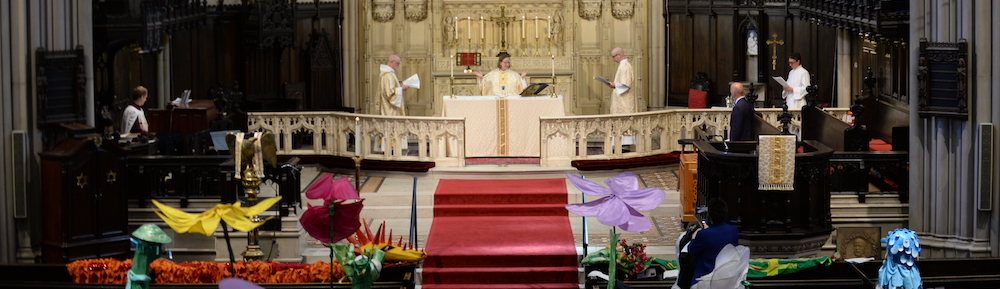
I’m begging you.

Epiphany 7C.   23 February 2025.  The Very Rev. Pamela L. Werntz

Genesis 45:3-11, 15. And he kissed all his brothers and wept upon them.
1 Corinthians 15:35-38, 42-50.  Someone will ask, “How are the dead raised?
Luke 6:27-38. A good measure, pressed down, shaken together, running over will be put into your lap.

O Most Merciful and Compassionate, grant us the strength, the wisdom and the courage to seek always and everywhere after truth, come when it may, and cost what it will.


During this season of Epiphany, our First Testament lessons have been from the Writings and the Prophets: Nehemiah, Isaiah, Jeremiah, and Malachi. Suddenly and unexpectedly, a lesson falls into our laps from Genesis about the long-lost Joseph encountering his brothers in Pharaoh’s court in Egypt. I want to make sure you know the backstory just in case you didn’t have at least a half a dozen years of Sunday School when you were growing up!

Here’s a quick synopsis of about a dozen chapters of Genesis: Joseph was the 11th of 12 sons of Jacob (aka Israel). Jacob had his last two sons with Rachel, who died in childbirth delivering Benjamin. The legend goes that Joseph was Jacob’s favorite, and his brothers were insanely jealous of their father’s favoritism and Joseph’s dreams of superiority. When Joseph was 17, his brothers, who couldn’t take it anymore, decided to kill him. Then they changed their minds and threw him into a pit instead. He got pulled out by some passersby, who sold him into slavery. The brothers tore up Joseph’s ornamented tunic, a special gift from their father, put blood of a goat on it, and told Jacob that his beloved son must have been devoured. [1] He was devastated. Joseph ended up in Egypt, where he was enslaved in a wealthy household and then jailed by the jealous master whose wife lusted after him. While in jail, Joseph interpreted the dreams of fellow prisoners and so gained the attention and then the trust of Pharaoh, who made him the second-most-powerful person in Egypt, in charge of the empire’s food supplies through a severe famine. 

Meanwhile, Joseph’s brothers, who were starving in the land of Canaan, learned that there was plenty to eat in Egypt; so they headed there to beg for food. They didn’t recognize Joseph when they met with him, but he knew them. He gave them sacks of food, but hid a golden cup in youngest brother Benjamin’s sack. He then accused Benjamin of theft and threatened to imprison him. When the brothers begged to be imprisoned in Benjamin’s place, Joseph revealed who he really was. High drama! That’s where our story this morning picks up.

What’s missing in our reading is the beautiful verse in which Joseph and Benjamin wept on each other’s necks in a poignant acknowledgement that the injury inflicted by the older brothers was not just to Joseph and Jacob, but also to Benjamin. The two sons of Rachel then weep over the other ten brothers. There is no righteous retribution, vindictiveness, or Schadenfreude at their desperate circumstances, even though, surely, they had it coming. There is a promise of mercy, compassion, material restoration, and care with a strong sense of divine providence turning decades of tragedy into a future of dignity and grace. Walter Brueggemann describes Joseph’s work as reinterpreting the past, redefining the present, and reimagining the future. [2]

In the light of this story from Genesis, I can see that Jesus was teaching Torah in Luke’s Sermon on the Plain. When I look through Luke’s particular lens at Torah and Gospel, I can see that he views the Good News as the healing power of relationship with the Divine, the healing power that flowed out of Jesus, to reinterpret the past, redefine the present, and reimagine the future. But Jesus’ teachings here are hard; the challenges are huge. Even if we agree with the ideas and the ideals of loving our enemies, putting that into practice takes a lifetime of work. Often in conversation about these teachings, there’s a quick move to the extremes: what about the oligarchs? What about the President? Going to the extremes is a way of avoiding looking at our own spheres of influence. Closer to home we might ask: what about someone who is in an abusive or exploitative relationship? No! What then? Are we to be passive or complacent? How do we reckon with evil without indulging it? Surely we should not tolerate intolerance! Jesus’ answers have to do with responding restoratively rather than retributively. Restoring what? Restoring dignity. Jesus asserts the healing power of restoring dignity in undignified circumstances. Jesus has no tolerance for public shaming or humiliation, and he knew that violence never ends violence. Only creative non-violence will do that. Hatred will never overcome hatred; only love will do that. (That’s a teaching from the Buddha, by the way.) Similarly, Jesus lays out a path of non-violent, dignified responses to injuries that affirms self-worth and the worth of the other, even if the path is completely obscured by the fog of cultural differences, language, and time.

It’s hard for me to think of a teaching of Jesus that requires greater translation across culture, time, and language than the one about turning the other cheek if someone strikes you. The word that gets translated strike describes the act of slapping someone with an open hand. The backhand slap was typically done in the context of humiliation or mockery, used to shame someone in a public setting. The Greek dictionary says, “It was considered a grave insult, reflecting a deep level of contempt or disdain.” [3]

I was far along into my theological education when I had the opportunity to see the great Walter Wink demonstrate this teaching from Jesus, and it made an indelible impression on my heart. He demonstrated the motion of backhanding someone on the right cheek (with his right hand) like someone with greater power would do to someone with less power. When the victim offered the other cheek, the only slap possible was to cup the person’s cheek, which was a gesture of affection. The move of offering the other check is physically, literally, disarming. It is an elegant response that asserts the dignity of both the perpetrator and the victim. Likewise, giving one’s shirt to someone who has just taken one’s coat is a non-violent way to demonstrate the dignity of nakedness and the indignity of injustice. In an honor-and-shame culture, nakedness brings shame on the one who sees, not on the one who lacks cover.

Although these are not teachings about being doormats for Jesus, what if we cannot manage to love our enemies? What do we do when loving is too hard or too dangerous? Remember, when the task is overwhelming and seems impossible, it means that the first step is too big; and so we need to break it down into smaller steps. One move is to step outside of what Pádraig Ó Tuama calls, “the energy of enmity,” which keeps us trapped or stuck, cornered or cowering. [4] Buddhist teachers Robert Thurman and Sharon Salzburg have said that, for them, the first step toward non-hatred is to become aware of how it feels to be scared and angry inside of oneself but not todiscount or ignore the injury. If you’re like me, lately, you’ve had opportunities to feel scared or angry every day. 

A next step is to cultivate a desire to not be stuck there: a desire to heal. Non-hate is the beginning of the journey. If you’re like me, you also have opportunities to step out of that narrow place of desire for revenge and into a place of mercy and compassion. If you’re looking for an example of what I mean, the Bishop of Washington, Marianne Edgar Budde, recently gave a master class on speaking truth to power in a most loving way, both in her sermon at the prayer service the day after the Inauguration and in subsequent interviews. (If you haven’t yet seen and heard Bishop Budde, then listening to her is a good next step.)

The idea of non-hate being the beginning of a journey toward love connects for me to Jesus’ command to be merciful. The verb can also be translated: become. Become merciful like the Holy One, who is merciful. Be in relationship with divine mercy for yourself and for others, along the Way. Do not judge, and you will not be judged by the Holy One. Do not condemn, and you will not be condemned by the Holy One. Perhaps you hear the echo, “Forgive us our sins as we forgive those who sin against us,” from the way Jesus taught his followers to pray. I don’t know about you, but I’m always hoping that God will forgive us our sins better than we forgive those who sin against us, because Christians in general are not that good at it yet. 

Another step toward non-hate, and this is very important, is to refrain from considering or declaring that our enemies are somehow less than or other than human. Violence toward others cannot be justified by dehumanizing them, even if they are behaving in depraved and terrible ways. And for me, it’s important to understand that we are capable of the most depraved and terrible things that we deplore in our enemies, which is one reason “We repent of the evil that enslaves us, the evil we have done, and the evil done on our behalf.”

What I want to suggest about the prohibition of judging and condemning is that there is an important distinction to me between judging and condemning people and judging and condemning behaviors. Even as I say this, I’m aware of how “Love the sinner, hate the sin” has been used against queer people like me. Nevertheless, even as Jesus says don’t judge, he is clearly judging against violent behaviors of all kinds. Also, according to Luke, Jesus responded in mercy and compassion to the criminal on the cross near him who believed that he deserved his own death sentence.  I’m sure that responding to one’s enemies with grace and mercy will and does change us for the better; responding with grace and mercy heals us and the world. When we can loose whatever grip righteous indignation has on us, when we stop consuming the poison of resentment and hatred, it’s like an abundance of grace, so much that it generously runs over like a gift falling into our laps!

I want to close by saying something about our lesson from First Corinthians. I just love Paul’s words of assurance that someone is going to ask, how are the dead raised? With what kind of body do they come? In other words, how exactly does resurrection work? “Fool!” he practically shouts. Listen up, Emmanuelites! Resurrection looks like: “They buried us but they did not know we were seeds.” Resurrection looks like twelve brothers reunited and forgiven. like mercy and compassion, like suffering with, like remembering and asserting one’s own dignity in the face of mistreatment, like respecting the dignity of every human being, and for Christians, like seeking and serving Christ in all persons, even when you cannot discern any evidence of the Christ. It looks like restorative rather than retributive justice, reinterpreting the past, redefining the present, and reimagining the future. It looks like using our power to heal, like a strong sense of divine providence turning decades of tragedy into a future of dignity and grace. It looks like Love that is stronger than death. Without that love, whatever we do is worth nothing, our opening collect today acknowledges. Take that Word of God seriously. I am begging you.


  1. Robert Alter’s translation in his The Hebrew Bible: A Translation with Commentary (NY: Norton, 2019).
  2. Walter Brueggemann, Genesis in Interpretation, Vol. 1 (Atlanta: John Knox Press, 1982), p.347.
  3. “Strike” in Strong’s Exhaustive Concordance.
  4. https://onbeing.org/programs/sharon-salzberg-robert-thurman-love-your-enemies-really?

In the Middle of Resurrected Life

Easter B, 31 March 2024. The Very Rev. Pamela L. Werntz

  • Isaiah 25: 6-9.  Then the Lord God will wipe away the tears from all faces, and the disgrace of God’s people will be taken away from all the earth, for the Lord has spoken.
  • 1 Corinthians 15: 1-11.  Also you are being saved.
  • Mark 16: 1-8. So they went out and fled from the tomb, for terror and amazement had seized them; and they said nothing to anyone, for they were afraid. 

O God of life, grant us the strength, the wisdom and the courage to seek always and everywhere after truth, come when it may, and cost what it will.


Hello! If you love being at Emmanuel on Easter Sunday, whether in person or on livestream, I’m so glad you’re here. I’m also glad you’re here even if you’re not sure you made the right choice this morning. Of all the days to come to church, I think Easter Sunday might be the most likely day to convince you that church is really not for you:  the service is long; the stories are unbelievable. Maybe the resplendent flowers make your nose itch, our puppets seem strange and ridiculous, or the hymns are not light enough to lift your heavy hearts. I get it; I see you. You might love the cantata this morning; it has all the feels. Continue reading

Claim Check

Proper 12C, 24 July.  The Rev. Pamela L. Werntz

Hosea 1:2-10. Children of the living God.
Colossians 2:6-19. See to it that no one takes you captive through philosophy and empty deceit.
Luke 11:1-13. Because of his [lack of shame or honor].

O God of dignity, grant us the strength, the wisdom and the courage to seek always and everywhere after truth, come when it may, and cost what it will.


I love that our hand fans proclaim that Emmanuel Church is prayer conditioned on a very hot day when our Gospel lesson is about Jesus’ teaching about how to pray. His answer to the disciples’ request to teach them to pray, the way John taught his disciples, is: ask, search, knock. Claim your honor and your dignity. Notice, though, that what is being sought is learning to pray, and what is being offered in Jesus’ response and words of assurance is a holy spirit, a spirit of holiness. In the original text, there is no definite article, and there are no capital letters. (This is long before the theological idea of Trinity got codified.) If you ask for a spirit of holiness, if you search for a spirit of holiness, if you knock on doors asserting your right to enter into a spirit of holiness, it will be given to you; it will be opened for you. Continue reading

Not the End of the Story

Proper 9C, 3 July 2022, The Rev. Pamela L. Werntz.

2 Kings 5:1-14. Had taken a young girl captive from the land of Israel and she served Naaman’s wife.
Galatians 6:1-16. “If anyone is detected in a transgression, you who have received the Spirit should restore such a one in a Spirit of gentleness….Bear one another’s burdens.
Luke 10:1-11, 16-20. Do not rejoice at this, that the spirits submit to you, but rejoice that your names are written in heaven.

O God of dignity, grant us the strength, the wisdom and the courage to seek always and everywhere after truth, come when it may, and cost what it will.


I’ve spent some time thinking about dignity in this past week as I continue to shudder at the dramatic disregard for the well-being of people whose right to bodily autonomy has been eliminated or severely jeopardized by the United States Supreme Court. Maybe you saw the guest opinion piece in last Sunday’s New York Times by Michele Goodwin, law professor at the University of California, who pointed out that in the Dodd decision, the majority of the Supreme Court failed to honor the 13th amendments which prohibits involuntary servitude and provides protection of bodily autonomy for Black women, and the 14th amendment which defend privacy and freedom. Goodwin wrote that “state-mandated pregnancy will exacerbate what are already alarming health and dignity harms, especially in states with horrific records of maternal mortality and morbidity.” [1] Her analysis was very present in my mind as I reflected on our reading for today from 2 Kings. Continue reading

The Discipline of Love

Easter 2C, 24 April 2022.  The Rev. Pamela L. Werntz

Acts 5:27-32. Jesus, whom you had killed by hanging him on a tree.
Revelation 1:4-8. To him who loves us and freed us from our sins by his blood.
John 20:19-31. Peace be to you.…I send you….Receive the spirit of holiness.

O God of inspiration, grant us the wisdom, the strength and the courage to seek always and everywhere after truth, come when it may, and cost what it will.


Our lectionary in Eastertide turns away from readings from the First Testament and toward the Acts of the Apostles, volume two of the Gospel of Luke. This makes a lot of sense because Acts of the Apostles contains the stories of what Jesus’ followers did after Jesus’ execution, how they were inspired with a spirit of holiness to carry on lives dedicated to Jesus’ ministry marked by justice and right-relationship, by compassion, mercy, and peace. Although the book is more romance than history (in the way we think of history), the stories show that experiences of the resurrection in the early church are not as much about theological or philosophical ideas, but about the consequential actions of being in relationship with the Divine in public practice. Jesus and then the apostles were teaching about calling people to make choices that would shape the well-being of the larger community by their living in greater fidelity with God and one another in the midst of the oppression of an occupying army.  Continue reading

Non-Hate

Epiphany 7C, 20 February 2022.  The Rev. Pamela L. Werntz

Genesis 45:3-11 & 15. He kissed all his brothers and wept upon them.
1 Corinthians 15:35-38, 42-50. Someone will ask, “How are the dead raised?”
Luke 6:27-38. Good measure, pressed down, shaken together, running over will be put into your lap.

Most Merciful and Compassionate, grant us the strength, the wisdom and the courage to seek always and everywhere after truth, come when it may, and cost what it will.


As I began the process of preparing my sermon for you over the last ten days or so, I found myself surprised by our readings and wondered if you’d recognize them. It’s rare to have a 7th Sunday in Epiphany; I don’t think that there has been one in lectionary Year C in my 20 years of ordained ministry! My first clue that there was something unusual going on was the lesson from Genesis about Joseph encountering his brothers in Pharaoh’s court. We’ve been hearing portions from Isaiah and Jeremiah through Epiphany and, suddenly, unexpectedly, stunning high drama of the end of Genesis falls into our laps? I wonder, how many of you even know the back story. If Andrew Lloyd Webber’s Joseph and the Amazing Technicolor Dreamcoat wasn’t a part of your cultural experience in the 1970’s, or you didn’t have at least half a dozen years of Sunday School, how would you know? Continue reading

The Harvest of Righteousness

Advent 2C.  19 December 2021. The Rev. Pamela L. Werntz

Baruch 5:1-9 Take off the garment of sorrow and affliction and put on the robe of righteousness.
Phillipians 1:31-11. And this is my prayer, that your love may overflow more and more with knowledge and full insight to help you to determine what is best, so that in the day of Christ you may be pure and blameless, having produced the harvest of righteousness that comes through Jesus Christ for the glory and praise of God
Luke 3:1-6 All flesh shall see the salvation of God.

God all merciful and all compassionate, grant us the wisdom, the strength, and the courage to seek always and everywhere after truth, come when it may and cost what it will.


As I said last week, Advent is a season for communal and institutional reflection and repentance, for collective atonement and reparations. Our readings for this second Sunday in Advent are so full and big with calls for repentance and reparations; it is almost as if they are pregnant with possibility. The prophet Baruch and the evangelist Luke are both reminding their hearers about the words of the prophet Isaiah. And Luke draws a picture of John the Baptist that is just like the prophet Jeremiah, consecrated before he was born, and just like Elijah by the Jordan in the wilderness. Luke also has already explained that John’s work was so closely related to Jesus’s work, their purposes were so akin to one another, that it was as if they must have known one another before they were even born. Continue reading

Peace at the Last

Proper 27B.  7 November 2021. The Rev. Pamela L. Werntz

Ruth 3:1-5; 4:13-17. I need to seek security for you.
Hebrews 9:24-28. Not to deal with sin, but to save those who are eagerly waiting for him.
Mark 12:38-44.  She…has put in everything she had.

O God of Peace, grant us the strength, the wisdom and the courage to seek always and everywhere after truth, come when it may, and cost what it will.


Being within the Octave or eight days of November 1, we are observing the celebration of All Saints’ Day today. Eight is a sacred number in Judaism, Christianity, and Islam. In our sacred texts, eight represents a fullness of time, more than complete, a time for new life and new beginning, entrance into the eternal. In Islam, there are eight gates to heaven. The Arabic numeral 8 on its side stands for infinity. For Christians, there are traditionally eight sides on a baptismal font recalling the Torah command to circumcise on the eighth day, the Torah command to observe the feast of Passover, and the Gospel account of the resurrection of Jesus on the eighth day. Today we are sacramentally full to the brim. Liturgically, our cup is overflowing with Jane Harte’s baptism and with our celebration of Holy Eucharist. Our Great Thanksgiving will memorialize and honor those on the heart of our parish who have died since All Saints’ Day in 2020, and the beautiful Ruehr requiem will commemorate Ruth Ann Richwine Ruehr and all who died in 2020. Continue reading

Pharisees

Proper 22B.  3 October 2021. The Rev. Pamela L. Werntz

Job 1:1, 2:1-10. Do you still persist in your integrity?
Hebrews 1:1-4, 2:5-12. Someone has testified somewhere.
Mark 10:2-16.  Receive the kingdom of God as a little child.

O God of the Pharisees, grant us the strength, the wisdom and the courage to seek always and everywhere after truth, come when it may, and cost what it will.


So how about those readings? One of the things that my clergy colleagues and I often do when we see each other in the week before particularly troublesome readings is ask one another, “Are you preaching on Sunday?” And if the answer is no, the response is, “lucky!” If the answer is yes, the follow up question is, “What are you going to do with those readings?” I usually keep this to myself, but I’ll confess to you that I actually feel lucky to engage and even debate challenging scripture texts. I think of the ways that People of the Book turn to one another for perspective, guidance, sympathy, insight, and sometimes in the form of an argument. It’s not always respectful, but I think we all know that it’s supposed to be. Continue reading

Signs

Proper 12B.  July 25, 2021

2 Samuel 11:1-15As you live, and as your soul lives, I will not do such a thing.
Ephesians 3:14-21.  That Christ may dwell in your hearts through faith, as you are being rooted and grounded in love.
John 6:1-21. Ego eimi mey phobeisthe.

O God of Love, grant us the strength, the wisdom and the courage to seek always and everywhere after truth, come when it may, and cost what it will.


 This morning we are observing the Feast Day of Mary Magdalene, transferred from July 22, thanks to our deacon, Bob Greiner’s initiative. Our observation is a little bit of a mash-up (this is Emmanuel Church, after all): the collect of the day, proper preface, and the color of our vestments reflect Mary Magdalene’s feast day, and our lectionary readings and music are for ordinary time because I didn’t want you to miss them. Besides, as Jane Redmont says, “Mary Magdalene challenges us to live in resurrection mode all the time.” So instead of hearing the Easter Day proclamation from Mary Magdalene, Apostle to the Apostles: “I have seen the Lord,” we just heard Bob read the Gospel of John’s version of the feeding of 5,000. It’s a demonstration of seeing the Lord.
Continue reading