
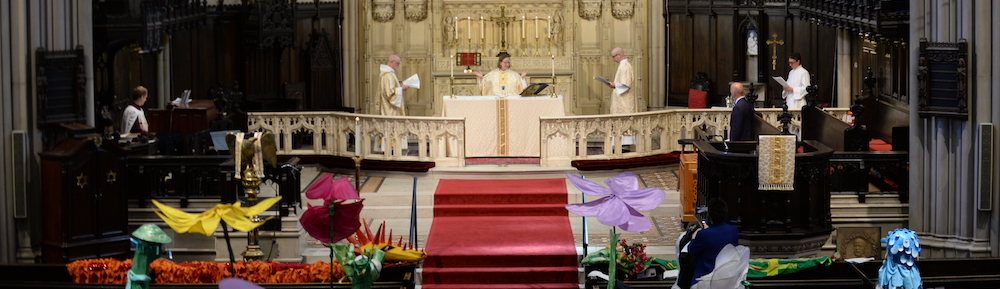
Epiphany 6C. 16 February 2025. The Very Rev. Pamela L. Werntz
Jeremiah 17:5-10. Iin the year of the drought it is not anxious and it does not cease to bear fruit.
1 Corinthians 15:12-20. The first fruits of those who have died.
Luke 6:17-26. Blessed…blessed…blessed….blessed…woe….woe…woe…woe.
O God of healing, grant us the strength, the wisdom and the courage to seek always and everywhere after truth, come when it may, and cost what it will.
Last week we heard the story about what happened when Simon Peter let Jesus use his boat to demonstrate an improbable abundance of fish caught by going deep in broad daylight! Last week Jesus told Peter and his friends that he would show them how to catch people. Somehow that sounded so good, according to Luke, that they left everything and followed Jesus. When Jesus then healed a man of leprosy, crowds started to show up wherever he went in the hope that they, too, could be healed. Luke writes that Jesus would withdraw to deserted places and pray. One day he healed a paralyzed man whose friends had lowered him through the roof, because that was the only way to get close to him. Luke reports, “Amazement seized all of them, and they glorified God and were filled with awe saying, ‘We have seen strange things today!'” Kind of reminds me of church!
When Jesus invited a tax collector named Levi to follow him, Levi gave a great banquet with a large crowd of tax collectors sitting at the table with them, which caused quite a stir among people with higher standards for dining companions. As controversy grew around Jesus’ healings and teachings, folks got mad enough to want to shut him down. “Now during those days,” Luke writes, “Jesus went out to the mountain to pray” all night, “and when day came, he called his disciples and chose twelve of them whom he also named apostles.” It was a motley crew for sure, and apparently not everyone made the team of apostles because he drew from a great crowd of disciples. (Remember, disciples are learners; apostles are learners who are sent out to teach and heal.) Did he choose the most capable, the most diverse, or only the ones who had nothing left to lose? Did the ones who didn’t get selected feel regret or relief? Dread or excitement? Probably a little of both. We don’t know.
Now you’re up to speed about the context for Jesus’ teaching about blessings and woes. One thing I want you to notice right away in today’s Gospel reading is that Jesus was addressing this teaching to “the great crowd of his disciples;” and he was addressing them directly. “You who are poor, you who are hungry, you who are weeping, you who are excluded, reviled, and defamed for humanity’s sake (which is another way of understanding the term Son of Man). And you who are rich, you who are full, you who are laughing, you who are well-spoken of.” They, too, were in the crowd of disciples or learners that Jesus is teaching. That reminds me of church, too!
I also want you to notice that Luke doesn’t spiritualize poverty; he’s talking about access to tangible resources: money, food, clothing, and shelter. Nor does he glorify poverty, hunger, sorrow, or being reviled and excluded. Rather than writing about life after death, he is writing about life before death. Remember Luke is the one who wrote about the early Jesus-following communities, which shared money and other resources in common so that each gave according to their ability and each received according to their need. That’s how living and leaning into the Realm of God or the Rule of Love works, according to Luke.
Taking a little further the idea that the crowd was a mixture of rich and poor, full and hungry, laughing and weeping, included and excluded, I think maybe every person had aspects of blessing and aspects of woe within themselves. I hear the Luke beatitudes as descriptions of needing the Holy One versus relying on one’s own strength; I hear them as descriptions of needing one another versus relying on one’s own strength.
Jesus looked at his disciples and declared God’s blessing on them for being poor, hungry, bereft, excluded, and defamed for his sake. It’s a peculiar honor. I hear Jesus saying, “God bless you for getting into this with me.” You who are poor, yours is the realm of God. (Not in the future, but right now.) You will be fed, experience joy, and experience the heaven of God, which is another way to say shalom, deep peace, or well-being. God bless you for putting everything on the line. And there’s trouble ahead to you who are rich and full, scoffing at the naïveté or laughing at the foolishness of practicing loving kindness to the point of poverty and hunger, sorrow, and slander. You will not experience the true joy of the realm of God unless or until you engage in extreme generosity and get in touch with your own need for God and one another. Jesus was speaking to everyone who would listen. That’s good news for us because we certainly are among the disciples now who are being challenged by Luke’s critique of wealth that is not used for the benefit of the community, so that each gives according to ability and each receives according to need.
Theologian Mark Davis describes the Luke beatitudes as describing the difference between is and ought. [1] How there is a yawning gap between over-resourced and under-resourced, even in the same crowd, and how there ought to be no gap at all. Unfortunately, our lectionary cuts the reading off in his mid-thought. Jesus said:
Woe to you when all speak well of you, but I say to you that listen, Love your enemies, do good to those who hate you, bless those who curse you, pray for those who mistreat you….be children of the Most high who is kind to the ungrateful and the wicked. Be merciful just as God is merciful.
In other words, even when you are on the receiving end of the bad behavior of others because of your faithfulness to the Love of God, respond with Love. And when others are on the receiving end of bad behavior, be merciful just as God is merciful.
It’s Love that made the early Church a most powerful resistor to the oppression and cruelty of the empire. Indeed, today when the Church is functioning at our best, we serve as a bold alternative to authoritarianism as we live into our strong alternative models of community and governance. When we are functioning at our best, we are providing for those in need in ways that are life-giving and liberating for both the givers and the receivers. We are living our best lives in the kingdom of God (aka realm of Love) when we do not confuse wealth, happiness, joy, or popularity with blessings, but understand that the blessings are in the practice of sharing with generosity, compassion, and integrity.
It occurs to me that while Jesus was addressing his followers, there were others within earshot, those from the multitudes who were seeking healing. It occurs to me that maybe we are really not so different at Emmanuel Church: part apostles, part disciples, part not identifying as Jesus followers but seeking welcome, which is a form of healing. Often we come to church somewhat depleted – emotionally, physically and spiritually. Often we come to church fearful, angry, and betrayed by some circumstance, institution, or person in our lives. Sometimes we aren’t fully conscious of our depletion, our fear, our anger, or our hurt. As a crowd (even a small one) we come with varying degrees of awareness about our own unclean spirits or our own dis-ease. Maybe we come out of habit; maybe we are curious; maybe we hope to hear a good word or spectacular music, receive a warm embrace, have the chance to be quiet, have the chance to be heard, or get something to eat or drink; maybe we hope to make a connection with the Divine, with ourselves, with others. Whatever our hope, we all need healing for our bodies and souls.
It also occurs to me that when a crowd (even a small crowd) of people with unclean spirits and dis-ease get together, there’s bound to be discomfort caused by competing or conflicting needs and depleted resources. Then I think, “Welcome to the Church!” We are a motley crew maybe not so different from the first ragtag bunches of people who were first drawn to the healing power of Jesus. And if you arrived at church hoping that either you are the only one with needs to be met, or that no-one else has needs that you will be asked to meet, you may be in for a rough morning.
But if you arrived at church hoping for a chance to give thanks to God for all the many ways that you have been blessed, and looking for opportunities to share those blessings, then you are in luck! This will be a good morning for you! Give thanks to God that you were able to get here at all. If you are able to sit in a pew in this lovely worship space on this snowy day, give thanks to God. If you are able to access this worship service on line in a place that is warm and dry, give thanks to God. If you are able to breathe unassisted, give thanks to God. If you are able to stand and to walk, give thanks to God. If you are able to move and feel your hands and your feet, give thanks to God. If you are able to see, hear, taste, smell, or use any or all of those senses, give thanks to God. Now notice who else is in the room or online. Give thanks to God that you are not the only one here this morning either physically or virtually. If you are able to offer your hand to another in Peace, give thanks to God. If you hunger for the bread and wine of communion, give thanks to God for your hunger and thirst. Or if you desire a blessing, give thanks to God for your desire.
As far as I can tell, giving thanks to God is the beginning of healing. And giving thanks to God in the midst of a crowd (even a small one and even if you give thanks in silence) begins a healing process in you and in everyone around you. Giving thanks is what replenishes our depleted selves – our emotionally, physically, and spiritually depleted selves. Giving thanks to God calms our fears, assuages our anger, provides forgiveness sufficient for the betrayals. Thanksgiving purifies our unclean spirits and heals our dis-ease. Thanksgiving is a sacrifice, because we have to release our hold on our dis-ease and our self-sufficiency. We will have to let go of our incapacitating anxiety and our playing too big or too small. We will have to open our hands and our hearts for healing and acknowledge the truth of our belovedness, becoming needy for the sake of the realm of God. Giving thanks is a powerful way to move from seeker and learner to teacher and healer. The promise of our scripture and our tradition is that the reward of our sacrifice of thanksgiving will dwarf whatever the cost. Offer to God, today, a sacrifice of thanksgiving and respond in Love, no matter what.
- D. Mark Davis, www.leftbehindandlovingit.blogspot.com.