2025

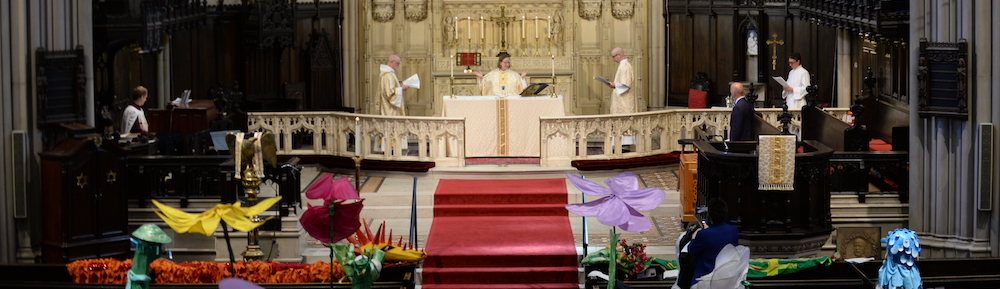
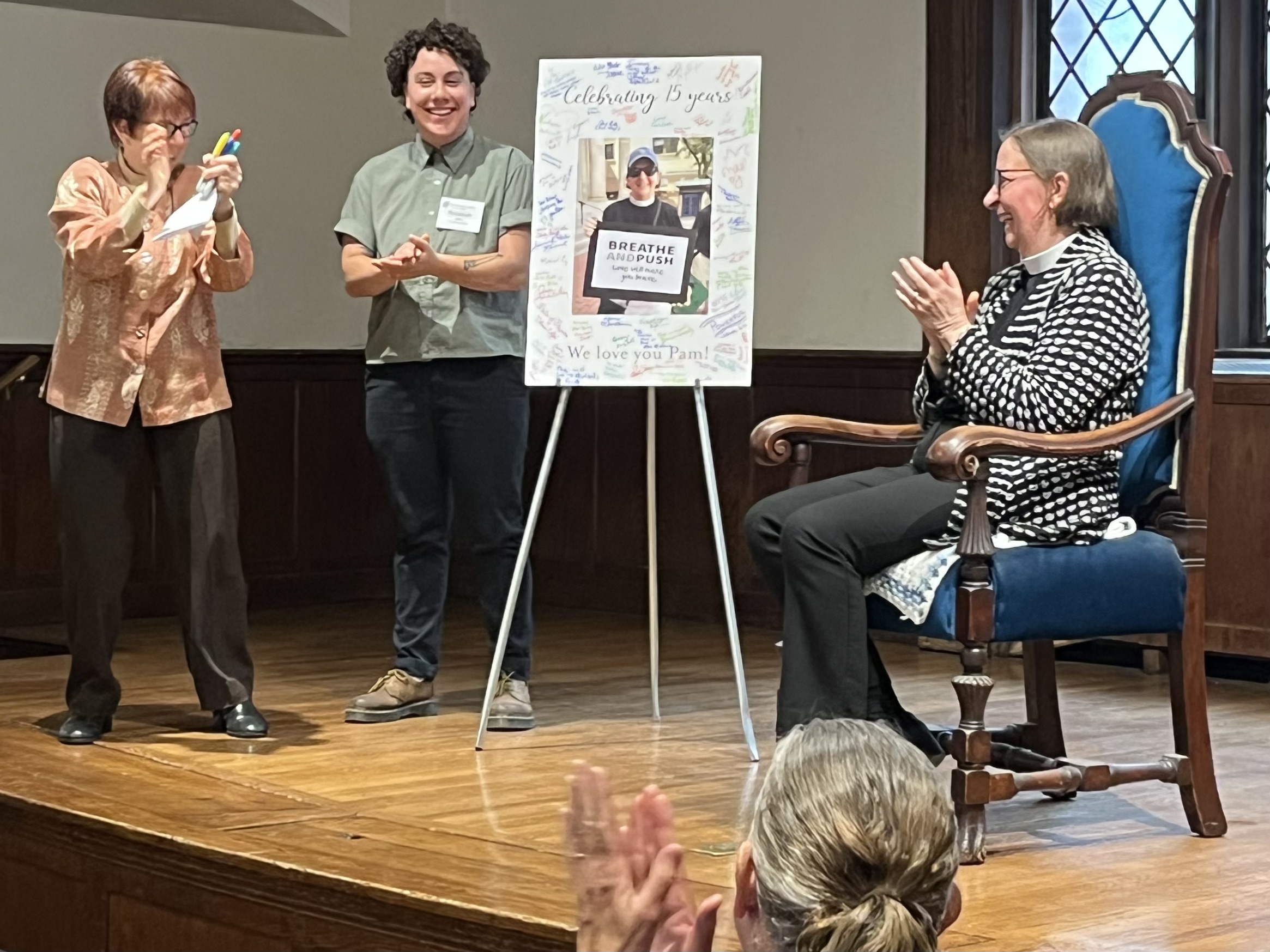
March 30.  We continued our annual meeting, which had begun in February via Zoom due to a snowstorm, with a celebration of the 15th anniversary of our rector’s installation. Actually Pam came to us as priest-in-charge 17 years ago and preached her first sermon on March 2, 2008.

Wardens Pat Krol & Rebekah Shore were joined by Jill Silverstein of Central Reform Temple in congratulating our rector Pam Werntz.

May 4.  Our rector presided at a memorial service in Lindsey Chapel for benefactor James Theodore Bartlett (2/13/1937 – 11/7/2024).  A beloved member of our congregation, Jim served for years as chair of our Finance Commission.
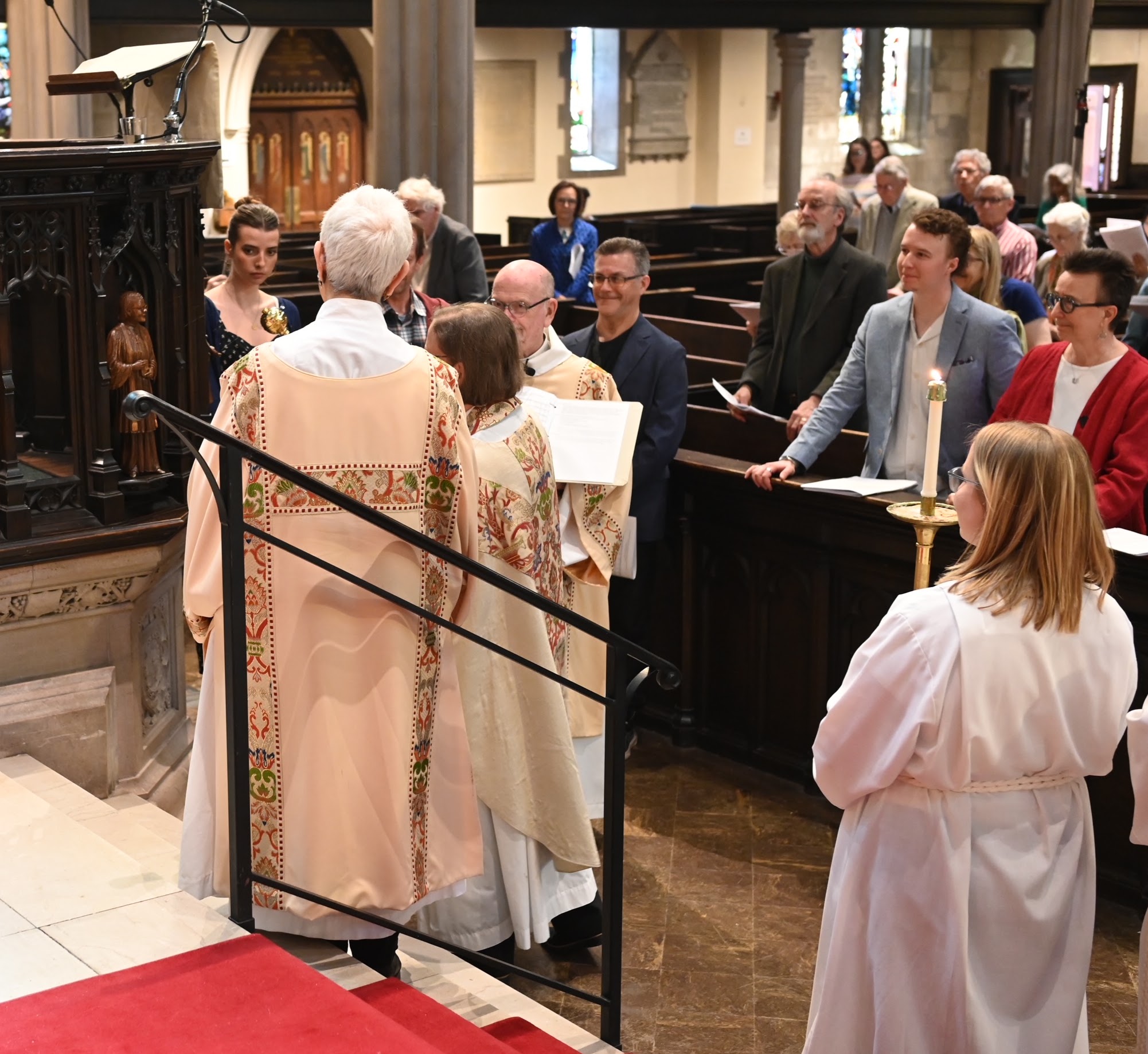
May 11.We dedicated our third pulpit statue to the Rev. Dr. Suzanne Radley Hiatt: theologian, prophet, priest, professor, and advocate.

Ordained as one of the Philadelphia 11 on July 29, 1974, this “bishop to the women” served as an inspirational mentor to many, including our rector, whose dedicatory sermon can be watched about 28 minutes into our recorded service.   For Dr. Hiatt’s connection to Pauli Murray, please see We’ve Come This Far by Faith.  We thank Ted Southwick and the friends of the late Dr. Hiatt for supporting this project.

Sculptor Ted Southwick smiled while our rector asperged his figure of the Rev. Dr. Suzanne Hiatt. Photo: JG Bullitt

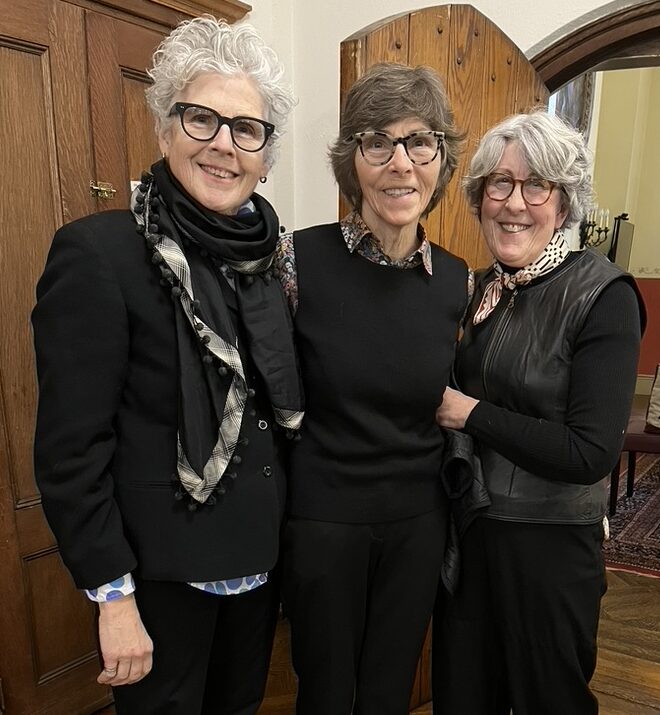
Marianne Iaucco, vestry member (2007-08), Clerk of Vestry (2009-10); Mary Blocher, Treasurer (1995), vestry member (2007-11); Anna Pauline Zeusler, vestry member (1990-93)

Dec 21.  We bade farewell to Mary Blocher and Marianne Iauco as they joined our diaspora in order to be closer to family after their four decades of service on our vestry and Worship Commission. Pauli Zeusler, who had known them when she served on our troubled vestry in the early 1990s, came to the luncheon they gave the parish before their departure.


Dec. 22.   The Rt. Rev. J. Clark Grew II, Bishop of Ohio (1994-2004) and our Associate Priest for many years, died in Boston. Born 20 Dec. 1939, he was the namesake of his great uncle J.C. Grew, US Envoy to Denmark & Switzerland, Ambassador to Turkey & Japan, then Undersecretary of State during WWII. The Grew family held Pew 62 from the foundation of Emmanuel, and Annie Clark (Mrs. Henry) Grew held the deed for Pew 51 from 1897-1925. 

Feast of Love

Lent 4C, March 30, 2025.  The Very Rev. Pamela L. Werntz

Joshua 5:9-12. The Lord said to Joshua, ‘Today I have rolled away from you the disgrace of Egypt.”
2 Corinthians 5:16-21. So we are ambassadors for Christ, since God is making his [sic] appeal through us.
Luke 15:1-3, 11b-32. Now all the tax collectors and sinners were coming near to listen to him. And the Pharisees and the scribes were grumbling.

O God of mercy, grant us the strength, the wisdom and the courage to seek always and everywhere after truth, come when it may, and cost what it will.


I’m not going to ask for a show of hands, but I wonder how many of you ever complained about someone else’s bad behavior? (I have too.) And I wonder when you complained, did you want an answer? (I have too.) I think it’s important to know that Jesus tells this story of the man who had two sons in response to the complaint that Jesus welcomes sinners. The story is part of Jesus’ answer to others complaining about his habit (or practice) of hanging out with people who behave badly. The complainers, according to Luke, were some of Jesus’ colleagues. And the complaint was that Jesus welcomed sinners – people who were dangerously out of step with the well-being of the community, people who were unclean, unethical, unlawful, just plain gross — and not only did Jesus welcome them, he even ate with them. Simply put, the complaint was, that’s foolish, that’s not right, and, for those who were jealous, that’s not fair.

That was the complaint, and Jesus’ response in the Gospel of Luke was to go on a kind of parable tear. In rapid succession, he told them about a shepherd finding a lost sheep, a woman finding a lost coin, and then this story of the man with two sons. Then he went right to a parable about a dishonest manager and then one about a rich man and Lazarus and it all ends with an instruction to forgive another disciple as many as seven times a day – which may be a clue as to just what kind of folks his disciples were and how often they needed to be forgiven!

This story, right in the middle of this cluster of parables, is the story that assures parents that for thousands of years, some siblings have been doing things that are not “right” and other siblings have been complaining “it’s not fair”. There’s the son who is reckless and wasteful but then has the incredibly bad luck of finding himself living in a land that has a famine – and most of us know stories of people whose lives seem to bounce between bad choices and bad luck – and some of us have been there ourselves. There’s the son who is steady and responsible, working the land all the years that his younger brother was gone, no extravagant parties – not even a roasted goat to celebrate with his friends. But, since the father had already given him the land, he was working his own land. He was working like a slave for something he already had. Actually his father no longer had a goat to give, because all the goats belonged to the older son. And most of us know stories of people whose lives seem burdened with responsibilities that they faithfully, and sometimes begrudgingly, sometimes resentfully attend to – and some of us have been there ourselves. That son worked so hard for so long that all his muscles, even the muscle of his heart had become hard. 

And most of us know stories of parents who do crazy things for their children. Here it’s the father, who divided his property prematurely. (In the Greek, the word for property literally is his “whole life” — the means of his subsistence.) He did something that was extremely foolish and even reckless. He endangered the well-being of himself and the rest of his family. Once his property was divided he had no way to ensure that he and the rest of his household would be provided for. His sons had no obligation whatsoever to provide for his care in a legal sense. Legally he was dead to them. If both sons had done what the younger son did, the father and the household would have been out of luck. And yet the father was overwhelmed with joy at the return of his younger son, and he replied to his older son’s “not fair” complaint, “son you are always with me, and all that is mine is yours.” And the father was not just feeding and clothing his returning son, he was honoring him.

The parables that Jesus told were powerful because of their ability to surprise and disturb. And they were subversive enough that they made people with military and economic power mad enough to want Jesus killed. Our challenge with hearing parables that are as familiar as this one is that we think we know what they mean. And often it’s what we learned in Sunday School, and we never go deeper. Many of you know something about sibling rivalry first hand (and the rest of you probably have seen it). Many of you know something about parenting – either from being a parent or watching other people be parents. So many people listen to this story and can imagine, “I’m that guy.” Many people listen to this story from the perspective of one of the characters. 

So I want you to imagine something a little differently than usual. I want you to go deeper. I want you to imagine that every one of the characters in this parable is a part of you. Every single one of us has each of the three characters inside of us. Each one of us has a part which makes bad choices and has bad luck. And, each one of us has a part which works hard and is judgmental about others who make worse choices or have better luck. And each one of us has a part that is called to be the foolishly loving one who goes out to forgive the stumbling self and goes out to appreciate the dutiful self. I want you to imagine that this story Jesus is telling is all about the capacity for joy and forgiveness inside of you as well as among you in the wider community.

And here is something that is surprising and scandalous. We have no proof that the younger child reformed and stayed home. We only know that this (grown) child tried to begin again and that the trying itself – the showing up — was enough for the loving parent – and that he was forgiven. We have no assurance that the hard-working, stay-at-home child ever repented of his jealousy and resentment but we know that his father went out to greet him too and to plead with him to join the party. His father reminded him that his inheritance was intact if he wanted it. We have no proof that the father was not stung time and again by both of them, or that he ever understood and took responsibility for his own recklessness in prematurely dividing his property. We only know that the parent understood the struggles of his sons and didn’t seem to be particularly interested in inheritance. He wasn’t particularly interested in accounting for the iniquities. We don’t know the long-term results, but what this parable suggests is surprising and actually pretty scandalous for people as results-oriented as we tend to be. 

If this parable is a glimpse into life fully lived in the gratitude, generosity, and grace of Love, or what Luke calls, “the realm” or “the kingdom,” then it may be about calling out from the depths to return and reaching into the depths to forgive. The younger son is not rejected. The older son is not rejected. In fact, in the parable, Jesus rejects the idea of one person (or one group) being rejected at the expense of another. The realm of God is universal, not particular. [1] It is big enough and wide enough to accommodate the foolish, the not-right and the not-fair. In the end, all in the story share all that there is.

As Paul says in the Epistle this morning, “in Christ God was reconciling the world, not counting their trespasses against them.” The Redeeming Urge of Love (the Christ) is reconciling the world, with no accounting of trespasses or sins. We have been entrusted with this message of reconciliation. We are ambassadors for Christ – that Redeeming Urge of Love. It is our responsibility to spread the Word, and to take care not to get lost in self-righteousness. Eugene Peterson likens the sin of Christian self-righteousness to iatrogenic illness – illness inadvertently caused by healthcare, like a staph or c diff infection picked up while being treated in a hospital. The sin of Christian self-righteousness can be inadvertently picked up in church. When we believe that we are the only ones, for example, who know how worship should be, how sermons should be, how prayers should be, how music should be, how mission or outreach should be. 

Peterson writes, that the best protection against the sin of self-righteousness is an acute awareness of our lost condition in which we so desperately and at all times need a Savior, because “as long as we hold on to any pretense of having it all together, we are prevented from deepening and maturing in the Christian faith….as long as we avoid recognition of our lostness we are prevented from experiencing the elegant profundities of foundness…as long as we insist on maintaining safe moral grids in which we always know where we stand (and where everyone else stands!) in poses of self-sufficiency, we disenfranchise ourselves from the company of the found sheep, the found coin, the …found brother and the celebrating angels.” [2] And we refuse to attend the party.

In an invitation to move from alienation to reconciliation – the father of the two sons seeks to reconcile them. This story calls us to reconcile, to re-call that we are members of The Body of Christ – members of God’s Body. We belong to one another. In the story hear the words, “this son of yours…this brother of yours” – they belong to each other. I’m reminded that the Greek word that gets translated “devil,” comes from the root that means to separate, to tear apart. The temptation is separation, alienation from one another, one’s own self, and God. A number of years ago when the presiding bishop of the Evangelical Lutheran Church in America, Elizabeth Eaton said that she believes if hell exists, it’s empty. But this is a story (for me) about why hell might not be empty – and it’s because the folks that are there put themselves there and refuse to come out.

The Biblical value being asserted in this story is completeness of the group – wholeness even across profound differences.[3] When the older brother complains bitterly, the father responds not with judgment, but with compassion: “you are always with me and all that is mine is yours, come to the party.” The parable doesn’t choose between the sons, but urges both to attend the celebration.[4] The parable says, go into the celebration. Whoever we are, whatever we’ve done, wherever we’ve been, we belong to one another. We are to be reconciled to one another, so come to the feast of Love.


  1.  Bernard Brandon Scott, Hear Then the Parable (Minneapolis:  Fortress Press, 1989), p. 125.
  2. Peterson, pp. 88-89.
  3.  The Chautauquan Daily, August 18, 2011 chqdaily.com interview with Amy-Jill Levine.
  4.  Bernard Brandon Scott, Hear Then the Parable: A Commentary on the Parables of Jesus (Minneapolis: Fortress Press, 1990), p. 125.

Improvisation

This week, we’re continuing rehearsals for the Easter Play, and I’m excited to incorporate some drama-therapy-based character work into the process. Through a series of movements and prompts, participants will step into their characters to explore their desires, motivations, and challenges through light improvisation.

This will be my first time facilitating exercises like these, so I’ll admit I’m a bit nervous.   I know, however, that the only way to improve is by practicing; and honestly, I couldn’t think of a better group to practice with.

If time allows, I’ll continue with my superhero interviews, but otherwise I’m taking it easy this week. Looking forward to seeing where all of this leads!

– Mary Schwabenland

Reckoning with History: The First Step toward Racial Reparation

Addressing the historical harms of slavery starts with facing up to a good deal of uncomfortable truth. What does this mean for white Americans like me or for members of an historically white American church like ours?  We must acknowledge first that the truth has been hidden from us. Participants in the “Stolen Beam” course on reparations, which Connie Holmes and I teach, will sometimes say, “Why was I never taught this?” We must seek information from unaccustomed sources, which requires effort and research. Continue reading

Preparation for Our Easter Play

This week, back from my spring break, I’m feeling refreshed and ready to dive back into creative collaboration here at common art.

First up is the kickoff meeting for our Easter Play! My plan is to start with a warm-up activity to break the ice and get everyone engaged before we do a read-through of the script, written by our beloved community member Richie Berman.  Since this script is shorter than our December play, I’m hoping we can spend more time having fun with it rather than getting too caught up in staging logistics.

Over the next few weeks, I’d love to incorporate more character work and acting exercises (with a therapeutic lens, of course), which you might see in a traditional theatre group.

Beyond that, I’m still continuing with the superhero interviews; and people are coming up with some truly creative responses. Last time, we had one superhero whose power came from sandwiches and another whose strength was fueled by friendship bracelets.  I loved seeing how much fun everyone was having with it.

That’s all for this week.  I’m excited to see where these projects take us!

Show what love looks like!

Lent 2C, March 16, 2025.  The Very Rev. Pamela L. Werntz

Genesis 15:1-12, 17-18. I am your shield.
Philippians 3:17-4:1.  He will transform the body of our humiliation.
Luke 13:31-35.  How often have I desired to gather your children together as a hen gathers her brood under her wings.

O God whose glory is always mercy, grant us the strength, the wisdom and the courage to seek always and everywhere after truth, come when it may, and cost what it will.


Today’s choice of a Gospel text for the second Sunday in Lent always strikes me as a little jarring. It’s jarring to begin the first week of Lent with Luke’s account of Jesus before his ministry began, resisting temptations in the wilderness, and then skip over miles of travel, teaching and healing all around the Galilee and beyond, to the middle of the Gospel of Luke, at the end of chapter thirteen. (Next week the scheduled portion is back at the beginning of chapter 13.) The slow, almost leisurely pace of Jesus’ ministry in Luke with magnificent story-telling, prayer and Sabbath meals is completely eclipsed in our Lenten readings from Luke’s Gospel. Our lectionary saves all those stories for the summer. Continue reading

Spectrogram

Last Wednesday, I decided to do a performance-based workshop with my common art poetry group, using Dylan Thomas’s “Do Not Go Gentle Into That Good Night”. We mixed things up with some acting exercises, which had everyone laughing and really brought the poem to life. It was such a great reminder of how performance can transform poetry into something so dynamic and engaging. The energy in the room was contagious! Continue reading

Boston’s Home for Aged Colored Women

March 3, 2025

To honor women’s history this month, we turn to a story of little seen women in Boston at the time Emmanuel was being founded. The Boston Globe published an article about the discovery of a marker for the Home for Aged Colored Women (1860-1944) in Dorchester’s Cedar Grove Cemetery (From a mass grave in Boston, unearthing Black women’s lives” by Karilyn Crockett (February 3, 2025)

The Home, founded in 1860, was among the Boston institutions that offered shelter and support to women who did not have financial or other family support. In the case of the Home for Aged Colored Women, historical news accounts and the organization’s records (located at the Massachusetts Historical Society) state that women of color applied to the Home after not being welcomed at almshouses and other benevolent institutions.

We discovered that Emmanuel parishioners were benefactors of the Home from the 1860s onward (among them was Susan Coombs Dana (Mrs. Wiliam R. Lawrence).

We invite you to explore these sites which explore the Home’s history in more detail

The West End Museum site.

The National Park Service’s page about the Home.

–Mary Beth Clack, Mary Blocher, Cindy Coldren, Pat Krol, Liz Levin

Preparing for Easter

Lent 1C, March 9, 2025.  The Very Rev. Pamela L. Werntz

Deuteronomy 26:1-11. Now I bring the first of the fruit of the ground that you, O Lord, have given me.
Romans 10:8b-13. The word is near you, on your lips and in your heart.
Luke 4:1-13. It is written…it is written…it is said.

O God of hope, grant us the strength, the wisdom and the courage to seek always and everywhere after truth, come when it may, and cost what it will.


I’m feeling relieved that it’s finally Lent. We’ve had a longer wait than usual because this year Easter is almost as late as it can ever be, but the calendar hasn’t been the only thing making these last weeks feel unbearably long. While I’ve waited, I’ve felt keenly aware of our need for penitence and healing, for a quarantine of almsgiving, prayer, fasting, and meditating on Holy Scripture. I’ve felt our need to get right with God, in the midst of the socio-economic collapse and exiles of all kinds that are happening in our world.
We have before us this morning five lessons from Deuteronomy, the fifth book of the Torah, also known as the Pentateuch, the Five Books of Moses. You might be tempted to look at your bulletin right now and wonder where the other four lessons are. They’re hard to see because they’re not labelled. One was our first reading today was from Deuteronomy. The other four lessons from Deuteronomy are embedded in Romans and Luke. Our Biblical literacy as Christians would improve greatly if we understood more about the first five books of the Bible because Paul and other early Jesus followers likely knew the Torah by heart.
The word Deuteronomy means second law, and that means reaffirmation of the pact or the covenant between the Holy One and the holy people. Deuteronomy is the reinterpretation or recapitulation of the Exodus story and forty years of sojourning in the wilderness. In Hebrew, the book is known as Devarim, which means words, because it is a series of speeches, sermons, if you will, written to persuade people in the late First Temple period and the Babylonian exile period to stay true to the Holy One in the midst of severe trials and tribulations. Hebrew Bible translator Robert Alter refers to Devarim as a great “rhetorical enterprise,” which took the narrative texts of Exodus (and Leviticus and Numbers) and restated them in words and ideas that people experiencing socio-economic collapse and exile could understand. [<a href=”#refs”><strong>1</strong></a>] Deuteronomy is a preacherly project – a series of orations delivered to remind people once again of the steadfast faith of the Holy One, and of the deadening and deadly repercussions of forgetting just who and Whose they are. Deuteronomy is a collection of sermons to help people make connections between their traditional teachings and their contemporary contexts.
In our first reading we hear Deuteronomy’s instructions for when (or whenever) the Holy One has given rest from one’s enemies. It doesn’t indicate how long the rest must be, but it’s long enough to harvest first fruits. The instructions are to show thanks to God by giving the first fruits of the people’s productivity to God through the priest. Deuteronomy 26 describes a liturgy of thanksgiving and gives the words to say. Say this: “we know that we have come from people who were aliens and slaves. The Holy One heard our cries and saw our afflictions and led us out of that hard place to a delightful place and so therefore we share our bounty in celebration with others who are resident aliens, that is strangers and foreigners living in our land.”

In our second reading, the Apostle Paul was writing to the Jesus followers in Rome. He reminds the congregation “The word is near you – on your lips and in your heart.” “The word” here means the Torah in the broadest sense. The word of God. The recipients know the rest. It’s Deuteronomy 30:11-14, which continues: “It’s not too hard or baffling for you, nor is it beyond reach or too far away. It is not in heaven that you should say, ‘who will go up to heaven for us and get it for us so that we may hear it and observe it?’ Neither is it beyond the sea so that you should say, ‘who will cross to the other side of the sea for us, and get it for us so that we may hear it and observe it.’ No, the word is very near to you; it is in your mouth and in your heart for you to observe.” What’s surprising about this passage in Deuteronomy is its universality. Paul upholds the idea of universality with his insistence that there is no distinction between Jew and Greek; the same Holy One is the Holy One of all and is generous to all who call on the Holy One. The Word of God is not just for a few people – it’s accessible to and the responsibility of all of the people.[2] The capacity to love is in all hearts – we are born with it. The capacity to speak blessings is in all mouths. The end of that passage in Deuteronomy that Paul alludes to is in the voice of Moses: “Look, I have set before you life and death, blessings and curses. Choose life. Choose love.” The Apostle Paul was urging what Jesus urged, which was what Moses urged. Even in the midst of socio-economic collapse and exile, choose life; choose love.

And then we have three teachings from Deuteronomy cited by Jesus in his conversation with the slanderer or the accuser (also known as the devil) when Jesus had gone into the wilderness following his inaugural immersion in the Jordan River. The word that gets translated “led” as in, “A spirit of holiness led Jesus into the wilderness” is not in past tense, not a completed action, but ongoing action. A spirit of holiness did not just drop Jesus off at the edge of the wilderness and wish him good luck. And there’s no definite article here – it’s not The Holy Spirit as the title of a character; it’s a spirit of holiness that filled Jesus to the brim and was leading him in the wilderness.

That’s good because Luke says that the devil tempted him for 40 days, not just on the 40th day. The slanderer or accuser was crafting biblical arguments in order to make a deal with Jesus. Speak this stone into bread, the devil said. You’re starving, Jesus, and surely God wouldn’t object to your having a little bread. You don’t have any regular ingredients, and only the little people bake their own bread anyway. [<a href=”#refs”><strong>3</strong></a>]Surely you can satisfy your own hunger. Jesus’ response quotes Deuteronomy 8:3: “One does not live by bread alone, but by every word that comes from the mouth of the Lord.” That Deuteronomy sermon goes on: “Know then in your heart that as a parent instructs a child, so the Lord your God instructs. Therefore, keep the commandments of God, by walking in God’s ways and by revering God, for your God is bringing you into a good land where there will be plenty of food for you and plenty to share with friends and strangers.”

The slanderer’s next move is to ask, “But what about Rome? He says, “The Roman Empire has been given to me. I’ll give it to you if you worship me.” I wonder who gave the Roman Empire to the devil? Was it the people who ceded their power because of their fear? Jesus’ response is from Deuteronomy 6:13: “The Holy One your God, you shall revere and you shall serve and by God’s name alone you shall swear.” In other words, pay no allegiance to an empire. This passage is right after the watchword of Jesus’ faith, the Sh’ma: “Listen deeply, O god-strugglers, the Holy One is our God, the Holy One alone, and you are going to love the Holy

One your God with all your heart and with all your soul and with all your very muchness. Keep these words that I am commanding you today in your heart. Recite them to your children and talk about them when you are at home and when you are away, when you lie down and when you rise. Bind them as a sign on your hand, fix them as an emblem on your forehead and write them on the doorposts of your house and on your gates so you will never forget them.”

Then the slanderer pulls out a line from a hymn (Psalm 92:1-12) about being protected from harm by angels by way of encouraging Jesus to jump off the pinnacle of the temple. Jesus’ response is to pick up close to where he left off in his last response from Deuteronomy 6:16: “Do not put the Lord your God to the test” In other words, don’t set up challenges for the Holy One, as in, if you do this thing for me, O Love Divine, and then I’ll do the next right thing.” Don’t do that. “You must diligently keep the commandments of the Holy One your God and the decrees and the statutes that the Holy One has commanded you. Do what is right and good in the sight of the Holy One so that it may go well with you.”

People of Emmanuel, I urge you to accept the invitation to the observance of a holy Lent. The whole idea of Lent is to deepen our awareness of the closeness of the Holy One – of the Divine, on our lips and in our hearts, and to get right with God. Lent is a time to strip away whatever separates us from our deepest knowledge of Love — in ourselves, in our parish, in our communities, and in the world around us – indeed, in total strangers and even enemies. The season of Lent invites and implores us to make a journey from a world that was into a world that is becoming. This journey will require commitment, adaptability, and the willingness to receive and give help.” This journey will get us ready for the terrifying and exciting Easter story!

What might you do with a handful or even an armful of a spirit of holiness today? How might you prepare for Easter by being more hungry, by acknowledging where (wherever) you are powerless without God’s help, and taking a break from bargaining with the Holy One. This Lent, fast from whatever is keeping you stuck in a narrow place. Pray in a way you’ve never prayed before. Perhaps take a break from cynicism or despair. Perhaps step away from resentment for a season. Fast from control, from irritation, from anger or shame, from worry or struggle. You can break your fast on Sundays – bring all of those difficult feelings to church, confess them and take in the assurance of absolution. Give away more money or time than you can afford for the relief and benefit of those who are poorer than you. And finally, read some scripture, preferably not by yourself but with other people –join our Tuesday morning or Thursday evening Bible study groups, or one of the language study groups. Or just listen to some sermons or other teachings about scripture!

Begin this Lent to get in better shape for the hope of the blessing of the Easter proclamation that Love is more powerful than any sin; Love is more powerful than even death. Stop doing whatever is keeping you feeling separate from The Great Love. Do whatever you can this Lent to get ready for going more fully, more whole-heartedly, into the place where your deep joy will meet the world’s deep need, which is the place where the gates of heaven are always wide open. You’ll enjoy Easter more if you’ve done some preparation. I guarantee.

  1.  Robert Alter, p.869.
  2.  Torah: A Modern Commentary (New York: Union of American Hebrew Congregations) p. 1542.
  3. I heard Martin Smith, formerly SSJE, say this in a sermon one time and have never forgotten it.
  4.  Martha Hickman’s Healing after Loss: daily meditations for working through grief.


Interviews with Superheros

Last week, I had the chance to try out my superhero interviews, and I’m happy to report that they went really well! I ended up conducting four interviews, which felt like a great way to explore and practice my therapeutic skills in this setting. Since each person interprets the questions differently this format really gives me an opportunity to guide them through the conversation. It’s a mix of reflecting back what they’ve shared, offering new words or ways to summarize their experiences, and asking for clarification or digging deeper into certain themes. It feels like a collaborative process in which we’re both learning and discovering.

One of the things I loved most was that every superhero I spoke to had a power that was rooted in helping or healing others—whether through music, seeing people’s truths, transforming darkness into light, or offering protection through faith.  Considering how much passion, kindness, and community-mindedness I’ve witnessed in this space, I’m not surprised but still find myself awed and inspired.

Since I find the superhero theme naturally lends itself to storytelling,  I can’t help but feel creative potentials percolating in my mind. Imagine an Avengers-style crossover of common art superheroes, here to bring the world towards healing and wholeness. That’s a story I could get invested in.

As for this week, I’m diving back into my poetry group. While it’s not superhero-themed, I’m hoping some of the creative energy from the interviews will carry over. I’ve planned some fun acting exercises to incorporate.  I’m excited to see whether they spark creativity and engagement in the group.

This Friday is Boston Warm’s first movie day of the year!  I’ll be leading a discussion after we watch “West Side Story”, which offers  so much to unpack.  I’m looking forward to exploring themes that feel especially relevant to our community, such as division and unity, discrimination and belonging, hope and despair, and more. The movie will begin at 9:00am, so feel free to join us if you can!

-– Mary Schwabenland, 26 Feb. 2025