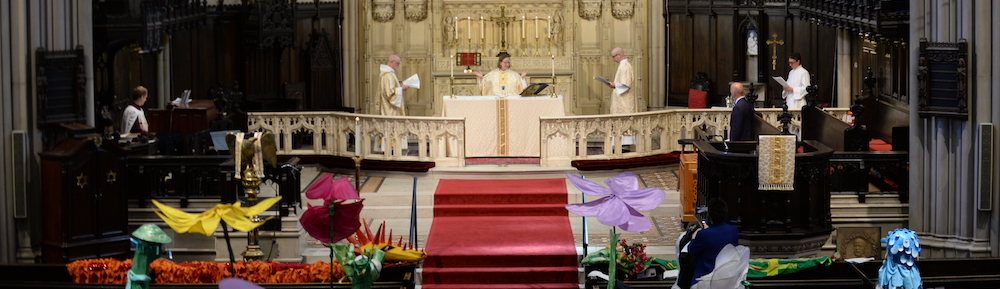
The Divine with Us

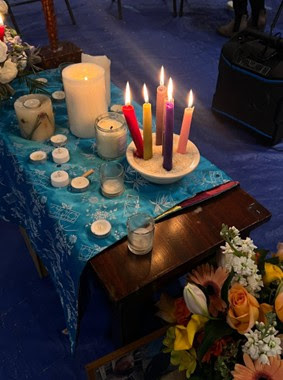
Hello, folks!  In reflecting on my time at common art and common cathedral this week, I felt inspired to write a poem about finding God in the common places. I hope this poem might prove to be a fun way to experience or envision these programs!

The Divine in the blue tarps
and folding chairs,
and the wax-stained tablecloth on the piano-bench altar. Continue reading

The Peace of God’s Realm

Proper 13 C, 3 August 2025.  The Rev. Dr. John D. Golenski.

Luke 12:13.  “Teacher, tell my sibling to divide the family inheritance with me.”


Whenever I hear this portion of Luke’s Gospel, I am carried back to an eerie parallel in my extended family’s history. One of my maternal uncles, Zephyr (everyone called him “Fee”), one of my mother’s younger brothers, returned from the Second World War in one piece. He had served in the Allied Persian Corridor Logistics Corps, which had built and maintained the route for almost half the lend-lease materiel sent from the US to the Soviet Union. They had helped the Russians to repulse the German invasion of 1941-44. Fee’s parents proudly displayed a photo of the “Big Three” meeting at Yalta. In the background, Fee is standing at attention as one of the honor guards. Continue reading

Preparing for Easter

Lent 1C, March 9, 2025.  The Very Rev. Pamela L. Werntz

Deuteronomy 26:1-11. Now I bring the first of the fruit of the ground that you, O Lord, have given me.
Romans 10:8b-13. The word is near you, on your lips and in your heart.
Luke 4:1-13. It is written…it is written…it is said.

O God of hope, grant us the strength, the wisdom and the courage to seek always and everywhere after truth, come when it may, and cost what it will.


I’m feeling relieved that it’s finally Lent. We’ve had a longer wait than usual because this year Easter is almost as late as it can ever be, but the calendar hasn’t been the only thing making these last weeks feel unbearably long. While I’ve waited, I’ve felt keenly aware of our need for penitence and healing, for a quarantine of almsgiving, prayer, fasting, and meditating on Holy Scripture. I’ve felt our need to get right with God, in the midst of the socio-economic collapse and exiles of all kinds that are happening in our world.

Continue reading

I’m begging you.

Epiphany 7C.   23 February 2025.  The Very Rev. Pamela L. Werntz

Genesis 45:3-11, 15. And he kissed all his brothers and wept upon them.
1 Corinthians 15:35-38, 42-50.  Someone will ask, “How are the dead raised?
Luke 6:27-38. A good measure, pressed down, shaken together, running over will be put into your lap.

O Most Merciful and Compassionate, grant us the strength, the wisdom and the courage to seek always and everywhere after truth, come when it may, and cost what it will.


During this season of Epiphany, our First Testament lessons have been from the Writings and the Prophets: Nehemiah, Isaiah, Jeremiah, and Malachi. Suddenly and unexpectedly, a lesson falls into our laps from Genesis about the long-lost Joseph encountering his brothers in Pharaoh’s court in Egypt. I want to make sure you know the backstory just in case you didn’t have at least a half a dozen years of Sunday School when you were growing up!

Here’s a quick synopsis of about a dozen chapters of Genesis: Joseph was the 11th of 12 sons of Jacob (aka Israel). Jacob had his last two sons with Rachel, who died in childbirth delivering Benjamin. The legend goes that Joseph was Jacob’s favorite, and his brothers were insanely jealous of their father’s favoritism and Joseph’s dreams of superiority. When Joseph was 17, his brothers, who couldn’t take it anymore, decided to kill him. Then they changed their minds and threw him into a pit instead. He got pulled out by some passersby, who sold him into slavery. The brothers tore up Joseph’s ornamented tunic, a special gift from their father, put blood of a goat on it, and told Jacob that his beloved son must have been devoured. [1] He was devastated. Joseph ended up in Egypt, where he was enslaved in a wealthy household and then jailed by the jealous master whose wife lusted after him. While in jail, Joseph interpreted the dreams of fellow prisoners and so gained the attention and then the trust of Pharaoh, who made him the second-most-powerful person in Egypt, in charge of the empire’s food supplies through a severe famine. 

Meanwhile, Joseph’s brothers, who were starving in the land of Canaan, learned that there was plenty to eat in Egypt; so they headed there to beg for food. They didn’t recognize Joseph when they met with him, but he knew them. He gave them sacks of food, but hid a golden cup in youngest brother Benjamin’s sack. He then accused Benjamin of theft and threatened to imprison him. When the brothers begged to be imprisoned in Benjamin’s place, Joseph revealed who he really was. High drama! That’s where our story this morning picks up.

What’s missing in our reading is the beautiful verse in which Joseph and Benjamin wept on each other’s necks in a poignant acknowledgement that the injury inflicted by the older brothers was not just to Joseph and Jacob, but also to Benjamin. The two sons of Rachel then weep over the other ten brothers. There is no righteous retribution, vindictiveness, or Schadenfreude at their desperate circumstances, even though, surely, they had it coming. There is a promise of mercy, compassion, material restoration, and care with a strong sense of divine providence turning decades of tragedy into a future of dignity and grace. Walter Brueggemann describes Joseph’s work as reinterpreting the past, redefining the present, and reimagining the future. [2]

In the light of this story from Genesis, I can see that Jesus was teaching Torah in Luke’s Sermon on the Plain. When I look through Luke’s particular lens at Torah and Gospel, I can see that he views the Good News as the healing power of relationship with the Divine, the healing power that flowed out of Jesus, to reinterpret the past, redefine the present, and reimagine the future. But Jesus’ teachings here are hard; the challenges are huge. Even if we agree with the ideas and the ideals of loving our enemies, putting that into practice takes a lifetime of work. Often in conversation about these teachings, there’s a quick move to the extremes: what about the oligarchs? What about the President? Going to the extremes is a way of avoiding looking at our own spheres of influence. Closer to home we might ask: what about someone who is in an abusive or exploitative relationship? No! What then? Are we to be passive or complacent? How do we reckon with evil without indulging it? Surely we should not tolerate intolerance! Jesus’ answers have to do with responding restoratively rather than retributively. Restoring what? Restoring dignity. Jesus asserts the healing power of restoring dignity in undignified circumstances. Jesus has no tolerance for public shaming or humiliation, and he knew that violence never ends violence. Only creative non-violence will do that. Hatred will never overcome hatred; only love will do that. (That’s a teaching from the Buddha, by the way.) Similarly, Jesus lays out a path of non-violent, dignified responses to injuries that affirms self-worth and the worth of the other, even if the path is completely obscured by the fog of cultural differences, language, and time.

It’s hard for me to think of a teaching of Jesus that requires greater translation across culture, time, and language than the one about turning the other cheek if someone strikes you. The word that gets translated strike describes the act of slapping someone with an open hand. The backhand slap was typically done in the context of humiliation or mockery, used to shame someone in a public setting. The Greek dictionary says, “It was considered a grave insult, reflecting a deep level of contempt or disdain.” [3]

I was far along into my theological education when I had the opportunity to see the great Walter Wink demonstrate this teaching from Jesus, and it made an indelible impression on my heart. He demonstrated the motion of backhanding someone on the right cheek (with his right hand) like someone with greater power would do to someone with less power. When the victim offered the other cheek, the only slap possible was to cup the person’s cheek, which was a gesture of affection. The move of offering the other check is physically, literally, disarming. It is an elegant response that asserts the dignity of both the perpetrator and the victim. Likewise, giving one’s shirt to someone who has just taken one’s coat is a non-violent way to demonstrate the dignity of nakedness and the indignity of injustice. In an honor-and-shame culture, nakedness brings shame on the one who sees, not on the one who lacks cover.

Although these are not teachings about being doormats for Jesus, what if we cannot manage to love our enemies? What do we do when loving is too hard or too dangerous? Remember, when the task is overwhelming and seems impossible, it means that the first step is too big; and so we need to break it down into smaller steps. One move is to step outside of what Pádraig Ó Tuama calls, “the energy of enmity,” which keeps us trapped or stuck, cornered or cowering. [4] Buddhist teachers Robert Thurman and Sharon Salzburg have said that, for them, the first step toward non-hatred is to become aware of how it feels to be scared and angry inside of oneself but not todiscount or ignore the injury. If you’re like me, lately, you’ve had opportunities to feel scared or angry every day. 

A next step is to cultivate a desire to not be stuck there: a desire to heal. Non-hate is the beginning of the journey. If you’re like me, you also have opportunities to step out of that narrow place of desire for revenge and into a place of mercy and compassion. If you’re looking for an example of what I mean, the Bishop of Washington, Marianne Edgar Budde, recently gave a master class on speaking truth to power in a most loving way, both in her sermon at the prayer service the day after the Inauguration and in subsequent interviews. (If you haven’t yet seen and heard Bishop Budde, then listening to her is a good next step.)

The idea of non-hate being the beginning of a journey toward love connects for me to Jesus’ command to be merciful. The verb can also be translated: become. Become merciful like the Holy One, who is merciful. Be in relationship with divine mercy for yourself and for others, along the Way. Do not judge, and you will not be judged by the Holy One. Do not condemn, and you will not be condemned by the Holy One. Perhaps you hear the echo, “Forgive us our sins as we forgive those who sin against us,” from the way Jesus taught his followers to pray. I don’t know about you, but I’m always hoping that God will forgive us our sins better than we forgive those who sin against us, because Christians in general are not that good at it yet. 

Another step toward non-hate, and this is very important, is to refrain from considering or declaring that our enemies are somehow less than or other than human. Violence toward others cannot be justified by dehumanizing them, even if they are behaving in depraved and terrible ways. And for me, it’s important to understand that we are capable of the most depraved and terrible things that we deplore in our enemies, which is one reason “We repent of the evil that enslaves us, the evil we have done, and the evil done on our behalf.”

What I want to suggest about the prohibition of judging and condemning is that there is an important distinction to me between judging and condemning people and judging and condemning behaviors. Even as I say this, I’m aware of how “Love the sinner, hate the sin” has been used against queer people like me. Nevertheless, even as Jesus says don’t judge, he is clearly judging against violent behaviors of all kinds. Also, according to Luke, Jesus responded in mercy and compassion to the criminal on the cross near him who believed that he deserved his own death sentence.  I’m sure that responding to one’s enemies with grace and mercy will and does change us for the better; responding with grace and mercy heals us and the world. When we can loose whatever grip righteous indignation has on us, when we stop consuming the poison of resentment and hatred, it’s like an abundance of grace, so much that it generously runs over like a gift falling into our laps!

I want to close by saying something about our lesson from First Corinthians. I just love Paul’s words of assurance that someone is going to ask, how are the dead raised? With what kind of body do they come? In other words, how exactly does resurrection work? “Fool!” he practically shouts. Listen up, Emmanuelites! Resurrection looks like: “They buried us but they did not know we were seeds.” Resurrection looks like twelve brothers reunited and forgiven. like mercy and compassion, like suffering with, like remembering and asserting one’s own dignity in the face of mistreatment, like respecting the dignity of every human being, and for Christians, like seeking and serving Christ in all persons, even when you cannot discern any evidence of the Christ. It looks like restorative rather than retributive justice, reinterpreting the past, redefining the present, and reimagining the future. It looks like using our power to heal, like a strong sense of divine providence turning decades of tragedy into a future of dignity and grace. It looks like Love that is stronger than death. Without that love, whatever we do is worth nothing, our opening collect today acknowledges. Take that Word of God seriously. I am begging you.


  1. Robert Alter’s translation in his The Hebrew Bible: A Translation with Commentary (NY: Norton, 2019).
  2. Walter Brueggemann, Genesis in Interpretation, Vol. 1 (Atlanta: John Knox Press, 1982), p.347.
  3. “Strike” in Strong’s Exhaustive Concordance.
  4. https://onbeing.org/programs/sharon-salzberg-robert-thurman-love-your-enemies-really?

With the Depths of Our Hearts

Advent 2C, 8 December 2024. The Very Rev. Pamela L. Werntz

Baruch 5:1-9. Put on the robe of righteousness that comes from God.
Philippians 1:1-11. And this is my prayer, that your love may overflow more and more with knowledge and full insight to help you to determine what is best.
Luke 3:1-6. Prepare the way of the Lord.

O disturbing God, grant us the strength, the wisdom and the courage to seek always and everywhere after truth, come when it may, and cost what it will.


This Advent, like most every Advent, I find myself wishing for some pre-holiday quiet;  but John the Baptist is always loud. It’s hard to get a sense of just what kind of loud he is from the first six verses of Luke, Chapter 3, when, in many of our heads, the prophet Isaiah’s words are accompanied by beautiful music from Handel’s Messiah. But in verse seven, which we will hear next week, John the Baptist shouts to folks who have come out to be baptized by him (mind you, they have come to receive the very baptism of repentance that he was calling for), and he yells at them, “You brood of vipers! Who warned you to flee from the wrath to come? Bear fruits worthy of repentance. If you don’t, you are like a tree that is cut down and thrown into the fire.” John the Baptist is loud, and he’s in a very bad mood. He’s wild-eyed and hopping mad. H is not the patron saint of sitting quietly sipping cocoa through a peppermint stick for a straw, dreaming of a white Christmas.

And so, liturgically, we are deliberately setting the context for our celebration of the Nativity in two weeks and two days, not with quiet reflection, but with disturbing visions from the Gospel of Luke. We began last week looking through Luke’s lens at the brink of the Passion. This week and next week we look back a little further at John the Baptist. Luke draws a picture of him as a cousin to Jesus. Perhaps they were blood relatives, but none of the other Gospels mention it; and I don’t think Luke is trying to portray a familial connection. I think, for Luke, John’s and Jesus’ work were closely related, their purposes were so akin to one another, that it was as if they had known one another since before they were even born. 

Luke’s audience would have immediately recognized John the Baptist as a prophet who was using words from Isaiah. And Luke’s audience would have immediately recognized him as a prophet just like Jeremiah. Both consecrated before birth, they predicted judgment at the end of the age, proclaimed God’s saving grace, and announced that God’s new covenant was available to everyone who repented. The books of Isaiah and Jeremiah are set in the contexts of specific points in history with references to the reigns of particular kings. So Luke dates the moment of this story of John the Baptist: It was in the fifteenth year of the domination of Emperor Tiberius, when the notoriously cruel Pontius Pilate was governor of Judea,  treasonous and insecure Herod ruled Galilee, Herod’s rival and brother Philip ruled Ituraea and Trachonitis, and Lysanias ruled Abilene. If that’s not enough, Luke adds to the context the corrupt and complicit high priesthood of the retired Annas and his son-in-law Caiaphas. Into this period of deepest despair a word of God came to John, son of Zechariah.

A word of God came to John in the wilderness (not the word; there’s no definite article here). Notably, a word of God didn’t come to anyone on the Who’s Who list of rulers of government or temple, but to John, out in the middle of nowhere in the year 26 or 27 CE . Isaiah heard a word of God in something like 738 BCE, which the compiler of the book of Isaiah put on a scroll more than a century after that, a word that Luke recorded two generations after John’s ministry, a word coming to us nearly two millennia later! Here is a word of God for all people for all time.

John was in a particular middle of nowhere at the mighty Jordan River; and he was in every place that is wilderness. Wilderness is the place of formation for God’s people, a place of disorganization and dispute, of loss and grief, of surprising beauty and even intermittent joy, of vulnerability and dependence on God (in other words, a long spiritual journey). Here is a word of God for our particular place on our particular spiritual journey. Here is a word of God for all people for all time in all places, all kinds of nobodies in all kinds of nowheres,  all flesh.

Rather than being a claim in the literal meaning of the term, that all flesh will see the salvation of God, this word of hope is echoed in a voice in every situation of despair. Commentator Mark Davis writes, “Its meaning may lie not so much in how it is fulfilled in any given moment in time, but in how true it is in every moment in time.”[1] A word of hope, a word of love is always and eternally being spoken by the Holy One. A word of hope, a word of love, is without limits to those who can hear.

It seems to me that being able to hear a word of hope, a word of love, has to do with immersing ourselves in repentance. Baptism is about immersion. The words baptize and immerse are synonymous in the New Testament. What does it mean to immerse ourselves in repentance, to bathe in repentance? It means to change. Repentance is not about being sincerely sorry, regretful or ashamed. Repentance is about changing thinking, direction, and action:  returning to God, returning from alienation to reintegration, from estrangement to reconciliation with God, remembering our citizenship in the realm of God. What does it mean to immerse ourselves in repentance for the forgiveness of sin? Forgiveness of sin here literally means to divorce sin, to send sin away. It means to give ourselves and others a future. It means freeing ourselves and freeing others to move forward in a new direction toward God, which is the direction of Love. It’s not easy, and we need help (a lot of help), but the cost of not doing it is so much greater than the cost of immersing ourselves in repentance, and turning again toward Love. 

If you’ve heard me preach before, you know I’m drawn to the practice of weaving together strands of theology, scripture, liturgy, and parish ministry in ways that provoke and motivate us to live out our mission in the world. I recently read about Gus Speth, an environmental lawyer who co-founded the Natural Resources Defense Council. Speth has said he used to think the most pressing environmental problems were the loss of biodiversity, the collapse of ecosystems, and climate change. He thought 30 years of good science could address and even solve those problems. Now he believes the most pressing environmental problems are selfishness, greed, and apathy; and to deal with those, he says, we need a spiritual and cultural transformation. Scientific methods don’t know how to address that, but people of faith do. Our scriptures and ethical teachings know about cultivating community where people learn to practice loving others, even complete strangers, to give with an open hand rather than grasp with a clenched fist, and to cultivate empathic and compassionate actions. 

A few weeks ago I mentioned novelist and essayist Cara Hoffman. Her latest piece in the New York Times yesterday responds to the voices of people who want to flee this country rather than live under the coming administration. She cautions that she knows from her own experience that it’s nearly impossible to live somewhere in the world where the US doesn’t have influence, positive or negative. Also, the far right is on the rise in many parts of the world. Hoffman’s advice is, “Don’t let the politics of fear displace you. It’s much more important to find your compatriots and to create a life worth living, no matter where that is…imagining what it is [you] want instead of reacting to what [you] fear.” That is the message of the whole Gospel. That is what we are doing here this morning, imagining what it is we want instead of reacting to what we fear, and not just imagining, but enacting. We are building a beloved community right now.

In light of our scripture, this compels me to ask, what repentance, what particular change, are we being called to on this December morning? What repentance for forgiveness of sin might we be immersed in today? What direct ways or level paths are we being called to prepare? What needs to be cleared or smoothed out so that all flesh will see the salvation of God? What joy can be a quiet subversion in the face of despair? This Advent, let us once again immerse ourselves in repentance, change our direction, and head again towards Love. Let us immerse ourselves because we have work to do. We have work to do to bear fruits worthy of repentance. Once again, the final chorale of today’s cantata sums it up beautifully, so I’m paraphrasing: we will succeed if (and whenever) we believe (and behave) in Love from and with the depths of our hearts.


  1.  D. Mark Davis, “All Flesh Shall See the Salvation of God,”  Left Behind and Loving It, 1 Dec. 2024.

Becoming

Proper 13B, 4 August 2024. The Very Rev. Pamela L. Werntz

  • 2 Samuel 11:26 -12:13a.  There were two men in a certain city, one rich, and the other poor.
  • Ephesians 4:1-16.  Speaking the truth in love…promotes the body’s growth in building itself up in love.
  • John 6:24-35. I AM the bread of life..

O God of continual mercy, may we have the wisdom, the strength, and the courage to seek always and everywhere after truth – come when it may and cost what it will.


I will confess to you that when I looked at the Gospel lesson for this Sunday, I wondered if I’d made a mistake starting my vacation tomorrow instead of last Thursday. John’s emphasis on believing and his assertion that whoever comes to Jesus will never be hungry or thirsty are teachings that are complicated for me. I don’t think they were intended to be stumbling blocks, but I find that they often are. So here goes! I’m stumbling forward. Continue reading

Thirst

Lent 3A, 12 March 2023. The Very Rev. Pamela L. Werntz

  • Exodus 17:1-7. The people thirsted there.
  • Romans 5:1-11. God’s love has been poured into our hearts through the Holy Spirit.
  • John 4:5-42. Give me a drink.

O God of water and thirst, grant us the strength, the wisdom, and the courage to seek always and everywhere after truth, come when it may and cost what it will.


One theme for the day that I hear in our scripture readings is thirst. Maybe you know Mary Oliver’s poem called “Thirst,” in her book by the same name. [1] When I first read the poem, I heard it in Mary Oliver’s voice; this time around the I hear two voices in dialogue. The first part of the poem seems like the voice of the Samaritan woman.  Continue reading

Pickled

The Baptism of Our Lord, January 10, 2021, The Rev. Pamela L. Werntz.

Genesis 1:1-5. God saw that light was good.
Acts 19:1-7. No, we have not even heard that there is a Holy Spirit.
Mark 1:4-11. People from the whole Judean countryside and all the people of Jerusalem…[and] Jesus came from Nazareth

O God, manifest in us the strength, the wisdom and the courage to seek always and everywhere after truth, come when it may, and cost what it will.


What a week. I’ve been reflecting more than usual on the history of Emmanuel Church, organized by a group of religious progressives, abolitionists whose wealth had come largely from the economics of enslaving people, though they were not slaveholders themselves. They formed Emmanuel in the spring of 1860, just eight months before states seceded from the United States, one year before the Civil War began. Our cornerstone was laid at the same time as the Battle of Bull Run in July 1861. Many in the North thought the conflict would be resolved quickly. They were so wrong; yet, their hope for the future represented by their church planting has produced so much good fruit, and it’s still producing today.

Continue reading

Fantastic News!

Advent 3B, December 13, 2020. The Rev. Pamela L. Werntz

Isaiah 66:1-4, 8-11. To give them a garland instead of ashes.
1 Thessalonians 5:16-24. May the God of peace sanctify you entirely.
John 1:6-8, 19-28. There was a man sent from God….He came to testify to the light….The true light, which enlightens everyone, was coming into the world.

O God of grace and mercy, may we have the wisdom, the strength, and the courage to seek always and everywhere after truth – come when it may, and cost what it will.


This Advent, I’ve been paying particularly close attention to our opening prayers, our collect for each Sunday. Our collect for this third Sunday in Advent pleads with the Holy One to stir up power and with great might come among us with bountiful grace and mercy because our sins are sorely hindering us. I love this prayer, and it also scares me. It’s not that I disagree with the idea that our sins are sorely hindering us; it’s just that I’d rather be praying, “Settle down, O God, so that we can have a peaceful and happy holiday season. Settle us down, O Desire of Nations, so that we can read or listen to the news without anxiety, fear, rage, or despair. Dear Jesse’s Branch, please don’t stir us up too much, because we’ve already been through it this year, between the ravages of COVID, the ravages of racism, and the ravages of weather-related disasters.” Here, however, is John the Baptist bearing witness to the powerful brightness of the coming Christ.

Continue reading

And the story isn’t finished.

First Sunday after Christmas, Proper 1B, December 31, 2017; The Rev. Pamela L. Werntz.

Isaiah 61:10-62:3. For the sake of Zion I will not be silent. For the sake of Jerusalem I will not rest.
Galatians 3:23-25, 4:4-7. So you are no longer a slave but a child, and if a child then also an heir, through God.
John 1:1-18. And the Word became flesh and lived among us.

O God of our story, grant us the strength, the wisdom and the courage to seek always and everywhere after truth, come when it may, and cost what it will.


First, a poem by Padraig O Tuama, called “Narrative Theology”.  [1]

And I said to him

Are there questions to all of this?

And he said

The answer is in a story

and the story is being told.


And I said

But there is so much pain

And she answered, plainly,

Pain will happen.


Then I said

Will I ever find meaning?

And they said

You will find meaning

Where you give meaning.


The answer is in the story

And the story isn’t finished.

Continue reading