
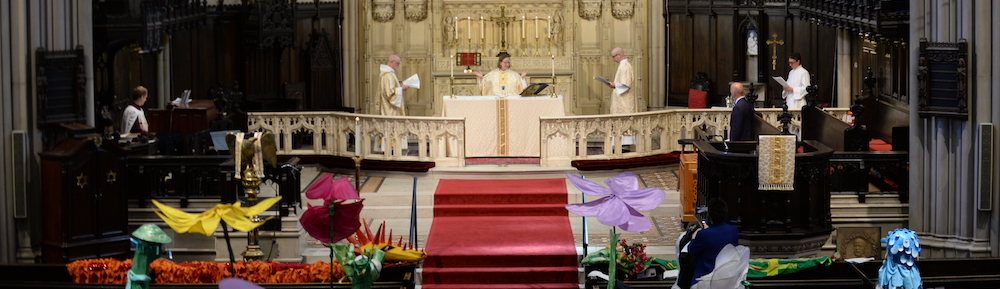
I’m begging you.

Epiphany 7C.   23 February 2025.  The Very Rev. Pamela L. Werntz

Genesis 45:3-11, 15. And he kissed all his brothers and wept upon them.
1 Corinthians 15:35-38, 42-50.  Someone will ask, “How are the dead raised?
Luke 6:27-38. A good measure, pressed down, shaken together, running over will be put into your lap.

O Most Merciful and Compassionate, grant us the strength, the wisdom and the courage to seek always and everywhere after truth, come when it may, and cost what it will.


During this season of Epiphany, our First Testament lessons have been from the Writings and the Prophets: Nehemiah, Isaiah, Jeremiah, and Malachi. Suddenly and unexpectedly, a lesson falls into our laps from Genesis about the long-lost Joseph encountering his brothers in Pharaoh’s court in Egypt. I want to make sure you know the backstory just in case you didn’t have at least a half a dozen years of Sunday School when you were growing up!

Here’s a quick synopsis of about a dozen chapters of Genesis: Joseph was the 11th of 12 sons of Jacob (aka Israel). Jacob had his last two sons with Rachel, who died in childbirth delivering Benjamin. The legend goes that Joseph was Jacob’s favorite, and his brothers were insanely jealous of their father’s favoritism and Joseph’s dreams of superiority. When Joseph was 17, his brothers, who couldn’t take it anymore, decided to kill him. Then they changed their minds and threw him into a pit instead. He got pulled out by some passersby, who sold him into slavery. The brothers tore up Joseph’s ornamented tunic, a special gift from their father, put blood of a goat on it, and told Jacob that his beloved son must have been devoured. [1] He was devastated. Joseph ended up in Egypt, where he was enslaved in a wealthy household and then jailed by the jealous master whose wife lusted after him. While in jail, Joseph interpreted the dreams of fellow prisoners and so gained the attention and then the trust of Pharaoh, who made him the second-most-powerful person in Egypt, in charge of the empire’s food supplies through a severe famine. 

Meanwhile, Joseph’s brothers, who were starving in the land of Canaan, learned that there was plenty to eat in Egypt; so they headed there to beg for food. They didn’t recognize Joseph when they met with him, but he knew them. He gave them sacks of food, but hid a golden cup in youngest brother Benjamin’s sack. He then accused Benjamin of theft and threatened to imprison him. When the brothers begged to be imprisoned in Benjamin’s place, Joseph revealed who he really was. High drama! That’s where our story this morning picks up.

What’s missing in our reading is the beautiful verse in which Joseph and Benjamin wept on each other’s necks in a poignant acknowledgement that the injury inflicted by the older brothers was not just to Joseph and Jacob, but also to Benjamin. The two sons of Rachel then weep over the other ten brothers. There is no righteous retribution, vindictiveness, or Schadenfreude at their desperate circumstances, even though, surely, they had it coming. There is a promise of mercy, compassion, material restoration, and care with a strong sense of divine providence turning decades of tragedy into a future of dignity and grace. Walter Brueggemann describes Joseph’s work as reinterpreting the past, redefining the present, and reimagining the future. [2]

In the light of this story from Genesis, I can see that Jesus was teaching Torah in Luke’s Sermon on the Plain. When I look through Luke’s particular lens at Torah and Gospel, I can see that he views the Good News as the healing power of relationship with the Divine, the healing power that flowed out of Jesus, to reinterpret the past, redefine the present, and reimagine the future. But Jesus’ teachings here are hard; the challenges are huge. Even if we agree with the ideas and the ideals of loving our enemies, putting that into practice takes a lifetime of work. Often in conversation about these teachings, there’s a quick move to the extremes: what about the oligarchs? What about the President? Going to the extremes is a way of avoiding looking at our own spheres of influence. Closer to home we might ask: what about someone who is in an abusive or exploitative relationship? No! What then? Are we to be passive or complacent? How do we reckon with evil without indulging it? Surely we should not tolerate intolerance! Jesus’ answers have to do with responding restoratively rather than retributively. Restoring what? Restoring dignity. Jesus asserts the healing power of restoring dignity in undignified circumstances. Jesus has no tolerance for public shaming or humiliation, and he knew that violence never ends violence. Only creative non-violence will do that. Hatred will never overcome hatred; only love will do that. (That’s a teaching from the Buddha, by the way.) Similarly, Jesus lays out a path of non-violent, dignified responses to injuries that affirms self-worth and the worth of the other, even if the path is completely obscured by the fog of cultural differences, language, and time.

It’s hard for me to think of a teaching of Jesus that requires greater translation across culture, time, and language than the one about turning the other cheek if someone strikes you. The word that gets translated strike describes the act of slapping someone with an open hand. The backhand slap was typically done in the context of humiliation or mockery, used to shame someone in a public setting. The Greek dictionary says, “It was considered a grave insult, reflecting a deep level of contempt or disdain.” [3]

I was far along into my theological education when I had the opportunity to see the great Walter Wink demonstrate this teaching from Jesus, and it made an indelible impression on my heart. He demonstrated the motion of backhanding someone on the right cheek (with his right hand) like someone with greater power would do to someone with less power. When the victim offered the other cheek, the only slap possible was to cup the person’s cheek, which was a gesture of affection. The move of offering the other check is physically, literally, disarming. It is an elegant response that asserts the dignity of both the perpetrator and the victim. Likewise, giving one’s shirt to someone who has just taken one’s coat is a non-violent way to demonstrate the dignity of nakedness and the indignity of injustice. In an honor-and-shame culture, nakedness brings shame on the one who sees, not on the one who lacks cover.

Although these are not teachings about being doormats for Jesus, what if we cannot manage to love our enemies? What do we do when loving is too hard or too dangerous? Remember, when the task is overwhelming and seems impossible, it means that the first step is too big; and so we need to break it down into smaller steps. One move is to step outside of what Pádraig Ó Tuama calls, “the energy of enmity,” which keeps us trapped or stuck, cornered or cowering. [4] Buddhist teachers Robert Thurman and Sharon Salzburg have said that, for them, the first step toward non-hatred is to become aware of how it feels to be scared and angry inside of oneself but not todiscount or ignore the injury. If you’re like me, lately, you’ve had opportunities to feel scared or angry every day. 

A next step is to cultivate a desire to not be stuck there: a desire to heal. Non-hate is the beginning of the journey. If you’re like me, you also have opportunities to step out of that narrow place of desire for revenge and into a place of mercy and compassion. If you’re looking for an example of what I mean, the Bishop of Washington, Marianne Edgar Budde, recently gave a master class on speaking truth to power in a most loving way, both in her sermon at the prayer service the day after the Inauguration and in subsequent interviews. (If you haven’t yet seen and heard Bishop Budde, then listening to her is a good next step.)

The idea of non-hate being the beginning of a journey toward love connects for me to Jesus’ command to be merciful. The verb can also be translated: become. Become merciful like the Holy One, who is merciful. Be in relationship with divine mercy for yourself and for others, along the Way. Do not judge, and you will not be judged by the Holy One. Do not condemn, and you will not be condemned by the Holy One. Perhaps you hear the echo, “Forgive us our sins as we forgive those who sin against us,” from the way Jesus taught his followers to pray. I don’t know about you, but I’m always hoping that God will forgive us our sins better than we forgive those who sin against us, because Christians in general are not that good at it yet. 

Another step toward non-hate, and this is very important, is to refrain from considering or declaring that our enemies are somehow less than or other than human. Violence toward others cannot be justified by dehumanizing them, even if they are behaving in depraved and terrible ways. And for me, it’s important to understand that we are capable of the most depraved and terrible things that we deplore in our enemies, which is one reason “We repent of the evil that enslaves us, the evil we have done, and the evil done on our behalf.”

What I want to suggest about the prohibition of judging and condemning is that there is an important distinction to me between judging and condemning people and judging and condemning behaviors. Even as I say this, I’m aware of how “Love the sinner, hate the sin” has been used against queer people like me. Nevertheless, even as Jesus says don’t judge, he is clearly judging against violent behaviors of all kinds. Also, according to Luke, Jesus responded in mercy and compassion to the criminal on the cross near him who believed that he deserved his own death sentence.  I’m sure that responding to one’s enemies with grace and mercy will and does change us for the better; responding with grace and mercy heals us and the world. When we can loose whatever grip righteous indignation has on us, when we stop consuming the poison of resentment and hatred, it’s like an abundance of grace, so much that it generously runs over like a gift falling into our laps!

I want to close by saying something about our lesson from First Corinthians. I just love Paul’s words of assurance that someone is going to ask, how are the dead raised? With what kind of body do they come? In other words, how exactly does resurrection work? “Fool!” he practically shouts. Listen up, Emmanuelites! Resurrection looks like: “They buried us but they did not know we were seeds.” Resurrection looks like twelve brothers reunited and forgiven. like mercy and compassion, like suffering with, like remembering and asserting one’s own dignity in the face of mistreatment, like respecting the dignity of every human being, and for Christians, like seeking and serving Christ in all persons, even when you cannot discern any evidence of the Christ. It looks like restorative rather than retributive justice, reinterpreting the past, redefining the present, and reimagining the future. It looks like using our power to heal, like a strong sense of divine providence turning decades of tragedy into a future of dignity and grace. It looks like Love that is stronger than death. Without that love, whatever we do is worth nothing, our opening collect today acknowledges. Take that Word of God seriously. I am begging you.


  1. Robert Alter’s translation in his The Hebrew Bible: A Translation with Commentary (NY: Norton, 2019).
  2. Walter Brueggemann, Genesis in Interpretation, Vol. 1 (Atlanta: John Knox Press, 1982), p.347.
  3. “Strike” in Strong’s Exhaustive Concordance.
  4. https://onbeing.org/programs/sharon-salzberg-robert-thurman-love-your-enemies-really?
For the Next Generation

February 17, 2025

During Black History Month, we invite you to read some of the works written by authors speaking to the next generation. Our suggestions include:

–Langston Hughes’s poem, “Mother to Son” (first published in 1922 in The Crisis, the official magazine of the National Association for the Advancement of Colored People (NAACP); in 1926, the poem was included in his Hughes’s poetry collection, The Weary Blues)

–James Baldwin’s “A Letter to My Nephew” (published as “My Dungeon Shook: Letter to My Nephew on the One Hundredth Anniversary of the Emancipation,” in The Fire Next Time (New York: Knopf Doubleday, 2013)

–Imani Perry’s Breathe: A Letter to My Sons (Boston: Beacon Press, 2019). Perry offers a layered meditation.

–Ta-Nehisi Coates’s Between the World and Me (New York: Random House, 2015)

–Mary Beth Clack, Mary Blocher, Cindy Coldren, Pat Krol, Liz Levin

Respond in love!

Epiphany 6C. 16 February 2025. The Very Rev. Pamela L. Werntz

Jeremiah 17:5-10. Iin the year of the drought it is not anxious and it does not cease to bear fruit.
1 Corinthians 15:12-20. The first fruits of those who have died.
Luke 6:17-26. Blessed…blessed…blessed….blessed…woe….woe…woe…woe.

O God of healing, grant us the strength, the wisdom and the courage to seek always and everywhere after truth, come when it may, and cost what it will.


Last week we heard the story about what happened when Simon Peter let Jesus use his boat to demonstrate an improbable abundance of fish caught by going deep in broad daylight! Last week Jesus told Peter and his friends that he would show them how to catch people. Somehow that sounded so good, according to Luke, that they left everything and followed Jesus. When Jesus then healed a man of leprosy, crowds started to show up wherever he went in the hope that they, too, could be healed.  Luke writes that Jesus would withdraw to deserted places and pray. One day he healed a paralyzed man whose friends had lowered him through the roof, because that was the only way to get close to him. Luke reports,  “Amazement seized all of them, and they glorified God and were filled with awe saying, ‘We have seen strange things today!'” Kind of reminds me of church!

When Jesus invited a tax collector named Levi to follow him, Levi gave a great banquet with a large crowd of tax collectors sitting at the table with them, which caused quite a stir among people with higher standards for dining companions. As controversy grew around Jesus’ healings and teachings, folks got mad enough to want to shut him down. “Now during those days,” Luke writes, “Jesus went out to the mountain to pray” all night, “and when day came, he called his disciples and chose twelve of them whom he also named apostles.” It was a motley crew for sure, and apparently not everyone made the team of apostles because he drew from a great crowd of disciples. (Remember, disciples are learners; apostles are learners who are sent out to teach and heal.) Did he choose the most capable, the most diverse, or only the ones who had nothing left to lose? Did the ones who didn’t get selected feel regret or relief? Dread or excitement? Probably a little of both. We don’t know.

Now you’re up to speed about the context for Jesus’ teaching about blessings and woes. One thing I want you to notice right away in today’s Gospel reading is that Jesus was addressing this teaching to “the great crowd of his disciples;” and he was addressing them directly. “You who are poor, you who are hungry, you who are weeping, you who are excluded, reviled, and defamed for humanity’s sake (which is another way of understanding the term Son of Man). And you who are rich, you who are full, you who are laughing, you who are well-spoken of.” They, too, were in the crowd of disciples or learners that Jesus is teaching. That reminds me of church, too!

I also want you to notice that Luke doesn’t spiritualize poverty; he’s talking about access to tangible resources: money, food, clothing, and shelter. Nor does he glorify poverty, hunger, sorrow, or being reviled and excluded. Rather than writing about life after death, he is writing about life before death. Remember Luke is the one who wrote about the early Jesus-following communities, which shared money and other resources in common so that each gave according to their ability and each received according to their need. That’s how living and leaning into the Realm of God or the Rule of Love works, according to Luke.

Taking a little further the idea that the crowd was a mixture of rich and poor, full and hungry, laughing and weeping, included and excluded, I think maybe every person had aspects of blessing and aspects of woe within themselves. I hear the Luke beatitudes as descriptions of needing the Holy One versus relying on one’s own strength; I hear them as descriptions of needing one another versus relying on one’s own strength.

Jesus looked at his disciples and declared God’s blessing on them for being poor, hungry, bereft, excluded, and defamed for his sake. It’s a peculiar honor. I hear Jesus saying, “God bless you for getting into this with me.” You who are poor, yours is the realm of God. (Not in the future, but right now.) You will be fed, experience joy, and experience the heaven of God, which is another way to say shalom, deep peace, or well-being. God bless you for putting everything on the line. And there’s trouble ahead to you who are rich and full, scoffing at the naïveté or laughing at the foolishness of practicing loving kindness to the point of poverty and hunger, sorrow, and slander. You will not experience the true joy of the realm of God unless or until you engage in extreme generosity and get in touch with your own need for God and one another. Jesus was speaking to everyone who would listen. That’s good news for us because we certainly are among the disciples now who are being challenged by Luke’s critique of wealth that is not used for the benefit of the community, so that each gives according to ability and each receives according to need. 

Theologian Mark Davis describes the Luke beatitudes as describing the difference between is and ought. [1] How there is a yawning gap between over-resourced and under-resourced, even in the same crowd, and how there ought to be no gap at all. Unfortunately, our lectionary cuts the reading off in his mid-thought. Jesus said:

Woe to you when all speak well of you, but I say to you that listen, Love your enemies, do good to those who hate you, bless those who curse you, pray for those who mistreat you….be children of the Most high who is kind to the ungrateful and the wicked. Be merciful just as God is merciful.

In other words, even when you are on the receiving end of the bad behavior of others because of your faithfulness to the Love of God, respond with Love. And when others are on the receiving end of bad behavior, be merciful just as God is merciful.

It’s Love that made the early Church a most powerful resistor to the oppression and cruelty of the empire. Indeed, today when the Church is functioning at our best, we serve as a bold alternative to authoritarianism as we live into our strong alternative models of community and governance. When we are functioning at our best, we are providing for those in need in ways that are life-giving and liberating for both the givers and the receivers. We are living our best lives in the kingdom of God (aka realm of Love) when we do not confuse wealth, happiness, joy, or popularity with blessings, but understand that the blessings are in the practice of sharing with generosity, compassion, and integrity.

It occurs to me that while Jesus was addressing his followers, there were others within earshot, those from the multitudes who were seeking healing. It occurs to me that maybe we are really not so different at Emmanuel Church: part apostles, part disciples, part not identifying as Jesus followers but seeking welcome, which is a form of healing. Often we come to church somewhat depleted – emotionally, physically and spiritually. Often we come to church fearful, angry, and betrayed by some circumstance, institution, or person in our lives. Sometimes we aren’t fully conscious of our depletion, our fear, our anger, or our hurt. As a crowd (even a small one) we come with varying degrees of awareness about our own unclean spirits or our own dis-ease. Maybe we come out of habit; maybe we are curious; maybe we hope to hear a good word or spectacular music, receive a warm embrace, have the chance to be quiet, have the chance to be heard, or get something to eat or drink; maybe we hope to make a connection with the Divine, with ourselves, with others. Whatever our hope, we all need healing for our bodies and souls. 

It also occurs to me that when a crowd (even a small crowd) of people with unclean spirits and dis-ease get together, there’s bound to be discomfort caused by competing or conflicting needs and depleted resources. Then I think, “Welcome to the Church!” We are a motley crew maybe not so different from the first ragtag bunches of people who were first drawn to the healing power of Jesus. And if you arrived at church hoping that either you are the only one with needs to be met, or that no-one else has needs that you will be asked to meet, you may be in for a rough morning. 

But if you arrived at church hoping for a chance to give thanks to God for all the many ways that you have been blessed, and looking for opportunities to share those blessings, then you are in luck! This will be a good morning for you! Give thanks to God that you were able to get here at all. If you are able to sit in a pew in this lovely worship space on this snowy day, give thanks to God. If you are able to access this worship service on line in a place that is warm and dry, give thanks to God. If you are able to breathe unassisted, give thanks to God. If you are able to stand and to walk, give thanks to God. If you are able to move and feel your hands and your feet, give thanks to God. If you are able to see, hear, taste, smell, or use any or all of those senses, give thanks to God. Now notice who else is in the room or online. Give thanks to God that you are not the only one here this morning either physically or virtually. If you are able to offer your hand to another in Peace, give thanks to God. If you hunger for the bread and wine of communion, give thanks to God for your hunger and thirst. Or if you desire a blessing, give thanks to God for your desire. 

As far as I can tell, giving thanks to God is the beginning of healing. And giving thanks to God in the midst of a crowd (even a small one and even if you give thanks in silence) begins a healing process in you and in everyone around you. Giving thanks is what replenishes our depleted selves – our emotionally, physically, and spiritually depleted selves. Giving thanks to God calms our fears, assuages our anger, provides forgiveness sufficient for the betrayals. Thanksgiving purifies our unclean spirits and heals our dis-ease. Thanksgiving is a sacrifice, because we have to release our hold on our dis-ease and our self-sufficiency. We will have to let go of our incapacitating anxiety and our playing too big or too small. We will have to open our hands and our hearts for healing and acknowledge the truth of our belovedness, becoming needy for the sake of the realm of God. Giving thanks is a powerful way to move from seeker and learner to teacher and healer. The promise of our scripture and our tradition is that the reward of our sacrifice of thanksgiving will dwarf whatever the cost. Offer to God, today, a sacrifice of thanksgiving and respond in Love, no matter what.


  1. D. Mark Davis, www.leftbehindandlovingit.blogspot.com.

Superheroic Personae

This week, in addition to my poetry group, I’m announcing a new project I’m starting with common art. I was inspired by our play last December, “Fix the Damn Sidewalk,” written by our beloved Richie Berman, to do something with superheroes. I’ve never been a superhero person, but I realized that there’s something about superheroes that makes for a great analogous tool when one tries to get to know people.  What are your strengths, your superhuman abilities, your weaknesses, your kryptonite? In drama therapy we would call this a projective device, something fictional or separate from oneself, which allows one to discover aspects of oneself within it.

Since I wanted to bring more intention to my one-to-one conversations with common art members this semester, I thought I would add some structure and creativity to it. So I decided to start a project wherein I would interview members as if they were superheroes. My goal is to have this be a long-term thing, where members would hopefully get inspired to create their own superhero personas and create art around them. There are lots of different directions we could take it, depending on how people respond. For now, I’m just testing the waters to see who’s interested. I may begin asking people some of my questions. I don’t think it would be hard to identify the superpowers in this community. Excuse my corniness, but I am blown away by their powers and talents every week. I have no idea how they would feel about this idea, but maybe that’s my superpower: trying things and finding out. Stay tuned!

–Mary Schwabenland

The abundance is all around us.

Epiphany 5C, 9 February 2025. The Very Rev. Pamela L. Werntz

Isaiah 6:1-8 [9-13]. Keep listening but do not comprehend.
1 Corinthians 15:1-11. Last of all, as to one untimely born, he appeared also to me.
Luke 5:1-11. Put out into the deep water.

O God of the deep, grant us the strength, the wisdom and the courage to seek always and everywhere after truth, come when it may, and cost what it will.


Our Gospel lesson for this week is the story about the day when Simon, James, and John decided to walk away from their night jobs, the day they decided to leave everything to follow Jesus, according to Luke. Just before this, Luke tells us that Jesus went down to Capernaum, a town on the shore of the lake of Gennesaret (also known as the Sea of Galilee), where he had been teaching. Jesus had exorcised an unclean spirit from among the people, and he had healed Simon’s mother-in-law by rebuking her high fever! He had been healing all kinds of diseases by laying his hands on sick people. Large crowds had begun to follow him wherever he went. In fact, even when he went to an isolated place to get away for a bit, Luke tells us that the crowds came looking for him; and when they got to him, they tried to keep him from leaving them.

One time, Luke says, Jesus was standing along the shore, and the crowd was pressing in on him. They were desperate to hear what he had to say, hungry for the word of God. Do you remember what he was teaching? He was proclaiming God’s favor for those who were poor, pardon for those imprisoned, and freedom for those who were oppressed. So we can be sure that this crowd was full of people who were hungry and bone-tired, distressed and diseased, and down and out. The story goes that Jesus climbed into a boat to get space between himself and the pressing crowd, then he taught for a while a little way out from the shore. He’d used Simon’s boat as a platform, a wobbly stage, while Simon and the others were washing their nets. I imagine that Simon, having worked all night and caught nothing. was hungry and tired, too.  When Jesus finished teaching, rather than thanking Simon and sending him home for a meal and a rest, he instructed him to put out again into the deep and let down the nets for a catch (the same nets that had just been put away).

Now this is a crazy idea on at least two levels. The first is that the fishermen have just come back in, presumably having tried everything during the night to catch fish. (Nighttime is when fishing happens there because in the daytime the fish can see and avoid the nets). They’ve just washed their nets. Going back out is a lot of work, and fishing in the daytime on Lake Gennesaret is just dumb. The next level of craziness is the idea of going into the deep, because the deep represents chaos. Put out into the deep, the chaos, Jesus is saying, in broad daylight, where everyone can see how foolish you are.

Simon Peter does not refuse, but he does signal his characteristic reluctance to believe that Jesus knows what he’s talking about. They then catch more fish than they can handle in a classic case of “Be careful what you wish for.” Exhaustion, chaos, and frightful excess – enough to sink a boat. I can just see Jesus smiling and saying, “You weren’t expecting that, were you?” But if exhaustion, chaos, and excess are what happen when we let Jesus instruct us on how to do our jobs, many of us would (and do) demur. No wonder Peter responds, “Go away from me because I am sinful. I don’t deserve or have any idea what to do with this kind of abundance.” Jesus’ response is: “No worries, I’ll show you.”

And then, according to Luke, Simon Peter and the sons of Zebedee James and John, left everything to follow Jesus. I don’t know about you, but I find considerable irony in their walking away after their most miraculous catch of all time. I can imagine walking away from a failing business, when there’s nothing left to lose. I actually have walked away from a position in a company that was doing immoral work, more than once. But this is a story of walking away from winning a jackpot catch of fish, that salted and preserved, would have provided sustenance for family and friends with more to export. In Luke, Jesus doesn’t say, “Follow me”; he says, “From now on you’ll be catching people”; and they left everything and followed him.

You know, the story of this catch is told as a post-resurrection story in the Gospel of John. Some New Testament scholars postulate that either Luke took a well-known post-resurrection story and placed it toward the beginning of his narrative; or John took a well-known beginning story and placed it at the end of his narrative to signal new beginning. This debate reminds me that none of us can really ever know what happened, or what any of it meant before the disciples experienced the radical and abundant new life given to them in the years after Jesus’ crucifixion. Every experience got remembered and reinterpreted, told and written down after their experiences of resurrection, in some cases generations after. Once Jesus’ followers experienced the radical and abundant new life given to them after Jesus’ crucifixion it changed everything!. Everyone who had a Gospel story to tell told the details differently. As you know, I love the theological elbow room that gets created by those kinds of differences.

The question for me is always, what does scripture have to say to us that might make a difference in the way we enact love in our lives? (Enacting love is a Biblical understanding of doing justice.) What might we learn today to apply to our own lives, as individuals and as a parish? How might this scripture help us to better live the words we pray? Here’s some advice that I’ve gleaned from this Gospel lesson in Luke. You may have heard it before, but since it’s my advice, I think it’s worth repeating! It’s advice I follow, and I highly recommend it to you.

  1. Let Jesus use your boat, that is, your livelihood, primary resource, mode of transportation, shelter from the storm, and sanctuary. Let Jesus use your boat to proclaim and enact God’s favor for those who are poor, freedom for those who are imprisoned or oppressed, healing and recovery for those who are diseased. Let Jesus use your boats even and maybe especially when you think that you know more than Jesus does about what’s realistic in your context, what’s sensible, or what’s possible (and what is not) when it comes to alleviating suffering.
  2. Whenever you feel as though you’ve been laboring in vain, get back out there and go deeper into the chaos; do something foolish in plain sight for the love of Jesus Christ. I often repeat a story that Bishop Barbara Harris told me about when as a recently ordained priest she went to see an important mentor of hers. She sat down in his office and said, “I am sick to death of teaching white people about racism. I’m done. I’m not doing it any more.” And he said to her, “You’re not done. You’re never going to be done. Get back out there.” I think about that every time I feel tired of teaching people (out there) about sexism, heterosexism, transphobia, or the case for reparations in the church. I also think about it when people who do not have the privilege or access to power I have challenge me to examine and check my own biases and assumptions, complicities and complacencies, or small views about what is possible. But the most important thing about this Gospel advice is, don’t go alone and do observe Sabbath. Then get back out there, taking a witness, being a witness. Gospel ministry is collaborative; go deep.
  3. Remember that when and whenever you/we experience abundance, there’s a catch!.  (Get it?) There’s always a catch, and here it is. We are obligated to share the abundance. When we experience abundance, we are called to gather people around us, people who need relief from hunger, disease, imprisonment, or oppression; and show them the abundance of grace. When Simon Peter, James, and John walked away from their business after a haul of fish that threatened to sink their boats, what do you think happened to all that fish? I bet it fed that big crowd on the shore and then some. In the version of this story in John’s Gospel, when the miraculous catch had been hauled in, Jesus asked three times “Simon Peter, do you love me?” And three times Simon Peter answered, “Yes, Lord”. Each time, Jesus replied, “Feed my lambs. Tend my sheep. Feed my sheep.” It doesn’t get any clearer than that.

 Based on my own experience, I don’t think there is a reason any of us could give that would persuade the Source of All Being that we can’t share more of our abundance or enact more love. The Bible is chock-full of stories of the Almighty calling on the least-qualified people to enact Love’s impractical or impossible work: to sing impossible songs ,pray impossible prayers, and walk impossible paths. We heard three such stories this morning. Isaiah is a man of unclean lips living among a people who have unclean lips. Paul says, “He is the least of the apostles, unfit to be called an apostle, because he persecuted the church of God.” Simon Peter says, “Go away from me, Lord, for I am a sinful person.” Moving beyond our reluctance and making those connections, we are called to invite people to experience the abundance of God’s grace in this community. The abundance is all around us. 


[8]

Poetry Exercises

Update on last week’s poetry group: it went well, although not exactly as I had expected.  I started the group off with a warm-up exercise called a locogram. This activity is like a multiple-choice question, but you have to physically move to a spot in the room that represents your answer. I started off with four words taken from Mary Oliver’s poem “The Journey.” These words were house, mend, stones, and voice. I placed the words on the floor in a large circle and asked the participants to move to whatever word they felt most drawn to and then explain why. Then I repeated the exercise with whole stanzas from “The Journey”. Continue reading

A Reflection on Reparations for Holocaust Remembrance Day

February 3, 2025

We met Constance Holmes when we participated in the last fall’s Stolen Beam program.

Connie is a founding member of the Reparations Interfaith Coalition and serves on the Episcopal City Mission Reparations leadership team. Here is Connie’s meditation for us on Holocaust Remembrance Day, January 28, 2025. Continue reading

Resist!

Presentation in the Temple. 2 February 2025. The Very Rev. Pamela L. Werntz

Malachi 3:1-4. He is like a refiner’s fire….Who can stand when he appears? (Anna can.)
Hebrews 2:14-18. Free those who all their lives were held in slavery by the fear of death.
Luke 2:22-40. There was also a prophet, Anna.

O God of the prophets, grant us the strength, the wisdom and the courage to seek always and everywhere after truth, come when it may, and cost what it will.


In the last few weeks our Gospel lessons have told the stories of the pre-adolescent Jesus getting separated from his parents, his baptism as an adult at the Jordan River, the wedding at Cana, and his spirit-filled preaching to the synagogue in Nazareth. Now we are back in the temple in Jerusalem with a story about the infant Jesus. Someone at our Tuesday-morning Bible study compared this haphazard storytelling to what happens at reunions, when stories tumble around without much concern about chronology or other logical order among people who have known one another for a long time. That kind of storytelling is much less about exact facts and much more about meaning making, right? Such stories are told to weave and strengthen the fabric of the community. Even when they’re fantastical and told out of order, we take them seriously. Indeed, Episcopalians take the scriptures too seriously to take them literally. May I just take a moment to remind us all that none of our Holy Scriptures were written by or about white people?

If this fourth Sunday after the Epiphany were not occurring on February 2, we would hear about how, after Jesus’ amazing preaching in Nazareth he declared God’s mercy on foreigners, which made so many people angry that they wanted to throw him off a cliff; but he slipped away. (I am not making this up.) But because February 2 is the fortieth day after Christmas, the Church observes the Feast of the Presentation of Jesus in the Temple, which the Gospel of Luke tells us occurred, as required, when Mary and Joseph took their infant into the Temple in Jerusalem to dedicate him to God and to celebrate his mother’s return to purity. There actually is no known requirement or even custom of presenting an infant in the temple. There was a rite of purification for a mother after delivering a baby, marking what my former seminary professor Andrew McGowan calls the return from the liminal space, the border between life and death. Giving birth has always been one of the most dangerous things a woman does; that was true then and it’s still true now.

Luke tells a beautiful story of Mary and Joseph presenting their infant son to God and the responses of Simeon and Anna, who have been looking for, praying for the consolation of Israel, in other words, the restoration of dignity and peace to God’s people.

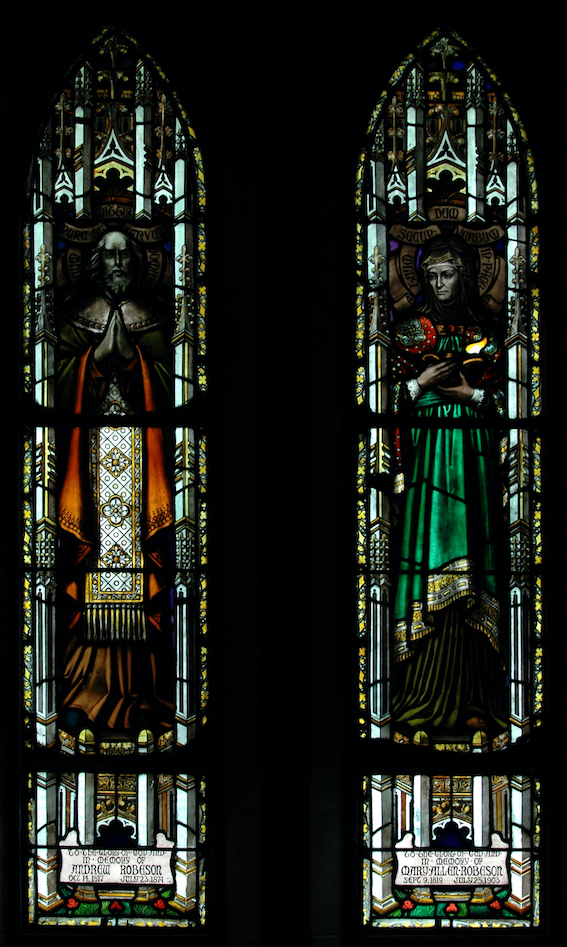
Our lancet windows of Simeon & Anna by Harry Eldridge Goodhue were given in 1905 by Alice Robeson Van Rensselaer. Photo by JG Bullitt.

The Gospel of Luke provides us one of the most beloved hymn texts in Christian history, the Nunc Dimittis or the Song of Simeon. It has been sung as part of daily evening-prayer services since at least the 4th century. The Song of Simeon has its grounding in the words of consolation and comfort in the book of Isaiah, written many centuries before,  when restoration and redemption were also sorely needed. Simeon sings a song of praise to God and then a song of blessing upon the young family. It’s a curious blessing, though, not one that I would want for my baby. It’s a blessing that predicts that the child is destined to create conflict and violence. If I had my baby in my arms and someone offered that blessing, I think I might turn away.

That’s when Anna the Prophet takes over. Luke makes sure that we know that she is a prophet before we know her marital status or her advanced age. Like Miriam of the Exodus in the wilderness, Deborah of Ephraim, Hulda of Jerusalem, or Mariann of Washington, D.C., Anna of the Temple was divinely inspired to see and bravely speak truth about both what is, and what is possible. Anna is the only woman in the New Testament who is named a prophet. The name Anna means grace or favor. (It’s the Greek version of the Hebrew name Hannah.) Luke’s emphasis is on her character and devotion. Unlike Simeon, her words aren’t recorded, but are described as praising the Holy One and speaking about Jesus to all who were looking for the redemption of Jerusalem, a city that was sorely oppressed by the brutality of the Roman Empire.

Anna was from the Tribe of Asher. That makes her “the only Jewish character in the New Testament who is said to belong not to one of the southern tribes of Judah or Benjamin, or the priestly tribe of Levi, but to one of the northern tribes of Israel.” [1] Asher was the eighth son of Jacob, and Asher means lucky, bearer of good fortune or salvation. Why did Luke include those details? Surely Anna was long gone by the time Luke was writing his Gospel three generations after the death of Jesus. Why were these details important to Luke’s audience at the end of the first century? Why do we need to know that Anna believed that Jesus would be the redemption of Jerusalem? Could we not just take Simeon’s word for it? Luke apparently did not think the presentation story was complete with just Simeon. It’s possible that Simeon represented the inhabitants of Judah and Anna, the Tribe of Asher, who represented exiles in the diaspora and hoped for return, reunion. [2] Luke’s first-century community of Jesus followers was in the diaspora in the north,  probably Syria or Turkey.

With both Simeon and Anna, the story includes male and female, inhabitants of the land and the exiled, the northern and the southern tribes of Israel, who are being restored in Jesus to be a light to all of the nations, which is another way of saying a light to the Gentiles. You might not know that “Judaism generally taught that salvation was for all people, not only for Jews.” [3] There’s another thing that Anna represents, in contrast to Simeon. Upon seeing the infant Jesus, Simeon’s song announced his dismissal in peace. Anna’s response is that she began to praise God and spread the word about the child to all who were looking for the redemption of Jerusalem, which means city of peace. Not only was Anna a prophet; she was the earliest New Testament evangelist. Her spreading the word of Jesus at the beginning of Luke’s Gospel is one bookend, and the other is the evangelism of Mary Magdalene and the other women who witnessed the empty tomb at the end of the Gospel. 

So Simeon saw the infant Jesus and retired, but Anna got back to work. She might have been old in age, but she was young in hope. [4] Apparently she didn’t waste any time on folks who were not looking for restoration or redemption. She spread the word to those who were looking. The good news about her words not being recorded is that it leaves room for our imagination about what she said. That kind of holy imagination used to read between the lines in the Bible is called midrash.

If you were going to use your holy imagination to read between the lines in this story, what do you think Anna said? What would you say if you were Anna? What would you say about Jesus to people who seem to be searching for restoration or redemption, looking for respect for the dignity of every human being, for liberation from oppression? What words of hope do you have for people looking for relief and reconciliation, for a city of peace, for a world of peace? Could you point them, even bring them, to a place where their dignity would be respected? If you were a person searching for restoration or redemption, what would you hope someone like Anna would say to you about Jesus? What words or signs would give you hope for peace in this city, or in this world, or even in your heart? Richard Rohr wrote, “People who sincerely search will touch upon the same truth in every age and culture. The direction is always toward more love and union – in ever widening circles.” [5]

You know, restoration and redemption were not just needed in the time of the prophet Anna; they are sorely needed now. The dignity of every human being is not yet universally respected. By including the story of Anna the Prophet, hearers of Luke’s Gospels learn that it is never too late see a sign of hope, nor to start spreading the word of hope. None of us is too old to be young in hope,  too far gone to be reunited with the Love of God, nor too old to shine the light of Christ in dim places.

Rabbi Shire and I were talking with folks from the parish and the synagogue about building up our moral courage in the year ahead to resist whatever is unjust, untruthful, or unloving. I mentioned our individual and shared resources of attention, prayer, time, money, and being in community with one another. When I finished that list, Rabbi Shire added that observing Sabbath is a form of resistance, not only about refraining from productivity, but experiencing refreshment and delight. Oh, we are so fortunate to have Rabbi Shire as our Rabbi-in-Residence. And I’m reminded of a poem by author and illustrator Loryn Brantz, which my daughter Sarah shared with me. 

In a time of hate
Love is an act of resistance.
In a time of fear
Faith is an act of resistance.
In a time of misinformation
Education is an act of resistance.
In a time of poor leadership
Community is an act of resistance.
In a time like this
Joy is an act of resistance.
Resist. Resist. Resist. 


  1. Richard Bauckham, Gospel Women: Studies of the Named Women in the Gospels, (Grand Rapids: Wm. B. Eerdmans Publishing,  2002), p. 77.
  2. Ibid., pp. 77-107.
  3. A.J. Levine’s note in the Jewish Annotated New Testament (New York: Oxford Press, 2011), p. 102-3.
  4. Thanks to Edith Dean for this phrase in All of the Women of the Bible (HarperSanFrancisco, 1955), p. 174
  5. https://cac.org/daily-meditations/widening-circles-2018-08-12/


[8]