
Resist!

Presentation in the Temple. 2 February 2025. The Very Rev. Pamela L. Werntz

Malachi 3:1-4. He is like a refiner’s fire….Who can stand when he appears? (Anna can.)
Hebrews 2:14-18. Free those who all their lives were held in slavery by the fear of death.
Luke 2:22-40. There was also a prophet, Anna.

O God of the prophets, grant us the strength, the wisdom and the courage to seek always and everywhere after truth, come when it may, and cost what it will.


In the last few weeks our Gospel lessons have told the stories of the pre-adolescent Jesus getting separated from his parents, his baptism as an adult at the Jordan River, the wedding at Cana, and his spirit-filled preaching to the synagogue in Nazareth. Now we are back in the temple in Jerusalem with a story about the infant Jesus. Someone at our Tuesday-morning Bible study compared this haphazard storytelling to what happens at reunions, when stories tumble around without much concern about chronology or other logical order among people who have known one another for a long time. That kind of storytelling is much less about exact facts and much more about meaning making, right? Such stories are told to weave and strengthen the fabric of the community. Even when they’re fantastical and told out of order, we take them seriously. Indeed, Episcopalians take the scriptures too seriously to take them literally. May I just take a moment to remind us all that none of our Holy Scriptures were written by or about white people?

If this fourth Sunday after the Epiphany were not occurring on February 2, we would hear about how, after Jesus’ amazing preaching in Nazareth he declared God’s mercy on foreigners, which made so many people angry that they wanted to throw him off a cliff; but he slipped away. (I am not making this up.) But because February 2 is the fortieth day after Christmas, the Church observes the Feast of the Presentation of Jesus in the Temple, which the Gospel of Luke tells us occurred, as required, when Mary and Joseph took their infant into the Temple in Jerusalem to dedicate him to God and to celebrate his mother’s return to purity. There actually is no known requirement or even custom of presenting an infant in the temple. There was a rite of purification for a mother after delivering a baby, marking what my former seminary professor Andrew McGowan calls the return from the liminal space, the border between life and death. Giving birth has always been one of the most dangerous things a woman does; that was true then and it’s still true now.

Luke tells a beautiful story of Mary and Joseph presenting their infant son to God and the responses of Simeon and Anna, who have been looking for, praying for the consolation of Israel, in other words, the restoration of dignity and peace to God’s people.
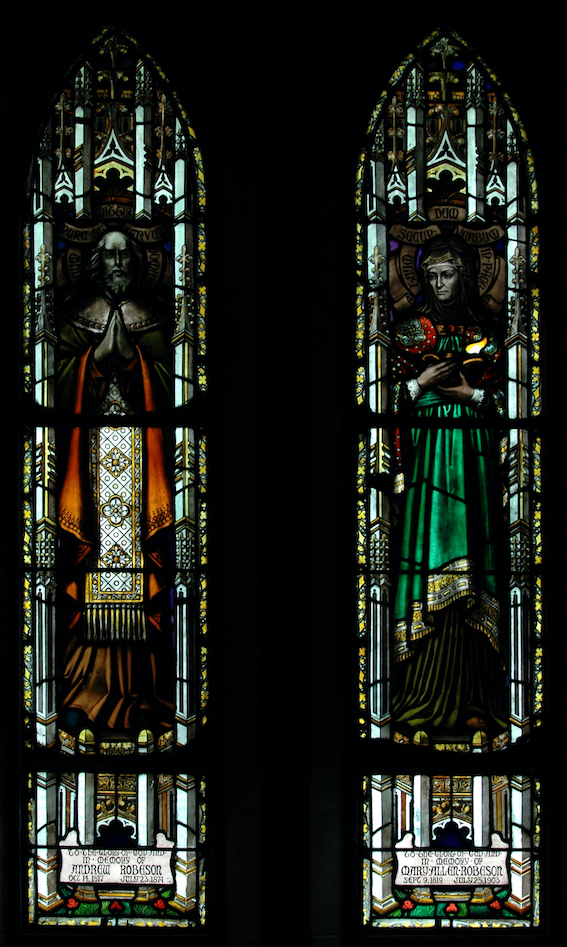
Our lancet windows of Simeon & Anna by Harry Eldridge Goodhue were given in 1905 by Alice Robeson Van Rensselaer. Photo by JG Bullitt.

The Gospel of Luke provides us one of the most beloved hymn texts in Christian history, the Nunc Dimittis or the Song of Simeon. It has been sung as part of daily evening-prayer services since at least the 4th century. The Song of Simeon has its grounding in the words of consolation and comfort in the book of Isaiah, written many centuries before,  when restoration and redemption were also sorely needed. Simeon sings a song of praise to God and then a song of blessing upon the young family. It’s a curious blessing, though, not one that I would want for my baby. It’s a blessing that predicts that the child is destined to create conflict and violence. If I had my baby in my arms and someone offered that blessing, I think I might turn away.

That’s when Anna the Prophet takes over. Luke makes sure that we know that she is a prophet before we know her marital status or her advanced age. Like Miriam of the Exodus in the wilderness, Deborah of Ephraim, Hulda of Jerusalem, or Mariann of Washington, D.C., Anna of the Temple was divinely inspired to see and bravely speak truth about both what is, and what is possible. Anna is the only woman in the New Testament who is named a prophet. The name Anna means grace or favor. (It’s the Greek version of the Hebrew name Hannah.) Luke’s emphasis is on her character and devotion. Unlike Simeon, her words aren’t recorded, but are described as praising the Holy One and speaking about Jesus to all who were looking for the redemption of Jerusalem, a city that was sorely oppressed by the brutality of the Roman Empire.

Anna was from the Tribe of Asher. That makes her “the only Jewish character in the New Testament who is said to belong not to one of the southern tribes of Judah or Benjamin, or the priestly tribe of Levi, but to one of the northern tribes of Israel.” [1] Asher was the eighth son of Jacob, and Asher means lucky, bearer of good fortune or salvation. Why did Luke include those details? Surely Anna was long gone by the time Luke was writing his Gospel three generations after the death of Jesus. Why were these details important to Luke’s audience at the end of the first century? Why do we need to know that Anna believed that Jesus would be the redemption of Jerusalem? Could we not just take Simeon’s word for it? Luke apparently did not think the presentation story was complete with just Simeon. It’s possible that Simeon represented the inhabitants of Judah and Anna, the Tribe of Asher, who represented exiles in the diaspora and hoped for return, reunion. [2] Luke’s first-century community of Jesus followers was in the diaspora in the north,  probably Syria or Turkey.

With both Simeon and Anna, the story includes male and female, inhabitants of the land and the exiled, the northern and the southern tribes of Israel, who are being restored in Jesus to be a light to all of the nations, which is another way of saying a light to the Gentiles. You might not know that “Judaism generally taught that salvation was for all people, not only for Jews.” [3] There’s another thing that Anna represents, in contrast to Simeon. Upon seeing the infant Jesus, Simeon’s song announced his dismissal in peace. Anna’s response is that she began to praise God and spread the word about the child to all who were looking for the redemption of Jerusalem, which means city of peace. Not only was Anna a prophet; she was the earliest New Testament evangelist. Her spreading the word of Jesus at the beginning of Luke’s Gospel is one bookend, and the other is the evangelism of Mary Magdalene and the other women who witnessed the empty tomb at the end of the Gospel. 

So Simeon saw the infant Jesus and retired, but Anna got back to work. She might have been old in age, but she was young in hope. [4] Apparently she didn’t waste any time on folks who were not looking for restoration or redemption. She spread the word to those who were looking. The good news about her words not being recorded is that it leaves room for our imagination about what she said. That kind of holy imagination used to read between the lines in the Bible is called midrash.

If you were going to use your holy imagination to read between the lines in this story, what do you think Anna said? What would you say if you were Anna? What would you say about Jesus to people who seem to be searching for restoration or redemption, looking for respect for the dignity of every human being, for liberation from oppression? What words of hope do you have for people looking for relief and reconciliation, for a city of peace, for a world of peace? Could you point them, even bring them, to a place where their dignity would be respected? If you were a person searching for restoration or redemption, what would you hope someone like Anna would say to you about Jesus? What words or signs would give you hope for peace in this city, or in this world, or even in your heart? Richard Rohr wrote, “People who sincerely search will touch upon the same truth in every age and culture. The direction is always toward more love and union – in ever widening circles.” [5]

You know, restoration and redemption were not just needed in the time of the prophet Anna; they are sorely needed now. The dignity of every human being is not yet universally respected. By including the story of Anna the Prophet, hearers of Luke’s Gospels learn that it is never too late see a sign of hope, nor to start spreading the word of hope. None of us is too old to be young in hope,  too far gone to be reunited with the Love of God, nor too old to shine the light of Christ in dim places.

Rabbi Shire and I were talking with folks from the parish and the synagogue about building up our moral courage in the year ahead to resist whatever is unjust, untruthful, or unloving. I mentioned our individual and shared resources of attention, prayer, time, money, and being in community with one another. When I finished that list, Rabbi Shire added that observing Sabbath is a form of resistance, not only about refraining from productivity, but experiencing refreshment and delight. Oh, we are so fortunate to have Rabbi Shire as our Rabbi-in-Residence. And I’m reminded of a poem by author and illustrator Loryn Brantz, which my daughter Sarah shared with me. 

In a time of hate
Love is an act of resistance.
In a time of fear
Faith is an act of resistance.
In a time of misinformation
Education is an act of resistance.
In a time of poor leadership
Community is an act of resistance.
In a time like this
Joy is an act of resistance.
Resist. Resist. Resist. 


  1. Richard Bauckham, Gospel Women: Studies of the Named Women in the Gospels, (Grand Rapids: Wm. B. Eerdmans Publishing,  2002), p. 77.
  2. Ibid., pp. 77-107.
  3. A.J. Levine’s note in the Jewish Annotated New Testament (New York: Oxford Press, 2011), p. 102-3.
  4. Thanks to Edith Dean for this phrase in All of the Women of the Bible (HarperSanFrancisco, 1955), p. 174
  5. https://cac.org/daily-meditations/widening-circles-2018-08-12/


[8]

Meditation on Gaudete Sunday

In this week’s sermon on the meaning of Gaudete (rejoice) Sunday, Pam encouraged us to eschew despair in times when our hearts are understandably heavy. As we enter into the week before Christmas, she suggested that we look for small instances of joy, in which we find evidence love’s power to redeem.

Howard Thurman, author, minister, civil-rights leader, and educator, inspired many civil-rights advocates in his time and ours. It is said that his well-known work Jesus and the Disinherited was deeply influential on Martin Luther King’s thought and preaching, and that MLK carried a well-worn copy of it during the Montgomery Bus Boycott. Dr. Kelly Brown Douglas invokes Thurman when she speaks about going beyond charity to engage in changing the conditions that allow inequality and injustice to prevail. Continue reading

Love has the last word.

Last Sunday after Pentecost,  Proper 29C: Christ the King.  The Very Rev. Pamela L. Wentz.

Jeremiah 23:1-6. I will raise up shepherds over them who will shepherd them!
Colossians 1:11-20. May you be made strong with all the strength that comes from his glorious power…prepared to endure everything with patience.
Luke 23:33-43. Today you will be with me in Paradise.

O God of mercy, grant us the strength, the wisdom and the courage to seek always and everywhere after truth, come when it may, and cost what it will.


 On the last Sunday of our liturgical calendar, our lectionary brings us to the foot of the cross in Luke’s Gospel, lest anyone get too sentimental about what it means to follow Jesus. This Gospel lesson is appointed for today because we are celebrating the all-embracing authority of God’s Christ, that is, Love’s redeeming urge, and we sing hymns of gratefulness and praise. While we do that we can always use a reminder that our King of kings and Lord of lords was executed as a criminal with other criminals accused of crimes against the state. He was friends with criminals while he lived; and then he died with them, too. The word that Luke uses for criminal is literally evil doer. Our king, our highest earthly authority was executed for sedition, that is, for inciting resistance or disobedience to the government. Continue reading

Raise your heads!

Advent 1C.  28 November 2021. The Rev. Pamela L. Werntz

Jeremiah 33:14-16 [Jerusalem] will be called [the Holy One] is our righteousness.
1 Thessalonians 3:9-13. Someone has testified somewhere.
Luke 21:25-36 Raise your heads because your redemption is drawing near.

O startling God, grant us the wisdom, the strength, and the courage to seek always and everywhere after truth, come when it may and cost what it will.


Good morning! Happy Advent! It’s the Church’s New Year and the beginning of a season characterized by re-awakening, of waking up to re-examine our collective systems, our institutions. Advent calls for corporate, collective reflection, and repentance. It’s like an annual check-up for our communal systems. It’s a season of waking up even more to reports of sin, chaos, and devastation among the nations confused and disturbed by the roaring sea, the waves, and the shaking, agitated heavens. Fortunately, that’s just what our Gospel reading addresses this morning. Continue reading

Respond, repair, rebuild!

Proper 26B.  31 October 2021. The Rev. Pamela L. Werntz

Ruth 1:1-18. Do not beg me to leave you anymore, woman.
Hebrews 9:11-14. Purify our conscience from dead observances for worship of the living God.
Mark 12:28-34.  You are not far from the Realm of God.

O God of our redemption, grant us the strength, the wisdom and the courage to seek always and everywhere after truth, come when it may, and cost what it will.


Many of you know that the formal name of our educational and artistic collaboration program with Central Reform Temple is Emmanuel Center. You’ll see our statement of purpose in the back of your bulletins. Essentially it says that faithfully rooted in our distinct religious traditions and shared spiritual heritage, we model compassionate encounters between Judaism and Christianity that affirm the difficult challenges of history and aspire to new levels of understanding. The Emmanuel Center Board comprises leaders from the parish and the synagogue to plan activities that explore spiritual and ethical perspectives on our shared human experience. When the board met this past Tuesday, we spent considerable time talking about the history being made right now with regard to the tens of thousands of refugees of rapacious militarism coming into the US from Afghanistan to be resettled here. Afghani people are living in refugee camps on five military bases in this country; the pictures of Fort Bliss (a highly ironic name) in New Mexico show about 100 huge tents holding 6,000 people. Our conversation on the board had to do with our moral obligation to respond with welcome and assistance, and the process of figuring out how. Where to begin? Continue reading

Covenantal Connectedness

Last Sunday after the Epiphany, B, February 14, 2021, The Rev. Pamela L. Werntz.

2 Kings 2:1-12. “Tell me what I may do for you, before I am taken from you.” Elisha said, “Please let me inherit a double share of your spirit.”
2 Corinthians 4:3-6. For it is the God who said, ‘Let light shine out of darkness,’ who has shone in our hearts to give the light of the knowledge of the glory of God in the face of Jesus Christ.
Mark 9:2-10. He did not know what to say for they were terrified.

O God of Revelation, grant us the wisdom, the strength and the courage to seek always and everywhere after truth, come when it may, and cost what it will.


We have come to the end of the season of Epiphany, the season of celebrating sacred gifts and divine disclosures. In our Hebrew Bible lesson this morning we have the wonderful story from 2 Kings about how Elisha got the power and the authority to carry on Elijah’s work after Elijah was gone, after he was “taken up.” Elisha had been travelling with and learning from Elijah for many years. He had burned his farming equipment and slaughtered his oxen, thus destroying his means of income, his livelihood;  he had left his home so that he could travel with the prophet Elijah (much more dramatic than leaving the boats and nets with Zebedee and his hired hands to follow Jesus).

Continue reading

Our Obligation and Opportunity to Shine

Presentation in the Temple
February 2, 2020 – Annual Meeting

Malachi 3:1-4 Who can stand when he appears? (Anna can.)
Hebrews 2:14-18 Free those who all their lives were held in slavery by the fear of death.
Luke 2:22-40 There was also a prophet, Anna.

O God of the prophets, grant us the strength, the wisdom and the courage to seek always and everywhere after truth, come when it may, and cost what it will.

This year, Emmanuel’s 160th Annual Meeting falls on the fortieth day after Christmas, the Feast of the Presentation of Jesus in the Temple, which the Gospel of Luke tells us occurred, as required, when Mary and Joseph took their infant into the Temple in Jerusalem to dedicate him to God and to celebrate the return to purity of his mother. This is a little bit odd because there actually is no known requirement or even custom of presenting an infant in the temple, but there was a rite of purification for a mother after delivering a baby.

Continue reading

Come clean!

Proper 26C
November 3, 2019

Habakkuk 1:1-2:4 Write the vision; make it plain so that a runner can see it.
2 Thessalonians 1:1-4,11-12 The love of everyone of you for one another is increasing.
Luke 19:1-10 The Son of Man came to seek out and save the lost.

O God of mercy, grant us the strength, the wisdom and the courage to seek always and everywhere after truth, come when it may, and cost what it will.

This morning we are celebrating the Feasts of All Saints’ Day, which was Friday, and All Souls’ Day, which was yesterday, with our music. However, we are observing the 24th Sunday after Pentecost with our readings, because I just couldn’t skip over the readings from Habakkuk and second Thessalonians, or the story of Zacchaeus from the Gospel of Luke.

Continue reading

Please do something!

First Sunday in Advent,
December 2, 2018.

Jeremiah 33:14-16 [Jerusalem] will be called [the Holy One] is our righteousness.
1 Thessalonians 3:9-13 May the Lord make you increase and abound in love for one another and for all.
Luke 21:25-36 Now when these things begin to take place, stand up and raise your heads because your redemption is drawing near.

O God, our righteousness: grant us the wisdom, the strength, and the courage to seek always and everywhere after truth, come when it may and cost what it will.

Good morning! Happy Advent! Happy Churchy New Year! Und fröhliche Leipzigerwoche! I’m so happy to be back with you after four months of time away.  I’m eager to hear about how you’ve changed and grown while we’ve been apart. I hope you’ll find a time to talk with me so we can catch up; or if you’re new here, so that we can get to know one another. I have a lot to tell you about my adventures learning Quranic Arabic and learning grandmothering of a new granddaughter and a newer grandson. and my adventures in Queens, NY, Annapolis, MD, Roslindale, MA, as well as Istanbul, Vienna, southern Spain and Lisbon. I also have a lot to say about Advent and ways we might approach this season before Christmas.  I have at least a dozen sermons that I want to deliver this morning, so I’m going to keep my time in this pulpit short because there really is too much to say!

Continue reading

Creative, Embodied, Inspired

Trinity Sunday, Year B, May 27, 2018; The Rev. Pamela L. Werntz

Isaiah 6:1-8 Then I heard the voice of the Lord saying, “Whom shall I send, and who will go for us?” And I said, “Here am I; send me!”
Romans 8:12-17 Children of God.
John 3:1-17 God did not send the Son into the world to condemn the world.

O God ‘increation,’ incarnation, inspiration, grant us the strength, the wisdom and the courage to seek always and everywhere after truth, come when it may and cost what it will.

This morning our Gospel lesson contains one of the most misappropriated and misunderstood passages of scripture in the whole Bible, in my view. “For God so loved the world that God gave the only Son, so that everyone who believes in him may not perish but may have eternal life.” John 3:16 has fueled some of the most damaging and unloving impulses of those who have taken the name Christian, from the Crusades to the destruction of conquered indigenous peoples, to the Holocaust, and to our present day, where the idea of the common good is endangered. If folks would just focus on what comes next, multitudes might have been spared. Verse 17 says: “Indeed, God did not send the Son into the world to condemn the world, but in order that the world might be saved through him” (or by him or because of him or for the sake of him. Being saved here means healing, integrity, and dignity. Being saved means being rescued from danger, liberated from oppression, being restored to right-relationship.
Continue reading