Dismantling the Doctrine of Discovery: An Online Talk with Sarah Augustine

Image

Part of our group’s experience with the Sacred Reckonings program was learning about the Doctrine of Discovery and its enduring effects on our world. An exploration of these papal bulls and decrees, and their implications is being offered in an online program hosted by the St. Paul Center this week. Sarah Augustine, a Pueblo (Tewa) descendant and founder/Executive director of the Coalition to Dismantle the Doctrine of Discovery, will speak. Augustine has worked in relationship with indigenous peoples for over 20 years and has represented their interests in a variety of global forums.

The Coalition “calls on the Christian Church to address the extinction, enslavement, and extraction done in the name of Christ on indigenous lands.” (website) The papal bulls or decrees that gave Christian explorers the theological and legal right to lay claim to any land not inhabited by Christians and available to be “discovered.” For more about the Doctrine, see this transcript and background information on the Gilder Lehrman Institute of American History site.

We look forward to hearing Sarah Augustine’s thoughts on the role of faith organizations in supporting indigenous rights and will report back in this space soon. To register for the September 10th DioMass online program, see this link.

–Mary Beth Clack, Convener, for the Racial Justice Working Group: Joel Anderle, Mary Blocher, Cindy Coldren, Ben Ericson, Pat Krol, Liz Levin, Pam Werntz (ex officio)


Revolutionary Lives: The Hidden History You Didn’t Know

Revolutionary Lives: The Hidden History You Didn’t Know

The Unitarian Universalist Urban Ministry of Roxbury recently hosted the first in a series of talks about the history and tradition of revolutionary action in Boston. The evening program drew an audience of over 60 people and was devoted to panel presentations which included:

  • Historian Thomas Plant on “Colonel George Middleton and The Bucks of America,” a little-known story about African American contributions to the Revolutionary War.
  • Dr. Alexandria Russell on “Finding Phillis: Phillis Wheatley’s Memorials in Boston  & Beyond.”
  • Dr. Aabid Allibhai reprising his timely and significant commissioned report on “Race & Slavery at the First Church in Roxbury.”

Dr. Russell’s remarks on the broader topic of naming legacies were of particular interest as we at Emmanuel continue our pulpit statue dedications. Russell’s book, “Black Women Legacies: Public History Sites Seen and Unseen” (University of Illinois Press, 2024), treats the culture of recognition of women that has developed in public memory, of both acclaimed and unheralded women.

In the summer of 2021, Emmanuelites visited the UU Urban Ministry during the two tours of the South End with Byron Rushing. We were welcomed at the historic meeting house by Executive Director Reverend Mary Margaret Earl. The tours were a wonderful part of our ongoing exploration of racial justice in Boston. We recall the Urban Ministry’s welcoming spirit and warm engagement with us at that time and look forward to the remaining talks in the series.

–Mary Beth Clack, Convener, for the Racial Justice Working Group: Joel Anderle, Mary Blocher, Cindy Coldren, Ben Ericson, Pat Krol, Liz Levin, Pam Werntz

Repairer of the Breach

Our thanks to the Reverend Dr. Martha Tucker for this meditation which first appeared in this column in 2023.

kintsukuroiIf you remove the yoke from among you, the accusing finger, and malicious speech;
If you lavish your food on the hungry and satisfy the afflicted;
Then your light shall rise in the darkness, and your gloom shall become like midday….
“Repairer of the breach,” they shall call you,
“Restorer of ruined dwellings.”

—Isaiah 58:9–10, 12

So many prophets radically and poetically call us to participate in a sacred restoration of wholeness, to be “restorers of the breach”. I believe that this is a valuable lens through which to gain perspective on the concept of reparations.

It is not about money, at least not principally so. It is about becoming part of a movement of restoration to a sacred wholeness in which all will be One, in which divisions will cease, in which mountains are leveled and valleys raised up, while lions and lambs live in peace.

The above are prophetic images and metaphors for some ultimate harmony in the realm toward which we are progressing, toward which God invites us. And…that realm, that “kingdom”, is here and yet to come, within and without. To jump to a discussion of reparations without the context of the goal of holy wholeness might tempt one to seek quick material fixes and similarly transactional responses. If I write a check, then I can discharge my duty.

The problem is that all that misses the opportunity, the opportunity, to make reparations a mission and ministry, to allow it to change our hearts. It seems to me to begin with a genuine acknowledgement that we are broken and have also been part of the breaking, albeit in some cases unknowingly and unwillingly, is to begin the process of gathering the fragments.

Deep bias and hegemonic power can masquerade as harmless when in fact they are crushing souls and discriminating mightily. Love in all its holy manifestations is what will mend and repair. I wonder whether the focus might be on gathering the fragments in the wake of centuries of oppression and becoming repairers of the breach.

Taking a cue from the Japanese art of kintsukuroi, wherein broken pottery is reassembled with a beautiful golden glue filament so that the seams and brokenness become renewed and even more beautiful and certainly unique, might be the prompt.

Imagine taking this image to God’s creation, where the binding gluey glittering materialis kindness, mercy, justice and humility. Imagine each of us pouring our gluey stuff into and onto the brokenness of the world, especially pouring it into the seam of the racial divide.

Specifically, I feel invited to turn toward the shards of systemic oppression and to offer compassion. I hope to be surprised by the beauty and magnificence of a renewing wholeness of humanity. I hope to become a repairer of the breach.

–Mary Beth Clack, Mary Blocher, Cindy Coldren, Pat Krol, Liz Levin

St. Cyprian’s Hosts Junteenth Celebration

Let us celebrate our collective liberation and hear how the struggle for justice and freedom continues. –from the Introduction to the service bulletin, St. Cyprian’s Church, June 19, 2026

The Juneteenth liturgy this year drew upon a variety of sources: the Book of Prayer of the Anglican Church of Kenya, the American Book of Common Prayer, and Prayers of the People by Bishop Carol J. Gallagher (2023),

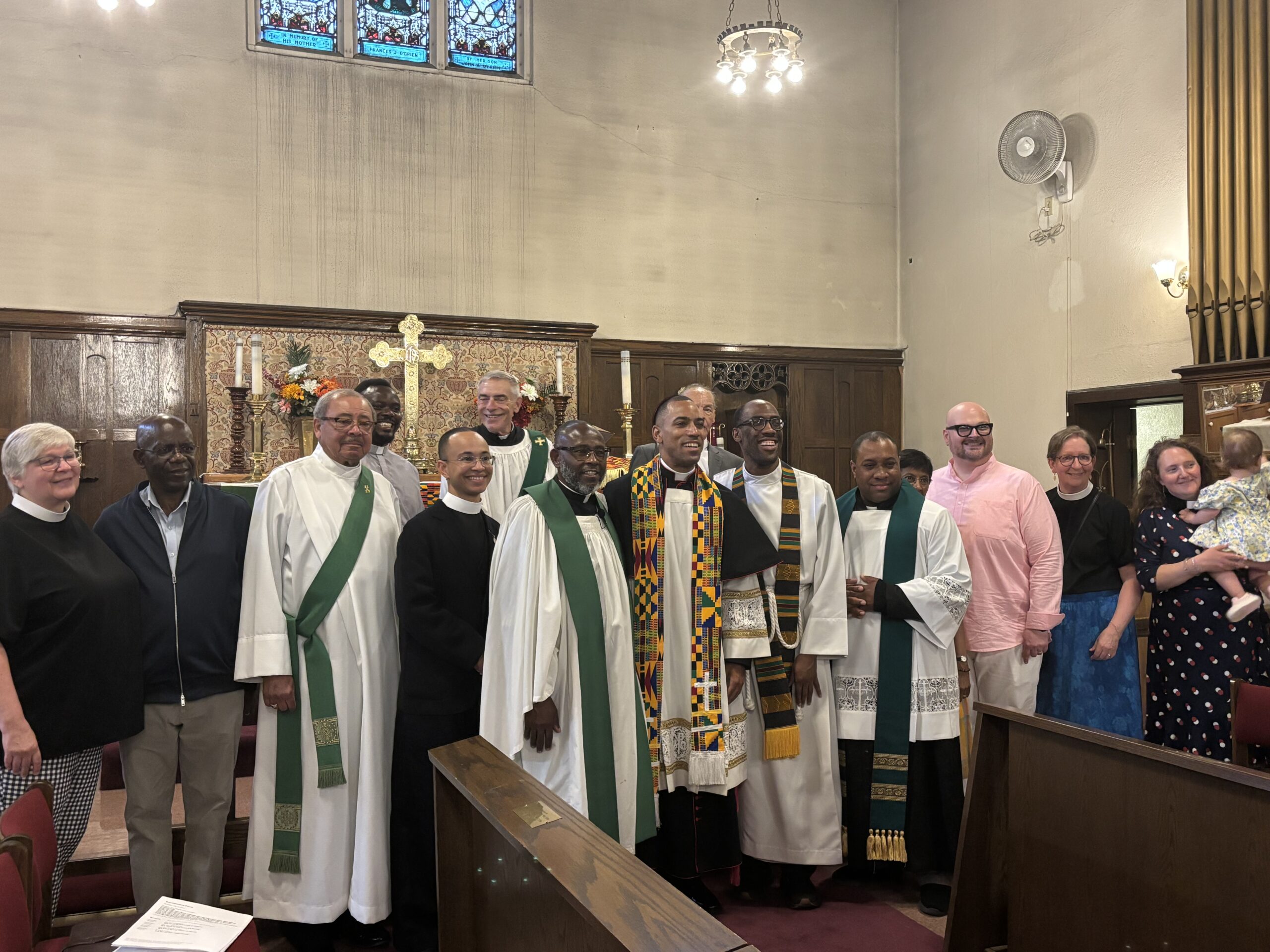
The Rev. Canon Dr. Canon Jean-Baptiste Ntagengwa, the Rev. Kevin Vetiac, and Rev. James Hairston, designed the service. Lift Every Voice and Sing provided most of the hymns. The singing was alternately rousing, joyous, reflective, and heart-felt, as in the rendition of “Take My Hand, Precious Lord” (sung by Rev. Vetiac).

A stirring sermon was given by The Rev. Canon Jordan F. Casson, a Philadelphia colleague and friend of Canon Jean Baptiste. Canon Casson’s years of advocacy and support for social justice were reflected in his choice of stories, anecdotes, and experiences in that journey. In his preaching, he blended emotional intensity, humor, and meditation. Emmanuelites who attended found inspiration in his words and a mindfulness that the struggle for justice continues.

St. Cyprian’s welcoming parishioners, who had laid out the altar’s kente cloths,  provided lunch and conversation. Many parishes were represented, which made for a lively time, good cheer, and thoughtful conversations.  All in all, it was a blessed Juneteenth.

–Compiled from the comments of attendees Mary Beth Clack, Joel Anderle, Bill Comer, Liz Levin, Mike Scanlon, and the Rev. Pamela Werntz.

St. Cyprian’s Church to Host Juneteenth Celebration

The Diocese of Massachusetts and the Bishop John M. Burgess Massachusetts Chapter of the Union of Black Episcopalians are coordinating this year’s Juneteenth Celebration on June 19, 2026. St. Cyprian’s Church, 1073 Tremont Street, will be the site of the 10am service and gathering afterward. All are invited to St. Cyprian’s to share the experience and spirit of Juneteenth.

Preaching will be the Rev. Canon Jordan F. Casson of St Michael’s Church, (Anglican/Episcopal), Yeadon, PA. He was commissioned Canon for Peace and Reconciliation for the Episcopal Diocese of Pennsylvania in 2020. He chairs that diocese’s Absalom Jones Committee and leads its Loving Presence initiative.

Canon Casson’s years of advocacy and support for social justice led to his induction into the Martin Luther King Jr. Board of Preachers and Scholars in 2014. Established in 1985, the Board honors global religious and ethical leaders who exemplify a commitment to nonviolence, social justice, and civil rights, and who are dedicated to advancing peace, human rights, and moral social responsibility.

We recommend Annette Gordon-Reed’s Juneteenth (New York Liveright, 2021), a succinct and thoughtful blend of personal history and historical scholarship on the meaning of the commemoration to her family and to our country.  In this video, she describes reactions to official document, General Orders, No. 3, which announced the declaration of freedom for enslaved persons in Texas. Jubilation was met with retaliation for that jubilation, reflecting both the reactions to the ending of legal enslavement, and the beginning of a renewed advocacy and struggle for civil rights in this country.

–Mary Beth Clack, Mary Blocher, Cindy Coldren, Pat Krol, Liz Levin


Juneteenth 2026

The National Museum of African American History will honor Opal Lee, the “grandmother of Juneteenth” in this year’s events.

Events for Juneteenth in Boston will take place from June 18-20, 2026. The flag raising ceremony on June 18th will commemorate “June 19, 1865, the day when enslaved African Americans in Galveston, Texas, were finally informed of their freedom more than two years after the Emancipation Proclamation was issued.” The city’s Juneteenth is a “celebration of freedom, remembrance, and the ongoing pursuit of equity and justice.” Other city events are described here.

Both locations of the Museum of African American History, Boston and Nantucket, will mark the holiday with a summer season of freedom as described here.  The Museum of Fine Arts offers a substantial array of programs as does the Institute for Contemporary Art: We Create the World.

This column provided a reflection by Alden Fossett in 2024.  Alden will be ordained to the diaconate in our diocese this week.

–Mary Beth Clack, Mary Blocher, Cindy Coldren, Pat Krol, Liz Levin

Who is America at 250?

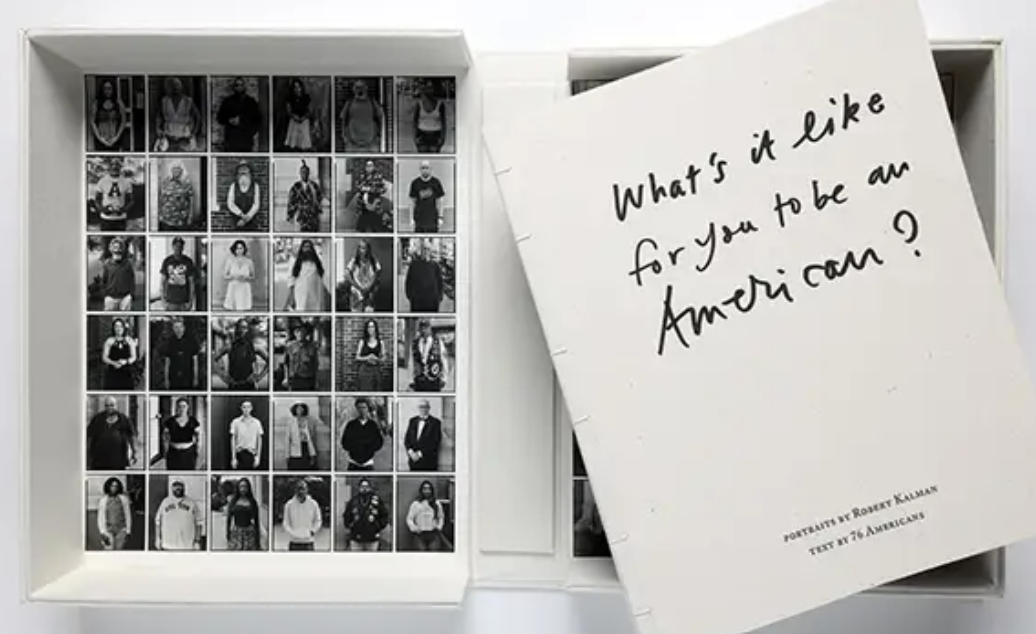
On view at the Boston Athenaeum until May 16, 2026, is the traveling exhibition,
“Who Is America at 250? Artists’ Books on the State of Democracy”.

Organized by the San Francisco Center for the Book and presenting works related to immigration, social injustice, racial inequity, and wage inequality, the exhibit prompts questions about the challenges and prospects of democracy. Its curators see the artists’ book as a meaningful conduit for open contemplation of democracy. Continue reading

The Pauli Murray Fellowship


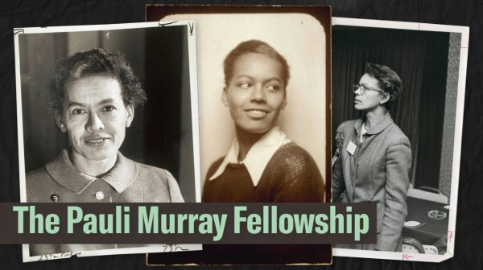
In October 2021, the Pauli Murray Fellowships were established by the American Civil Liberties Union (ACLU).

The Spring 2026 ACLU Magazine reported on two activists, Areej Qadeer and Ollie Henry, who were selected for the 18-month positions in non-profit management at the ACLU. Areej had been working in grassroots organizing in the American-Muslim community, serving on the Council of American-Islamic Relations’ legal team. Ollie’s work for reparations, advocating at the intersection of gender, disability, and race positioned her to support the ACLU’s initiatives in these areas. Part of their work had involved leading workshops for high school and college students at the ACLU National Advocacy Institute, which focused on building coalitions for intersectional legal work. Continue reading

“What is your hand in this?”

Commemorative concerts for America’s 250th anniversary will be dotting the musical landscape in 2026. An inventive program that may prove to be one of the most challenging for audiences has been launched by Davóne Tines and Ruckus, “a shapeshifting, collaborative, baroque ensemble with a visceral and playful approach to early music.” Sanders Theater hosted them on January 31, 2026, as part of their ten-cities tour.

Created by bass-baritone Davóne Tines, bassist Douglas Adam August Balliett, and Clay Zeller-Townson, founder of Ruckus, the program called “What is your hand in this?” recasts “Colonial and Revolutionary-era hymns, ballads, and Baroque compositions, on a musical journey that weaves through the pre-Civil War period, the Civil Rights era, and into the present day.” (Everyone 250 Continue reading

The Fierce Urgency of Now

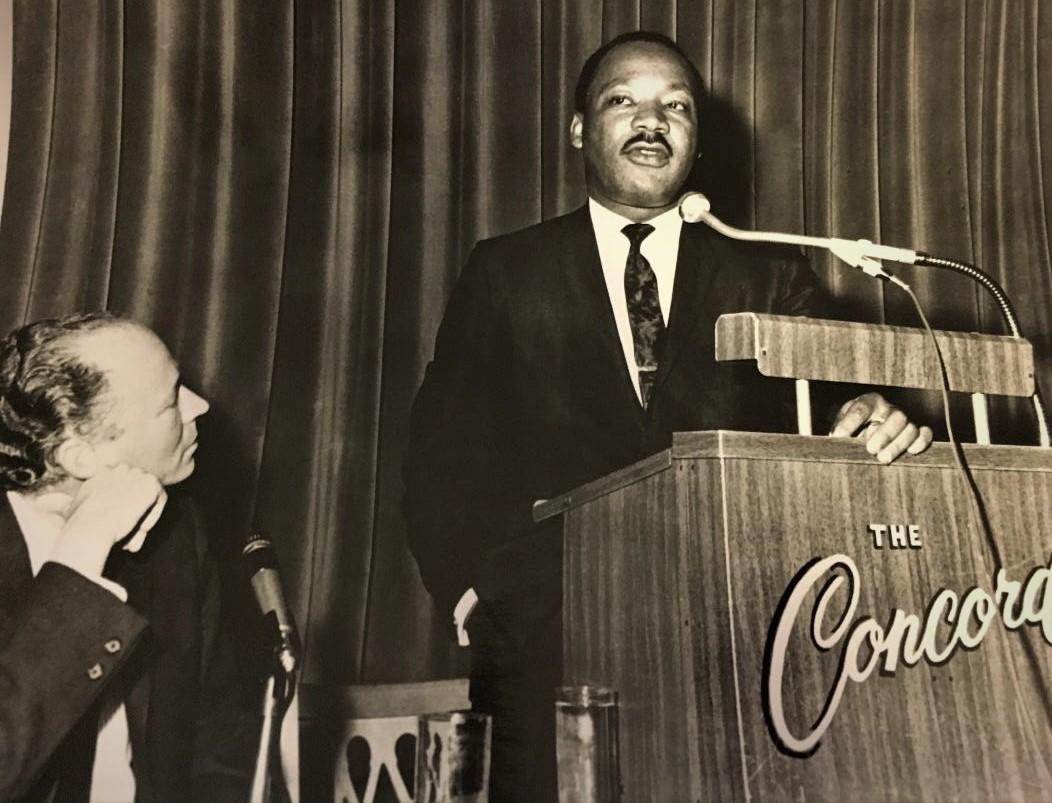
On Monday, January 19th, 2026, the 56th Annual Martin Luther King Jr. Memorial Breakfast will be held in Boston.

The MLK Breakfast Memorial Committee is comprised of representatives from St. Cyprian’s Episcopal Church and Union United Methodist Church. The event is the longest-running celebration of its kind in the U.S.; scholarships are provided each year to students from nine Boston public high schools.

Continue reading