Show what love looks like!

Lent 2C, March 16, 2025.  The Very Rev. Pamela L. Werntz

Genesis 15:1-12, 17-18. I am your shield.
Philippians 3:17-4:1.  He will transform the body of our humiliation.
Luke 13:31-35.  How often have I desired to gather your children together as a hen gathers her brood under her wings.

O God whose glory is always mercy, grant us the strength, the wisdom and the courage to seek always and everywhere after truth, come when it may, and cost what it will.


Today’s choice of a Gospel text for the second Sunday in Lent always strikes me as a little jarring. It’s jarring to begin the first week of Lent with Luke’s account of Jesus resisting temptations in the wilderness before his ministry began and then to skip, over his teaching and healing all around the Galilee and beyond, to the end of Chapter 13 at the middle of the Gospel of Luke.  (Next week the scheduled portion is back at the beginning of that chapter.) The slow, almost leisurely pace of Jesus’ ministry in Luke with magnificent story-telling, prayer, and Sabbath meals is completely eclipsed in our Lenten readings from Luke’s Gospel. Our lectionary saves all those stories for the summer. Continue reading

Resist!

Presentation in the Temple. 2 February 2025. The Very Rev. Pamela L. Werntz

Malachi 3:1-4. He is like a refiner’s fire….Who can stand when he appears? (Anna can.)
Hebrews 2:14-18. Free those who all their lives were held in slavery by the fear of death.
Luke 2:22-40. There was also a prophet, Anna.

O God of the prophets, grant us the strength, the wisdom and the courage to seek always and everywhere after truth, come when it may, and cost what it will.


In the last few weeks our Gospel lessons have told the stories of the pre-adolescent Jesus getting separated from his parents, his baptism as an adult at the Jordan River, the wedding at Cana, and his spirit-filled preaching to the synagogue in Nazareth. Now we are back in the temple in Jerusalem with a story about the infant Jesus. Someone at our Tuesday-morning Bible study compared this haphazard storytelling to what happens at reunions, when stories tumble around without much concern about chronology or other logical order among people who have known one another for a long time. That kind of storytelling is much less about exact facts and much more about meaning making, right? Such stories are told to weave and strengthen the fabric of the community. Even when they’re fantastical and told out of order, we take them seriously. Indeed, Episcopalians take the scriptures too seriously to take them literally. May I just take a moment to remind us all that none of our Holy Scriptures were written by or about white people?

If this fourth Sunday after the Epiphany were not occurring on February 2, we would hear about how, after Jesus’ amazing preaching in Nazareth he declared God’s mercy on foreigners, which made so many people angry that they wanted to throw him off a cliff; but he slipped away. (I am not making this up.) But because February 2 is the fortieth day after Christmas, the Church observes the Feast of the Presentation of Jesus in the Temple, which the Gospel of Luke tells us occurred, as required, when Mary and Joseph took their infant into the Temple in Jerusalem to dedicate him to God and to celebrate his mother’s return to purity. There actually is no known requirement or even custom of presenting an infant in the temple. There was a rite of purification for a mother after delivering a baby, marking what my former seminary professor Andrew McGowan calls the return from the liminal space, the border between life and death. Giving birth has always been one of the most dangerous things a woman does; that was true then and it’s still true now.

Luke tells a beautiful story of Mary and Joseph presenting their infant son to God and the responses of Simeon and Anna, who have been looking for, praying for the consolation of Israel, in other words, the restoration of dignity and peace to God’s people.

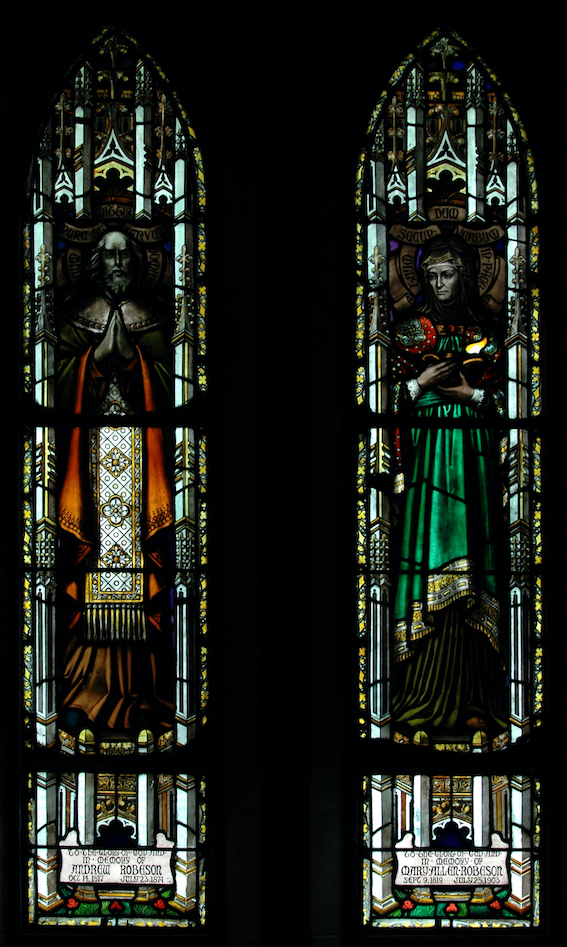
Our lancet windows of Simeon & Anna by Harry Eldridge Goodhue were given in 1905 by Alice Robeson Van Rensselaer. Photo by JG Bullitt.

The Gospel of Luke provides us one of the most beloved hymn texts in Christian history, the Nunc Dimittis or the Song of Simeon. It has been sung as part of daily evening-prayer services since at least the 4th century. The Song of Simeon has its grounding in the words of consolation and comfort in the book of Isaiah, written many centuries before,  when restoration and redemption were also sorely needed. Simeon sings a song of praise to God and then a song of blessing upon the young family. It’s a curious blessing, though, not one that I would want for my baby. It’s a blessing that predicts that the child is destined to create conflict and violence. If I had my baby in my arms and someone offered that blessing, I think I might turn away.

That’s when Anna the Prophet takes over. Luke makes sure that we know that she is a prophet before we know her marital status or her advanced age. Like Miriam of the Exodus in the wilderness, Deborah of Ephraim, Hulda of Jerusalem, or Mariann of Washington, D.C., Anna of the Temple was divinely inspired to see and bravely speak truth about both what is, and what is possible. Anna is the only woman in the New Testament who is named a prophet. The name Anna means grace or favor. (It’s the Greek version of the Hebrew name Hannah.) Luke’s emphasis is on her character and devotion. Unlike Simeon, her words aren’t recorded, but are described as praising the Holy One and speaking about Jesus to all who were looking for the redemption of Jerusalem, a city that was sorely oppressed by the brutality of the Roman Empire.

Anna was from the Tribe of Asher. That makes her “the only Jewish character in the New Testament who is said to belong not to one of the southern tribes of Judah or Benjamin, or the priestly tribe of Levi, but to one of the northern tribes of Israel.” [1] Asher was the eighth son of Jacob, and Asher means lucky, bearer of good fortune or salvation. Why did Luke include those details? Surely Anna was long gone by the time Luke was writing his Gospel three generations after the death of Jesus. Why were these details important to Luke’s audience at the end of the first century? Why do we need to know that Anna believed that Jesus would be the redemption of Jerusalem? Could we not just take Simeon’s word for it? Luke apparently did not think the presentation story was complete with just Simeon. It’s possible that Simeon represented the inhabitants of Judah and Anna, the Tribe of Asher, who represented exiles in the diaspora and hoped for return, reunion. [2] Luke’s first-century community of Jesus followers was in the diaspora in the north,  probably Syria or Turkey.

With both Simeon and Anna, the story includes male and female, inhabitants of the land and the exiled, the northern and the southern tribes of Israel, who are being restored in Jesus to be a light to all of the nations, which is another way of saying a light to the Gentiles. You might not know that “Judaism generally taught that salvation was for all people, not only for Jews.” [3] There’s another thing that Anna represents, in contrast to Simeon. Upon seeing the infant Jesus, Simeon’s song announced his dismissal in peace. Anna’s response is that she began to praise God and spread the word about the child to all who were looking for the redemption of Jerusalem, which means city of peace. Not only was Anna a prophet; she was the earliest New Testament evangelist. Her spreading the word of Jesus at the beginning of Luke’s Gospel is one bookend, and the other is the evangelism of Mary Magdalene and the other women who witnessed the empty tomb at the end of the Gospel. 

So Simeon saw the infant Jesus and retired, but Anna got back to work. She might have been old in age, but she was young in hope. [4] Apparently she didn’t waste any time on folks who were not looking for restoration or redemption. She spread the word to those who were looking. The good news about her words not being recorded is that it leaves room for our imagination about what she said. That kind of holy imagination used to read between the lines in the Bible is called midrash.

If you were going to use your holy imagination to read between the lines in this story, what do you think Anna said? What would you say if you were Anna? What would you say about Jesus to people who seem to be searching for restoration or redemption, looking for respect for the dignity of every human being, for liberation from oppression? What words of hope do you have for people looking for relief and reconciliation, for a city of peace, for a world of peace? Could you point them, even bring them, to a place where their dignity would be respected? If you were a person searching for restoration or redemption, what would you hope someone like Anna would say to you about Jesus? What words or signs would give you hope for peace in this city, or in this world, or even in your heart? Richard Rohr wrote, “People who sincerely search will touch upon the same truth in every age and culture. The direction is always toward more love and union – in ever widening circles.” [5]

You know, restoration and redemption were not just needed in the time of the prophet Anna; they are sorely needed now. The dignity of every human being is not yet universally respected. By including the story of Anna the Prophet, hearers of Luke’s Gospels learn that it is never too late see a sign of hope, nor to start spreading the word of hope. None of us is too old to be young in hope,  too far gone to be reunited with the Love of God, nor too old to shine the light of Christ in dim places.

Rabbi Shire and I were talking with folks from the parish and the synagogue about building up our moral courage in the year ahead to resist whatever is unjust, untruthful, or unloving. I mentioned our individual and shared resources of attention, prayer, time, money, and being in community with one another. When I finished that list, Rabbi Shire added that observing Sabbath is a form of resistance, not only about refraining from productivity, but experiencing refreshment and delight. Oh, we are so fortunate to have Rabbi Shire as our Rabbi-in-Residence. And I’m reminded of a poem by author and illustrator Loryn Brantz, which my daughter Sarah shared with me. 

In a time of hate
Love is an act of resistance.
In a time of fear
Faith is an act of resistance.
In a time of misinformation
Education is an act of resistance.
In a time of poor leadership
Community is an act of resistance.
In a time like this
Joy is an act of resistance.
Resist. Resist. Resist. 


  1. Richard Bauckham, Gospel Women: Studies of the Named Women in the Gospels, (Grand Rapids: Wm. B. Eerdmans Publishing,  2002), p. 77.
  2. Ibid., pp. 77-107.
  3. A.J. Levine’s note in the Jewish Annotated New Testament (New York: Oxford Press, 2011), p. 102-3.
  4. Thanks to Edith Dean for this phrase in All of the Women of the Bible (HarperSanFrancisco, 1955), p. 174
  5. https://cac.org/daily-meditations/widening-circles-2018-08-12/


[8]

More so Among us

Epiphany 3C, 26 January 2025. The Very Rev. Pamela L. Werntz

Nehemiah 8:1-3, 5-6, 8-10. Do not be grieved; the joy of the Lord is your strength.
1 Corinthians 12:12-31a. We were all made to drink of one spirit.
Luke 4:14-21. Today this scripture has been fulfilled in your hearing.

O God of love, grant us the strength, the wisdom and the courage to seek always and everywhere after truth, come when it may, and cost what it will.


It’s been a week, hasn’t it? I’ll remind you of what we do when times are terrible, frightening, angering, sorrowful: we stick together and we stay close to the scriptures. They were written in times of deep distress, and they are our guiding lights. I’m talking about the actual scriptures, the first and second testaments of our Bible, which testify to loving our neighbors as ourselves.

Today we hear Luke’s story of the beginning of Jesus’ ministry. The four Gospel writers were very careful about how they began their accounts of the beginning of Jesus’ ministry. They all agreed that Jesus’ public ministry began after John the Baptist was arrested by Herod. Like siblings, each Gospel writer’s account about where and how Jesus’ public ministry began is different.  Mark tells of Jesus exorcising an unclean spirit in the synagogue in Capernaum. Matthew’s first story of Jesus’ ministry is about a large body of teaching, which he addressed to the crowds on a mountain. John’s story of his ministry begins with the water-to-wine extravaganza at the wedding in Cana. And Luke tells about Jesus’ visit to his home synagogue in Nazareth.

Jesus, Luke says, was filled with a spirit of holiness, the same spirit of holiness that would fill his followers after his death. Luke says that it was Jesus’ custom to attend synagogue on the Sabbath. When the scriptures were handed to him, he read Isaiah’s proclamation of freedom: freedom from hunger, illness and disability, poverty, prison, debt, freedom and all kinds of oppression. It’s more of a mash-up than a direct quote from Isaiah, but certainly the spirit of Isaiah is as Jesus reports. Isaiah was proclaiming the end of the Babylonian exile. According to Luke, Jesus was proclaiming that his ministry, too, was going to be about liberation, about freedom. At the core of his ministry was (and still is) a powerful ethic of love, of compassion and mercy, forgiveness and reconciliation, nonviolence and well-being, shalom. It is the same ethic that is at the heart of the Torah, the Prophets, and the Writings. I usually don’t think of myself as a conspiracy theorist, but I do believe that all good things come from Love, which is another name for God. My conspiracy theory is that Love is the Way, the only Way.

It’s interesting to me to think about this in light of Nehemiah’s story of the return of the Hebrew people from exile and slavery in Babylon. Having returned to Jerusalem, they have gathered at the eastern gate of the city, where the water flowed from a spring. Nehemiah says they wept when they heard the word of the Holy One. They wept, the water flowed from the springs in their eyes, perhaps because they realized how far from free they had been in Babylon. Perhaps they realized how far from free they still were even though they were back in familiar territory. Perhaps they wept for all that had been lost. And the religious leaders – Ezra, Nehemiah, and the Levites – respond to their mourning with an instruction to celebrate!

Don’t mourn, celebrate, because rejoicing in the Holy One is the source of your strength. This day is sacred. You are God’s sacred people. Don’t mourn over the past. (You know, stop hoping for a better past.) Go eat and drink, and share what you have with whoever has nothing prepared.

Now, you might have noticed that verses 4 and 7 are missing from our reading from Nehemiah this morning. Maybe you even guessed that I would tell you, because I usually do! Those two verses contain long lists of names. Perhaps they’re left out in deference to lesson readers everywhere, but I wish they hadn’t been omitted. Verse 4 lists the names of the people who stood with Ezra as he read the sacred text. Nehemiah says that Ezra was standing with eleven others on a wooden platform, which had been made for the purpose. He was standing with his leadership team.  [1] And then in verse 7 is a list of thirteen additional people who were there to help the congregation to understand the sacred text, because it was hard to understand.  [2] Let’s not miss the idea that the scripture has always been challenging to understand and that Ezra had a very large leadership team helping to proclaim freedom from oppression!

It’s interesting to me to think about freedom in light of Paul’s teaching about the body of Christ. As members of the body, he says, Christians are not free to disregard the value of another part of Christ’s body, or member, even if that member is weak or seems less important. Every part is important, Paul says. The eye must not say to the hand, “I have no need of you.” The ear must not say, “Because I am not an eye, I do not belong to the body.” 

The reason that Paul was writing about this to the people in the church in Corinth was that they were arguing with each other about who was most important. We know that in the olden days, sometimes people in churches didn’t like each other, didn’t respect one another’s opinions or sufficiently regard one another’s dignity. In the olden days, sometimes people who were a part of the church behaved very badly toward one another. (Can you imagine?) In the early church, some people thought that other people shouldn’t be members of the church, or sometimes people felt that they themselves didn’t belong or didn’t really fit in! Paul was trying to teach them that everyone is important, and everyone belongs, even members who are weaker, less honored, or less respected than others. Paul was giving a pep talk about what it means to be a part of a team:  one body with many members with a variety of gifts, who have great need of one another, despite ideas to the contrary.

Paul was using the metaphor of a body to say that some parts are more noticeable or may seem more important than others, but every part is important. Every part deserves compassion and respect. Think for a moment about what compassion and respect mean. Now think for a moment about what you would say if I went around the room and asked each one of you what you think of as the strongest part of your body, and what the weakest part or the least-likable part of your body is. Think for a moment about what you might do differently if you started treating the weakest or least-likable part of your body with more compassion and respect. Maybe it’s your hair, belly, upper body, legs, nose, teeth, hands, or feet? I feel certain that each one of us has at least one body part that could use more compassion and respect.

 Now think of Emmanuel Church as a body with lots of parts. Think for a moment about what you would say if I went around the room and asked each one of you who you think are the most honored, popular, or influential Emmanuelites and who are the least honored, popular, or influential? Think for a moment about how much stronger our body at Emmanuel would be if we treated the least honored, popular, or influential members with greater respect. Maybe when you thought about it, you thought to yourself, “Actually I think I’m one of the least honored, popular, or influential Emmanuelites.” Maybe you thought, “I’m not sure I’m even considered an Emmanuelite.”  (Well I can tell you that you are today by virtue of your presence with us this morning, whether you are here physically or virtually, because that’s how it is around here.) Think for a moment about how much stronger our body at Emmanuel Church would be if you treated yourself and everyone else with greater compassion and respect, and if everyone else treated you with greater compassion and respect. 

I think starting with yourself and your parish community is what is called practicing religion. Emmanuel Church is where we practice greater self- and communal compassion and respect so we can do it out there. Even if you are already a very compassionate and respectful person, I guarantee that you can do something today that is even more compassionate and respectful than usual. Even if, and maybe especially if, you’re feeling a little cranky, less than comfortable, or nervous, you too can do something that is compassionate and respectful. Maybe it’s toward someone in your immediate family, someone who you don’t usually think about or try to avoid, someone you love but don’t agree with or understand, or someone you don’t even know and may never see again. So what does that have to do with freedom? Well, if a body is at odds with itself, it is not free. If a stomach is grumbling, for example, or an ear is aching, the whole body suffers. If people in the church are grumbling or aching, the whole community suffers. When we’re suffering, we’re not free to pay attention to the needs of others, to help get other people free.

I want to interject something about focus because when the news is as overwhelming as it has been lately, it’s tempting to give into despair or to just tune out and shut down. One antidote is to pick one issue to focus on and to act on it; take a step in the direction of advocacy and support. If the first step is too hard, break it down into smaller steps.

Helping get other people free is our job as Christians, because Christians are the body of Christ. If, as Luke says, Jesus Christ was filled with a spirit of holiness to fulfill the scriptures, to set people free, then, as the body of Christ filled with the same spirit, we Christians have inherited the same responsibility. We have the same call, invitation, and challenge to express the compassion and respectfulness that are manifestations of true holiness. Today we have opened the scriptures that proclaim freedom: freedom from hunger, illness, disability, poverty, prison, debt, harassment, and all kinds of oppression. Today we are called to rejoice in the source of our strength and share what we have with those who have no provisions for a celebration. Today let’s do what we can to make sure that this scripture is fulfilled in our hearing. Not just in the distant past and not in some unforeseeable future. Today, let’s see how it could be more so among us.


  1.  Mattithiah, Shema, Anaiah, Uriah, Hilkiah, and Maaseiah on his right hand; and Pedaiah, Mishael, Malchijah, Hashum, Hash-baddanah, Zechariah, and Meshullam on his left hand
  2.  Jeshua, Bani, Sherebiah, Jamin, Akkub, Shabbethai, Hodiah, Maaseiah, Kelita, Azariah, Jozabad, Hanan, and Pelaiah

 

Ponder these words in your heart!

Christmas 2C. 5 January 2025. The Very Rev. Pamela L. Werntz

Jeremiah 31:7-14 “their life shall become like a watered garden”
Ephesians 1:3-6, 15-19a “I do not cease to give thanks for you as I remember you in my prayers.”
Luke 2:41-52 “I must be in that belonging to my Father.”

O God with us, grant us the strength, the wisdom and the courage to seek always and everywhere after truth, come when it may, and cost what it will.


We are lingering in Christmastide for one more day. Epiphany is coming, but not quite yet! The Gospel of Luke contains the only story of the boyhood of Jesus in the Bible, and it baffles Biblical scholars. We know that ancient biographies commonly told stories of heroes in their youth to demonstrate that there were signs of greatness early on. There are some fantastic stories about Jesus’ magical powers as a young boy that didn’t make the cut when the scriptural canon was being negotiated. None of the other three Gospels, which did make it into the Bible, have any stories from Jesus’ youth; and Luke’s intention is not clear.

Is Luke demonstrating that Jesus was just like other heroes, fulfilling a divine promise that was clear to others in his boyhood? Or was Luke demonstrating that Jesus was NOT like the others because he didn’t start out knowing everything? Is this a story that demonstrates Jesus’ human-ness early on? Was he a child prodigy, learning from and asking questions of the teachers in the temple? Or was the young Jesus an ordinary adolescent, not telling his parents where he was, doing something quite dangerous, getting separated from his family, worrying them sick for the better part of a week? The answer to any of these questions could be, “Yes.”

Luke seems to be using a literary convention that matters to him and to his cosmopolitan audience to conclude his two-chapter prologue. In this little passage, however, he works in three important ideas that he wants the hearer to understand about Jesus, which found in  his Gospel.

First, in the verses just before today’s portion, Luke goes to great lengths to describe the preparation for the ceremony of Jesus’ circumcision, his dedication in the temple, the devout and righteous blessing of Simeon, and the praise of God for Jesus from the prophet Anna. We’ll hear that story on February 2 for the Feast of the Presentation. The passage ends with, “When they had finished everything required by the law of the Lord, they returned to Galilee, to their own town of Nazareth.” Then Luke says that every year Jesus’ family went up to Jerusalem for the festival of Passover. We know that Jews living within about fifteen miles of Jerusalem were expected to go to the temple three times a year: for Passover, the Feast of Unleavened Bread; for Shavuot, the Feast of Weeks (we call it Pentecost); and for Succot, the Feast of Booths. But Nazareth was more than four times that distance away. The image presented of the temple in Jerusalem by Luke is very positive, and Jesus’ parents are presented as very devout. 

Second, Jesus’ parents search and find him sitting among the rabbis, learning from them, asking questions, and demonstrating his own understanding of scripture. Here is a thoroughly Jewish Jesus, well-educated and well-grounded in his religious tradition. When Jesus asks his mother why she was searching for him, his question, literally translated, reads, “Did you not know that I must be in that belonging to my father?” This is the dramatic center of the story and these are the first words that Jesus speaks in the Gospel of Luke. The Greek words do not include the word house as in, “Did you not know that I must be in my Father’s house?” (NRSV), nor do they include the word business as in, “Did you know that I must be about my Father’s business?” Nor does the Greek include any indication of a proper noun (no reason to capitalize the word father). Much is made about the tension between Joseph as father and God as father, and that can be there, but not necessarily. The word father is the same, so there’s no reason to believe that what Jesus is doing doesn’t belong to Joseph as well. That Jesus must be ‘in that belonging’ to his father can mean in that Jewish tradition, or in that educational Jewish dialogue. Amy-Jill Levine points out that Father’s House is a common term in the Torah, but not used to describe the temple in Jerusalem. According to Luke, the point is that Jesus was really devoutly Jewish.

A third thing to think about in this passage is a theme Luke takes up again and again: the theme of losing, searching, and finding within an expansive idea of family. Here is a story of Jesus not being in close enough contact with his parents to know that they were leaving or to let them know that he was staying; we don’t really know which. All we know is that Mary and Joseph assumed that he was with their departing caravan, and they didn’t realize he wasn’t until they were a whole day’s journey away. If this sounds implausible to you, it’s either because you don’t come from a large, extended, chaotic family, or your family has a much better grip than most. In my family of origin, I think each one of us four children got lost or left behind at least once on a family trip. Each adult thought that a particular child was with another adult or being watched by older kids. It’s a wonder we all made it out of childhood alive!

The theme of losing, searching and finding gets reprised in Luke (in stories that only appear in Luke) in the parables of the lost sheep and the lost coin and of the prodigal son. Later in this Gospel Jesus rejoices about a rich man named Zacchaeus promising to give half of his possessions to the poor and pay back four times the amount if he has defrauded anyone of anything. Jesus says in response to Zacchaeus, that the Son of Man came to seek out and to save the lost. The theme of family gets defined and redefined in stories about leaving home, or not being welcome at home. It is in Luke that Jesus’ disciples let him know that his mother and brothers are searching for him and he famously replies, “My mother and my brothers are those who hear the word of God and do it.” This is hugely comforting to people who have left or been rejected by their families of origin because of their understanding or misunderstanding of who (and Whose) they are. 

Jesus’ wider definition of belonging is Good News to any who need, or long, to be welcomed into a more expansive, a more inclusive household of God. In Luke, Jesus employs an ever-larger definition of family, a definition of belonging and beloving that doesn’t depend on biology or inheritance, but on adoption by grace of those who listen deeply and behave lovingly toward one another. In Luke it’s clear that love makes a family. Maybe getting a glimpse of the idea that we belong and are beloved in the household of God is gift enough for this twelfth day of Christmas; or maybe it’s more than we could have thought to ask for.

At Emmanuel, I often think of the cantata as our fourth reading as well as our musical sermon. Today’s cantata text picks up the themes of losing, finding, and belonging to Jesus; or maybe it’s more about Jesus belonging to us, promising not to leave us bereft and panicked. Here we are all invited to identify with Mary searching for her dearest Jesus, her desire and joy. Here Jesus responds that he can and will always be found in the Love of God, in the love that is God. One of my colleagues, Steve Garnaas-Holmes wrote this in his poetry blog, Unfolding Light.[1] While it’s called, “Losing Jesus,” it’s more about finding Jesus.

Sometimes it feels like we’ve lost him.
Even so soon after Christmas
the magic is gone.

But we find him eventually
in the true temple:
not some place of special power or mystique,
but that sacred place within.
Where is the temple
but in that silence in the holy of holies
in you?

When you can’t find the Holy One
you may be looking too far afield.

Treasure these words and ponder them in your heart.


  1. www.unfoldinglight.net

Our souls tell out.

Advent 4C, 22 December 2024. The Very Rev. Pamela L. Werntz

Micah 5:2-5a. And he shall be the one of peace.
Hebrews 10:5-10. In burnt offerings and sin offerings you have taken no pleasure.
Luke 1:39-56. Blessed is she who believed.

O God of she who believed, grant us the strength, the wisdom and the courage to seek always and everywhere after truth, come when it may, and cost what it will.


I have always loved Mary, the mother of Jesus, the Godbearer, more than it seems a good Protestant girl should. It is Mary who draws me to the catholicity of the Episcopal Church. I’ve never understood her to be meek or mild, and I don’t know how anyone who reads Biblical accounts of her could understand her that way either. I don’t know how anyone who hears the words of the Magnificat, which are taken from the Song of Hannah in the Book of Samuel, could hear anything but a religious and political manifesto sung to overthrow tyrants and systems of oppression. Some years ago, the Rev. Nancy Rockwell, wrote an essay entitled, “No More Lying about Mary,” which captured what I have always believed about Mary: she was brave, and she was strong.

Rockwell writes, “God chose a spunky woman” to be the mother of Jesus. She points out that nothing in the text indicates Mary’s age or sexual status, just just that she is not married and has not previously delivered a child. Here’s her description: [1

Mary is unmarried when the angel comes. The angel’s invitation and her independent decision tell us Mary does not need permission of clergy –or her parents-– to become pregnant. Mary, wanted by God, according to the angel, for her bold, independent, adventuresome spirit, decides to bear a holy child – for a bold agenda: to bring the mighty down from their thrones; to scatter the proud in the imagination of their hearts, to fill the hungry with good things and send the rich empty away. This is Mary: well-spoken, wise, gritty. Traveling alone, like every prophet before her, she sets out on her …journey, to [her kinswoman] Elizabeth’s house, to declare her agenda. There will be more journeys: to Bethlehem; to Egypt and back [according to Matthew], to Jerusalem [at least several time until Jesus was]…crucified.

After Jesus’ death, according to Christian history, Mary traveled northwest to Ephesus, where she lived out the rest of her days, in a city well-known for the professional leadership of women.

 It seems to me that Mary’s courage doesn’t imply an absence of fear. I imagine that she left Nazareth and headed for the hills driven first by a desire to get out of town and to check in with Elizabeth, whom the angel Gabriel had said was also unexpectedly pregnant. Perhaps this was before Mary was convinced that any of the news she had was good. Perhaps she wasn’t sure any of her news was good until she was greeted with joy and declared blessed by Elizabeth: “Blessed is she who believed that there would be a fulfillment of what was spoken to her by the Lord.” Notice the circularity of the manifesto:  the poor will become rich, and the rich will become poor. “Where is the good news in that?” the rich might wonder. Well, as soon as one becomes poor, the blessings start to flow again. The description is not of a particular cataclysmic event or end, but of the circle of life. I’ve experienced this firsthand. Perhaps you have too.

This most fantastic story is of the only two pregnant prophets to have a scene in the whole Bible, and with uninterrupted dialogue! Joseph wasn’t there, and Zechariah had lost his ability to speak. Reflecting on the scene this past week as I worked on this sermon, I felt stirred to retell a story from my young adulthood.

Back in the early 1990’s, I was beginning the difficult and frightening process of coming out of the closet…as a church lady who felt called to the priesthood. Coming out as a Lesbian, even in the hostile territory south of the Mason-Dixon line, was much easier than coming out as someone imagining ordination in the Episcopal Church. Most of my straight church friends and queer unchurched friends thought I was insane. Looking back on that struggle, however, all of it seems easier than coming out of the closet as someone who has had mystical experiences, sleeping and waking.  I have never wanted people to think of me as the religious nut that I probably (okay, actually) am. Perhaps some of you have suspected it all along, but I am always reluctant to offer evidence from the pulpit.

My journey from Vice President of Human Resources for a large corporation based in Virginia to seminarian at Episcopal Divinity School in Massachusetts included some real danger and sizable emotional and financial cost. I risked everything, although I’m glad to say that I didn’t lose everything, I did lose a lot. I’m still paying for it; and I’m still benefiting from it. The love and support of other people made it possible, but what really propelled me forward during those early years was a series of vivid dreams. They were so compelling that I wrote them down; I studied them, analyzed them in therapy, and prayed with them. That’s not really the religious nut part. The things I had dreamed, however, started appearing in my waking life. Scenes and activities in my dreams that I had understood as symbolic, metaphorical but not real, started actually happening in the months and few years that followed.  I kept that mostly to myself. As I settled into life in Massachusetts, the memories of the dreams stayed with me.

In one of the dreams, I had returned to St. John the Baptist Roman Catholic parish school run by Franciscans in Joliet, Illinois, which my brother and I had attended for four years of elementary education. Back then, it wasn’t just my status as a Protestant that kept me from having a turn serving at the altar at daily Mass; Catholic girls were not allowed either. But in my dream, a guide encouraged me to journey into the sacristy and then to the altar. The invitation was thrilling, and I accepted with great joy. Then I was told that the whole improbable journey to being permitted to stand at the altar was powered by the surprise discovery of a spring of living water, a source of energy deep within, underneath the structure (the building); and I was invited to walk downstairs to see that wellspring. I awoke with a renewed sense of wonder and courage, well-being and thanksgiving.

Almost fifteen years after I had that dream, in 2007, when I had been a priest for just a few years, I traveled to Palestine and Israel with a group from Parish of the Epiphany in Winchester. Part of the pilgrimage included a stop at The Church of the Visitation at Ein Karem, in the Judean hill country. There in the courtyard is a stunning sculpture of Elizabeth greeting Mary, arms outstretched, with their pregnant bellies nearly touching. Behind the statue is a wall covered with ceramic plaques painted with the opening words of the Magnificat: “My soul magnifies the Lord, my spirit rejoices in God my Savior”, in more than thirty languages, which makes it abundantly clear that this song applies and belongs to everyone, to the whole world.

The Church of the Visitation stands on the site traditionally identified as the location of the home of Elizabeth and Zechariah. There are Byzantine ruins of a chapel there and subsequent buildings, which have crumbled through the centuries. In 1937 the Franciscans built on top of the ruins in order to preserve the remains of previous chapels found there. When I walked into the chapel, a guide invited me to walk down several flights of stairs to see an ancient wellspring. It was the very wellspring I had seen in my dream so many years earlier. I really don’t have words to describe my shock at seeing it. I was overwhelmed and thrilled by the holy mystery of the fulfillment of what had been shown to me in a dream.

In Luke’s story of this pair of pregnant prophets, I have always heard a story of allowing God’s blessing in difficult situations, of claiming “the privilege of doing hard things,” as one vestry member has called it. I have experienced this Gospel story as giving us an example of how we might be inspired, filled with a spirit of holiness, and how our souls might enlarge or magnify the view of God in the blessed and the stressed situations of our own lives. In this story, each of us is given words to say, “Blessed is she who believed that there would be a fulfillment of what was spoken to her by the Lord,” and in our own languages to repeat whenever we receive an untimely blessing: “My soul magnifies the Lord, and my spirit rejoices in God my Savior.”  I also hear this as a story of coming out, as acknowledging having received inspiration and  blessing, not only bearing it, but sharing it: telling it out loud. It occurs to me even more deeply that in gestating and giving birth to inspiration, we are called to more than a private experience. We are called also to a form of coming out.

One of the things I’ve learned, as I reflect back on the movement for LGBTQ rights and recognition over the last decades, is that what has made all of the difference is individuals telling their stories: coming out. I believe the Episcopal Church, indeed Emmanuel Church, each one of you (whether you are here for the first time or the umpteenth time) could grow stronger and strengthen others by coming out as who and Whose you are, more and more. The song of Mary applies and belongs to everyone. And as anyone who has come out about anything knows, coming out isn’t ever a one-and-done. Once you come out, staying out becomes a lifetime practice of coming out over and over and over again.

Perhaps you remember the beautiful words of the 13th-century prophet and mystic Meister Eckhart, who wrote this:

What good is it to me
if this eternal birth of the divine Son
takes place unceasingly
but does not take place within myself?

And,
what good is it to me
if Mary is full of grace
and if I am not also full of grace?
What good is it to me
for the Creator to give birth to [a] Son
if I do not also give birth to him
in my time and my culture?

This, then, is the fullness of time:
When the Son of God
is begotten in us. 

I want to add, ‘This, then, is the fullness of time: when our souls tell out the greatness of the Lord.”


  1. The Rev. Nancy Rockwell, “No More Lying about Mary:,  http://www.patheos.com/blogs/biteintheapple/no-more-lying-about-mary.