
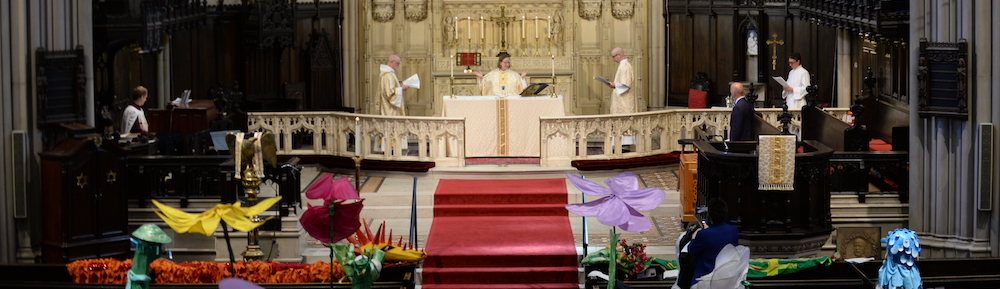
Christmas 2C. 5 January 2025. The Very Rev. Pamela L. Werntz
Jeremiah 31:7-14 “their life shall become like a watered garden”
Ephesians 1:3-6, 15-19a “I do not cease to give thanks for you as I remember you in my prayers.”
Luke 2:41-52 “I must be in that belonging to my Father.”
O God with us, grant us the strength, the wisdom and the courage to seek always and everywhere after truth, come when it may, and cost what it will.
We are lingering in Christmastide for one more day. Epiphany is coming, but not quite yet! The Gospel of Luke contains the only story of the boyhood of Jesus in the Bible, and it baffles Biblical scholars. We know that ancient biographies commonly told stories of heroes in their youth to demonstrate that there were signs of greatness early on. There are some fantastic stories about Jesus’ magical powers as a young boy that didn’t make the cut when the scriptural canon was being negotiated. None of the other three Gospels, which did make it into the Bible, have any stories from Jesus’ youth; and Luke’s intention is not clear.
Is Luke demonstrating that Jesus was just like other heroes, fulfilling a divine promise that was clear to others in his boyhood? Or was Luke demonstrating that Jesus was NOT like the others because he didn’t start out knowing everything? Is this a story that demonstrates Jesus’ human-ness early on? Was he a child prodigy, learning from and asking questions of the teachers in the temple? Or was the young Jesus an ordinary adolescent, not telling his parents where he was, doing something quite dangerous, getting separated from his family, worrying them sick for the better part of a week? The answer to any of these questions could be, “Yes.”
Luke seems to be using a literary convention that matters to him and to his cosmopolitan audience to conclude his two-chapter prologue. In this little passage, however, he works in three important ideas that he wants the hearer to understand about Jesus, which found in his Gospel.
First, in the verses just before today’s portion, Luke goes to great lengths to describe the preparation for the ceremony of Jesus’ circumcision, his dedication in the temple, the devout and righteous blessing of Simeon, and the praise of God for Jesus from the prophet Anna. We’ll hear that story on February 2 for the Feast of the Presentation. The passage ends with, “When they had finished everything required by the law of the Lord, they returned to Galilee, to their own town of Nazareth.” Then Luke says that every year Jesus’ family went up to Jerusalem for the festival of Passover. We know that Jews living within about fifteen miles of Jerusalem were expected to go to the temple three times a year: for Passover, the Feast of Unleavened Bread; for Shavuot, the Feast of Weeks (we call it Pentecost); and for Succot, the Feast of Booths. But Nazareth was more than four times that distance away. The image presented of the temple in Jerusalem by Luke is very positive, and Jesus’ parents are presented as very devout.
Second, Jesus’ parents search and find him sitting among the rabbis, learning from them, asking questions, and demonstrating his own understanding of scripture. Here is a thoroughly Jewish Jesus, well-educated and well-grounded in his religious tradition. When Jesus asks his mother why she was searching for him, his question, literally translated, reads, “Did you not know that I must be in that belonging to my father?” This is the dramatic center of the story and these are the first words that Jesus speaks in the Gospel of Luke. The Greek words do not include the word house as in, “Did you not know that I must be in my Father’s house?” (NRSV), nor do they include the word business as in, “Did you know that I must be about my Father’s business?” Nor does the Greek include any indication of a proper noun (no reason to capitalize the word father). Much is made about the tension between Joseph as father and God as father, and that can be there, but not necessarily. The word father is the same, so there’s no reason to believe that what Jesus is doing doesn’t belong to Joseph as well. That Jesus must be ‘in that belonging’ to his father can mean in that Jewish tradition, or in that educational Jewish dialogue. Amy-Jill Levine points out that Father’s House is a common term in the Torah, but not used to describe the temple in Jerusalem. According to Luke, the point is that Jesus was really devoutly Jewish.
A third thing to think about in this passage is a theme Luke takes up again and again: the theme of losing, searching, and finding within an expansive idea of family. Here is a story of Jesus not being in close enough contact with his parents to know that they were leaving or to let them know that he was staying; we don’t really know which. All we know is that Mary and Joseph assumed that he was with their departing caravan, and they didn’t realize he wasn’t until they were a whole day’s journey away. If this sounds implausible to you, it’s either because you don’t come from a large, extended, chaotic family, or your family has a much better grip than most. In my family of origin, I think each one of us four children got lost or left behind at least once on a family trip. Each adult thought that a particular child was with another adult or being watched by older kids. It’s a wonder we all made it out of childhood alive!
The theme of losing, searching and finding gets reprised in Luke (in stories that only appear in Luke) in the parables of the lost sheep and the lost coin and of the prodigal son. Later in this Gospel Jesus rejoices about a rich man named Zacchaeus promising to give half of his possessions to the poor and pay back four times the amount if he has defrauded anyone of anything. Jesus says in response to Zacchaeus, that the Son of Man came to seek out and to save the lost. The theme of family gets defined and redefined in stories about leaving home, or not being welcome at home. It is in Luke that Jesus’ disciples let him know that his mother and brothers are searching for him and he famously replies, “My mother and my brothers are those who hear the word of God and do it.” This is hugely comforting to people who have left or been rejected by their families of origin because of their understanding or misunderstanding of who (and Whose) they are.
Jesus’ wider definition of belonging is Good News to any who need, or long, to be welcomed into a more expansive, a more inclusive household of God. In Luke, Jesus employs an ever-larger definition of family, a definition of belonging and beloving that doesn’t depend on biology or inheritance, but on adoption by grace of those who listen deeply and behave lovingly toward one another. In Luke it’s clear that love makes a family. Maybe getting a glimpse of the idea that we belong and are beloved in the household of God is gift enough for this twelfth day of Christmas; or maybe it’s more than we could have thought to ask for.
At Emmanuel, I often think of the cantata as our fourth reading as well as our musical sermon. Today’s cantata text picks up the themes of losing, finding, and belonging to Jesus; or maybe it’s more about Jesus belonging to us, promising not to leave us bereft and panicked. Here we are all invited to identify with Mary searching for her dearest Jesus, her desire and joy. Here Jesus responds that he can and will always be found in the Love of God, in the love that is God. One of my colleagues, Steve Garnaas-Holmes wrote this in his poetry blog, Unfolding Light.[1] While it’s called, “Losing Jesus,” it’s more about finding Jesus.
Sometimes it feels like we’ve lost him.
Even so soon after Christmas
the magic is gone.
But we find him eventually
in the true temple:
not some place of special power or mystique,
but that sacred place within.
Where is the temple
but in that silence in the holy of holies
in you?
When you can’t find the Holy One
you may be looking too far afield.
Treasure these words and ponder them in your heart.