
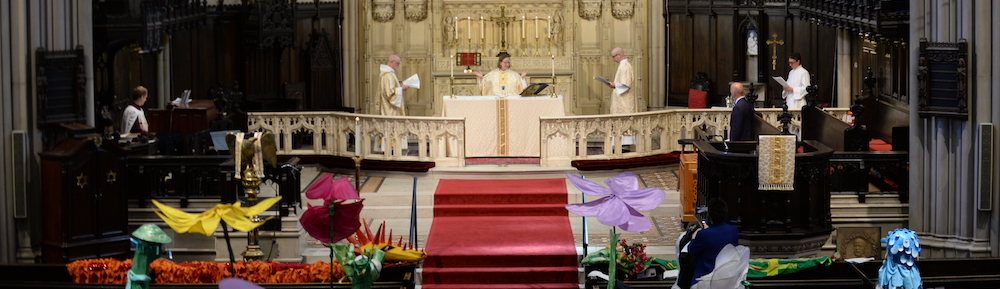
I’m begging you.

Epiphany 7C.   23 February 2025.  The Very Rev. Pamela L. Werntz

Genesis 45:3-11, 15. And he kissed all his brothers and wept upon them.
1 Corinthians 15:35-38, 42-50.  Someone will ask, “How are the dead raised?
Luke 6:27-38. A good measure, pressed down, shaken together, running over will be put into your lap.

O Most Merciful and Compassionate, grant us the strength, the wisdom and the courage to seek always and everywhere after truth, come when it may, and cost what it will.


During this season of Epiphany, our First Testament lessons have been from the Writings and the Prophets: Nehemiah, Isaiah, Jeremiah, and Malachi. Suddenly and unexpectedly, a lesson falls into our laps from Genesis about the long-lost Joseph encountering his brothers in Pharaoh’s court in Egypt. I want to make sure you know the backstory just in case you didn’t have at least a half a dozen years of Sunday School when you were growing up!

Here’s a quick synopsis of about a dozen chapters of Genesis: Joseph was the 11th of 12 sons of Jacob (aka Israel). Jacob had his last two sons with Rachel, who died in childbirth delivering Benjamin. The legend goes that Joseph was Jacob’s favorite, and his brothers were insanely jealous of their father’s favoritism and Joseph’s dreams of superiority. When Joseph was 17, his brothers, who couldn’t take it anymore, decided to kill him. Then they changed their minds and threw him into a pit instead. He got pulled out by some passersby, who sold him into slavery. The brothers tore up Joseph’s ornamented tunic, a special gift from their father, put blood of a goat on it, and told Jacob that his beloved son must have been devoured. [1] He was devastated. Joseph ended up in Egypt, where he was enslaved in a wealthy household and then jailed by the jealous master whose wife lusted after him. While in jail, Joseph interpreted the dreams of fellow prisoners and so gained the attention and then the trust of Pharaoh, who made him the second-most-powerful person in Egypt, in charge of the empire’s food supplies through a severe famine. 

Meanwhile, Joseph’s brothers, who were starving in the land of Canaan, learned that there was plenty to eat in Egypt; so they headed there to beg for food. They didn’t recognize Joseph when they met with him, but he knew them. He gave them sacks of food, but hid a golden cup in youngest brother Benjamin’s sack. He then accused Benjamin of theft and threatened to imprison him. When the brothers begged to be imprisoned in Benjamin’s place, Joseph revealed who he really was. High drama! That’s where our story this morning picks up.

What’s missing in our reading is the beautiful verse in which Joseph and Benjamin wept on each other’s necks in a poignant acknowledgement that the injury inflicted by the older brothers was not just to Joseph and Jacob, but also to Benjamin. The two sons of Rachel then weep over the other ten brothers. There is no righteous retribution, vindictiveness, or Schadenfreude at their desperate circumstances, even though, surely, they had it coming. There is a promise of mercy, compassion, material restoration, and care with a strong sense of divine providence turning decades of tragedy into a future of dignity and grace. Walter Brueggemann describes Joseph’s work as reinterpreting the past, redefining the present, and reimagining the future. [2]

In the light of this story from Genesis, I can see that Jesus was teaching Torah in Luke’s Sermon on the Plain. When I look through Luke’s particular lens at Torah and Gospel, I can see that he views the Good News as the healing power of relationship with the Divine, the healing power that flowed out of Jesus, to reinterpret the past, redefine the present, and reimagine the future. But Jesus’ teachings here are hard; the challenges are huge. Even if we agree with the ideas and the ideals of loving our enemies, putting that into practice takes a lifetime of work. Often in conversation about these teachings, there’s a quick move to the extremes: what about the oligarchs? What about the President? Going to the extremes is a way of avoiding looking at our own spheres of influence. Closer to home we might ask: what about someone who is in an abusive or exploitative relationship? No! What then? Are we to be passive or complacent? How do we reckon with evil without indulging it? Surely we should not tolerate intolerance! Jesus’ answers have to do with responding restoratively rather than retributively. Restoring what? Restoring dignity. Jesus asserts the healing power of restoring dignity in undignified circumstances. Jesus has no tolerance for public shaming or humiliation, and he knew that violence never ends violence. Only creative non-violence will do that. Hatred will never overcome hatred; only love will do that. (That’s a teaching from the Buddha, by the way.) Similarly, Jesus lays out a path of non-violent, dignified responses to injuries that affirms self-worth and the worth of the other, even if the path is completely obscured by the fog of cultural differences, language, and time.

It’s hard for me to think of a teaching of Jesus that requires greater translation across culture, time, and language than the one about turning the other cheek if someone strikes you. The word that gets translated strike describes the act of slapping someone with an open hand. The backhand slap was typically done in the context of humiliation or mockery, used to shame someone in a public setting. The Greek dictionary says, “It was considered a grave insult, reflecting a deep level of contempt or disdain.” [3]

I was far along into my theological education when I had the opportunity to see the great Walter Wink demonstrate this teaching from Jesus, and it made an indelible impression on my heart. He demonstrated the motion of backhanding someone on the right cheek (with his right hand) like someone with greater power would do to someone with less power. When the victim offered the other cheek, the only slap possible was to cup the person’s cheek, which was a gesture of affection. The move of offering the other check is physically, literally, disarming. It is an elegant response that asserts the dignity of both the perpetrator and the victim. Likewise, giving one’s shirt to someone who has just taken one’s coat is a non-violent way to demonstrate the dignity of nakedness and the indignity of injustice. In an honor-and-shame culture, nakedness brings shame on the one who sees, not on the one who lacks cover.

Although these are not teachings about being doormats for Jesus, what if we cannot manage to love our enemies? What do we do when loving is too hard or too dangerous? Remember, when the task is overwhelming and seems impossible, it means that the first step is too big; and so we need to break it down into smaller steps. One move is to step outside of what Pádraig Ó Tuama calls, “the energy of enmity,” which keeps us trapped or stuck, cornered or cowering. [4] Buddhist teachers Robert Thurman and Sharon Salzburg have said that, for them, the first step toward non-hatred is to become aware of how it feels to be scared and angry inside of oneself but not todiscount or ignore the injury. If you’re like me, lately, you’ve had opportunities to feel scared or angry every day. 

A next step is to cultivate a desire to not be stuck there: a desire to heal. Non-hate is the beginning of the journey. If you’re like me, you also have opportunities to step out of that narrow place of desire for revenge and into a place of mercy and compassion. If you’re looking for an example of what I mean, the Bishop of Washington, Marianne Edgar Budde, recently gave a master class on speaking truth to power in a most loving way, both in her sermon at the prayer service the day after the Inauguration and in subsequent interviews. (If you haven’t yet seen and heard Bishop Budde, then listening to her is a good next step.)

The idea of non-hate being the beginning of a journey toward love connects for me to Jesus’ command to be merciful. The verb can also be translated: become. Become merciful like the Holy One, who is merciful. Be in relationship with divine mercy for yourself and for others, along the Way. Do not judge, and you will not be judged by the Holy One. Do not condemn, and you will not be condemned by the Holy One. Perhaps you hear the echo, “Forgive us our sins as we forgive those who sin against us,” from the way Jesus taught his followers to pray. I don’t know about you, but I’m always hoping that God will forgive us our sins better than we forgive those who sin against us, because Christians in general are not that good at it yet. 

Another step toward non-hate, and this is very important, is to refrain from considering or declaring that our enemies are somehow less than or other than human. Violence toward others cannot be justified by dehumanizing them, even if they are behaving in depraved and terrible ways. And for me, it’s important to understand that we are capable of the most depraved and terrible things that we deplore in our enemies, which is one reason “We repent of the evil that enslaves us, the evil we have done, and the evil done on our behalf.”

What I want to suggest about the prohibition of judging and condemning is that there is an important distinction to me between judging and condemning people and judging and condemning behaviors. Even as I say this, I’m aware of how “Love the sinner, hate the sin” has been used against queer people like me. Nevertheless, even as Jesus says don’t judge, he is clearly judging against violent behaviors of all kinds. Also, according to Luke, Jesus responded in mercy and compassion to the criminal on the cross near him who believed that he deserved his own death sentence.  I’m sure that responding to one’s enemies with grace and mercy will and does change us for the better; responding with grace and mercy heals us and the world. When we can loose whatever grip righteous indignation has on us, when we stop consuming the poison of resentment and hatred, it’s like an abundance of grace, so much that it generously runs over like a gift falling into our laps!

I want to close by saying something about our lesson from First Corinthians. I just love Paul’s words of assurance that someone is going to ask, how are the dead raised? With what kind of body do they come? In other words, how exactly does resurrection work? “Fool!” he practically shouts. Listen up, Emmanuelites! Resurrection looks like: “They buried us but they did not know we were seeds.” Resurrection looks like twelve brothers reunited and forgiven. like mercy and compassion, like suffering with, like remembering and asserting one’s own dignity in the face of mistreatment, like respecting the dignity of every human being, and for Christians, like seeking and serving Christ in all persons, even when you cannot discern any evidence of the Christ. It looks like restorative rather than retributive justice, reinterpreting the past, redefining the present, and reimagining the future. It looks like using our power to heal, like a strong sense of divine providence turning decades of tragedy into a future of dignity and grace. It looks like Love that is stronger than death. Without that love, whatever we do is worth nothing, our opening collect today acknowledges. Take that Word of God seriously. I am begging you.


  1. Robert Alter’s translation in his The Hebrew Bible: A Translation with Commentary (NY: Norton, 2019).
  2. Walter Brueggemann, Genesis in Interpretation, Vol. 1 (Atlanta: John Knox Press, 1982), p.347.
  3. “Strike” in Strong’s Exhaustive Concordance.
  4. https://onbeing.org/programs/sharon-salzberg-robert-thurman-love-your-enemies-really?

Reparations

Proper 21B. 29 September 2024. The Very Rev. Pamela L. Werntz

Esther 7:1-6,9-10; 9:20-22. Days for sending gifts of food to one another and presents to the poor.
James 5:13-20. Are any among you suffering? They should pray. Are any cheerful? They should sing songs of praise.
Mark 9:38-50. Have salt in yourselves, and be at peace with one another.

O God of beauty, grant us the strength, the wisdom and the courage to seek always and everywhere after truth, come when it may, and cost what it will.


So I will get to our hell-fire Gospel lesson in a minute, but not before I say something about Queen Esther: beautiful, brave, patient, and smart, who used her position and gifts, and risked her own life on behalf of her people. This mighty woman’s name appears more times than any other woman in the Bible, and she speaks more than any named women except for Judith. She is the ideal against which Herodius was compared  (in the Christian testament of the Bible) and was found to have utterly missed the mark when a king, intoxicated by wine and the beauty of a woman, offered to do anything she wanted. Queen Herodius coached her daughter to ask for the murder of John the Baptist. Queen Esther asked that she and all of her people be saved from a scheduled massacre. Esther’s courage, compassion, and integrity and the quality of her leadership changed her wartorn world and brought peace. 

 Esther is a great leader to have in mind when we hear this reading from the Gospel of Mark. You might recall the disciples have just been arguing amongst themselves about who is greater. Jesus has said, whoever wants to be first must be the servant of all. Now a random person has been casting out demons in Jesus’ name. Someone who isn’t even one of Jesus’ group of followers, is casting out demons in his name; and they think, that’s gotta stop. John tells Jesus, “You can’t let just anybody use your good name as their authority. You’ve got to have some standards Jesus!”

And Jesus’ response? He says, don’t stop him; whoever is not against us is for us. Once again, it’s opposite day with Jesus in Mark. (later, Matthew 12:30 has Jesus say the more familiar, “Whoever is not for me is against me.”) But according to Mark, it’s whoever is not against us is for us! Here it’s not about tests of identification or criteria for membership. The disciples may still not get it, but Jesus has actually learned something from his encounter with the Syro-Phoenician woman. He has learned that God’s healing grace is bigger, deeper, and wider than previously thought . Don’t try to place restrictions on it, or on people who are delivering it. If demons are being cast out in Jesus’ name, if people are being healed in his name, if hungry and thirsty people are being offered food and drink in his name, it’s all good. Anyone working for just distribution of resources and liberation from oppression is on the same side. Invariably this raises the question, what about people who really are against us? That question must have come up for the Gospel of Matthew’s community because Jesus says, “Love your enemies and pray for those who persecute you.” That’s a hard one.

But back to the Gospel of Mark. Right away, without missing a beat, Jesus reminds his disciples that they need others; they depend on those with whom they minister for the basic necessities of life. Boy, that’s also hard one isn’t it? “Whoever gives you a cup of water to drink because you carry the name of the Anointed (the Christ), I swear to you, such a person certainly won’t go unrewarded!” Whoever assists you will be honored in God’s name. Here’s a lesson for any of you who’d prefer to not be on the receiving end of help from people whom you are trying to help! I know you’re out there, because I know myself and how uncomfortable I get when someone I am trying to help wants to offer me help. Jesus is teaching here about mutual ministry. Jesus is teaching here about the realm of God.

Then Jesus admonishes them by saying, “Don’t you put stumbling blocks in the way of beginner seekers.” (That’s what little ones means in the Gospels. It could be a reference to the one casting out demons or a reference to the ones offering water; that’s not clear.) In other words, don’t scandalize people who are doing good deeds even if they are not following Jesus the way you are or you think they should. Don’t try to stop someone who is offering to care for you when you think you don’t need their help. One of the things that people who like to give often forget is that giving and receiving are as connected as breathing in and breathing out. It’s quite deadly to do one without the other for very long. 

This reading from Mark suggests just how highly we should regard a relationship with the Holy One. Jesus uses pretty strong language, indeed radical language, to say that if any part of us blocks our right-relationship with the Divine, get rid of it; it’s not worth it. It’s clear to me that the examples Jesus gives about getting rid of a body part that causes someone to trip someone else up are not to be taken literally. Judaism never advocated self harm, and Jesus’ followers did not practice it either. Jesus is using hyperbolic language to assert that whatever gets in the way of a relationship with God, let it go. It would be better to live into the realm of God without some part of ourselves, than to live in the burning trash heap outside of the city walls, a garbage dump place called Gehenna, here translated as hell. By the way, you might think, based on the pop culture notions of Christianity (assisted by our lectionary), that hell is a pretty big issue for Jesus or a pretty big issue in the New Testament. It’s not; there’s really not that much talk about Gehenna. Gehenna was a real valley outside the city of Jerusalem, where rubbish was gathered and burned; it was a metaphor for separation from God. Most of the thought and talk of hell by Christians was developed in the imaginations of later Christians after the New Testament was written. Remember that the Apostle Paul, argues eloquently that nothing whatsoever can separate us from the love of God. 

Then we hear Jesus reminding his followers about salt. Everyone will be salted with fire. (Other ancient manuscript copies of Mark say that everyone will be salted with salt.) Salt is good, and this fire is testing, refining fire. Salt is good, but if salt has lost its saltiness, how can it season? Have salt within yourselves (in this tasteless world), and keep peace in one another. That’s one of my favorite lines in the Gospel of Mark. Have salt within yourselves, Jesus said. I can think of at least eight reasons that salt would be a good thing to have within ourselves. I’ve recited these before; maybe you remember them? Here they are:

  • In Jesus’ time salt was used as currency, as a form of money.  Salt and salary come from the same root.
  • Salt has healing qualities.
  • Salt has preservative qualities. 
  • Salt has seasoning qualities; it enhances flavor.
  • Salt has cleansing or purifying qualities.
  • Salt was considered to be a portent against evil forces. People still throw salt over their left shoulder to keep the devil at bay.
  • Salt was a sign of permanence.  Eating salt with someone in Biblical times meant you were bound to them in loyalty, in a covenant of friendship.
  • Salt thrown into a kiln when pots are being fired will change and beautify the surfaces of the vessels in ways that are unpredictable and can’t be completely controlled.

Whether Jesus was thinking of just one, several, or all of these reasons, what he was saying was have value within yourselves and everyone else. Keep peace with one another. 

In the realm of God (or Love) everyone will be salted with fire. In the realm of Love, everyone will be subject to refinement with unpredictable and uncontrolled beauty! Have salt in yourselves, and keep peace with one another. Notice that Jesus is saying to the group, have value in yourselves,  plural. You are all valuable, he is reminding them, those of you in the in group, and those outside the group, all. Remember that; hold on to it; have value in yourselves, have healing and preservative qualities, have the spice of life in yourselves, have cleansing and protective qualities, have distinctive character,, and keep peace with one another. Keeping peace means more than just keeping one’s mouth shut. Take your lead from brave Queen Esther, who bravely spoke out on behalf of herself and her people. 

Keeping peace, shalom, is much deeper, more profound than keeping quiet. Keeping peace is definitely not at the expense of valuing oneself or one’s community. And it’s not valuing oneself or one’s community so much that we cannot work for peace. It’s both/and, as we like to say. It’s carrying the tension of knowing that each one is so beautiful and so valuable, this community is so beautiful and so valuable, that conflicts that arise must be resolved. Being at peace is not about avoiding conflicts, it’s about resolving conflicts that inevitably arise in community and between communities. What I hear Jesus saying is: in the realm of God everyone is beautiful in unpredictable ways. Seek and you will find that beauty hiding in plain sight.

I was thinking about this on Friday when I signed my name to a public statement confessing the sin of racism and calling for atonement, repair, and reconciliation from predominantly white churches in metropolitan Boston. Faith leaders were signing as individuals, not on behalf of our congregations, but it’s easy enough to find out for whom I am working. The lead organizers, The Rev. Kevin Peterson and the Rev. John Gibbons, told us that we were doing something that had never been done:  an interfaith group of white faith leaders signing a confession and call, witnessed by an interfaith group of black faith leaders. Will it stir up conflict? Yes, it already has. Will it make a big difference or a little difference? I don’t know yet, but for me, it was the right thing to do. For me, it was a step forward in building and repairing relationships that will be essential to engaging more deeply in the work of reparations in the City, of holding the salt and passing the peace. I urge you to also take steps forward in the work of building and repairing relationships in the City of Boston and beyond.


Reminders of Healing Power & Promise

Lent 4B, March 14, 2021

Numbers 21:4-9. Moses prayed for the people.
Ephesians 2:1-10. This is not your own doing; it is the gift of God.
John 3:14-21. Those who do what is true come to the light.

O God of Grace, may we have the wisdom, the strength, and the courage to seek always and everywhere after truth – come when it may and cost what it will. Amen.


One of the many joys of grandparenting for me is watching Sesame Street! I know I don’t have to have grandchildren to watch it, but they’re a good excuse! Some of you might remember a Sesame Street song called “One of these things is not like the other.” That is an apt song for our Hebrew Scripture passage this morning wedged into a Sunday series of covenant stories during Lent. Remember we started Lent with the story of God’s promise to Noah and then the story of God’s promise to Abraham. Then the promise from God that when (and whenever) we are loving God, we won’t behave in ways that do damage to one another and to ourselves. Next week we will hear the story of God’s promise to write God’s love on the hearts of people so that no one will have to be taught about God, everyone will already know God – by heart. But this week, we have one of those things which is not like the others. We have this peculiar little story from the Book of Numbers.
Continue reading