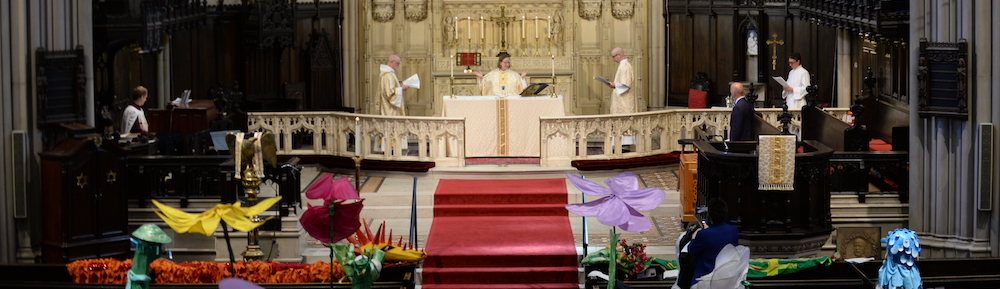
Happy Halloween to those who celebrate!

We had a fun week here at common art and Boston Warm. Let me catch you up with an encouraging story from this week:

Two Fridays ago, one of our members found a Notre Dame class ring on the street. He came to me wondering how we could track down the owner of the ring. He told me that he could easily pawn the ring and get the money for it, but wanted to return the ring to the rightful owner because he knew they would be hurting over the loss of such a sentimental and valuable ring. Because the ring was engraved with the owner’s initials and graduation date, we decided it might be worth a shot to call the Notre Dame alumni office to see if they could track this person down. Low and behold, it worked! The alumni office was able to find the owner, so I was able to return the ring to her this past Wednesday before common art. Continue reading

It’s already in you.

Proper 12C, July 27, 2025.  The Very Rev. Pamela L. Werntz

  • Hosea 1:2-10.  In the place where it was said to them, ‘You are not my people,’ it shall be said to them, ‘Children of the Living God.’,
  • Colossians 2:6-19. Do not let anyone disqualify you.
  • Luke 11:1-13. Everyone who ask . . . everyone who searches . . . everyone who knocks.

O God of Everyone, grant us the strength, the wisdom and the courage to seek always and everywhere after truth, come when it may, and cost what it will.


I want to preach about the Gospel lesson from Luke, but I cannot leave the reading from Hosea just hanging there! Hosea, a prophet of Israel, was crying out against his people for breaking the covenant by not worshipping The Holy One alone. Idolatry and whoredom, in ancient Hebrew, are the same word – the very same thing. [1]  The people had promised fidelity to the Holy One of Israel, but they had been seeing other gods. They had been engaged in moral defection, fraud and cheating, improper intercourse with other deities. They have been putting their faith in wealth and other forms of power, engaging in dishonorable and undignified behavior, rather than acting in compassion and with high regard for both neighbors and aliens. (This could be ripped from today’s headlines.) Hosea charged that economic resources were being misused to wage war, and the government was exploiting poor people. When the Lord first spoke within Hosea, Hosea heard, ‘find a wife who is seeing other gods, because you’ll not be able to find one who is not seeing other gods – everyone in the land is doing it…and name your children after a place of a brutal massacre; “no compassion;” and “not my people.” Hosea heard God saying, “because I am not your becoming; I am not your being; I am not your will be.”

Continue reading

Labyrinth

Proper 8C, June 29, 2025.  The Very Rev. Pamela L. Werntz

  • 2 Kings 2: 1-2,6-14. Please let me inherit a double share of your spirit.
  • Galatians 5:1,13-25. You were called to freedom…do not use your freedom as an opportunity for self-indulgence.
  • Luke 9: 51-62. Follow me.

O God of the prophets, grant us the strength, the wisdom and the courage to seek always and everywhere after truth, come when it may and cost what it will.


All three of our scripture readings today speak about the costs of seeking after truth – of following great teachers, of listening to prophets, of listening for God’s very Self-disclosure, and the cost of discipleship, which, as the late Walter Brueggemann used to say, is no picnic!
Continue reading

Shehecheyanu Redux

See also our rector’s 2013 sermon of the same title.

Epiphany, Last Sunday.  2 March 2025.  The Very Rev. Pamela L. Werntz

Exodus 34:29-35. The skin of his face was shining and they were afraid to come near him.
2 Corinthians 3:12-4:12. Since then, we have such a hope, we act with great boldness.
Luke 9:28-43a. And all were astounded by the greatness of God.

O God of faithfulness, grant us the strength, the wisdom and the courage to seek always and everywhere after truth, come when it may, and cost what it will.


One of the many benefits for me of sharing the pulpit of Emmanuel Church with a rabbi-in-residence and with an Ark of the Covenant in my peripheral view is that it continues to challenge and change the way I encounter Holy Scripture and the prayers and hymns of the Episcopal Church. My sensitivity to the need for corrective lenses in the Church is heightened. My desire to preach against the ways that the Christian Church has promoted supersessionist theology continues to rise. Christian supersessionism is very much like racism as far as I am concerned.   It’s systemic, oppressive, often internalized, hard for many Christians to see, and always wrong. It distorts our vision and damages our souls. 

I especially need to call this out on a day when we welcome a child with dual citizenship in the realm of God, as both a son of Israel and a member of the Body of Christ. Levi and his older sister and brother all have two spiritual passports in the realm of God; they are full citizens of both Judaism and Christianity. How is it possible? I don’t exactly know, but I do know that with God anything born of love is possible. And I know that at Emmanuel Church we have a long history of experiencing glorious impossibilities.

And so on this day on which we mark the end of the Epiphany season with stories of the transfiguration of Jesus, in light of the stories of Moses’ shining countenance, I’m drawn to preach about the Apostle Paul and his words to the Church in Corinth, because our passage today sounds as if Paul was dismissing Moses and the Israelites as old news (and he was). It sounds as if Paul was preaching the newness and better-ness of Christianity (but he wasn’t quite doing that). I have to tell you (or remind you) that Paul was not a Christian. [1] While he recruited Gentiles to follow Jesus, as a Jew through and through, he was arguing with people within his own tradition for openness and inclusivity in the realm of God, . Furthermore, neither Paul nor Jesus was inventing the ideas of openness and inclusivity. To varying degrees both of them were declaring stretched boundaries and widened gates for belonging and beloving as people of God, using the Law and the Prophets as their scriptural foundations. The Apostle Paul and the Evangelist Luke were asserting continuity and expansion of belonging and beloving in encouraging people to follow the Jesus Way.  Looking back on Paul’s arguments with corrective lenses, however, it becomes clear that he was arguing about who was out and who was in as he contended that the glory of Moses was dimming and the glory of Jesus was brightening.

Paul was reacting to rivals, whom he derisively called super-apostles, who were insisting that to be faithful to Jesus required being faithful to Torah. The Rev. Dr. Dan Joslyn-Siemiatkoski, Director of the Center for Christian-Jewish Learning at Boston College, wrote the other day that although this was an intramural argument within Judaism, it was “aimed towards Gentile Jesus believers, [and] it quickly becomes an argument that can and does fuel anti-Jewish perspective.” [2] Dan argues that this reading should not be included in the Lectionary at all. I think he’s right. We should go back to using the Episcopal Church Lectionary assignment for this Sunday, which calls for 1 Corinthians 12:27-13:13, Paul’s treatise on the primacy of love.

I know that there are those who dislike Paul, and they have good reasons. I used to dislike him, but now I like him enough to want to argue with him rather than just discount him. My seminary professor and Jewish New Testament scholar Larry Wills taught me to use a different interpretive framework or lens to know and appreciate Paul. The new framework or lens getting developed over the last several decades takes into account all of what Paul wrote (that we still have in scripture). It’s a much broader approach than the one that excludes the things that don’t fit in a more traditional Protestant Reformation framework. 

I would like to persuade you that Paul was not a phony, ignorant, or a liar, although I admit he was a bit of a jerk. I would like to persuade you that we don’t need to imagine that he was hating and rejecting himself or his tradition even as he challenged his rival apostles within it. He was a great writer, and he had a passion for welcoming folks into the beloved community by proclaiming that the God of Israel’s mercy and grace extended to all nations, i.e. all Gentiles.

The context for our passage from 2 Corinthians is this. Having founded the community of Jesus followers in the city of Corinth, Paul moved on to gather similar communities in other cities. After he was gone, some super-apostles came to Corinth and insisted that, in order to truly be people of the God of Israel, the Gentile men had to be circumcised and the Gentile people had to follow halakhah, or Jewish dietary laws and other established faithful practices. The thing is, Paul’s audience in Corinth was made up of Gentiles. He was arguing that the Torah does not apply to Gentiles. In his letter to the church in Rome, he wrote: “Do we then render Torah void? God forbid! On the contrary, we uphold the Torah!”  Torah is so much deeper and wider than our English word law.  Torah is a way of being, created before the world (as in, “In the beginning was the Word, and the Word was with God, and the Word was God.”) Torah is the Word, the way of being, given to Jews.

So if all of this is true (and I believe it is), what does any of it have to do with us? Well, according to Paul, God’s mercy and grace extend to people even if they aren’t Jews. This is good news, great news actually! Interest in openness and inclusiveness has its roots in the Hebrew Bible and is continued in the Christian Testament. We bear witness to openness and inclusiveness at Emmanuel Church with scripture, tradition, and reason as our foundation, and with the authority that comes from engaging with the Holy One, Who is always doing a new thing.

New covenant doesn’t nullify any previous covenants from the standpoint of the God of Israel.  God was offering new covenants to God’s people throughout ancient history: the new covenant of Noah, the new covenant of Abraham, the new covenant with Moses and the people in the wilderness, the new covenant with David, the new covenant written on the hearts of the people described by the prophet Jeremiah, the new covenant proclaimed by Jesus. In her book entitled Paul was Not a Christian, Jewish New Testament scholar Pamela Eisenbaum asks the rhetorical question: “Has Jesus’ act of faith rendered the covenant between God and Israel meaningless? God forbid! On the contrary, we who are members of Israel are fulfilling the prophesies of Torah by acknowledging God’s redemption of the whole world.” [3]

Here’s what I notice about the story of Moses veiling his face and about Paul’s interpretation. Moses was radiant, brilliant, dazzling, terrifyingly luminous because of his encounters with the Divine. Since the people were afraid, he he veiled his face to avoid frightening them when he talked to them. The scripture tells us that Moses, plagued by doubt and anxiety, had sought the Divine Presence and positively glowed after his encounter. with God.   According to Paul, Moses had good intentions; but in trying to protect people from their fears, he obscured something essential: the reflection of the glory of God. According to Paul, being shielded from the reflection of the glory of God hardened the people’s minds. That’s an interesting idea. Paul was encouraging his audience to be bold and to shine with the glory of God. The Church has been wrong in making this an anti-Jewish message. The story of the transfiguration in our Gospel today, written decades after Paul’s letters, reveals and upholds that Jesus’ closest companions saw Moses, Elijah, and Jesus in relational community. Sadly, our English translation willfully obscures the word exodus when Jesus was talking with Moses and Elijah about his departure, which he was about to accomplish in Jerusalem. Jesus was speaking with them about his forthcoming exodus, i.e. liberation from slavery and journey through the wilderness to a land of well-being, a land of the well cared for.

We are all called to boldly shine with the glory of God when we encounter the power of love in community. Shining can be so much more difficult than lamenting, especially when times are tough. To express beauty and joyfulness in the midst of so much anxiety and sadness in the world is brave and hopeful. It’s not a denial of suffering, but a nevertheless gladness to be alive, gratefulness to have survived to this point. It doesn’t negate any of the sorrows prior to this day or the sorrows felt by other people. It’s bold to say it,  to pray it, to radiate with it, and not to hide it. It seems like a most fitting way to end this sermon: giving thanks to God for the joy of this gathering. If you know the Shehecheyanu, say it with me! Baruch atta Adonai eloheinu melech ha’olam, she-hecheyanu v’ki-yemanu v’higianu lazman hazeh. Blessed are you Holy One, sovereign of the universe, Who has kept us in life and sustained us and brought us to this time.


  1.  Pamela Eisenbaum, Paul was Not a Christian: The Original Message of a Misunderstood Apostle (HarperCollins, 2009).
  2. Dan Joslyn-Siemiatkoski.  https://www.facebook.com/dan.joslynsiemiatkoski
  3. Eisenbaum, op. cit., electronic book edition (no page numbers).

Be joyful in Love, all you peoples!

Easter 7B, 123 May 2024. The Very Rev. Pamela L. Werntz

  • Acts 1:15-17.  The crowd numbered about one hundred..
  • 1 John 5:9-13.  So that you may know that you have eternal life.
  • John 17:6-19. So that they may have my joy made complete in themselves.

O God of our complete joy, grant us the strength, the wisdom and the courage to seek always and everywhere after truth, come when it may and cost what it will.


In the church year, we are now as deep into the Easter Season as we can go. We have just passed the Feast of the Ascension, which is a Principal Feast Day in the Episcopal Church, but a celebration that is perhaps a little embarrassing for many progressive Christians. I mean, it’s a little embarrassing to commemorate a day when, according to the writer of Luke and Acts, a full forty days after he was raised from the dead, Jesus opened their minds to the scriptures and gave his final blessing. He then was lifted up off of the ground, and a cloud took him out of his disciples’ sight. But as my friend Brother James Koester, the Superior at St. John the Evangelist across the river in Cambridge, recently wrote: [1]

The Ascension is not rocket science, and it loses its power if we reduce it to a literal description….Instead, the Ascension is about the mystery of Christ’s present reality: risen, ascended, and glorified. This not only shall be ours one day but it is ours today. Continue reading

Becoming

Proper 13B, 4 August 2024. The Very Rev. Pamela L. Werntz

  • 2 Samuel 11:26 -12:13a.  There were two men in a certain city, one rich, and the other poor.
  • Ephesians 4:1-16.  Speaking the truth in love…promotes the body’s growth in building itself up in love.
  • John 6:24-35. I AM the bread of life..

O God of continual mercy, may we have the wisdom, the strength, and the courage to seek always and everywhere after truth – come when it may and cost what it will.


I will confess to you that when I looked at the Gospel lesson for this Sunday, I wondered if I’d made a mistake starting my vacation tomorrow instead of last Thursday. John’s emphasis on believing and his assertion that whoever comes to Jesus will never be hungry or thirsty are teachings that are complicated for me. I don’t think they were intended to be stumbling blocks, but I find that they often are. So here goes! I’m stumbling forward. Continue reading

Don’t skip the verses!

Proper 11B, 21 July 2024. The Very Rev. Pamela L. Werntz

  • 2 Samuel 7:1-14a. I have not lived in a house since the day I brought up the people of Israel from Egypt to this day.
  • Ephesians 2:11-22.  He came and proclaimed peace to you who were far off and peace to those who were near.
  • Mark 6:30-34, 53-56. You give them something to eat.

O God of compassion, grant us the strength, the wisdom and the courage to seek always and everywhere after truth, come when it may, and cost what it will.


I hope you noticed that our Gospel portion for this morning is missing quite a few verses, nineteen to be exact; and then it acts like nothing happened. These verses, in my view, are essential to the story, so I’m chagrined that they never get read in church, not next week or any week. They are the Gospel of Mark’s particular version of Jesus telling the weary twelve, who were anticipating a needed rest, to use the five loaves and two fish that they had between them to feed to a crowd of 5,000. After dinner they got back in the boat without Jesus, who had gone up the mountain to pray. Then early the next morning, straining against an adverse wind, they saw Jesus walking on the water. Jesus intended to pass them by, Mark writes, but he saw their terror and told them not to be afraid. When he got in the boat with them, the wind ceased. They were astounded; indeed, they did not understand about the loaves, for their hearts were hardened. In other words, Jesus has just walked on water and calmed a storm, but the disciples are still grumbling about the loaves. Continue reading

Eternal Life

Easter 7A, 21 May 2023. The Very Rev. Pamela L. Werntz

  • Acts 1:6-14. All of these were constantly devoting themselves to prayer, together with certain women.
  • 1 Peter 4:12-14; 5:6-11 [but what about 4:16?]. If any of you suffers as a Christian, do not consider it a disgrace, but glorify God because you bear this name.
  • John 17:1-11. Protect them in your name that you have given me…so that they may be one as we are one.

O God our protector, may we have the wisdom, the strength, and the courage to seek always and everywhere after truth – come when it may and cost what it will.


Today in our Church calendar we mark the time between the Feast of the Ascension and the Feast of Pentecost. It’s a liturgical acknowledgement of a sort of limbo, in which Jesus has triumphed over death and but has yet to go to his heavenly reward; the comfort and the inspiration, the clarifying flame of the Holy Spirit, which he had promised to send, has not yet arrived. It’s a little bit like the in-between time at Emmanuel between the end of our cantata season and the beginning of chapel camp. Continue reading

Our Only Way

Easter 5A, 7 May 2023. The Very Rev. Pamela L. Werntz

  • Acts 7:55-60. But they covered their ears.
  • 1 Peter 2:2-10. Once you were not a people, but now you are God’s people; once you had not received mercy, but now you have received mercy.
  • John 14:1-14.  Jesus said to him, “I am the way, and the truth, and the life. No one comes to the Father except through me.”

O God of our redemption, may we have the wisdom, the strength, and the courage to seek always and everywhere after truth – come when it may and cost what it will.


When I was in seminary, I took a class called “Teaching and Preaching Texts of Terror.” The idea behind the title was that there are passages in scripture that scare the daylights out of people; and this was a course designed for us to face our terrors with some companions. We each had to pick our top-two-most-terrifying Biblical texts. (Picking only two was the hardest part!) Our Gospel lesson for today was one of the two that I picked because of Jesus’ claim that no one comes to the Father except through him. I do love Jesus, but I’m terrorized by the idea of Jesus as the only way: Jesus, the gatekeeper, rather than the gate; Jesus holding all the tickets; Jesus, the anti-Jewish Jew; Jesus on the shields of the Crusaders; Jesus, the champion of the Doctrine of Discovery; Jesus, who became definitively white in Warner Sallman’s ubiquitous depiction in 1940 of “The Head of Christ” with blond-hair and blue-eyes; Jesus on the minds of those who commit all kinds of hate crimes and enact hateful legislation; Jesus in the prayers of the “in groups” as they justify the exclusion of others. Isn’t it ironic, then, that this passage begins with “Let not your hearts be troubled.” Do not give in to your distress. Continue reading

Need

Lent 1A, 26 Feb. 2023. The Very Rev. Pamela L. Werntz

  • Genesis 2:15-17, 3:1-7. You will not die.
  • Romans 5:12-21. But where sin increased, grace abounded all the more.
  • Matthew 4:1-11. Away with you, Satan!

O God all gracious and all merciful, grant us the strength, the wisdom and the courage to seek always and everywhere after truth, come when it may, and cost what it will.


We have just crossed the threshold into the season of Lent in the Church, for period of forty days, not including Sundays (hence our special reception after our service today)! The forty days are set aside for Christians to examine our estrangement from the grace and mercy of the Holy One and to return to right relationship with God and one another. Although each person is called on to do their own Lenten practice, as a congregation we come together for mutual support and encouragement as we go through a this period of intensified self-examination with a call to increased generosity in almsgiving, praying, fasting, and studying scripture. Continue reading