
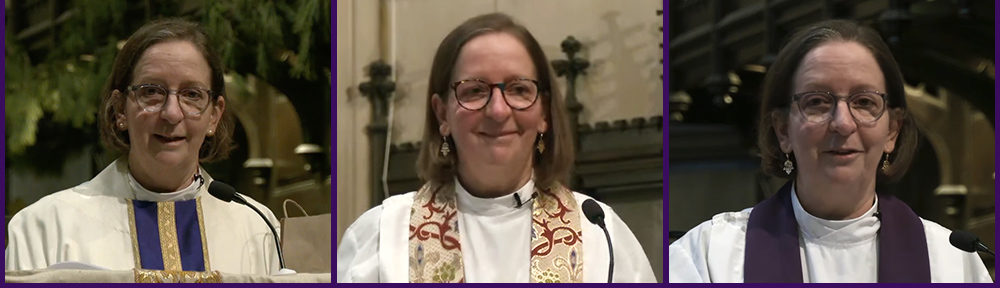
Proper 8C, June 29, 2025. The Very Rev. Pamela L. Werntz
- 2 Kings 2: 1-2,6-14. Please let me inherit a double share of your spirit.
- Galatians 5:1,13-25. You were called to freedom…do not use your freedom as an opportunity for self-indulgence.
- Luke 9: 51-62. Follow me.
O God of the prophets, grant us the strength, the wisdom and the courage to seek always and everywhere after truth, come when it may and cost what it will.
All three of our scripture readings today speak about the costs of seeking after truth – of following great teachers, of listening to prophets, of listening for God’s very Self-disclosure, and the cost of discipleship, which, as the late Walter Brueggemann used to say, is no picnic!
In our Hebrew Bible lesson this morning we have the curious story from 2 Kings about how Elisha got the power and the authority to carry on Elijah’s work after he was gone, after Elijah was “taken up.” Elisha had been traveling with and learning from Elijah for many years. He had burned his farming equipment and slaughtered his oxen, thereby destroying his livelihood, as he left his home to travel with the great prophet. When Elijah asked Elisha what he could do for him before he was taken away, Elisha asked for a double portion of Elijah’s spirit. Some say that just means that Elisha was asking to be the designated successor to Elijah, the official leader of the prophet guild–-like the oldest son in a family, who got a double share of the inheritance when his father died in those days.
But I think Elisha wanted Elijah to leave behind his spirit and drive. A more literal translation of the Hebrew would be: “Please give me twice the mouth of your spirit,” or “Please give me twice the edge of your spirit.” Elijah’s response was, “Ooh that’s a hard thing that you’re asking for.” If it were just a rightful inheritance of twice the wealth or status, what would be so hard about that? Twice Elijah’s mouth would have a double edge; that’s asking for a world of trouble!
Speaking of a world of trouble, Paul’s letter to the Galatians describes the cost of freedom. He’s arguing that the Galatians are free from the burdens of conditions of membership that other Jesus followers are trying to place on them. They are free from behavioral codes that other Jesus followers are insisting on. This isn’t a Christian vs. Jew argument; it’s one of a group of Jesus missionaries (that is, Paul) arguing with other Jesus missionaries. Paul is asserting that codes and conditions that others are trying to impose don’t count. The only thing that counts for belonging is faith working, or made effective, through the fruits of the spirit, through love. Paul is asserting we have been made free in Christ all and only for loving one another. Loving one another is the great benefit, and loving one another entails great cost.
Then there’s our reading from Luke. Jesus has begun his journey toward Jerusalem, where he will be “taken up.” (That’s just what happened to Elijah). He’s looking for some hospitality along the way. When he encounters hostility instead, his associates enthusiastically offer to annihilate those pesky Samaritans who did not receive him. Now we’re not talking about a lack of hospitality as if they hadn’t invited him in for tea. The lack of hospitality in biblical times was a matter of life and death, and offering hospitality to travelers was a fundamental, scriptural obligation. (Still is.) The disciples were right to be incensed. Still, Jesus must have been thinking: “How many times do I have to tell these guys that violence only begets more violence? We don’t command fire to come down from the sky and consume our enemies. We just keep going.” As an aside, I just have to wonder where is the outcry from Biblical literalists about the violence that contemporary Christians do to their enemies when Jesus clearly taught that we must love our enemies?
Jesus’ rebuke usually strikes churchy folks as harsh. Rebuke is a harsh word (perhaps it’s meant to be), but the Greek word epetimaysen also means to honor. Jesus honors his disciples by admonishing them. I’ve been reading Loretta Ross’s new book, Calling In: How to Start Making Change with Those You’d Rather Cancel. [1]. She teaches ways to call people in rather than calling them out, or canceling them out. I recommend it for those of you who are in relationships with family or friends in which you have strong disagreements. (That might be most of you!)
It seems that the lack of hospitality and the knee-jerk response to retaliate put Jesus in a very bad mood because next, as they were going along the road, someone said to him, “I will follow you wherever you go.” Rather than expressing his gratitude, Jesus’ response was a warning not to be naïve, to think that following him would not be at all comfortable or safe.
Another person came along and Jesus said, “Follow me.” The person said, “First let me go and bury my father.” In other words, “I have a family obligation, then I’ll get back to you.” Jesus, however, said to him: “Let the dead bury their own dead; but as for you, go and proclaim the realm of God.” This sounds shocking and downright offensive. Now I don’t want to make excuses for Jesus (as he certainly had reasons to be grumpy), but I am persuaded by the opinion in my Greek lexicon that this saying is an idiom, an adage that means, “The matter in question is not the real issue,” or “That is not the point.” [2] Just as if we might say to someone, “That’s apples and oranges,” meaning, “You’re talking about two different things.” In our idiomatic conversation, we don’t mean that someone is literally talking about fruit. The lexicon suggests that Jesus is not talking literally about dead people burying other dead people. Jesus is saying, “Your family obligations are not the real issue…keeping you from following me….Go and announce the justice and peace of God.”
A third person said, “I will follow you, Lord; but let me first say farewell to those at my home.” Jesus replied to him, “No one who puts a hand to the plow and looks back is fit for the realm of God.” This doesn’t sound as offensive but simply impossible. Who among us doesn’t look back from time to time or wouldn’t want to say goodbye to our family before we embark on a journey? But Jesus likens saying goodbye to looking back while operating a plow. A plow in Jesus’ time required constant focused attention. Diverting one’s attention from unruly oxen even for a short while could lead to disaster. A modern analogy might be the consequence of driving down a highway while looking over one’s shoulder, or fixing one’s eyes on the rear-view mirror.
I think Jesus is saying that following him is not for those who put security at a premium, for those who are ambivalent, distracted, or faint of heart. Perhaps following Jesus is most difficult for those of us who have a lot to lose. As one of my colleagues once said: “Most of us, most of the time don’t want to follow Jesus. We want Him to follow us. We would like him to be available to us as we go on our self-appointed rounds, to keep us safe, well-fed and tucked into warm beds at night, protected on our way, our travel maps and plans in [our backpacks], credit cards at the ready.” But when Jesus is saying “follow me,” he wants a commitment to provide for those who are strategically undervalued in our economy. He wants a massive shift in our attention, a keen focus on the future well-being of those who are not faring well at all. [3]
In case we hear those three accounts of folks who aren’t fit to follow and wonder how we or anyone we know could make the cut, Luke blithely writes in the very next verse, “After this the Lord appointed seventy others and sent them on ahead of him in pairs to every town and place where he himself intended to go.” The Gospel doesn’t mention what kind of screening process Jesus used to select the seventy. This is oddly comforting to me. Maybe it’s hard to be fit to follow, but the standards for going out ahead to prepare a place for the Lord are not so high! And what we usually discover in going out to prepare a place, is that the Lord has already arrived. We meet the Lord in the places and people we go to serve.
That makes me think of an experience I had two weeks ago at a continuing-education conference at a retreat center I’ve been to a dozen or so times. I’d always heard about their labyrinth, but I’d never seen it. You probably know, labyrinths are not like mazes. A maze is designed to make you lose your way, while a labyrinth is intended to help you find your way. Walking a labyrinth is an ancient spiritual practice of various religions, including Christianity, to help calm one’s mind, or connect with the Divine, or to get some clarity on a specific issue. So at this conference, as we had some time to reflect on what we were learning, I decided I would find the labyrinth.
When looked at a map of the grounds and couldn’t figure out how to get there, I asked at the volunteer at the reception desk. She walked outside with me and pointed to a stone wall across a big field, told me to go to it, turn left, walk forward a bit, and I would see it. I walked across the field to the wall, turned left, walked forward, and started looking: nothing. There was a woman sitting on a bench having an animated phone conversation. I didn’t want to interrupt her, so, feeling ridiculous, I wandered around some more. Just when I was about to give up, I saw a circle of stones, but even then I wasn’t sure it was the labyrinth. I couldn’t tell where the starting point was, and I could barely make out the path markings, which were covered by moss and dozens of anthills. Hoping that the way would become clear, I decided to step onto the stones. Walking slowly, studying the pattern of the stones, avoiding stepping on the ants, I finally saw the entrance. I stepped off of the labyrinth, went to the entrance, and began again, making my best guesses about where to turn and finally got to the center. I would have sat down, but for those ants. I wound my way back out with the feeling that, although I had succeeded, I never felt confident I’d done it right or that I could do it again. I left with the clarity that this was such an apt representation of my own spiritual journey. Thomas Merton’s lovely prayer came right to mind. [4]
My Lord God, I have no idea where I am going. I do not see the road ahead of me. I cannot know for certain where it will end. Nor do I really know myself, and the fact that I think that I am following your will does not mean that I am actually doing so. But I believe that the desire to please you does in fact please you. And I hope I have that desire in all that I am doing. I hope that I will never do anything apart from that desire. And I know that if I do this you will lead me by the right road, though I may know nothing about it. Therefore will I trust you always, though I may seem to be lost and in the shadow of death. I will not fear, for you are ever with me, and you will never leave me to face my perils alone.
May it be so.