
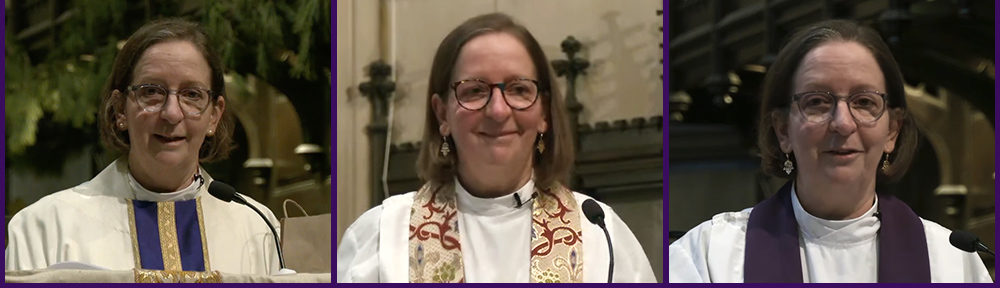
Easter 3C, May 4, 2025. The Very Rev. Pamela L. Werntz
Acts 9:1-6(7-20). “Go, for he is an instrument whom I have chosen.”
Revelation 5:11-14. And the four living creatures said, “Amen!”
John 21:1-19 . Come and have breakfast.
O God of resurrection, grant us the wisdom, the strength and the courage to seek always and everywhere after truth, come when it may, and cost what it will.
We are well on our way into the Great Fifty Days of Easter, the extended Feast of the Resurrection. I love that the Church calendar gives 40 days for Lent, but 50 days for Easter because Easter is harder. Lent is easier for many of us – we know our need for increased focus on penitence, discipline, prayer, study, and our need for mercy. Many of you tell me that Lent is your favorite church season. On the other hand, a season of increased focus on resurrection (on rising from the dead) trips people up, especially when the news of what’s going on in the world is so bad. (I’ll tell you something; it was bad for the earliest Jesus followers, too.)
So the Church gives us extra time (an extension) to observe, to celebrate new life after what has died, or ended, been discarded, or lost! Some of you might be thinking that ten extra days is not nearly long enough. That’s okay; this is a group project, not an individual assignment; just stick with us. If we can’t complete the work of celebrating resurrected life, we can try again next year. This morning I want to offer you an understanding of resurrection that is scripturally based. Our readings for today illuminate an understanding of resurrection for us that is universal, mystical, behavioral, and defiant! [1]
In the dramatic telling of St. Paul’s conversion in Acts of the Apostles, one of the pieces of the story that gets too little attention (in my view) is the story of a disciple named Ananias. It’s important to know that Saul did not become Paul all by himself. He did not become Paul by pondering the experience of getting knocked off his donkey, being blinded by a flash of light, and hearing a voice that nobody else with him heard. It was Ananias who was converted before Saul. When Ananias heard God tell him that he was to say healing prayers over a man from Tarsus named Saul, he protested. He said, “Look God, that guy is notoriously evil. He’s done a lot of damage to Jesus followers in Jerusalem. He’s dangerous. He could hurt me. He could have me arrested. I don’t want to. It’s not a good time for me. It wouldn’t be prudent.”
What Ananias heard in response to his protests was God saying to him, “Go, for Saul is an instrument whom I have chosen to bring my name before Gentiles, kings, and the people of Israel; I myself will show him how much he must experience for the sake of my name.” The word translated suffer can be positive, neutral, or negative; a less judgmental rendering is experience. Ananias comes to understand that God-self will show Saul how much he must experience for the sake of the Holy Name. So Ananias went and entered the house on the street called Straight.”(You will not be surprised to learn that I prefer to translate that as a street called Integrity.) He laid his hands on Saul and said, “Brother Saul, the Lord Jesus, who appeared to you on your way here, has sent me so that you may regain your sight and be filled with a spirit of holiness.” Note that Saul had not confessed or repented in order to be healed. This is another in a long line of biblical stories of the Holy One seeing potential where others don’t. This is another call to proclaim loving-kindness and right-relationship to Gentiles and Jews, in other words, to everyone.
There are universal themes in our other two readings as well: in the image of thousands of thousands singing before the throne in Revelation and in the curious detail of 153 fish in the Gospel of John. According to Bible scholar Adele Reinhartz’s note in the Jewish Annotated New Testament, the early Church theologian Jerome wrote that Greek zoologists had recorded 153 different types of fish, so that number is symbolizing the universality of the Gospel’s message. [2] The good news of God’s redeeming work, that the risen Jesus continued to oversee, is represented with a net that can hold every kind of fish without exception and without fail. Resurrection is intended to be universal.
The bad news, however, as Wendell Berry has written:
We [by we he means hegemonistic colonizers] have lived our lives by the assumption that what was good for us would be good for the world. We have been wrong. We must change our lives so that it will be possible to live by the contrary assumption that what is good for the world will be good for us. And that requires that we make the effort to know the world and learn what is good for it.
And by world we mean all creation.
Resurrection is also mystical: that is, spiritually mysterious, arousing awe and fascination. Things happen that cannot be easily explained; events take on divine meaning: encounters with bright lights, choirs and orchestras of angels, and strangers who appear and disappear, bringing news of Divine Love that must be communicated with or without words (or “not only with our lips but in our lives” as our Book of Common Prayer says). I’m not just talking about pre-modern experiences called miracles, which can now be explained with post-modern scientific analysis. I’m not just talking about near-death experiences (although some near-death experiences would certainly qualify). I’m talking about a tradition of interpretation of mysterious encounters that invite us from personal growth to communal or even global transformation.[3] You may have had such an experience. My hunch is that far more people have such experiences than are willing to talk about them, because they always sound a little kooky when reported. Probably because I’m a priest, people tell me fairly often about mystical experiences they’ve had, and I’m expected not to share the details (and I don’t); but I’m here to tell you that resurrection is mystical.
Resurrection is behavioral and defiant. That’s most clear in our Gospel lesson for today, my favorite gospel story of all. Resurrection is behavioral in the sense of moral and ethical. Resurrection calls, bids, pleads with us to love; and the biblically faithful way to experience love, according to both our First and Second Testaments, is in our behavior. Engage in acts of loving-kindness even with one’s enemies, worship the Holy One of all creation (and while we’re at it, care for all creation!), follow Jesus’ example: feed and care for all of the lambs of God. Resurrection is much more about behaving than it is about offering assent to a fancy intellectual idea. Resurrection is a form of praxis.[4] Resurrection is a practice of defying misery and death with compassion and kindness. In this way, resurrection is both divine and extremely practical.
Here’s a shining example of what I mean by resurrection being behavioral. I spent three days this past week at the Diocese of Massachusetts’ clergy conference with The Rev. Becca Stevens, Episcopal priest and founder of Thistle Farms, based in Nashville. Nearly 30 years ago she created a house for five women who were victims of human trafficking and addiction, who hoped to heal and reclaim their lives; they moved into a house. Stevens said to us, it’s crazy to think that changing the lives of five women could change the world, but it’s even crazier to think that the world will ever change if you don’t change the lives of five women.
Since 1997, Stevens’ work has expanded to found 11 more nonprofits and justice enterprises, which mentor 70 sister organizations around the country with a globally shared trade network of 39 partners in 21 countries from Ecuador to Malawi, Thailand to Ukraine, Mexico to the West Bank. There are now 92 organizations, providing more than 500 beds to survivors in the Thistle Farms network. The waiting list capped at 100 is always full. Every resident receives hospitality centered in and grounded in love, with all kinds of support. In addition to free housing, women receive healthcare, counseling, job-readiness training, and employment for two years. And 5 years after program completion, 75% of graduates are living healthy, independent lives. That is a staggering success rate. It all runs, she says, on an economy of love. She counseled us that you don’t have to be inspired to do the work of kindness and compassion. What you have to be is committed. She says, “Nobody cares if you’re inspired!” The questions to ask are: “What happened to you and how can we help?” Curiosity and creativity in our responses are most helpful to people who are hurting.
Resurrection is universal, mystical, behavioral, and defiant. I believe that and, as your priest, I encourage you to believe it as well. But if you don’t believe it, I encourage you to behave as if it were true, just in case it is! In these next 35 days of Eastertide, look for universal, mystical, behavioral, and defiant signs of resurrection and find ways, however small, to jump in so love can grow!
- Thanks to Bruce Epperly for this idea. See www.patheos.com/blogs/livingaholyadventure.
- Adele Reinhartz, “The Gospel of John,” in The Jewish Annotated New Testament (New York: Oxford University Press, 2011), p. 196.
- Bruce Epperly, www.patheos.com/blogs/livingaholyadventure
- Giles Fraser, “The Resurrection Isn’t an Argument.” The Guardian 31 Mar. 2016. PDF available .