
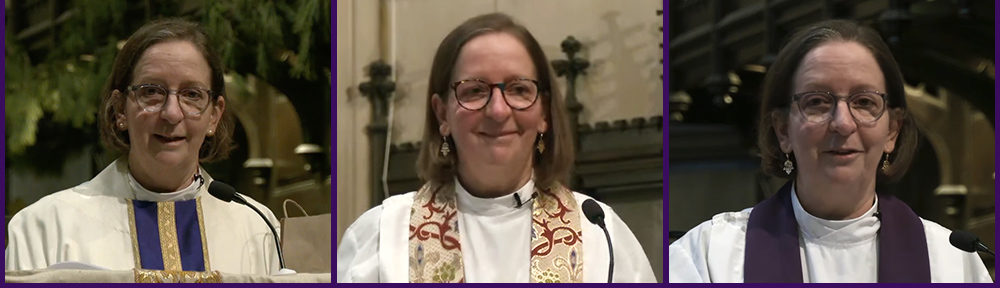
Easter 2C, April 27, 2025. The Very Rev. Pamela L. Werntz
Acts 5:27-32. Jesus, whom you had killed by hanging him on a tree.
Revelation 1:4-8. To him who loves us and freed us from our sins by his blood.
John 20:19-31. Peace to you…peace to you…peace to you.
O God of love, grant us the wisdom, the strength and the courage to seek always and everywhere after truth, come when it may, and cost what it will.
Blessed are you who come to church on the Sunday after Easter, in spite of a trifecta of truly terrible theological ideas that get repeated every single year on this day, no matter what. The first is from Luke the Evangelist in the Acts of the Apostles, where Peter accuses the high priests of having Jesus executed. The second is from John the Divine in Revelation, the idea that Jesus’ death was a blood sacrifice required for atonement with God. The third is the disparagement of doubt from John the Evangelist. We will hear some good and comforting news today from the prophet Isaiah, but you’ll have to wait to hear it until after communion. These four texts (the first three from the New or Second Testament, and then the text from Isaiah in the Old or First Testament) do not support the fallacious idea that the God of the Old Testament is a God of wrath and the God of the New Testament is a God of love. I cannot say often enough that the God of Jesus is the God of Israel. There is plenty of love from God in the First Testament and plenty of wrath in the Second Testament, but Christians tend not to hear or read scriptures in a way that facilitates our comprehension.
There’s another terrible idea in John: that is, that Jesus’ followers were hiding from the Jews on that first day of the week after the crucifixion and burial of Jesus. Those followers, of course, were Jews; perhaps they were Jewish Galileans hiding from Jewish Judeans. I chose to use the word neighbors in our Gospel reading today because neighbors are often the hardest to love and trust, especially when we disagree about what is the next right thing to do in situations that are dangerous, especially when the government is encouraging people to turn each other over to the authorities.
There are many resurrection stories with at least twenty mentions of appearances of the Risen Lord in the Gospels and First Corinthians. It’s always helpful to me to remember that resurrection stories are biblical. This might sound obvious, but think for a minute about stories of the Creation or the Exodus. Most of us understand them to be foundational myths, that is, deeply true but not historically factual, scientifically accurate, or mathematically provable. They were never meant to be history, science, or math in the way we understand them in a meta-modernist age. Rather, they were meant to convey experiences that were too deep, too profound for words, so profound that they feel divine. I imagine that you have had experiences like that, so strong that they seemed palpable. This Gospel story we heard today is a kind of creation story and a kind of liberation story. It’s a resurrection story, and so it’s not about history, science, or math. It’s about art and love. As Emmanuel’s ninth rector, The Rev. Al Kershaw, famously said, “Art and love alone are capable of opening us up to the eternal that stands behind them.”
The setting for today’s Gospel story was evening on the day when the tomb where Jesus’ body had been placed had been found empty. It was the evening of the day when Mary Magdalene had been called by name by a man she mistook for the gardener. It was that day that Mary Magdalene told the others that she had seen the Lord; and yet, the followers of Jesus were gathered behind locked doors because they were afraid.
I want to invite you to hear four directives or instructions that are given by the Risen Lord to the followers who were huddling together in the room with the door barred. Jesus’s first instruction is “Peace to you.” I don’t think it’s a churchy way of saying hello. Jesus is imploring them to give themselves over to the love that casts out fear and sin. It’s not a peace founded on naïveté or denial, but a sense of clear-eyed well-being and of God’s goodness in the face of evil. His second directive is, “As my father has sent me, so I send you.” In other words, “Get back out there. I’m sending you out to do the work you have to do.” And what is the work? Visiting, clothing, comforting, healing, washing, feeding, slaking, sheltering, liberating, serving.
Jesus’ third instruction is, “Receive a spirit of holiness, which is being offered to you.” Do not take a pass; it’s imperative. A spirit of holiness is not religious enthusiasm or piety, but a transforming, empowering energy for right-relationship with others. The point of receiving a holy spirit, according to John, has to do with the power to let go or release the sins of any. Sins, in the biblical sense, are departures from doing the right things. If you let them go, they are let go. Our English translation uses the word forgive, which is far down the list in the dictionary definition of the word; it’s release, let go, send away. If you let go of behaviors that miss the mark, they have been let go. If you hold on to them, they are held, carried. This is a description of how it is when you have a holy spirit: you can let things go or carry them around with you. (The thing is, they get really heavy.)
After a week goes by, they’re back in the locked room, this time with Thomas. Thomas got just what he said he needed. Jesus loved him and showed up for him. Jesus again said, “Peace to you,” then, “Do not become unbelieving but become believing.” Becoming believing is a last step here, not the first. It comes as a consequence of giving ourselves to the work of compassion and right-relationship. After Thomas’s response, “My Lord and my God,” what follows is not necessarily a question. Remember, there’s no punctuation in ancient Greek. The words say, “You have seen me and have believed. Blessed (or fortunate) those who have not seen and believed.” Both are authentic, legitimate, viable ways of becoming believing; some see and some don’t. Either way, we all have work to do.
The important thing, according to the Gospel of John, however you get there, is to have life in the name of Jesus the Christ, child of the Holy One. This kind of life is full of compassion, right-relationship, service to others, joy, love: fullness of life, remembering the words of Isaiah: “Do not fear. I am with you. Do not be frightened, for I am your God. I strengthen you, and I help you. I will redeem you. I have called you by your name. You are mine.”
What stories do you know of creation, liberation, or resurrection in your own life? Think about seemingly chance encounters that have made the impossible possible. Think about when something was made out of nothing, and it was good. Think about being suddenly freed from being stuck in a tight spot or a punishing situation. Think about discovering again that love is stronger than death, even the most shattering and shameful death. Then give thanks to God through acts of service and become believing; become a blessing; become risen.
Listen to poet Jan Richardson’s Easter poem, “Risen.” [1]
If you are looking for a blessing,
do not linger here.
Here is only emptiness,
a hollow, a husk
where a blessing used to be.
This blessing was not content
in its confinement.
It could not abide its isolation,
the unrelenting silence,
the pressing stench of death.
So if it is a blessing you seek,
open your own mouth.
Fill your lungs with the air
this new morning brings
and then release it with a cry.
Hear how the blessing breaks forth
in your own voice;
how your own lips form every word
you never dreamed to say.
See how the blessing circles back again,
wanting you to repeat it, but louder,
how it draws you, pulls you,
sends you to proclaim its only word:
Risen.
Risen.
Risen.
- Jan Richardson, Circle of Grace: A Book of Blessings for the Seasons (Orlando: Wanton Gospeller Press: 2015), p. 151.