
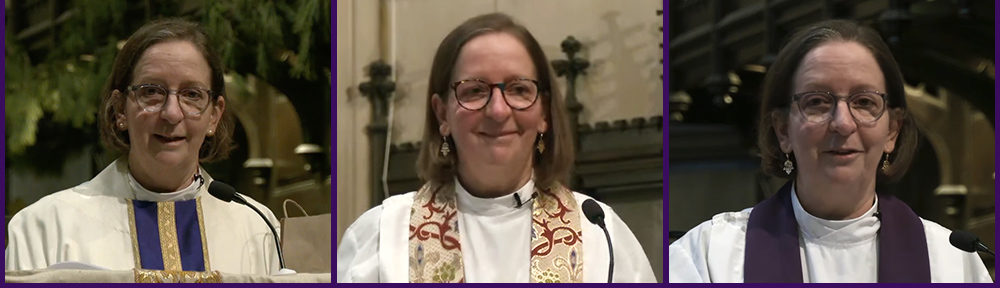
Proper 26B. 3 November 2024. The Very Rev. Pamela L. Werntz
Isaiah 25:6-9. The disgrace of [God’s] people [God] will take away from all the earth.
Revelation 21:1-6a. See I am making all things new.
Mark 12:28-34. You are not far from the realm of God.
O God of our salvation, grant us the strength, the wisdom and the courage to seek always and everywhere after truth, come when it may, and cost what it will.
This morning we are observing the great Feast of All Saints’ Day. But I have to tell you that rather than reading the assigned reading from the Gospel of John for All Saints, about the raising of Lazarus, I have substituted the Gospel lesson appointed for this Sunday, which is the lesson Bob just read from the Gospel of Mark. I did this because we are not just remembering and celebrating all the saints of the Church, that great cloud of witnesses, known or unknown, and honoring the souls of those dear to us who have died since last All Saints Day. We are also on the eve of Election Day eve (erev erev Election Day) and it feels to me like we are on the precipice of what feels to me might be like an abyss. but we can’t see what’s immediately ahead of us. This past Thursday morning, our next-door neighbor created a great cloud of unknowing that enveloped the fronts of the houses of his immediate neighbors while he tested out his new dry ice fog-making machine for Halloween. The front of our house was completely in a thick blanket of fog while the back of our house was all clear. I thought, “huh! That’s a metaphor!” We couldn’t see ahead, we could only what was behind us!
You might know that polls suggest that more than half of voters have already voted or expect to vote before election day. Slightly less than half of voters are very worried about post-election violence and about misconduct among election officials. Those worries seem to be evenly spread among Democrats, Republicans, and Independents. [1] So if you are very worried, you have a lot of company. That’s some good news. And slightly more than half are not very worried. That might be good news, or they might just not be paying attention! In any case, the way forward is in progress but we just can’t see it yet.
We hear from two prophets this morning, from Isaiah in the late 8th century BCE, and from John the Divine near the end of the 1st century CE with very similar visions, set in texts like mighty oratorios, singing about visions of peace for all peoples, for all nations. Walter Brueggemann writes that for Isaiah, a welcome feast of rich food and fine wine is already coming into being in a place where healing and emancipation happen. Death, in this passage, means not just the end of life, but stands for whatever limits or diminishes well-being and prevents communion with our neighbors or with God, who is also known as Love. In Isaiah’s radical vision of complete transformation, Bruggeman says, “Biblical faith…is not a mode of holding on or staying in control. It is rather an act of yielding in the present…to the assurances given for [Love’s future where the] disgrace of being helpless, powerless, and exploited; the shame of being stepped on…all will be overcome.” [2]
What is clear for Isaiah and John the Divine, as well as for us right now, is that we have to wait. On that day, when the Holy One will remove and destroy the shroud of shame and the pall of mourning, and swallow up the pall that covers all the nations, it will be said, “this is the Holy One for whom we have waited.” That word “wait” can also be translated “trust” and get this: the root of the word has to do with twisting in tension. This is not about idly passing the time, trying to distract ourselves. It’s not passive; it’s active. This waiting is actively stretching. What kind of stretching? The kind that happens when we are loving our neighbors, with all our hearts, with all our souls, with all our understanding, and with all of our very muchness. (That’s how my Hebrew teacher liked to translate strength or might.)
Here’s something to notice about our Gospel lesson in Mark. Jesus is in the temple precinct a few days before his arrest and in the middle of considerable conflict and disagreement. Some people are mad enough or afraid enough to wish he were dead, and he will be dead before the week is over. In the midst of this, a Biblical scholar, a scribe, heard the priests arguing with Jesus about the lawfulness of paying taxes to the emperor, and about marriage in the resurrection. You probably know that, according to Mark, Jesus got asked a lot of questions and if he answered at all, he usually responded with another question or a mystifying parable. Rarely did he give a clear and direct answer. His disciples rarely understood what he was talking about. But in the middle of a big crowd, a scribe asked Jesus, “which is the first commandment of all?” And Jesus answered the question directly, maybe for the only time in Mark: “The first is, ‘Hear, O god-wrestler [that’s what Israel means] the Holy Name is our God, the Holy Name is one.” “Shema y’srael, Adonai elohenu, Adonai echad.” Hear. Listen deeply. Understand. That is the first and greatest command. That is the starting point for all other commands. “Hear” is an imperative. What comes next is a verb that is indicative of the future. When you hear, when you listen deeply, you will love. It’s what will happen when you listen very carefully. You’re going to be loving the Divine and you’re going to be loving your neighbor with all your heart, with all your person, with all your understanding, and with all your very-muchness. The command is to listen and the loving will follow. It’s not theoretical. It requires muscles that are loosened by stretching.
Another noteworthy thing in this lesson from the Gospel of Mark is that the scribe and Jesus are demonstrating mutual regard. The scribe calls Jesus’ response to his question right. And in response to the scribe’s affirmation, Jesus calls the scribe “wise” and adds that he is very near to the realm of God. It is a reprise of what Jesus started saying in the beginning of this Gospel: “The time is fulfilled, and the kingdom of God has come near. Turn around, change your ways and lean into the good news.” The kind of listening that leads to loving is much more important than all offerings and sacrifices made to and for the Holy One. I also want to make sure you hear what Jesus did not say. In the midst of the crowd in the temple precinct, Jesus did not say, “above all, keep safe; stay pure; keep clean; be holy; say your prayers.” He did not say, “first and foremost, figure out who is and who is not worthy of your consideration and care.” First and foremost, hear that the Holy is our God and the Holy is One. I wonder who told this story after Jesus’ death. Was it the disciples? Was it the scribe? Was it other witnesses? In the months and years after folks experienced Jesus’ resurrection, who remembered the command to listen? To hear?
Perhaps it was easy to remember because the Shema is prayed in every Jewish liturgy and in daily prayer. Perhaps it is the first commandment and most frequent prayer precisely because it is so difficult to do. In order to listen, in order to hear the Oneness of the Holy, we have to be still to remember that God is God and we are not God. We have to pause from talking to God or to ourselves or talking to others and get really quiet. I’m aware of the irony of speaking about the value of silence. I also know from experience that some have a greater capacity for silence than others. If it’s hard for you, start with a minute and work your way up. In an era where trumpets of advertising and misinformation blare from every device, silence requires practice and discipline. It’s a stretch while we wait for whatever happens next. While we listen and wait for whatever happens next we will love as fiercely as we are able. And I believe that Loving will make us real. Loving will make us brave. And Loving will make a way where there is no way, because it always has. That’s what I can see clearly looking out my back door!
As a post-script to this sermon, here’s something to keep in mind if you are a praying person, or a praying person by proxy! (That means that you are close to a praying person.) It’s a poem by a retired United Methodist minister named Steve Garnaas-Holmes, who writes daily reflections. Martha Tucker sent this poem to me last week and I wanted you all to hear it. It’s called, “Please, God…”
We plead for God to intervene,
even “just this once…”
But I don’t think that’s how God works;
the Holocaust would have been a good time to do so.
No, God doesn’t stop the tyrant,
or nudge the car on the icy road.
God’s not a Big Guy with a magic finger
he [sic] deploys now and then (but not always).
God is the Love at the heart of all being,
as constant as gravity, infinitely attentive,
and can’t be more present or active than right now.
When we ask for God’s help,
what we mean is to align ourselves
with the great power of God’s grace already at work.
Like musicians in perfect tune,
we create harmonies, notes that sound
though none of us is producing them.
Our harmony with God creates an energy field
that does indeed change things.
In troubled times it takes great concentration
to align ourselves with grace instead of force,
with love instead of fear.
We begin by allowing ourselves to be loved,
along with the rest of creation,
and then we fall into that love,
and let that love flow through us into the world.
I think that’s what we mean when we pray,
“Please, God…”
- Zachary Karabell writing on Thursday, October 31, 2024 for edgyoptimist@substack.com
- Walter Brueggemann, Isaiah 1-39, (Louisville: Westminster John Knox Press, 1998), pp. 199-20.