
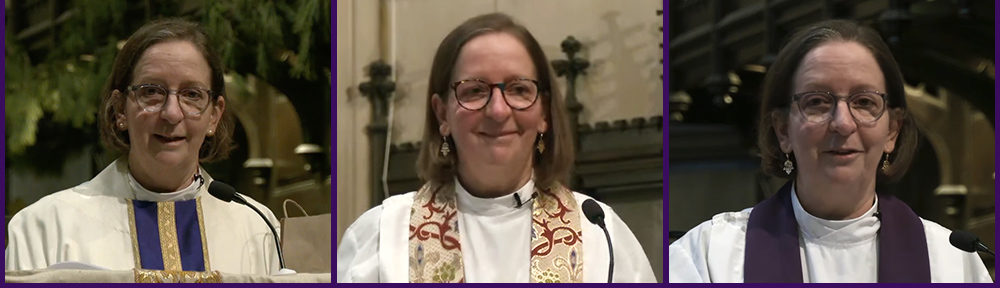
Proper 27B. 10 November 2024. The Very Rev. Pamela L. Werntz
Ruth 3:1-5; 4:13-17. I need to seek security for you.
Hebrews 9:24-28. Not to deal with sin, but to save those who are eagerly waiting for him.
Mark 12:38-44. She … has put in everything she had.
O God of love, grant us the wisdom, the strength, and the courage to seek always and everywhere after truth, come when it may and cost what it will.
Well the fog that I spoke about last Sunday cleared for a bit and what we could see was a shattering loss for nearly half of our country. It wasn’t just an election lost, but a particular vision of the future lost that now we’re going to have to figure out how to enact in other ways, but only after we create some space for grief, and acknowledge our fears. For some it will take longer than others, but we will stick together.
On Wednesday morning, I drove into the city and realized when I arrived at the church that I had forgotten my office key. When I finally got in and pulled up my computer screen, the message I saw said, “insufficient memory.” I said to the computer, “You’ve got that right!” And it’s not just about my own memory, it seems like half the world. And then on Thursday morning, my sorrow became very particular when I learned about a devastating personal and parish loss in the death of Jim Bartlett, who has contributed mightily to the well-being of this parish in the last 15+ years in many ways, but particularly as a vestry member and on the finance commission, and with his beloved wife, Hanna, as an advisor and supporter of my ministry among you at Emmanuel Church. He loved Emmanuel Church so much. And I am reminded of what another important mentor taught me: when we are grieving or in pain, stay close to the scriptures. And for Christians, I’d say, stay close to Jesus.
The Gospel lesson that we just heard is a very familiar story about the woman who put two copper coins, approximately enough money to buy one meal, in the offering in the temple. It’s a story many of us learned in Church School. People know it by the title, “the widow’s mite” (mite meaning a tiny little bit). It’s a nice story for little children who are learning about mite boxes and putting coins in offering plates. I’m aware that when the story gets told about Jesus commending the woman for giving everything she had, especially during pledge stewardship season (probably no coincidence, by the way), many of us adults kind of seize up inside. We kind of brace ourselves for what’s coming next.
But you can relax (a little) because I’m keenly aware of Jesus’ stern warning at the beginning of this Gospel reading to educated religious folks “who like to walk around in long robes, and to be greeted with respect in the marketplaces, and to have the best seats in the places of worship and places of honor at banquets — [who] devour widows’ houses and for the sake of appearance say long prayers. They will receive the greater condemnation,” because they are the ones that should know better than to exploit poor people. They are the ones with memory of the law that insists on providing for poor people.
There’s scholarly debate about whether Jesus really approved of the kind of giving he outlined in verse 44. It’s not at all certain whether the widow is modeling generosity in a way that should be admired, or Jesus is illustrating what a victim of religiosity run amok looks like. [1] This story appears in the context of a larger passage about Jesus’ teaching against excessive piety – so clergy should beware when we take this particular story out of context and use it to promote sacrificial giving at stewardship time. It’s possible Jesus is making an observation about the impoverished widow who has been exploited by some religious leaders to give what she needed to live on and he’s not praising her as much as he is condemning wealthy people who scorn the offerings of those who are poor. There are other ancient rabbinic teachings about asserting the dignity of the offerings of people who are poor.
In any case, it is completely wrong to hear this reading and assume an anti-Jewish or even anti-Temple agenda, because the scribes who exploit widows are described as being in marketplaces and banquets, not in the Temple. Furthermore, Jewish New Testament scholar Amy-Jill Levine points out that Jesus did nothing to stop the woman from offering everything she had – she was doing exactly what Jesus has instructed the rich young man to do a little while back. Levine calls this a story about how even the poorest woman could make a meaningful contribution, and says that for Christian preachers to turn this into condemnation of the Temple is just wrong. [2] So I’m in tricky territory here, and fool that I am, I’m going to press on a bit (or a mite) about sacrificial giving because I think it demonstrates great dignity. You can take everything I say with a big fat grain of salt since I’m the one wearing the long robe, and I teach about this at my own risk of greater condemnation!
It seems to me that many things that seem impossible to do as individuals, like giving everything one has to live on, are possible in a community of faith like Emmanuel Church. It’s possible in a parish like this, for example, to aim for what William Temple, one-time Archbishop of Canterbury, called “the fullest possible development of individual personality in the widest and deepest possible fellowship.” [3] In this parish, as a parish, it is possible to whole-heartedly give everything we’ve got. And we not only do it, we survive and even thrive! There are times when we give everything we have in terms of effort and energy – when we try as hard as we can; when we work as hard as we can. There are times when our ability to exert effort or our capacity to work is very strong. Yes, but what about times when we hardly have any energy left? Times when we are nearly out of steam? Times when we are close to exhausted? It might feel like what we have left to offer in terms of effort is very small – a very little bit – and it’s a huge stretch and still we offer it on behalf of others. I see it every day, and I see a long history of this kind of gift of effort and energy on behalf of others at and through Emmanuel Church.
This parish gives whole-heartedly everything we have when it comes to time. There are occasions when we have plenty of time for what is needed, and giving some of that time, even a lot of that time, is really no big deal, because we have it to give. And there are times when we don’t have much time at all, when there’s really no slack in our schedule, and the time we are able to give looks puny in comparison to what other parishes are giving – and, as small as it is, it’s more than we can afford and still we offer it. We offer everything we have on behalf of others. I know that we’ve done this throughout our history.
And we whole-heartedly give everything we have, and we survive and even thrive, when it comes to money. Some of you know that the predictions that Emmanuel Church would not survive began before we ever really started. This church was planted “so far out of town” we had to assert our belonging in our name, “Emmanuel Church in the City of Boston.” People said nobody would want to go to church so far out of town, and vendors claimed “it’s not really in the City of Boston” so they could charge us extra for deliveries. There are times when we have had plenty of money for what is needed and giving some of our money is easy. And there are times when we don’t have much money at all, and what we have to offer is a very little bit – and it’s really more than we can afford and still we give it on behalf of others. I’ve seen Emmanuel do this as a parish throughout our history.
I was wondering the other day about what compels us to make offerings on behalf of others, when all we have is a very little bit. What moves us to give all we’ve got for someone else? For a community? I’ll tell you, I do not think it’s ever duty or guilt that moves us to give all. I think it’s love. Love is what persuades people to make sacrifices for others. I imagine love being behind the widow’s gift in our Gospel story. And then I thought about what 1st John says about God. “Those who live in love, live in God because God is love.” “God is Love.” As our former Presiding Bishop, Michael Curry, says again and again, “if it’s not about love, it’s not about God.” That’s why I often encourage exchanging the word Love for the word God in our praying or singing or reading. I also encourage exchanging the word Love for the word Blood (when blood is used as a metaphor for life poured out in love). Today in our communion hymn, I’ve also substituted the word Love for Christ so as not to malign other spiritual paths that I believe are every bit as holy as our Way, our Truth, and our Life.
For those of us who are not so sure what God is or whether God exists, I encourage us to talk about listening deeply to Love and Loving Love with our whole heart and our whole mind, and loving our neighbors as ourselves. We can talk about believing in Love. We can imagine and even experience the almighty and immortal power of Love. We can with confidence assert that Love is creative, redemptive and inspirational. We can affirm that Love is liberating, saving, sustaining and comforting. We can offer to Love a sacrifice of thanksgiving. Perhaps we can understand more deeply that the Holy Name is both an eternal entity and an eternal action into which we are called, invited to tap; into which we are beckoned, encouraged to participate more and more fully and deeply. My experience is that Love grows when we trust in it. Love grows whenever we give everything we’ve got to give on behalf of others. And when we make those offerings that seem small in comparison to others, but they are all we have, the offerings are large in Love’s eyes; and the offerings become the hands and feet, the arms and legs of almighty Love in the world. Our offerings become Love redistributed. Biblical Love is so much about action and not so much about feeling. Loving, or as one of my seminary professors would have said, “godding” is an incomplete, ongoing action. It’s not about surviving. It’s about thriving.
When we welcome people into this building, into this community, into this parish, we offer extraordinary and extravagant welcome into our way of loving (or godding) — that incomplete, ongoing action. We are offering extraordinary and extravagant worship with worship leaders who are giving everything we’ve got to live on — prayers, readers, singers, players. As a parish, we are offering all we’ve got to live on. Can we find room for one more 12-step group that needs a welcoming and safe place to meet? Can we share our beautiful garden with someone sleeping on a cardboard box? Can we also be a center for musicians and artists and provide a home for Bach cantatas to live and breathe on Sunday mornings? Can we provide daytime hospitality and overnight accommodations for people who have physical and mental illnesses, or who are suffering from the scourge of addiction, who have been discarded by our government? Can we house a synagogue – not just as renters but in a covenanted relationship? Can we welcome to a weekly luncheon GLBT seniors whose lives depend on re-building beloved community? Can we create intentional housing communities that enrich their neighborhoods and their parishes? Can we find meaningful ways to engage in the work of reparations? Can we as a parish give away more than a tithe of our much-needed income to others and thrive? Can we give all that we have to live on and thrive? Can we have sufficient memory? Yes, we can and we must. We are doing it, and we will continue to do it, together, with Love’s help, cost what it will. As we’ll hear, and sing, later in today’s final cantata chorale: Es ist genung.
- Michael A. Turton. “There is no support for historicity in this pericope.” Historical Commentary on the Gospel of Mark.
- Amy-Jill Levine, The Misunderstood Jew: The Church and the Scandal of the Jewish Jesus (New York: Harper Collins Publisher, 2007), pp. 149-157.
- Excerpted by Richard H. Schmidt in Glorious Companions: Five Centuries of Anglican Spirituality (Grand Rapids: William B. Eerdmans Publishing Company, 2002), p. 264. William Temple’s feast day is Nov. 6.