
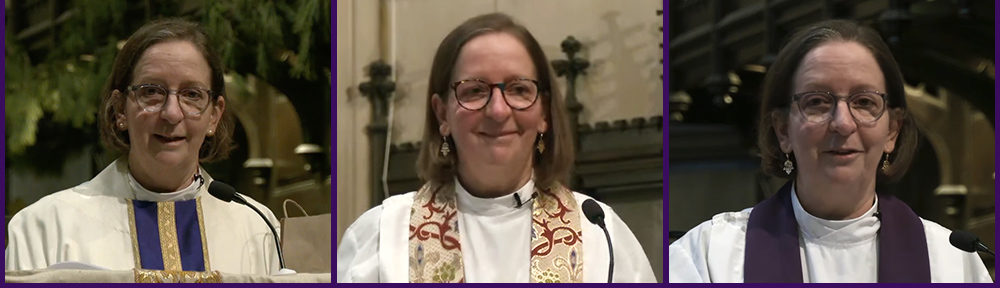
Easter 4C, May 11, 2025. The Very Rev. Pamela L. Werntz
Acts 9:36-43. He gave her his hand and helped her up.
Revelation 7:9-17. He will guide them to springs of the water of life.
John 10:22-30. It was winter.
O God of life, grant us the strength, the wisdom and the courage to seek always and everywhere after truth, come when it may, and cost what it will.
During Eastertide, our lectionary offers no lessons from the First Testament. The effect, I think, is to overemphasize a break between Jesus’ followers and Jesus’ religious heritage. Instead, we have passages from the Acts of the Apostles’ romantic accounts of the beginnings of Christianity, written toward the end of the first century about “the good old days.” Today it’s Peter raising Dorcas from the dead with a line that is almost exactly the same as what Jesus said to raise Jairus’ daughter from the dead: arise or wake up, come alive! In other words, Peter was ministering just like Jesus. I love line, “he gave her his hand and helped her up.”
During Eastertide, we have passages from the Revelation to John the Divine about how, in the end, God is going to set everything right that the oppressive (Roman) Empire is getting completely wrong. During Eastertide, we have stories about resurrection appearances – except we have run out of those, and now we’re back in the middle of the Gospel of John, on the Portico of Solomon, in the winter during the Feast of the Dedication (that is, Hanukkah). What I want to make sure you know is that all three of these readings reveal a devotion to Jesus that is still integrated with, and true to, first-century Judaism.
The folks who gathered around Jesus in John’s story were not in a celebratory mood, even though it was a festival. The verses just before this say that people were divided about whether Jesus was possessed by a demon, whether he was crazy. The question these people ask, literally translated, is: “How long are you taking away our life?” It’s an idiom that in modern Greek means, “How long will you irritate us? How long are you going to drain the energy right out of our heels?” The word translated gathered is more confrontational in its meaning. This is more menacing than a story of a gathering of people with a sincere desire to get a question resolved. Indeed, what happens next in the story is that enraged people took up stones to throw at Jesus; and he escaped to the desert.
Here’s what I think is going on in this Gospel passage. There is a debate about identity that goes something like this: “Just who do you think you are, Jesus, the savior of the world?” And the response from Jesus is, “I’ve told you that the work I do testifies to my relationship with God, but you aren’t getting it. Actions speak louder than words. If you were following along, you would get it, because my actions would be speaking to you. But you’re not following; you’re not watching what I do. For the folks who are following along, my work gives them a sense of timelessness, of Oneness with the universe without beginning or ending, a sense of deep peace that no-one can take away. It’s amazing. I’m doing God’s work.”
Jesus is not saying that these questioning people cannot be his followers. He is not even saying that they should be his followers, or that they can’t or don’t have a chance to experience timeless oneness with the universe because they aren’t his followers. He’s just saying that the reason they don’t get what he’s talking about is that they’re not his followers. Jesus is saying that his followers have something that can’t be taken away, an experience of One-ness that transcends chronological time, One-ness which is a fullness of life. He is not saying that he and God are one nature, essence, or person. (I mean, don’t try to retrofit the Nicene Creed into this reading.) Jesus is saying that in his actions, through his behavior, he’s completely united with God.
Barbara Brown Taylor has written, “When people wanted [Jesus] to tell them what God’s realm was like, he told them stories about their own lives. When people wanted him to tell them God’s truth about something, he asked them what they thought. With all kinds of opportunities to tell people what to think, he told [and showed] them what to do instead: “Wash feet. Give your stuff away. Share your food. Favor reprobates. Pray for those who are out to get you.” It is maddening isn’t it? [1] And it’s one thing to imagine it in church and quite another to put it into practice in real life. Real life is what Jesus means when he’s talking about eternal life. The Church may have promised some never-never land kind of heaven, but I’m sure Jesus didn’t. Jesus’ actions, his behaviors, were always answering the question, “Can there be life before death?”
This Gospel story may be pure fantasy; this exact scene may never have happened. More plausibly, it might have happened that Jesus’ followers (after his death) were accused of being crazy, driving others crazy, and making folks mad enough to want to kill them. Think Martin Luther King, Jr., Fanny Lou Hamer, Oscar Romero, or Malala Yousafzai. Think of anyone offering a hand to oppressed people to arise, wake up, or come alive! Think of Suzanne Radley Hiatt.
Today we are dedicating the pulpit statue of Sue Hiatt, not only to honor and remember her, but to be inspired by the life and ministry of a trailblazer, a woman who dared to believe that the Church could be much more than it was. Sue was a priest, theologian, prophet, professor, and advocate. She was also a good shepherd. As a young adult, Sue joined the Episcopal Church, a church that did not allow women to preach from the pulpit or serve at the altar. Yet she knew in her heart of hearts that the call to ordained ministry was not limited by sex or gender. She argued that the term men could not logically mean everybody in most of our Book of Common Prayer including ordination of deacons, and at the same time exclude non-males from ordination to priesthood or the episcopacy.
In 1974, Sue organized and helped orchestrate an event that would shake the foundations of the Episcopal Church: the ordination of eleven women to the priesthood in Philadelphia, while the Church was slowly, endlessly studying whether women could be ordained to the priesthood. In 1975, four more women were ordained in Washington, D.C.. The ordinations showed everyone that they could! Two years later, the Church finally officially (and retroactively) permitted women to be ordained priests and bishops. The women—now known as the Philadelphia Eleven and the Washington Four—were ordained not out of rebellion, but out of obedience, obedience to a God who calls all people to ministry, obedience to the Holy One Who says, “Whom shall I send?” and Who hopes to hear, “Hear I am; send me” from women as well as men and non-binary people. Sue and the others faced backlash, controversy, and even exclusion, but they also saw transformation. Sue became known as “bishop to the women,” consecrated by her sisters’ strong need to be taken seriously, and her own strong and generous pastoral gifts. Sue taught us that unity in Christ demands equality. She reminded us that the Church must always be reforming, always listening for the Spirit’s whisper, even and especially when it sounds like change. Sue demonstrated again and again that when we improve the lives of women, we improve whole communities.
By the time I met Sue, she was nearing retirement, but she had been inspiring me for a long time. In 1975, when the Episcopal Divinity School was looking to hire one newly-ordained woman priest, Sue insisted none of the qualified women would accept the job unless they hired two: outrageous! She knew it’s never good to go alone. I used her argument when I was offered a long-awaited promotion to be the first woman vice-president for human resources at the company I worked for. I told the president of the company I would only accept if they named another woman vice-president at the same time so that we could have each other’s backs. He shook his head and sighed audibly, but he did it. I learned from Sue to never be the only woman.
The year Sue retired from EDS, there were big plans to name a chair The Sue Hiatt Chair in Feminist Pastoral Theology at the commencement ceremony, with many special guests invited to share in the celebration. Meanwhile, the administrative office contacted two graduating students, one Black woman and one white transgender person, to remind them that they had not paid the fee for rental of the customary academic gowns. When the two responded that they did not want to spend the money on the gown rentals, they were told they would not be permitted to participate in the graduation ceremony unless they were wearing gowns. Sue got wind of it and went directly to the President of the seminary to quietly say she didn’t realize that academic regalia was a requirement to participate in the ceremony, and if that was the case, she wouldn’t be participating either. Within a very short time, both graduating students were back in the ceremony. I learned from Sue to use my power quietly, politely, and fiercely on behalf of others.
There are so many lessons I learned from Sue, but here’s the last one I want to share in this sermon. In the early days of Sue’s priesthood, she was invited to preside at the Eucharist at Church of the Messiah in Woods Hole, MA. As she stood at the communion table and raised her arms to begin the Great Thanksgiving, the elastic in her plaid wool skirt gave out, and her skirt dropped to the floor. Fortunately, she was wearing an alb. Without skipping a beat, she continued the prayer while kicking her skirt under the altar. She sheepishly returned to the altar after the service and explained to the altar guild why her skirt was under the communion table. I learned from Sue that when humiliating things happen in the middle of a justice movement, just keep your chin up and carry on.
I hope our pulpit statue of Sue will remind us to be bold in confronting injustices-– large and small, and to press the Church toward deeper inclusion and fuller love. Let us be like Sue—courageous in conviction, rooted in the redeeming love of God, and ready to answer the call, no matter the cost. Ways to do that will differ from person to person and from congregation to congregation. In this congregation what it might take for any of us to follow Jesus’ lead in helping people experience life before death includes regular involvement with a brave and generous community, plenty of encouragement, support, and forgiveness, and large doses of beautiful music to recharge our batteries, to restore our souls, to wake us up, to rise up, to come alive! It is our way of getting a hand to help us, as Peter gave to Dorcas.
Many of us need to experience beauty in here so that we can go back out there ready to wash those feet, give more stuff away, share our food, favor reprobates, pray for those who are out to get us (and there are people out to get us), to visit people who won’t want us to leave, to provide some tender loving care to people who are hurting (even if they’ve brought the hurt on themselves), to do justice and love mercy with family, friends, and strangers (especially strangers), remembering that the gracious, merciful and compassionate Holy One is always in our midst. So arise! Wake up! Come alive to become who and Whose you are called to be.
- Barbara Brown Taylor, An Altar in the World: A Geography of Faith (New York: HarperOne, 2009), pp. 118-119.