
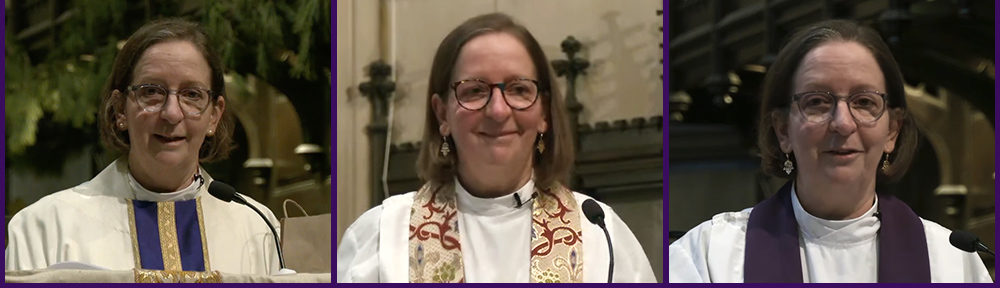
Lent 4C, March 30, 2025. The Very Rev. Pamela L. Werntz
Joshua 5:9-12. The Lord said to Joshua, ‘Today I have rolled away from you the disgrace of Egypt.”
2 Corinthians 5:16-21. So we are ambassadors for Christ, since God is making his [sic] appeal through us.
Luke 15:1-3, 11b-32. Now all the tax collectors and sinners were coming near to listen to him. And the Pharisees and the scribes were grumbling.
O God of mercy, grant us the strength, the wisdom and the courage to seek always and everywhere after truth, come when it may, and cost what it will.
I’m not going to ask for a show of hands, but I wonder how many of you ever complained about someone else’s bad behavior? (I have, too.) I wonder when you complained, did you want an answer? (I have, too.) I think it’s important to know that Jesus tells this story of the man who had two sons in response to the complaint that Jesus welcomes sinners. The story is part of Jesus’ answer to others complaining about his habit (or practice) of hanging out with people who behave badly. The complainers, according to Luke, were some of Jesus’ colleagues. And the complaint was that Jesus welcomed sinners, people who were dangerously out of step with the well-being of the community, people who were unclean, unethical, unlawful, just plain gross. Not only did Jesus welcome them, he even ate with them. Simply put, the complaint was, that’s foolish, that’s not right, and, for those who were jealous, that’s not fair.
That was the complaint, and Jesus’ response in the Gospel of Luke was to go on a kind of parable tear. In rapid succession, he told them about a shepherd finding a lost sheep, a woman finding a lost coin, and then this story of the man with two sons. Then he went right on to a parable about a dishonest manager and another about a rich man and Lazarus. It all ends with an instruction to forgive another disciple as many as seven times a day, which may be a clue as to just what kind of folks his disciples were and how often they needed to be forgiven!
This story, right in the middle of this cluster of parables, assures parents that for thousands of years, some siblings have been doing things that are not right, which prompted their siblings to complain, “It’s not fair”. There’s the son who is reckless and wasteful but then has the incredibly bad luck of finding himself living in a land that has a famine. Most of us know stories of people whose lives seem to bounce between bad choices and bad luck; and some of us have been there ourselves. There’s the son who is steady and responsible, working the land all the years that his younger brother was gone, with no extravagant parties, not even a roasted goat to celebrate with his friends. Since his father had already given him the land, however, he was working his own land. He was working like a slave for something he already had. Actually his father no longer hadproper a goat to give, because all the goats belonged to the older son. Most of us know stories of people whose lives seem burdened with responsibilities that they faithfully, and sometimes begrudgingly, sometimes resentfully, attend to; and some of us have been there ourselves. That son worked so hard for so long that all his muscles, even the muscle of his heart, had become hard.
Most of us also know stories of parents who do crazy things for their children. Here it’s the father who divided his property prematurely. (In the Greek, the word for property literally is whole life, the means of his subsistence.) He did something that was extremely foolish and even reckless. He endangered the well-being of himself and the rest of his family. Once his property was divided, he had no way to ensure that he and the rest of his household would be provided for. His sons had no obligation whatsoever to provide for his care in a legal sense; legally he was dead to them. If both sons had done what the younger son did, the father and the household would have been out of luck. Yet the father was overwhelmed with joy at the return of his younger son. He replied to his older son’s not fair complaint, “Son, you are always with me, and all that is mine is yours.” The father was not just feeding and clothing his returning son, he was honoring him.
The parables that Jesus told were powerful because of their ability to surprise and disturb. They were subversive enough that they made people with military and economic power mad enough to want him killed. Our challenge with hearing parables that are as familiar as this one is that we think we know what they mean. Often it’s what we learned in Sunday school, and we never go deeper. Many of you know something about sibling rivalry first hand (and the rest of you probably have seen it). Many of you know something about parenting, either from being a parent or watching other people be parents. So many people listen to this story and can imagine, “I’m that guy.” Many people listen to this story from the perspective of one of the characters.
So I want you to imagine a little differently than usual; I want you to go deeper. I want you to imagine that every one of the characters in this parable is a part of you. Everyone of us has each of the three characters inside of us. Each one of us has a part that makes bad choices and has bad luck. Each has a part that works hard and is judgmental about others who make worse choices or have better luck. And each one of us has a part that is called to be the foolishly loving one, who goes out to forgive the stumbling self and to appreciate the dutiful self. I want you to imagine that this story Jesus is telling is all about the capacity for joy and forgiveness inside of you as well as among you in the wider community.
Here is something surprising and scandalous; we have no proof that the younger child reformed and stayed home. We only know that this (grown) child tried to begin again and that the trying itself (the showing up) was enough for the loving parent, so that he was forgiven. We have no assurance that the hard-working, stay-at-home son ever repented of his jealousy and resentment, but we know that his father went out to greet him, too, and to plead with him to join the party. His father reminded him that his inheritance was intact if he wanted it. We have no proof that the father was not stung time and again by both of them, or that he ever understood and took responsibility for his own recklessness in prematurely dividing his property. We only know that he understood the struggles of his sons and didn’t seem to be particularly interested in inheritance. He wasn’t particularly interested in accounting for the iniquities. We don’t know the long-term results, but what this parable suggests is surprising and actually pretty scandalous for people as results-oriented as we tend to be.
If this parable is a glimpse into life fully lived in the gratitude, generosity, and grace of Love, or what Luke calls, the realm or the kingdom, then it may be about calling out from the depths to return and reaching into the depths to forgive. The younger son is not rejected; the older son is not rejected. In this parable, Jesus rejects the idea of one person (or group) being rejected at the expense of another. The Realm of God is universal, not particular. [1] It is big enough and wide enough to accommodate the foolish, the not-right, and the not-fair. In the end, all in the story share all that there is.
As Paul says in the epistle this morning, “In Christ God was reconciling the world, not counting their trespasses against them.” The Redeeming Urge of Love (the Christ) is reconciling the world, with no accounting of trespasses or sins. We have been entrusted with this message of reconciliation. We are ambassadors for Christ, that Redeeming Urge of Love. It is our responsibility to spread the Word and to take care not to get lost in self-righteousness. Eugene Peterson likens the sin of Christian self-righteousness to iatrogenic illness, that is one inadvertently caused by healthcare, like a staph or C. diff infection picked up in a hospital. The sin of Christian self-righteousness can be inadvertently picked up in church. When we believe, for example, that we are the only ones who know how worship should be, how sermons, prayers, music, mission, or outreach should be.
Peterson writes that the best protection against the sin of self-righteousness is an acute awareness of our lost condition, in which we so desperately and always need a Savior because: [2]
As long as we hold on to any pretense of having it all together, we are prevented from deepening and maturing in the Christian faith….As long as we avoid recognition of our lostness we are prevented from experiencing the elegant profundities of foundness….As long as we insist on maintaining safe moral grids in which we always know where we stand (and where everyone else stands!) in poses of self-sufficiency, we disenfranchise ourselves from the company of the found sheep, the found coin, the…found brother and the celebrating angels.
And we refuse to attend the party.
In an invitation to move from alienation to reconciliation, the father of the two sons seeks to reconcile them. This story calls us to reconcile, to recall that we are members of The Body of Christ, members of God’s Body; we belong to one another. In the story hear the words, “This son of yours…this brother of yours”; they belong to each other. I’m reminded that the Greek word that gets translated devil, comes from the root that means to separate, to tear apart. The temptation is separation, alienation from one another, one’s own self, and God. A number of years ago when the Presiding Bishop of the Evangelical Lutheran Church in America, Elizabeth Eaton, said that she believes if Hell exists, it’s empty. For me this is a story about why Hell might not be empty, because the folks that are there put themselves there and refuse to come out.
The biblical value asserted in this story is completeness of the group, wholeness even across profound differences. [3] When the older brother complains bitterly, the father responds not with judgment, but with compassion: “You are always with me and all that is mine is yours; come to the party.” The parable doesn’t choose between the sons, but urges both to attend the celebration.[4] The parable says, go into the celebration. Whoever we are, whatever we’ve done, wherever we’ve been, we belong to one another. We are to be reconciled to one another, so come to the feast of Love.
- Bernard Brandon Scott, Hear Then the Parable (Minneapolis: Fortress Press, 1989), p. 125.
- Peterson, pp. 88-89.
- The Chautauquan Daily, August 18, 2011 chqdaily.com interview with Amy-Jill Levine.
- Bernard Brandon Scott, Hear Then the Parable: A Commentary on the Parables of Jesus (Minneapolis: Fortress Press, 1990), p. 125.