
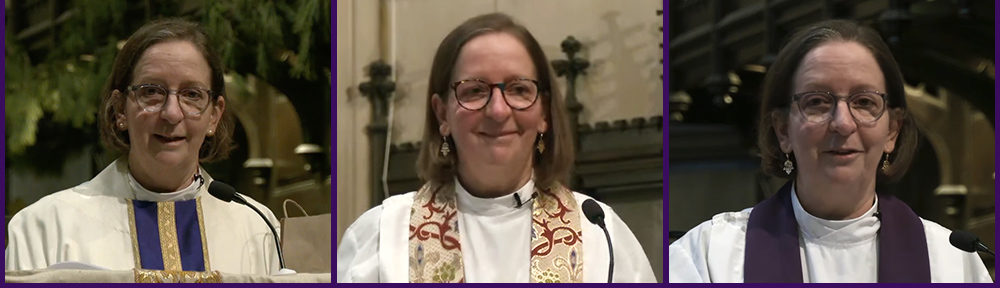
Proper 22B. 6 October 2024. The Very Rev. Pamela L. Werntz
Job 1:1, 2:1-10. Do you still persist in your integrity?
Hebrews 1:1-4, 2:5-12. Someone has testified somewhere.
Mark 10:2-16. Receive the kingdom of God as a little child.
O God of the Pharisees, grant us the strength, the wisdom and the courage to seek always and everywhere after truth, come when it may, and cost what it will.
My first instinct when I saw the Gospel reading assigned for today was to think about preaching on Job or Hebrews. Just because I’m trained to address the hard teachings of Jesus, doesn’t mean I want to do it! What do we make of Jesus’ teaching on divorce and why do we have reminders about the value of little ones for the third week in a row? Clearly Jesus’ disciples still didn’t get it, and my guess is that neither do we. So here we go. Take 3.
This morning our Gospel lesson gives us another opportunity to remember that many Christians have been trained to distain the Pharisees when they appear in our Christian testament. (Episcopalians usually hiss silently, of course.) The word Pharisee, in many people’s minds has come to be synonymous with hypocrite. I want to make sure that you know that synonyms for hypocrisy are deceit, sanctimoniousness, insincerity, duplicity, but Pharisee is not, I repeat not, a synonym for hypocrisy. What many Christians don’t understand is that Jesus’s body of teaching, both in content and in style was Pharisaic. In Jesus’ time, Pharisees weren’t the bad guys any more than Episcopal priests today are the bad guys. Maybe I should say Pharisees weren’t any worse than Episcopal priests, since results may vary!
In the first century of the common era, there were two main schools of Pharisees: the House of Rabbi Hillel, and the House of Rabbi Shammai. They agreed on most things, according to the Talmud, although the House of Hillel was typically looser and the House of Shammai typically stricter in interpretating the Torah. They had vigorous and spirited debates about ethics, theology and ritual practices. For example, the House of Shammai denied that Gentiles could experience right relationship with God. The House of Hillel taught that it was possible for Gentiles to be in right-relationship with God, and that Moses commanded Israelites to spread that good news. [1] (That’s what both Jesus and the Apostle Paul were doing, by the way. Paul was also trained as a Pharisee.) Two other examples of what the Houses of Shammai and Hillel disagreed about: The House of Shammai taught that only worthy students could be admitted to study Torah. The House of Hillel taught that Torah may be taught to anyone, in the hope that they will repent and become worthy. (Sounds like debates among Christians about who may receive the sacraments.) The House of Shammai taught that a man could only divorce his wife for a serious transgression. The House of Hillel permitted divorce for something as small as burning a meal. (Sounds like our debates in the church about, well, divorce.)
In Jesus’ time, the House of Shammai had the influence and power, but that changed dramatically when Jerusalem was destroyed in the year 70 CE, and the House of Hillel rose, while the House of Shammai diminished. Nevertheless, the Mishna tractate called Chapters of the Fathers affirmed the value of disagreement, saying: “a disagreement which is for the sake of Heaven will be preserved and one which is not for the sake of Heaven will not be preserved. What is a disagreement that is for the sake of Heaven? The disagreement of Hillel and Shammai. What is not for the sake of Heaven? The disagreement of Korah and his congregation.” [2] Well that should clear things right up! The story of Korah’s rebellion is in the Torah, Numbers 16. The rabbis teach that the problem was Korah was trying to grab greatness and power, rather than serving the people (so, not for the sake of heaven). And the Zohar teaches that Korah quarreled with shalom, and the one who quarrels with shalom, quarrels with the Holy One. [3] Perhaps you remember from last week that Jesus has just said “have value (have salt) in yourselves and be at peace with one another.”
This is all context for when, one day, according to Mark, some colleagues were asking Jesus, “what do you tell people who want to divorce?” They all knew Moses permitted divorce and remarriage (but two people couldn’t marry each other again if there had been an intervening marriage. That was a bridge too far! Joy and I both had great aunts and uncles who did that: married, divorced, remarried others, then remarried each other.) Here, Jesus and his colleagues’ debate was about what was permissible in contemporary first century Israel, just like our debate is about what is permissible in the contemporary twenty-first century Church. Jesus warned that, what Moses taught, had to do with the people’s hardness of heart – the Greek word is sclerocardia. Hardness of heart was the problem, according to Jesus.
Clearly, Jesus thought marriage should not be taken so lightly that a burned meal could be cause for divorce. It’s strange that he cites the beginning of creation, though, when he teaches that a man shall leave his father and mother and join his wife when Adam had no mother and father to leave when he coupled with Eve. Furthermore, the word for marry or marriage isn’t even mentioned in the Torah until the 19th chapter of Genesis when Lot has two daughters who are engaged to be married. Also, I should mention that polygamy was primary model for Biblical marriage in Genesis..
In reminding his hearers of the creation story, perhaps Jesus was saying, “I want everyone to remember who made you and how you were made.” You were made by God (who is Love) with Love for Love. I think Jesus was saying, “Remember to whom you belong and why you’re here.” I think Jesus was saying, “Remember God’s joy in creating you and in creating others.” He reminded them of Divine intent for the dignity of every human being. You belong to Love and you are here for Love. You are here to companion others – to be helpmates, partners. Your hardness of heart is keeping you from remembering that and doing that. Indeed, Jesus was saying, the law permitting divorce and remarriage was written because of hardness of heart – to create order and protection for people, one from one another.
Another example of hardness of heart is using Jesus’ teachings on marriage and divorce as blunt instruments to hurt people. Biblical commentator Sharyn Dowd has written, “It is no less than blasphemous to use the Markan prohibition of divorce to encourage terrified people to remain in abusive relationships that should not even be dignified with the term ‘marriage.’” [4] Even in marriages that are not abusive, but that threaten the well-being of a couple, the Church is sinfully remiss in not providing a ritual unbinding for couples who need to part from one another. I think it’s hard-hearted for the Church not to offer a dignified way for couples to loose their marriage knots, especially when there are other examples of faithfully undoing life vows for clergy or other religious vocations. Divorcing couples and their families and friends would be much better cared for if we could amplify and honor their integrity after a marriage has come to an end, assisting in forgiveness where pardon is needed and acknowledging what has gone wrong or gotten broken, as well as whatever had been abundant loving in the relationship.
We don’t always feel God’s love so abundantly, do we? We don’t always like to give – in the give and take of life. We don’t always even know that we have anything TO give, especially when we’re in conflict and our hearts have hardened. We have struggles and challenges, disappointments, conflicts, and failures. But taking the long view of Jesus’ teaching, we see that his emphasis is always on the fullness of life – his emphasis is always on the full part of lawful or faithful. So I want to say that if anyone is listening to my sermon and realizes that they have been carrying the burden of guilt and shame because of a divorce – of your own or of someone you love, leave that burden behind you today. If you are still carrying around hurt and anger caused by a divorce, let the Holy One, Whose name is Love, dispose of that burden. That burden you are carrying will only make your heart harder. If there are amends to be made, make them, if in doing so you will not injure others by opening old wounds or creating new harm, to borrow the wisdom of the 9th step of 12-steps.
I was thinking of softening agents when I was writing this sermon – you know, water softeners, fabric softeners, skin softeners. Some of you might remember the television ad that depicted a chaotic domestic scene with a harried mother in a kitchen fixing a meal, a crying kid, phone ringing, and she says, “Calgon, take me away.” The next scene was the same woman in a bubble bath with Calgon skin softener and the voiceover says, “It’s paradise!” I started wondering about heart-softening agents that open paradise for us.
Because, when Jesus teaches that the realm of God or Love is for ones who are like little children, he means those with soft hearts: vulnerable, powerless, trusting, unguarded. What makes hearts soft? What makes your heart softer? That’s the question for today, it seems to me. I hear Jesus saying that a soft heart is what’s needed to enter the way of Love, that is, the realm of God, aka paradise on earth.
Here’s a heart-softening idea. God woke us up today and we get to experience the beauty of this day in this beautiful place with others of all sorts and conditions invited to receive the kindness and welcome of Jesus, which is cast in a permanent gesture of welcome at Emmanuel Church. We get to hear transcendent music. We are all welcome to participate in a taste of heaven in the bread and the cup. We are invited to receive the kindness and welcome of Jesus as a little child – with a capacity for wonder and imagination, without possessions or cynicism weighing us down, whole heartedly, with joy! We are being invited by Jesus to sit at the kids’ table! The grace of God, the realm of Love, is always being offered to us again and again. So remember to whom you belong and why you’re here: Love. In the words of St. Francis: “you have been called to heal wounds, to unite what has fallen apart, and to bring home those who have lost their way,” including your own aching hearts.
- http://content.time.com/time/magazine/article/0,9171,1048374,00.html
- Pirkei Avot 5:17.
- The Torah: A Modern Commentary, W. Gunther Plaut, ed. (New York: UUn p. 1134.
- Sharyn E. Dowd, Reading Mark: A Literary and Theological Commentary (Reading the New Testament Series) (Macon, GA: Smyth & Helwys Publishing, Inc., 2000) p. 103.