
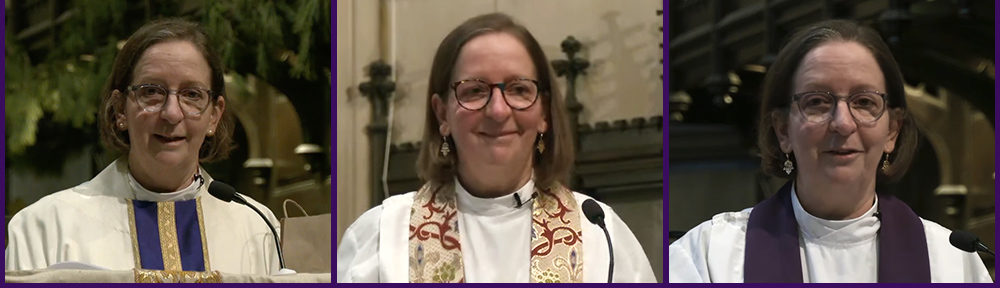
Proper 23B. 13 October 2024. The Very Rev. Pamela L. Werntz
Job 23:1-9. Today my complaint is bitter.
Hebrews 4:12-16. Let us therefore approach the throne of grace with boldness.
Mark 10:17-31. For God all things are possible.
O God of possibility, grant us the strength, the wisdom and the courage to seek always and everywhere after truth, come when it may, and cost what it will.
Our Gospel readings from Mark have been getting increasingly difficult for followers of Jesus as he journeys toward the cross. As we just heard in Hebrews, “indeed, the word of God is living and active, sharper than any two-edged sword, piercing until it divides soul from spirit, joints from marrow; it is able to judge the thoughts and intentions of the heart. And before God no creature is hidden, but all are naked and laid bare to the eyes of the one to whom we must render an account.” What account will we render? What do we who are unwilling to sell all that we have to benefit those who are poor, do with this Gospel lesson? Maybe the better question is, “what will this Gospel lesson do with us?” Will it inspire us to follow Jesus or offend us?
Indeed, the word of God is living and active. It’s sharp and in the wrong hands and mouths, it does a lot of damage. My awareness of that is particularly heightened because tomorrow is Indigenous People’s Day, a day in which we acknowledge the devastation wrought by Bible-toting, mission-driven European “Christians” whose guns and germs enabled their land and labor grabs. The colonists and later the United States government displaced and killed millions of people who were living here first, with the express blessing or tacit consent of the Anglican and later Episcopal Church. The devastation is ongoing, both for Indigenous Peoples and for the rest of us. The intergenerational trauma is collective and communal. It affects us all whether we are conscious of it or not. If and whenever, in the words of our Rite I confession, “We acknowledge and bewail our manifold sins and wickedness…against [God’s] divine Majesty …the remembrance [of our misdoings] is grievous unto us, the burden of them is intolerable.”
Yes, the burden is intolerable, so we need help. And help is available in the Most Gracious, the Most Merciful spirit of Love, incarnation of Love and creator of Love. The Most Gracious and the Most Merciful has a response throughout scripture. The arc of the narrative, the compilation of many voices that are still speaking to us says: “Turn away from whatever separates you from the most gracious, the most merciful Love of God.” I think that’s what today’s Gospel lesson is about, at least in part.
As Jesus was setting off on a journey, a man ran up and knelt in front of him and asked what he had to do to inherit eternal life. Remember that Biblically speaking, eternal life always includes life before death. Jesus said, “you know the commandments.” Then Jesus does a curious thing and lists six: you will not murder; you will not violate marriage; you will not take what belongs to another; you will not lie; you will not defraud, honor your father and mother.” (Two intriguing things to me about this list: defrauding was not listed on Moses’ two tablets; and Jesus includes honoring father and mother even when his disciples have left their fathers and mothers.) <[2] But even before that, I wonder about the man’s use of the word “inherit,” which carries a certain entitlement by virtue of position or election or lineage and birth order.
The man replied that he had been careful about those commandments since he was a child. Jesus, looking at him, loved him. This is the only time the Gospel of Mark says that Jesus loved someone. (So don’t miss that – that is good news!) Jesus replied that he should spend some time selling his possessions, giving the money to those who are poor, and then follow Jesus in the life of a wandering beggar who will have a large family made from Love, but also persecutions – literally hounding. (That’s the bad news.)
I like to point out that this is a Jesus who could never get a job in the Episcopal Church. <[1] The note in his file would say, “turned away wealthy prospect!” And I do wonder why, if anything is possible with God, Jesus didn’t say to the man, come along, we’ll figure out meaningful things to do with all of your wealth! Sometimes preachers teach that the issue is more about detachment or indifference to wealth, or about being careful not to be conspicuous about one’s consumption. But Jesus was not talking about being detached or inconspicuous here. Jesus was demanding relief for those who are poor through the redistribution of wealth. Both Torah and Gospel are abundantly clear about the sacred obligation of people who have more to care for and share with people who have less, and the prophets are clear about the dangers of wealth.
Now this is a fundamental, literal interpretation of a scriptural command (and not one, I might add, that I have ever seen Biblical literalists putting on signs at marches and rallies). Jesus’ instructions are extreme – actually against the grain of rabbinical teaching of the time, which held that a man should not give away more than one fifth of his possessions during his lifetime lest he become a public charge. <[3] This is still our concern about the risk of giving too much, but we’re usually hovering around 4-5% rather than 20%. We don’t want to risk giving away too much and becoming needy ourselves. Heaven forbid? Well maybe not. According to Jesus, heaven requires.
Was Jesus using hyperbole? Or was he really serious? If he was serious, does his instruction only apply to that rich man or to all rich people? Can those of us who are not rich men relax? No, I don’t think so. This teaching of Jesus is amplifying the inherent conflict between wealth and discipleship, and we should take it seriously. Although we have a wide range of incomes and other resources at Emmanuel Church, I’m quite confident that I’m not preaching right now to many who are very rich – they tend to go to the parishes on your right and on your left. At the same time, I know that most of us are rich by the world’s standards even if we are not very rich by Boston’s Back Bay standards. The late Lamar Williamson wrote, “after we have done our best to make this text say something less upsetting to our system of values, Jesus looks intently at us and continues quietly to affirm that [eternal] life is to be [entered] not by accumulating things, but by disencumbering ourselves.” <[4] We cannot inherit it; we may enter it.
You know, the Bible is full of instructions and examples to follow – in fact, a lot of conflicting instructions and examples. One of the ways I discern which instructions and examples are binding and which ones are not, is to look through the lens of the love ethic exemplified for us by Jesus. Back to Hebrews, “Since, then, we have a great high priest…Jesus, the Child of God, let us hold fast to our confession. For we do not have a high priest who is unable to sympathize with our weaknesses.” If we look through the lens of love to try to figure out which commandments we should follow, what do we see? Looking through the lens of love requires that we look for whether it is responsible, caring, mutual, non-exploitative, honest, with genuine concern for the best interests of the other and of society as a whole.
The Gospel of Mark tells us that Jesus loved this rich guy – and that when Jesus told him to sell all his stuff, give the money to poor people and then follow him, the guy walked away. Mark tells us the rich guy was shocked and grieving because he had many possessions. One of the things that I notice is that he didn’t respond, like the Syro-Phoenician woman, when Jesus’ response to her question was inadequate. She argued, “Yes, Lord, but,” but the rich man didn’t argue. He just walked away, maybe ashamed, maybe angry, or shocked and deeply sad. When I look at this story through the lens of Love, I see what Jesus says next differently than I used to see it. I used to see that part about the camel and the eye of a needle as a judgmental reproach. Now I see it as a lament — Jesus’ own grief – his own deep sadness that the rich man who he loved just walked away. I have this sense that Jesus showed the rich man that the gates of heaven are so wide you can’t even see the sides of the opening – and all he had to do was put his stuff down and walk in, but he didn’t want to. He didn’t even want to continue the conversation – and I think that made Jesus so sad. The wide gates might as well be as narrow as an eye of a needle. The lens of Love makes it clear to me that Jesus was expressing his own grief.
What I think Jesus knew then, and what I know now, is that the more achievements, affluences, and appearances we are trying to keep up, the less we think we need God, and the less we think we need others. Oh I can worship God, do my best to follow the commandments, even give my life over to the priesthood – but when I behave as if I don’t need the love of God the way someone who has nothing needs the love of God, I am not entering or experiencing eternal life, which is not an inheritance, but an ongoing invitation to all who are in need.
I also know that I am wealthy by the world’s standards. I don’t like thinking about that, but I know it’s true. But I’ll tell you this – I’m not walking away. I want to follow Jesus. I want to participate in redistributing wealth – my personal wealth, the wealth of this parish, and the wealth of the wider Episcopal Church. I want to alleviate poverty and provide relief to people who lack dignified shelter, who search for food in the trashcans on Newbury Street and sleep on flattened cardboard boxes in our garden and on our steps, whose jackets are too thin for the cool fall days, and the coming winter. I also want to offer reparations to those whose people were mistreated and whose land and labor was stolen. I want to be a part of healing our collective traumas. I want to encourage you to do these things also.
So what does that mean? It means for me, that every year my own giving is increasingly intentional, proportional and sacrificial. I spend more time thinking and praying about my own access to resources – and figuring out how to use less and give away more. Every year, I give away a higher proportion of my income. Sometimes the increase is in baby steps – like a half a percent more than the year before. Sometimes it’s a bigger step. I’ve lived through the very humbling experience of taking big steps and then falling short – that is, making a pledge for giving to the church that represented a significant stretch and not being able to meet it. I can tell you, that’s not the end of the world. And my giving is increasingly sacrificial. What I mean by that is, if I can give away money and possessions and not even miss them, I’m sure that it wasn’t enough. Giving should change one’s life. It should matter. It’s both difficult and rewarding.
I know I want to follow Jesus and so I’m not walking away – I’m arguing with him sometimes, and I’m asking for help, but I’m not walking away. Furthermore, I know that as your priest, it’s my work to be concerned for your spiritual health which includes your financial giving, and it’s my work to encourage you to not walk away. As your priest, I’ve got to tell you that I believe Jesus really meant it when he sadly observed how hard it is for how it will be for those of us who have many possessions to enter into and fully experience the realm of God. But I don’t think it’s because the realm God doesn’t want or welcome us – I think rather, that the more we have – that is, the less needy we are, the less likely we are to want to enter the realm of God, which is open to all without exception. I also believe that Jesus really meant it when he said that for God, with God, in God, all things are possible. And for today, that news is good enough for me. May Jesus be our joy, our hearts’ delight, and our treasure.
- Stephanie Spellers, The Church Cracked Open (New York: Church Publishing, Inc., 2021), p. 59.
- Instead, see Exodus 20:17 and Deuteronomy 24:14.
- Samuel Tobias Lachs, A Rabbinic Commentary on the New Testament: The Gospels of Matthew, Mark and Luke. KTAV Publishing House, Inc., 1987, p. 331.
- Lamar Williamson, Jr., “Mark” in Interpretation: A Bible Commentary for Teaching and Preaching, (Louisville: Fort Knox Press, 1983), p. 188.