
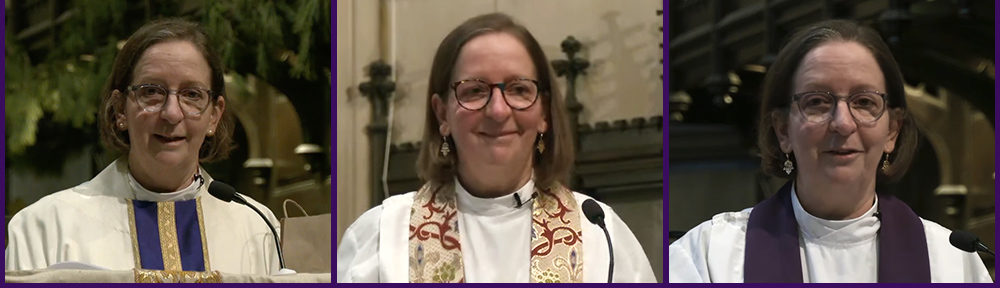
Proper 20B, September 22, 2024. The Very Rev. Pamela L. Werntz
- Proverbs 31:10-31 A capable wife who can find?…Give her a share in the fruit of her hands.
- James 3:13-4:3, 7-8a A harvest of righteousness is sown in peace for those who make peace.
- Mark 9:30-37 Welcomes…welcomes…welcomes…welcomes.
O God of our radical welcome, grant us the strength, the wisdom and the courage to seek always and everywhere after truth, come when it may, and cost what it will.
Hello! I’m so glad you’re here! This is a happy new year of sorts, the first of several that will be observed in this sanctuary. Today we begin a new year worshiping in the sanctuary, which is looking particularly shiny, thanks to the restored stained glass window in the clerestory and the restoration of the apse walls and reredos, and Emmanuel Music begins a new season with us. We are anticipating the High Holy Days observances of Central Reform Temple in a week and a half. Those days between Rosh Hashanah and Yom Kippur are called “The Days of Awe.” I love that. This is such a wonderful place to cultivate awe, isn’t it?
The great Rabbi Abraham Joshua Heschel once said “the beginning of awe is wonder, and the beginning of wisdom is awe…awe is a way of being in rapport with the mystery of all reality. The awe that we sense or ought to sense when standing in the presence of a human being is a moment of intuition for the likeness of God which is concealed in [the human being’s] essence…The secret of every being is the divine care and concern that are invested in it. Something sacred is at stake in every event.” [1] I believe that is true whether the event is most welcome or entirely unwanted, whether the event unexpected or long-awaited, something sacred is at stake in every event, every encounter.
We have three lessons from scripture before us that speak to something sacred being at stake in every event. The first, from the conclusion of the Book of Proverbs, is a beautiful description of a successful woman who does everything well. Before you get your undies in a knot about the patriarchal bias about the capable wife, I’ll tell you that in Hebrew, the word for wife is the same as the word for woman – ishah. The word for husband is the same as the word for man – ish.) She may be a good wife, but Bible calls her ishah-chayil. When chayil is used to describe men in the Bible, it’s translated “mighty.” [2] My complaint is not with the ancient Book of Proverbs; it is with the modern translation of “a capable wife” when it’s far more accurate to say “a mighty woman.”
Sadly for us, the passage doesn’t mention that she ever rests, but we can be assured that because she was a faithful woman, she rested from productivity one day out of every seven. Notice that this passage also doesn’t say anything about this woman’s worth being derived from her man. It doesn’t list pregnancy or childbirth among her key credentials, nor does this long passage mention her physical appearance. [3] Instead, we hear a long list of events – of business transactions and giving generously to those who are poor, stretching her hands out to those in need. Clearly, for this woman, something sacred is at stake in every event, every encounter.
The Letter of James teaches that wisdom is made manifest in deeds of generosity and kindness – and that “one of the greatest gifts of wisdom is its capacity to lead [people] to a peaceful resolution of a conflict.” [4] James assumes conflict – indeed, is written in the midst of tremendous political and religious conflict. The letter attributes conflict to a disease of the human heart, wherein the healing comes from turning to Love in a way that is generative and has integrity of purpose. [5] If the beginning of wisdom is awe, then the end of wisdom is harmony. The way between awe and harmony is “extraordinarily rigorous,” and it is both our obligation and great honor to follow it, knowing something sacred is at stake in every event, in every encounter.
I don’t know if you’ve noticed, but the parts of Mark that we’ve been hearing for the past few weeks are increasingly tense and full of conflict. To give you some context, the disciples and Jesus are heading back home to the fishing village of Capernaum. They have been on the road for a while, travelling all over Jewish and Gentile territory, changing locations forty-some times in a few short chapters of Mark’s Gospel. Most recently in the story, the disciples tried and failed to heal a boy. A short-tempered, perhaps travel-weary Jesus has caught up with them and healed the boy himself, but not without asking the question, “how long must I put up with you people?”
The disciples seem to be fairly cranky too. You know, Jesus’ earliest followers were called, “People of the Way.” But they might have been better known as “People who argued on the Way.” The Gospel of Mark explains that Jesus was teaching his disciples things they didn’t understand and they were afraid to ask him to explain. They were arguing with one another along the way, and when Jesus interrogated them (the word is stronger than just asking), they were silent. They didn’t want to tell him that they had been arguing about who was the greatest.
I wonder about what they’re afraid of – afraid that Jesus will bark at them maybe. Perhaps they were both afraid to go with him and afraid that he might leave them behind. Afraid to admit that they don’t fully grasp what’s going on, that they don’t get what he’s talking about. I’ve always imagined that they were arguing something like, Peter saying, “I’m the greatest because I’m solid as a rock, Jesus said so.” And John was saying, “No, I’m the greatest because he calls me the Son of Thunder,” and so on. But they might have been arguing that another was greater – a little like the old Smothers Brothers routine where Tommy tells his brother Dick, “Mom always liked you best.” Or arguing something like, “you should really take the lead on following Jesus because you’re better than I am.” “You’re the greatest; no I’m not, you are.” Or they might have been arguing that they as a group were better or worse than another group. You know, arguing about how “our group is better than, or not as good as, that other group.” Or was it Moses versus Elijah? John the Baptist versus Jesus? In a way, it doesn’t matter whether the disciples were arguing they were individually or collectively better or worse than another. It’s arrogant to believe that you are better than another. It’s also arrogant to believe that you are not as good as another. It is an affront to the Holy One who made each and every person marvelously well.
Then Jesus called the twelve for some further instruction. Jesus’ “call” to the twelve is actually the word for a rooster crow. It’s a wake-up call – an alarm. Jesus sits down in the house in Capernaum they have entered, and says, “whoever wants to be first must be last of all and servant of all.” He turns the “better than” or “worse than” argument on its head. Jesus teaches them that the measure of greatness is not expertise or intelligence or money or power. The measure of greatness in the realm of God is servanthood – service to others. Greatness is not measured by being served – greatness is in serving like the mighty woman in Proverbs. This was (and still is) a very subversive message, an empowering message to be teaching to people who didn’t have political or religious or financial power.
And in case his words aren’t scandalous enough, the story goes that Jesus took a little child in his arms and said, “whoever welcomes one such child in my name welcomes me, and whoever welcomes me welcomes not me but the [O]ne who sent me.” Here Jesus is asserting an identifying connection between God and himself and a little one, a most vulnerable one. Jesus is identifying himself and the Holy One with one who is at the bottom of the pecking order for honor or significance, who is most powerless and inconsequential, weakest, lowliest, most marginalized, socially invisible in a room full of serious adults. Jesus is asserting that welcoming such a relative nobody is welcoming him, and welcoming him is welcoming the One who sent him. Jesus and God and the child are One. This is a holy Trinity. Did you hear the word welcome four times when the Gospel was read? The Greek word means receive, accept, greet with hospitality.
The thing is, there are always people in our midst who need welcoming – people who are outside circles of influence, outside of the various mainstreams of our society, outside of the mainstreams of our church, or our politics, or our religious rituals, who need welcoming, and in whose eyes we will find God. Welcome means much more than tolerance or perfunctory acceptance. My guess is that most of us know the difference in how it feels to be endured rather than embraced. My next guess is that most of us know what it’s like to live in the margins in at least one aspect of our lives, even if we don’t wholly occupy that space. I bet each of us has at least one part of who we are that dwells in the margins – one part that is unaccustomed to being welcomed with open arms. It is about that part of ourselves that Jesus is teaching us to embrace!
Here Jesus is teaching that leadership is about giving radical welcome and inclusion to one outside any circle of influence, by virtue of cultural or political or financial constructs. It’s about involving someone who you think probably isn’t going to do a thing for you. Even more startling is the idea that our capacity to receive those who have been most marginalized is a measure of our capacity to receive the Holy One. This is true whether we are talking about parts of our own selves, parts of our immediate circles of concern, parts of our commonwealth, parts of our world. We, who are People of the Way – even People Arguing on the Way, have both an obligation and the great honor to respond with welcome, welcome, welcome, welcome, knowing something sacred is at stake in every event, every encounter, and in every child of God.