
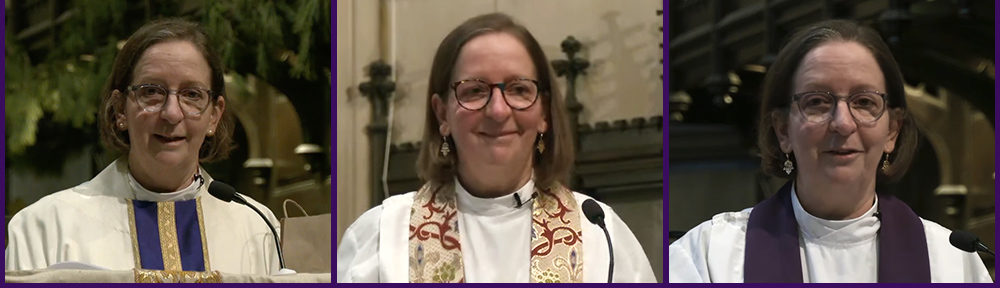
Christmas 1C, 29 December 2024. The Very Rev. Pamela L. Werntz
- Isaiah 61:10 – 62:3. I will greatly rejoice in the LORD.
- Galatians 3:23-25, 4:4-7. So you are no longer a slave but a child, and if a child then also an heir, through God.
- John 1:1-18. No one has ever seen God. It is God the only Son, who is close to the Father’s heart, who has made him known.
O God of love, grant us the strength, the wisdom and the courage to seek always and everywhere after truth, come when it may, and cost what it will.
Our lectionary, which assigns the prologue to the Gospel of John for the first Sunday in Christmas, baffles me. Since we’re in a Gospel of Luke year, why not the story of the presentation of Jesus as an infant in the Temple eight days after he was born? The answer, I guess, is that story will be read on February 2, which is the Feast of the Presentation.
If you were with us the other night on Christmas Eve, you heard Deacon Bob and me chant the prologue to the Gospel of John by candlelight. Reading it in the daytime, even in this beautiful chapel, is no match for that mystical expression of the love song about God coming into the world, loving us believe it or not. Whether it’s light or dark, this is still a song about God loving us so much, but somehow the daylight makes it harder to imagine than the candlelight!
So, rather than preaching about John’s prologue in the daylight, I want to say some things about our first reading from Isaiah, from the final part of Isaiah, which is sometimes called “Third Isaiah.” Even though Isaiah is one long book in the Bible, it was written by at least three different authors, who spanned centuries from the mid-8th century to the late-6th century BCE, from many years before the Babylonian Exile to the rebuilding of the Temple in Jerusalem. Our passage today is the center point of the last portion of the book, but our reading really should begin with chapter 61, verse 1. You will probably recognize it:
The spirit of the Lord God is upon me, because the Lord has anointed me; he has sent me to bring good news to the oppressed, to bind up the brokenhearted, to proclaim liberty to the captives, and release to the prisoners; to proclaim the year of the Lord’s favor, and the day of vengeance of our God; to comfort all who mourn and…to give them a garland instead of ashes, the oil of gladness instead of mourning, the mantle of praise instead of a faint spirit.
This was the message that Jesus was born to practice, which he used to begin his public ministry. This was the groundwork of the Beatitudes and the foundation of all of his teachings. Just to be clear, the prophet(s) Isaiah were not imagining or predicting Jesus or the Church. It was Jesus who was claiming the scriptural authority of Isaiah when he began his work of bringing healing and restoration of dignity and community to those who were suffering and oppressed some 500 years after this part of Isaiah was written. We claim the scriptural authority of Isaiah when we continue Jesus’ work of bringing healing and restoration of dignity and community to those who are suffering and oppressed 2500 years later.
The cause to “greatly rejoice [literally, joy joy!] in the Lord,” where our reading for today begins, is that God is faithfully going to make reparations, which will be like clothing the faithful people with garments of salvation and robes of righteousness, like causing a garden to spring up, making an everlasting covenant of Love, complete with new names for with those who have been treated unjustly. The verses following the end of our reading promise that the city will no more be called Forsaken, and the land will no more be called Desolate. The city will be called My Delight is in Her, and the land will be called Well-Cared-For. The prophet is looking around at a city called forsaken and a land called desolate, and promising that Love will find a way to raise up the former devastations and repair the ruins of many generations.
The Hebrew word tzedakah that gets translated righteousness carries with it a sense of overflowing goodness from The Holy One, which transforms the world with right-relationship, visible to everyone. Tzedakah means social justice and is understood as an obligation to help others in order to bring well-being to the world. Although it often looks like charity, tzedakah is not a marker or indication of generosity or choice, but of moral obligation for everyone, even for people who only have a little, to help those less able, or less skilled, regain their God-given dignity. Injustice, robbery, and wrongdoing insult The Holy One. Justice and right-relationship are the praise The Holy One desires, according to all the law and the prophets.
Walter Brueggemann explains that this extraordinary vision in “Third Isaiah” seeks to summon the people of God out of the temptation to despair. The hope-filled message is deeply embedded in God (or Love), and it concerns restored community, which will become a spectacle for all the peoples to observe. These same peoples had assumed the people of God were hopeless and that The Holy One was an irrelevance. The vision of that restored community will be a beacon of hope for others to also claim right-relationship with God and one another, if the vision is handled with care, which is to say if it is handled with prayer.
Here are a few beacons of hope that I’ve experienced in the last couple of weeks, which have been handled with prayer. In mid-December, common art staged a new play by community member Richie Berman about the many daily obstacles faced by people who lack dignified housing in the City of Boston. When he asked me to take a role, I was delighted. When he told me that he wanted me to be the voice of God, I was a little chagrined. I acquiesced because I wanted to be in the play. When it was time for the production, the characters (well, the good guys anyway) were decked out in garments of gladness and beauty: sparkles, feathers, and riotous colors, all on loan from Sara Peattie’s puppet workshop in our basement. The costumes transformed the players in ways that I hadn’t anticipated. Their lines were bolder and easier to understand. Our drama-therapy intern Mary interviewed the actors after the end of the play in the form of a talkback. One actor talked about messages that they are not good, which people who are unhoused get all the time. He said that when he comes up the access ramp to Emmanuel Church and sees the word good painted on the ramp, he remembers that they are all good because they are here together. The common art community is a beacon of hope for others to also claim right-relationship with God and one another because the community is handled with prayer.
Then the letter from the Emmanuel House about their community garden arrived in the mail and described a difficult sixth season of growing and shared undaunted enthusiasm for the upcoming season, all on one page. It told of the encouragement from Bishop Mary Glasspool, who, at the next-door Allston Abbey’s dedication, had preached on the theme Love grows here. Bishop Glasspool highlighted the work of the Emmanuel House garden as a metaphor for the growth and gladness of cultivating community, enacting a vision to provide green space and gardening by and for neighbors in Allston and beyond. The Emmanuel House garden is another beacon of hope for others to also claim right-relationship with God and one another. The letter asked for our prayers, again handled with prayer.
The last story of a beacon of hope, handled with prayer, happened before any of us were born and on the other side of the country. The story was sent to me by The Rev. Dr. Martha Tucker, who wrote, “It sounds like an Emmanuel story.” When I read it, I thought so, too. It was the story of the city of Nogales, divided by the southern border of the U.S. in Arizona and the northern border of Mexico in Sonora. This newspaper clipping from December 24, 1929, decribed what was about to happen there on Christmas Day during the Great Depression.
The United States will be a few acres smaller tomorrow for a period of three hours. The occasion is a municipal Christmas tree to which the children of both border cities are invited. At the last moment it was discovered that about 3,000 children living on the Mexican side would be barred by immigration laws. After a great many conferences between American and Mexican officials it was decided to move the international border back far enough to include the tree. At 9 a.m. inspectors and guards will be moved back two city blocks. There they will stay until each child has received its presents. At a signal they will begin to gently herd the youngsters back to their own country, each hugging a bag of candy, a toy, and some new clothing. Great care will be taken to see that none of the children slip through the line, although no trouble is expected.
Apparently no trouble occurred, because that’s not part of the story. The lessons I take from this Emmanuel-like story are that sometimes borders need to be adjusted, and sometimes places need to be renamed from desolate to delightful in order to handle each other with prayer.
Here’s what handling with prayer looks like according to the prophet Isaiah, Jesus of Nazareth, and Emmanuel Church of Boston. Reaffirming beauty and dignity with colorful, sparkly clothes, redeeming an abandoned patch of dirt with food and flowers springing from the earth, renaming a place from forsaken to well-cared-for, from desolate to delightful. I urge you to look for more beacons of hope to inspire you to approach what seems impossible or unjust with this mantra: handle with prayer.
- Walter Brueggemann, Isaiah 40-66 (Louisville: Westminster John Knox Press, 1998), p. 218.