
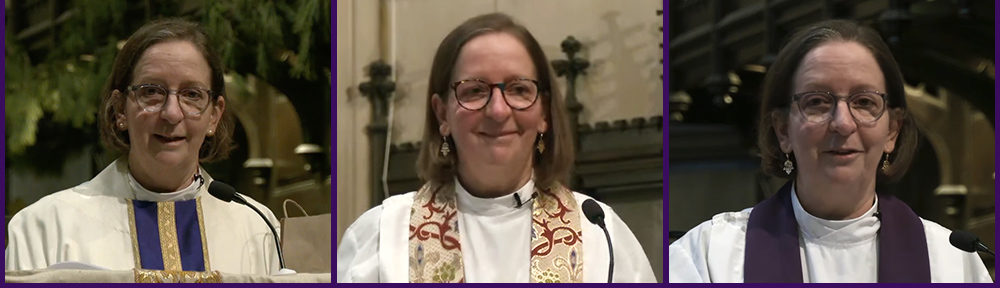
Proper 11C, July 21, 2025. The Very Rev. Pamela L. Werntz
- Amos 8:1-12. The end has come upon my people Israel.
- Colossians 1:15-28. Christ Jesus is the image of the invisible God.
- Luke 10:38-42. She had a sister named Mary, who [ALSO] sat at the Lord’s feet.
O God of mercy, grant us the strength, the wisdom and the courage to seek always and everywhere after truth, come when it may, and cost what it will.
Here we go again with another set of lectionary readings that have been used to advance truly regrettable theologies about women, work, contemplation versus action, and divine judgment. What a combination: the apocalyptic vision of Amos, the cosmic Christ of Colossians, and two sisters whose story has been weaponized for centuries to pit so-called “spiritual” people against those who engage in the messy work of hospitality and care. However, I see glimmers of hope in this collision of texts that seem to speak past each other at first glance. I invite you to hear these passages not as separate little moral lessons, but as a unified testimony written over the course of more than 800 years about divine priorities and what it means to lean into God’s realm.
First, we heard Amos, the prophet who was “no prophet, nor a prophet’s son, but a herdsman and a dresser of sycamore trees” – in other words, someone who worked with his hands, someone who understood the rhythms of the earth and the needs of ordinary people. God shows Amos a basket of summer fruit, ripe and ready for harvest, and declares: “The end has come upon my people Israel; I will never again pass them by.” Now, if you’ve heard my preaching, you know I have little patience for the kind of apocalyptic theology that turns God into a cosmic executioner. But Amos isn’t talking about the end of the world. He’s talking about the end of tolerance for injustice. The Hebrew word for “end” here is qets, which can mean completion, or harvest time. It’s the moment when fruit is so ripe it will rot if not picked.
What fruit is ready for harvest? Amos says: “Hear this, you that trample on the needy, and bring to ruin the poor of the land, saying, ‘When will the new moon be over so that we may sell grain; and the sabbath, so that we may offer wheat for sale? We will make the ephah small and the shekel great, and practice deceit with false balances, buying the poor for silver and the needy for a pair of sandals, and selling the sweepings of the wheat.'” This is not about a distant judgment day. It’s the immediate divine response to economic exploitation, to the corruption of religious observance by greed, to the systematic oppression of those who are vulnerable. Then the merchants couldn’t wait for the holidays to end so they can get back to cheating people. (Today, merchants don’t even take time off for holidays!) They’re using false weights and measures, selling contaminated grain, and buying human beings as slaves for the price of a pair of sandals. The structures of society are dangerously out of alignment. When the most vulnerable members of the community are crushed by those who should be protecting them, when religious observance becomes a mere interruption to exploitation, when the very systems meant to sustain life become instruments of death – that’s when the divine “No” becomes swift and absolute.
In Colossians, we encounter one of the most theologically dense passages in the entire Second Testament. In what scholars call the “Christ hymn” – the writer shares a cosmic vision of Jesus as “the image of the invisible God, the firstborn of all creation,” the Christ through whom and for whom all things were created, in whom all things hold together, the head of the body, the church, and the firstborn from the dead. The Greek word for “firstborn” here is prototokos, meaning first in importance. It’s about primacy, more than chronology.
But here’s what’s crucial: this cosmic Christ is not some distant divine principle floating above the messiness of human existence. The hymn says “in Jesus Christ all the fullness of God was pleased to dwell, and through him God was pleased to reconcile to Godself all things, whether on earth or in heaven, by making peace through the blood of his cross.” The word “reconcile” here (apokatallasso) – means to restore completely, to bring back into right-relationship. It’s the opposite of alienation, it’s the healing of what has been broken or separated from Love. And notice: it’s not just humans who need reconciling. It’s “all things” – the entire cosmos, the whole of creation that has been fractured by sin and injustice. Do you hear the connection to Amos? The cosmic Christ who holds all things together is the same one who stands with those who are poor and oppressed, the one who declares that exploitation and injustice are incompatible with the divine order. Amos and the writer of Colossians offer us two aspects of the same divine movement toward wholeness.
Which brings us to Mary and Martha, a story mangled by centuries of interpretation turning it into a morality tale about the superiority of contemplation over action, of spiritual pursuit over practical service. How many women have been told that their work of hospitality, their attention to the needs of others, their care for the physical well-being of their communities is somehow less valuable than sitting quietly, even silently at Jesus’ feet?
Let’s look more carefully at what Luke actually says in these five short verses. Jesus enters a village, and Martha welcomes him into her home. The Greek word used here [hypodechomai], means to receive as a guest, to show hospitality. This is not casual entertaining – this is the sacred duty of hospitality that was (and still is) central to Mediterranean culture. Martha has a sister named Mary, who sits at Jesus’ feet and listens to his word. This is crucial: in the first century, sitting at a rabbi’s feet was the position of a disciple, a student preparing for ministry. Women were typically not permitted to assume this position. Mary is not just being “spiritual” – she’s claiming the right to learn, to be taught, to be treated as a serious student of the divine.
When Martha complains that she’s been left to do all the serving alone, Jesus responds: “Martha, Martha, you are worried and distracted by many things; there is need of only one thing. Mary has chosen the good portion, which will not be taken away from her.” Now, what’s the “good portion”? The Greek word is meris, which can mean a part, a share, or an inheritance. In the context of Jewish thought, it often refers to one’s share in the divine life. I want to suggest that Jesus is advocating presence, not pitting contemplation and action against each other, whether we are sitting or serving.
Martha is distracted by “many things” – polla. The word suggests being pulled in multiple directions, being fragmented, discombobulated. Mary has chosen the “one thing” – henos – that which brings unity, focus, centeredness. It’s not that service is bad and contemplation is good. It’s that anxious, fragmented, discombobulated service can keep us from being fully present to the divine and to each other.
Here’s where these three readings begin speaking to each other. Amos’ proclamation of divine justice, the early church’s celebration of cosmic reconciliation in Colossians, and Mary’s choice are all about living with integrity, when our deepest values align with our daily actions.
The merchants in Amos are distracted by many things – profit, competition, the accumulation of wealth – and they’ve lost sight of the one thing that matters: the dignity and well-being of their neighbors. Their religious observance has become fragmented from their economic behavior. They’ve forgotten that there is only one measure of faithfulness to God: how we treat the most vulnerable among us. The cosmic Christ of Colossians is not an escape from the world but the divine presence holding all things together in love. The reconciliation God is working through Christ is about the healing of ALL relationships – between humans and God, between humans and each other, between humans and the earth itself. And Mary’s choice is not about withdrawing from the world but about finding the centered place from which authentic service can flow– the source from which true hospitality emerges.
Amos warns of God sending “a famine on the land…not a famine of bread, or a thirst for water, but of hearing the words of the Lord.” In a world where the divine voice has been drowned out by the clamor of exploitation and greed, where religious observance has been divorced from ethical action, where justice has been abandoned, people will desperately seek a word from God but it will be scarce.
This is perhaps the most terrifying judgment in all of Hebrew prophecy: not physical destruction but spiritual desolation, not the absence of religion but the absence of authentic encounter with the divine. When we lose the ability to hear the voice of God in the cry of those who are poor, when we can no longer recognize the image of the invisible God in the face of the stranger, when we become so distracted by many things that we cannot receive the good portion of divine presence – this is the deepest famine of all.
So how do we align ourselves with justice while remaining centered in the cosmic love that holds all things together? It means asking ourselves: What are the false weights and measures in our own economic system? How are we complicit in structures that trample on the needy and bring to ruin the poor of the land? What would it look like to align our individual and collective lives with divine justice?
What does it mean for us, here and now, to choose the good portion? It means examining where we have allowed ourselves to be distracted by many things – by the accumulation of wealth, by the pressure to achieve, by the false urgency of a culture that has forgotten how to practice sabbath, and simply be present to the divine and to each other. It means refusing to separate contemplation from action, spiritual practice from social justice, the love of God from the love of neighbor. It means recognizing that the authentic hospitality Martha was called to offer – flows from the kind of centered presence that Mary chose to cultivate. It means listening deeply, as the Sh’ma commands us, to the voice of the One who speaks through the cry of those who are oppressed, through the ancient prophets and today’s headlines, through the cosmic Christ and the Jesus who sits on our steps asking for a cup of water or something to eat.
Luke’s Jesus tells us the good portion Mary chose, “will not be taken away from her.” This is the language of inheritance, of permanent possession, of something that cannot be lost or stolen. In a world where so much is uncertain, where economic systems rise and fall, where even our most precious relationships are subject to change and loss, what endures is the capacity to be present to the divine love holding all things together. This is not a privatized spirituality that ignores the suffering of the world. It is the deep wellspring from which authentic compassion flows. It is the centered place from which we can engage in the work of justice without being consumed by anxiety and burnout. It is the good portion that enables us to hear the voice of God even in the midst of famine.
As we leave this place today, may we carry with us Amos’ call to justice, the early church’s vision of cosmic reconciliation, and Luke’s good portion of divine presence. May we refuse to separate what God has joined together: the love of God and the love of neighbor, the spiritual and the political, the contemplative and the active life. And may we trust that the One who holds all things together is also holding us, calling us to choose the good portion, inviting us to align our lives with the divine justice that will never pass away. In that alignment, in that choice, in that centered presence, may we find the deep source of hope that enables us to engage the world with courage and compassion.