
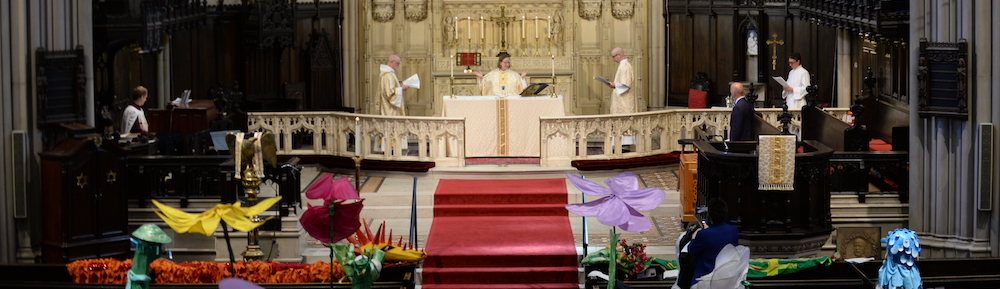
- April 24. Emmanuel Church was consecrated. It was the first building constructed on Newbury Street.
- Pew deeds were issued.
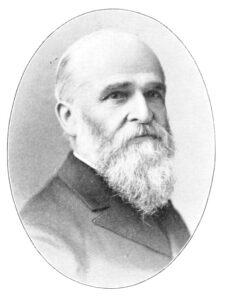
- Publisher Edward Payson Dutton became Clerk of the Vestry.
Monthly Archives: February 2013
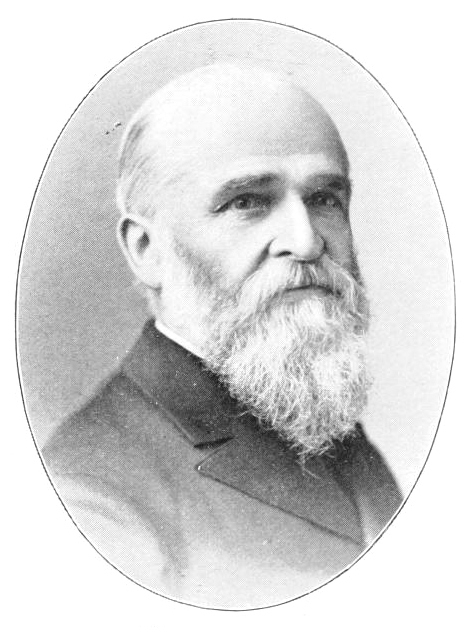
1861
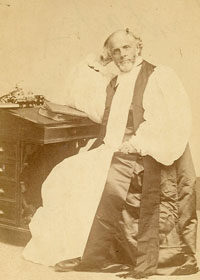 March 24. The Rev. Dr. Frederic Dan Huntington (May 28, 1819-July 11, 1904) was ordained and became Emmanuel’s First Rector. See also the chapter on him in Emmanuel Church, 1860-1960: The First Hundred Years.
June 17. Cornerstone laid for the church on Newbury St. Alexander Esty (18 Oct. 1826 – 2 July 1881) was our architect.
1 Oct. William Reed Huntington, who had studied theology under Dr. Huntington at Harvard, was ordained to the transitional diaconate. After serving as assistant to Dr. Huntington for a year, he became rector of All Saints Church, Worcester.
Dec 15. First service in the church
1860
- March 17. The first meeting held at William R. Lawrence’s house, 98 Beacon
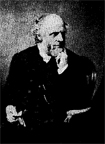
The Rev. Dr. F. Dan Huntington
Street. A committee was formed to secure Dr. Frederic Dan Huntington (1819-1904) as rector, although he had yet to be ordained an Episcopalian priest. Richard Sullivan. Fay, Jr. (1833-1882) was chosen as Chairman of the Committee of Subscribers.
- April 9 (Easter Monday). At their foundation meeting the name Emmanuel Church was formally adopted and these officers elected:
- Edward Sprague Rand (1809-84), senior warden until 1864
- William Richards Lawrence (1812-1885), who had bought the land but declined the honor of being senior warden, served as junior warden until 1863.
- John B. Alley (1817-1896), clerk
- Jere E. Bridge, treasurer
- Sept 12. Dr. Huntington was ordained a deacon at Trinity Church, which was then on Summer Street.
- Sept 16. The first service was held at Mechanics Association Hall, at the intersection of Bedford and Chauncy streets.
- Proprietors of the Corporation were:
- Benjamin Franklin Burgess (1817-1909)
- Col. John Jeffries, Jr. (1823-1897)
- William Richards Lawrence (1812-1885)
- Edward Sprague Rand (1809-84)
- Henry Sigourney (1831-1873)
- Henry Timmins (1800-1863)
- George Phineas Upham (1826-1901)
- Foster Waterman (1805-1870)
- Arlington St. (Unitarian) Church, also built in 1860, was the first building in the Back Bay. Boston’s earlier Episcopal churches were considered to be liturgically different or inconvenient for residents of the newly-filled neighborhood.
- King’s Chapel, founded in 1686, had became Unitarian in 1785.
- Christ Church (Old North), 1723
- Trinity Church, 1740
- St. Paul’s Church, 1819
- Church of the Advent, 1844
windows
Like a Hen
Lent 2C, February 24, 2013; The Rev. Pamela L. Werntz
Genesis 15:1-12, 17-18 I am your shield.
Philippians 3:17-4:1 He will transform the body of our humiliation.
Luke 13:31-35 How often have I desired to gather your children together as a hen gathers her brood under her wings.
Philippians 3:17-4:1 He will transform the body of our humiliation.
Luke 13:31-35 How often have I desired to gather your children together as a hen gathers her brood under her wings.
O God our shield and defender, grant us the strength, the wisdom and the courage to seek always and everywhere after truth, come when it may, and cost what it will.
Today’s Gospel text strikes me as a little strange. It’s strange to be catapulted from Luke’s account of Jesus in the wilderness before his ministry began, past miles of travel, teaching and healing all around the Galilee and beyond, to the middle of the Gospel of Luke, at the end of chapter thirteen. (Next week the scheduled portion is back in the beginning of chapter 13.) The slow, almost leisurely pace of Jesus’ ministry which includes story-telling, prayer and Sabbath meals gets completely eclipsed in our Lenten reading of Luke’s Gospel. Continue reading
Get ready to celebrate!
Lent 1C, February 17, 2013; The Rev. Pamela L. Werntz
Deuteronomy 26:1-11 Then you, together with the Levites and the aliens who reside among you, shall celebrate with all the bounty that the Lord your God has given to you and to your house.
Romans 10:8b-13 How beautiful are the feet of those who bring good news!
Luke 4:1-13 Jesus, full of the Holy Spirit, returned from the Jordan and was led by the Spirit in the wilderness.
Romans 10:8b-13 How beautiful are the feet of those who bring good news!
Luke 4:1-13 Jesus, full of the Holy Spirit, returned from the Jordan and was led by the Spirit in the wilderness.
O God of our callings, grant us the strength, the wisdom and the courage to seek always and everywhere after truth, come when it may, and cost what it will.
The Gospel of Luke tells us that Jesus was led by the Holy Spirit in the wilderness. It’s a little gentler version than the Gospel of Mark’s description of Jesus being driven out to the wilderness by the Spirit. It was after he was baptized, according to Luke, but not before Luke recites Jesus’ genealogy. It’s a curious place to put a 77 generation genealogy – four chapters in to the story. But for Luke, it becomes the connective tissue between the baptism and the wilderness in which Jesus began his work – his ministry. The genealogy demonstrates that Jesus is a child of Israel, a child of all humanity, and a child of the Creator. Our lectionary does this crazy thing of splitting the story of Jesus’ baptism which we heard at the beginning of Epiphany, early in January, and this time in the wilderness. In the last six weeks we’ve heard all kinds of other stories in between the baptism and the wilderness, like last week’s account of the Transfiguration which comes much later in Luke. But the Gospel narrative is that Jesus, filled with the Holy Spirit at baptism goes immediately into a harsh place of physical and spiritual danger. Continue reading
Shehecheyanu
Last Sunday After the Epiphany (C), February 10, 2013; The Rev. Pamela L. Werntz
Exodus 34:29-35 the skin of his face was shining and they were afraid to come near him.
2 Corinthians 3:12-4:12 Since then, we have such a hope, we act with great boldness.
Luke 9:28-43a And all were astounded by the greatness of God.
2 Corinthians 3:12-4:12 Since then, we have such a hope, we act with great boldness.
Luke 9:28-43a And all were astounded by the greatness of God.
O God of faithfulness, grant us the strength, the wisdom and the courage to seek always and everywhere after truth, come when it may, and cost what it will.
One of the benefits for me of regularly sharing the pulpit of Emmanuel Church with a Rabbi is that it continues to challenge and change the way I encounter Holy Scripture. My sensitivity to the need for “corrective lenses” is heightened. My desire to preach against the ways that the Christian Church has promoted supersessionist theology is even more keen than before I got here five years ago. Christian supersessionism is very much like racism as far as I am concerned – it’s systemic, it’s oppressive, it’s often internalized, and it’s always wrong. It distorts our vision and damages our souls. Continue reading