

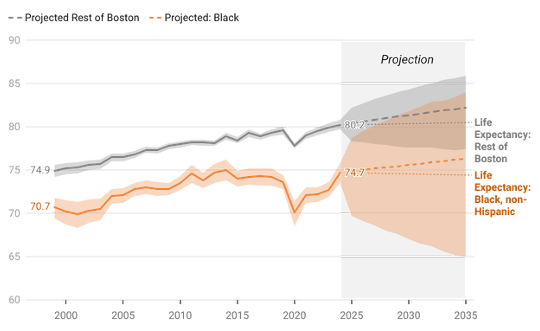
 The Boston Globe recently reported data related to the widening gap in life expectancy between Boston’s Black residents and the city’s other racial and ethnic groups. Growing from 3.3 years to almost 7 years, it has doubled in the past decade according to new data from the Boston Public Health Commission.
On February 27, they issued Closing the Gap: An Examination of Life Expectancy among Black Residents in Boston. The data brief intended for community members, advocates, and decision-makers alerts readers to the fact that preventable deaths before the age of 65 account for much of the gap. Key assertions include:
- The most effective actions to reduce inequities would focus on correctives that expand access to resources that could shape health across a lifetime.
- Comparative data gathered in the brief respond to two goals:
- “First, to understand overall trends in life expectancy among Black residents in the context of the entire city.”
- “Second, while White residents make up a large share of Boston’s population, they do not have the highest life expectancy. So comparing Black residents to all other groups provides a clearer picture of inequities in Boston today.”
- Of prime importance is the fact that Boston’s Black population has roots across the Caribbean, the West Indies, and Africa. So findings included “age-adjusted mortality data by ethnicity for the top three diasporas in Boston: Haitian, Cabo Verdean, and Jamaican.” The differences show that “culturally responsive and community-specific strategies are required.”
March 12, 2026 –Mary Beth Clack, Mary Blocher, Cindy Coldren, Pat Krol, Liz Levin