
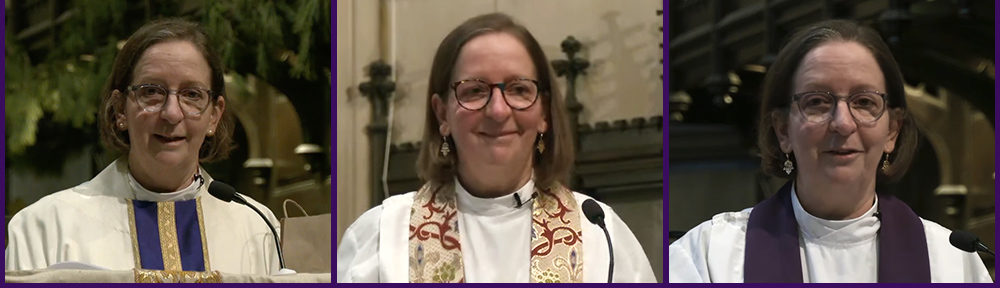
Lent 2C, March 16, 2025. The Very Rev. Pamela L. Werntz
Genesis 15:1-12, 17-18. I am your shield.
Philippians 3:17-4:1. He will transform the body of our humiliation.
Luke 13:31-35. How often have I desired to gather your children together as a hen gathers her brood under her wings.
O God whose glory is always mercy, grant us the strength, the wisdom and the courage to seek always and everywhere after truth, come when it may, and cost what it will.
Today’s choice of a Gospel text for the second Sunday in Lent always strikes me as a little jarring. It’s jarring to begin the first week of Lent with Luke’s account of Jesus resisting temptations in the wilderness before his ministry began and then to skip, over his teaching and healing all around the Galilee and beyond, to the end of Chapter 13 at the middle of the Gospel of Luke. (Next week the scheduled portion is back at the beginning of that chapter.) The slow, almost leisurely pace of Jesus’ ministry in Luke with magnificent story-telling, prayer, and Sabbath meals is completely eclipsed in our Lenten readings from Luke’s Gospel. Our lectionary saves all those stories for the summer.
In addition to disregarding the arc of the narrative in Luke, our Lectionary gives us five peculiar verses that are difficult to translate and interpret. Because the language is awkward both in English and in Greek, much gets lost in translation across language, culture, and time.
What we can understand is that this passage begins with a warning that Herod Antipas (that is, Herod the Great’s son) wanted to kill Jesus. I want you to notice that some Pharisees delivered this warning to Jesus. We Christians are conditioned by centuries of libelous teaching to think of Pharisees as “the bad guys” of the Gospel stories, but that portrayal is overly simplistic (at best). Luke describes at least three meals that Jesus had with Pharisees, and we can assume that there were more. Any sense of a negative view of Pharisees from the Gospel stories of Jesus is anachronistic, representing disputes that arose in communities long after Jesus had died. Luke paints a complex picture of Jesus’ considerable amount of time spent with Pharisees. In this story, these Pharisees warned Jesus that Herod wanted to kill him. Just after this passage they invited him to a Shabbat meal. These Pharisees were looking out for him, likely because he was one of them.
Sure, there is tension. There’s disagreement about what can and cannot be done on the Sabbath, but it’s a debate among friends, not between enemies. In spite of what you might have been taught in Sunday school, the Pharisees were literate, moderate, clean, polite, upstanding members of society. They were concerned with the renewal of Jewish spiritual life, just as Jesus was. We really don’t have a lot of historical information about them, but whether Jesus was a Pharisee (as I have come to imagine) or a close friend of Pharisees, we should understand that we have a lot in common with them . We should certainly refrain from disparaging remarks about them in our discourse. As a group, they were not the bad guys.
So some Pharisees came and said to Jesus, “Get away from here, for Herod wants to kill you.” This was not an idle threat; Herod had recently had John the Baptist executed and his head served up on a platter at a party. These Pharisees wanted Jesus to get away to safety. Maybe they feared for their own safety because he was hanging around with them. Jesus, however, would not go away because of the threat of Herod. In other words, Jesus would not stop his healing and liberating work because of the risks associated with crossing a wicked ruler and a corrupt government. Jesus calling Herod that fox is funny and dismissive. Herod called himself a lion, the Lion of the Galilee. Lions are majestic and noble, while foxes are crafty, opportunistic scavengers. Jesus was resizing Herod with a word that would make his hearers laugh (even if a little nervously).
The words Jesus says about his work are probably idioms for day-by-day followed by a certain day, as in “The day is coming soon enough that I will be finished, but it’s not here yet.” Nevertheless, Jesus and Luke’s audience know what’s coming; anyone can see how this story will end. There is foreshadowing of Jesus’ eventual entry into Jerusalem in time for the Passover (“Blessed is the one who comes in the name of the Lord,” from Psalm 118, is recited during festivals.) There’s foreshadowing of how the city government will respond to Jesus’ prophetic witness when he stirs up the people.
Notice that sensing this, Jesus does not react with condemnation, judgment, or predictive retribution, but lament. Jesus lamented; he wept about Jerusalem, the city that kills the prophets and stones those who are sent to it. Now the story doesn’t explicitly say here that Jesus wept; but since lamenting means grieving or weeping, and this is a lament about the urban center of his world and its dehumanizing structures, which kept it from receiving the help it needed to heal, I imagine Jesus crying out with tears. I talk often about my view that tears are the third sacrament instituted by Jesus, a sacrament being an outward and visible sign of an inward and spiritual grace (according to our catechism). Weeping opens us up to the Holy; in fact, I don’t know a surer sign of the presence of the divine than tears. Perhaps because when we are moved to tears, our guard is down. Physically and spiritually, tears are cleansing and transformative.
Perhaps you know that on the Mount of Olives there is a chapel built in the 1950s by the Franciscans named Dominus Flevit, the Lord wept. Overlooking the City of Jerusalem, its dome is built in the shape of a tear. When you face the altar, you can see the city through the clear-glass picture window behind it. According to Luke, Jesus cried out about Jerusalem long before he went there for the last time.
I think Jesus was cleansed and transformed by the sacrament of tears because, according to Luke, he then named his desire to shield and protect the children of Jerusalem, as a hen gathers her brood under her wings. At the foot of the altar in Dominus Flevit is a 7th-century mosaic of a mother hen with her wings spread over a flock of chicks. Here, Jesus does not claim to be, or even desire to be, the roaring Lion of Judah. He does not claim to be or desire to be the soaring Eagle of the Torah. He explicitly desires to be the mother hen of Jerusalem. You know, hens are awkward, messy, and argumentative; they are not majestic. They are not predators; they are prey. They don’t roar or soar; they pluck. They’re plucky yardbirds; they will put themselves between their chicks and danger every time.
In Luke’s narrative, rather than seeking distance from danger, Jesus desires to move forward, come what may, cost what it will. The next place Jesus went was the house of a leader of the Pharisees, where they shared a meal on the Sabbath. There he healed a man and did some important teaching about humility, hospitality, and discipleship (in other words, about what Love looks like in action). It was as if Jesus’ weeping gave him a renewed sense of resolve and energy to go on with his work.
You know, for us, Boston is Jerusalem, our urban center. Another way to translate the phrase, “See, your house is left to you,” is “See, your economy is divorced – desolate. Behold your economy is estranged from the Holy One.” [1] Our economy is divorced, desolate, estranged from the Holy One, because some people continue to have more than they need and many have far less than they need; and even what they have is being taken away. Our people are in danger; many of the streets of our city are not safe. There are people who are not well-cared for because of people whose end is destruction, whose god is the belly, and whose glory is in their shame, as the apostle Paul writes to the church in Philippi. Our people are in danger; the crisis is likely to escalate in the next few years; and we are the Body of Christ. That means we are to open our wings wide and invite those who are vulnerable to take cover under our protective shield, to find refuge and shelter. Take a moment right now and spread your arms out. That is the posture to assume.
As a parish, we do assume this posture with our Safe Haven shelter for women, BostonWarm, common art, and the weekly lunch distribution called “A Faith That Does Justice.” We assume this posture for the 18 12-step groups that meet here each week. We assume this posture for Café Emmanuel, the weekly gathering of GLBT seniors, for music makers and artists of all kinds, for people of many faiths and people of no faith. It’s the posture that lets people know, “Surely the Holy One is in this place.” That is also the posture we are to assume across our city so that people will know, “Surely the Holy One is in this city.”
Meister Eckhart famously said, “Whatever God does, the first outburst is always compassion.” As the Body of Christ, we are to enact God’s compassion and God’s mercy. We are to put ourselves, our bodies, between those who are vulnerable and those who would devour them and to weep, not judge, when folks are scurrying around, unwilling to be gathered. We are to move toward, rather than away from, risking tender mercy and persistent concern for the well-being of all who are being strategically undervalued by wicked tyrants and corrupt governments. We are to extend God’s mercy in the name of Love. We are to show again and again what Love looks like. May it be so.
- Francis D. Weinert, “Luke, the Temple and Jesus’ saying about Jerusalem’s Abandoned House (Luke 13:34-35)” in Catholic Biblical Quarterly 44, no. 1 (Jan 1982), p. 68-76.