
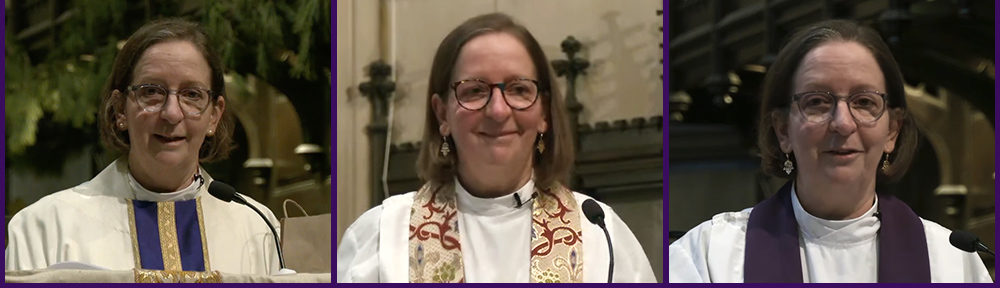
Proper 28B. 17 November 2024. The Very Rev. Pamela L. Werntz
1 Samuel 1:4-20. I am a woman deeply troubled.
Hebrews 10:11-25. Let us consider how to provoke one another to love and good deeds.
Mark 13:1-8. This is but the beginning of the birthpangs.
O God of enduring and eternal Love, grant us the strength, the wisdom and the courage to seek always and everywhere after truth, come when it may, and cost what it will.
We are nearing the end of our liturgical year. This is the last we’ll hear from the Gospel of Mark for another three years. It’s highly ironic to me to pray the beautiful words of the opening collect about scripture – to read, mark, learn and inwardly digest – on a day when our appointed Gospel lesson is the beginning of the apocalypse in Mark. Episcopalians generally don’t like dwelling on the fact that we have apocalyptic scripture. We don’t know what to make of it and we’d rather not have to try.
But this week, and this year, the Gospel lesson seems teed up to address our current dystopian circumstances. In today’s Gospel reading we hear a part of a speech – a kind of farewell speech – that Mark reports Jesus delivering in the last few days of his life. Like Jacob and Moses and King David before him, Mark’s Jesus gave his hearers instructions for how to live – how to go on, facing whatever comes their way, after he’s gone. And he’s instructing his followers about how to respond in the midst of catastrophic endings. Although his prediction that not one stone would be left upon another at the great temple in Jerusalem was something of an exaggeration, life as they knew it surely came to an end when Jesus died. And life as they knew it surely came to an end when the Romans sacked Jerusalem in response to the Jewish uprising in what we call 70 CE.
Perhaps wondering how best to prepare, Peter, James, John and Andrew interrogated Jesus privately about when the end would come and what the signs of the end would be. I hear them longing for certainty. As is so often the case, Jesus’ response does not answer their questions. He seems to be saying again, without so many words, that they’re asking the wrong questions. Jesus seems to be much more about questioning the answers than he is about answering the questions of his followers in the Gospel of Mark! Instead, he says, “see that no one leads you astray by using my name.” Astray from what? Well my guess is astray from the feeding and freeing work that they are called to be doing: casting out polluted spirits and restoring health, widely proclaiming and enacting the love of God, and building up the beloved community. Don’t be led astray from provoking one another to love and good deeds as the author of Hebrews writes. Don’t be led astray from loving your neighbors. Don’t let wars and rumors of wars, earthquakes in various places or famines disturb or startle you and keep you from loving one another and loving God.
The fascinating thing to me about this speech is that Jesus uses the metaphor of childbirth here. That’s a metaphor that really resonates with me! Jesus talks of the labor of birthing. I have to say I take great issue with the translation of a word “odeen” in Greek that means intense and unavoidable suffering, severe distress, and even death into the word “pang” that sounds like a twinge or stitch or a sting. Jesus is saying the pain is going to be bone-splitting agony. Jesus was not really addressing why labor hurts, just that it does – that it’s one of the signs of change –of a new life struggling to be born – about to be delivered through a process of extreme suffering. And let’s be clear, back then and even now, birth is very risky for both the mother and the baby. Survival is uncertain. His stated purpose in his farewell speech is to reduce emotional anxiety. Jesus’ followers are not to be alarmed. The pain is normal. It most assuredly does not feel good – and that can lead to fear. But “do not be alarmed” is Jesus’ refrain. Pay attention, keep alert, use your eyes and ears – and don’t worry. You have what you need. You know what you need to know. He’s like a birth coach! Keep breathing, he says.
People will come along and try to convince you that you don’t really have to behave lovingly toward “those” people. Voices will try to persuade you that the message of love is thin and facile, the opposite of mighty, that good deeds are too small to make a difference, or that unethical behavior is now justified. Keep your hearts and minds in the love of God and of one another, even in the midst of catastrophes, violence and great suffering, Jesus’ followers are to continue to live in love knowing that love is always more powerful than death. Jesus’ followers are to remember that anytime scripture is cited to defend behavior that’s not motivated by the law of love, something is seriously wrong.
We know that Jesus is talking about love because of the part of Mark’s Gospel just before the farewell speech begins. The wise scribe says it and Jesus affirms it. I’ll tell it to you – but I know that you already know it: “Hear, O Israel (or translated differently, “Listen deeply you god-strugglers”): Listen, O my wrestling people: the [name which is too sacred to pronounce] is our God, the [Holy Name] alone; (and when you listen deeply) you are going to love the Holy Name your God with all your heart, and with all your life force, and with all your mind, and with all your very muchness. (When you do that) you are going to love your neighbor as your self.” That’s it. That’s all you need to know. Indeed, that’s all we need to know.
And with that knowledge, we have the ability to do something great today – every single one of us, whether you are worshiping with us on-line or you’re sitting in the pews. If you’ve already done something great this morning, fantastic, you probably still have time to do another great thing. If you are alert – if you use your eyes and your ears and you pay attention, the Holy One will provide an opportunity to put aside your worry or your fear of war or rumors of war, of earthquakes in various places, and of famine, to go with only the clothes on your back, yes, empty-handed, open-handed, and to share who you are, and what you have, and what you know about the love of God, using words only if necessary. You can let your life speak, as the Quaker saying goes.
In his parting words, Jesus is making it clear that whenever the stones come tumbling down, it’s not the end with a capital E; it’s an opportunity for transformation. So, in the words of the writer of Hebrews, “Let us consider how to provoke one another to love and good deeds, not neglecting to meet together…but encouraging one another, all the more.” According to Jesus, God does not invite us into abundant life by urging us to play it safe. [1] Do not be alarmed – love one another. I’m not talking about feelings. I’m talking about enacting compassion and kindness, gentleness and patience, leaning into the disarming power of love that is mightier than death. I mean enacting this love with annoying members of your own family, with your friends, with acquaintances, with complete strangers, with other drivers or commuters (I see you, Boston), even with those who wish you harm.
Perhaps you saw the piece in the Boston Globe on Friday by novelist and essayist, Cara Hoffman, writing about how to respond to authoritarian rule. [2] She wrote, “When the state fails or turns against us, penalizing us, denying us resources, restriction our speech and freedom of movement, and attacking the weakest among us, all we have is each other: our bravery, our competence, our delight, our anger, our refusal to back down or see another harmed.” She was writing about a neighborhood of Athens where she lives, but I immediately thought of Emmanuel Church and our long history of subverting the dominant paradigms through radical hospitality and advocacy, through sanctuary, through extravagant engagement with the arts. I thought of the steady stream of generosity that flows in and out from this place.
Howard Thurman wrote about how to respond to turbulent times, wisely and bravely saying, “there is no need to fear evil. There is every need to understand what it does, how it operates in the world, what it draws upon to sustain itself…the real target of evil is to corrupt the spirit of [hu]man[s] and to give to [their] soul[s] the contagion of inner disintegration.” Thurman concludes: ”To drink in the beauty that is within reach, to clothe one’s life in simple deeds of kindness, to keep alive a sensitiveness to the movement of the Spirit of God in the quietness of the human heart and in the working of the human mind – this is as always the ultimate answer to the great deception.”[3]
Our primary concern is being and becoming more and more living testimony to the Gospel, which is to say, food for those who are hungry, water for those who are thirsty, healing for those who are ailing, release for those who are captive, welcome for those who are alien, and reparation for those who have been wronged. Christianity has been formed and reformed in times of intense distress, when what seems like weakness becomes the very thing that strengthens us to go where the Love is and to be the people and the place where Love is. What we do matters. I’m going to close with a prayer from Jan Richardson, called “Blessing When the World is Ending”. [4]
Look, the world is always
ending somewhere.
Somewhere the sun
has come crashing down.
Somewhere it has gone
completely dark.
Somewhere it has ended
with the gun, the knife, the fist.
Somewhere it has ended
with the slammed door,
the shattered hope.
Somewhere it has ended
with the utter quiet
that follows the news
from the phone, the television,
the hospital room.
Somewhere it has ended
with a tenderness
that will break your heart.
But, listen, this blessing means
to be anything but morose.
It has not come to cause despair.
It is simply here because
there is nothing a blessing
is better suited for than an ending,
nothing that cries out more
for a blessing than when a world
is falling apart.
This blessing will not fix you,
will not mend you,
will not give you false comfort;
it will not talk to you
about one door opening
when another one closes.
It will simply sit itself beside you
among the shards
and gently turn your face
toward the direction
from which the light
will come, gathering itself
about you as the world begins again.
- Thanks to Bob Eldan at http://preachingtip.com
- The Boston Globe, November 15, 2024.
- Howard Thurman, “Life Goes On,” in Meditations of the Heart (Boston: Beacon Press, 1953), p. 109-10.
- Jan Richardson, “Blessing When the World is Ending”, Circle of Grace: A Book of Blessings for the Seasons. Orlando FL: Wanton Gospeller Press, 2015.