
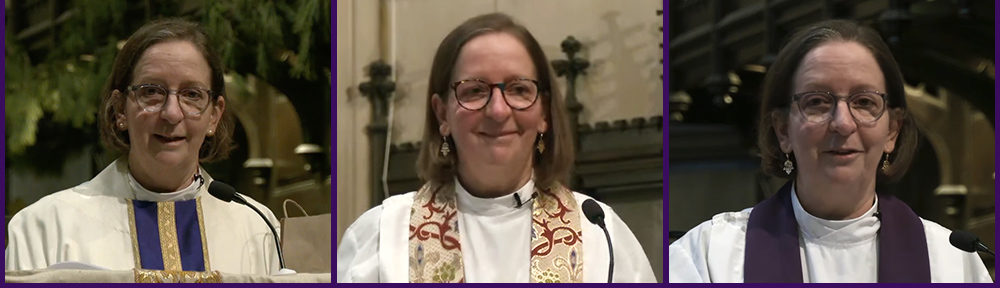
Trinity C, June 15, 2025. The Very Rev. Pamela L. Werntz
Proverbs 8:1-4,22-31. Does not wisdom call, and does not understanding raise her voice? ….”To you, O people, I call, and my cry is to all that live.”
Romans 5:1-11. We boast in our hope of sharing the glory of God…because God’s love has been poured into our hearts through the Holy Spirit that has been given to us.
John 16:12-15. I still have many things to say to you, but you cannot bear them now.
O indescribable Holy One, grant us the strength, the wisdom and the courage to seek always and everywhere after truth, come when it may, and cost what it will.
For any who struggle with the Gospel of John, today’s Gospel reading is for you. It begins with an acknowledgement that, while there is much more to say, Jesus knows that you cannot bear it now. Perhaps this is recognition of saturation, of exhaustion, of grief, of the lack of additional capacity among Jesus’ followers. It seems like it might be compassionate or parental; or perhaps it was the confession or projection of a tired scribe. Whatever the case, I like to imagine it is a true statement in every age, that there are more things than we can hear or bear. (Just keep up with the news, and you’ll know what I mean.) I find it to be a hopeful idea that there is more wisdom and truth than are recorded in the scriptures. Wisdom and truth were not fully revealed in Jesus’ time; they are not completely revealed even yet. The revelation of the Divine is ongoing, continuing. “God is still speaking,” as the United Church of Christ’s banners proclaimed some years ago; and we are still listening.
So far, so good. But then our text has a series of potholes that, for this feminist preacher, threaten to blow out all of my tires. In this little passage, in three short verses, the masculine pronoun appears eight times in reference to the spirit of truth. He, he, he; for crying out loud, this drives me crazy! The Greek word for spirit, pneuma, is neuter; and the word for truth, aletheia, is feminine. The spirit of truth is not a he. It reminds me of a conversation I had with one of my cousins when she saw my t-shirt from the early days of the Episcopal Women’s Caucus, which said, “God is not a boy’s name.” And my cousin Linda said, “Well, God does sound like a boy’s name.” And I responded, “Of course God sounds like a boy’s name, because you have never heard anything but male pronouns referring to God!” She agreed that she hadn’t but insisted it just sounded weird to think of God in any way but He. But I digress.
Listen to the passage read this way: “When the spirit of truth comes, it will guide you into all truth; it will not speak on its own, but will speak whatever it hears; and it will declare to you the things that are to come. It will glorify me because it will take what is mine and declare it to you.” I get the power of the metaphor of the personification of the spirit, truth, wisdom, or grace. I also understand that, according to our Gospel writers, Jesus referred to God as Father. I believe the spirit of truth is still speaking, and I believe she is suggesting the word Author in place of Father, since Jesus is called “The Word.” And, if we are not going to use neutral pronouns for the spirit of truth, we really must use the feminine. “When the spirit of truth comes, she will guide you into all truth; she will not speak on her own, but will speak whatever she hears; and she will declare to you the things that are to come. She will glorify me because she will take what is mine and declare it to you. All that the Author has is mine. For this reason I said that she will take what is mine and declare it to you.”
You know, breath and spirit are the same word (same thought) in both Hebrew and Greek. Breath makes vocalizing possible. There is something lovely about the breath of truth (or the spirit of truth) listening first and speaking what she hears. The spirit of truth thus follows the central command of the Hebrew Bible: Sh’ma. Hear! Listen deeply! The spirit of truth speaks what she hears when she listens deeply. It’s like Quaker meeting or the Great Silence in monastic life. The spirit of truth is still enough to hear and then communicate the Voice of the Deep, the Author of us all. Our word for that, I think, is Inspiration. Do you believe in Inspiration? (Yes, I believe you do.) Do you know how she works? (Maybe not.) Can you control her? (Definitely not.) Would you want to live in a world without her? (I wouldn’t.)
Today is the day that the Church designates Trinity Sunday. That’s what this Gospel lesson is doing here in our lectionary. Although (in my humble opinion) it’s not particularly strong evidence, it appears to contain some foundational ideas of what the Church calls “the three persons of God.” Trinity Sunday is a day to focus our attention on the mystery of diversity in the unity of God, of threefold union; and it’s the kind of topic that theologians have written libraries full of books on. My problem (well, one of my problems) is that I can’t see how any one of them has gotten close to making sense of what the early church took several centuries to agree on; they finally said, one God in three persons: Father, Son, and Holy Spirit. I imagine that afterwards the church leaders were so exhausted that nothing else has ever really taken hold.
I have to confess I’ve never been interested enough in systematic theology in general or the doctrine of the Trinity, specifically. I’m so much more interested in early Christian development before doctrine and systematics started getting hammered out (and I do mean hammered). I recently read Bart Ehrman’s How Jesus Became God: The Exaltation of a Jewish Preacher from Galilee; and I commend it to you. [1] It’s about Jesus’ transformation from a human prophet to being thought of as equal with God Almighty, Creator of all things. I take some comfort from Adam Gopnik’s great piece in The New Yorker many years ago: [2]
The passion with which people argued over apparently trivial word choices [in the Nicene Creed and other documents] was…not a sign that they were specially sensitive to theology. People argued that way because they were part of social institutions – cities, schools, clans, networks – in which words are banners and pennants…It wasn’t that they really cared about the conceptual difference[s]…they cared about [who was]… going to run the Church.
It seems to me that is still the case with doctrinal arguments today. Who gets to run the Church? Who gets the power? Who gets the property and the money?
But if I back away from arguing the rightness, wrongness, or “only-ness” of the doctrine of the Trinity and wonder whether there is anything useful in it for us, then I notice that I am quite drawn to the idea that the Trinitarian model is one of the divine in relationship, in community, which moves beyond a singular idea of one, beyond a binary to a communal idea of one for the Divine. The interesting thing about relationships and community is that they are always messy and somewhat mysterious when they are real. One of the fascinating things about Jesus, whether you view him as a great religious leader or the very embodiment of the Christ, or both, is that Jesus was not teaching about removing oneself from the mundane or the mysterious. Jesus spent his life teaching that the Divine was somehow in the midst of the mess of everyday life and everyday relationships, and ultimately even on the cross.
One of the things that hangs many of us up is the variety of names for God in the Trinity. The words Father, Son, and Holy Ghost or Spirit are stumbling blocks for many. I think the ancient Israelites had it right when they made a word that could not be spoken to represent the Holy One. The idea is that God’s name is so holy it cannot be uttered. Silence or a placeholder or a substitute word is all that makes sense. Another way to understand the name of God is the sound of breathing in and out: breath – spirit – wind – in and out. That sound is the Holiest Name of God. Maybe, as one colleague has suggested, acknowledging the Trinity gives us a breather! [3] Hebrew scripture did have many titles for God: the wisdom from on high, the creator; the one who sees me, the eternal. There were descriptions of God being like a rock, a potter, an eagle, a father, a judge, and my favorite, an author creating the world with words. There were activities associated with God: God who creates and blesses, who calls, who speaks, who rules and disciplines, who rescues and restores. God was both male and female, and essentially plural in Hebrew Scripture. Male and female were created in God’s image. Hebrew scripture has many placeholder names for the Divine in addition to Lord or sovereign. Some of the best are ha shem (The Name), ha makom (The Place), and perhaps the most intriguing, the word mi, which is Who. One answer, then, to the question asked in Isaiah (40:26) about the stars, “Who created these?” is “Yes.” Who. I know it sounds a little like the Abbot and Costello routine: “Who created these?” Yes. “Who?” Yes.
The idea of the Divine, the Author of existence; of the Divine, the Word in the midst of the mess; and of the Divine, the Inspiration listening deeply and speaking (that is, inspiring) seems to me to provide a generous amount of elbow room, which is always what we are looking for more of at Emmanuel Church. It’s a way out of what can feel like a very narrow place of dogma. Once freed from that narrow place, as people of God, we might understand ourselves called to be co-creators, co-operators, and co-conspirators (conspiring with God)! Next week we’re back to Luke, I promise, in the Holy Name of the Trinity: Author, Word and Inspiration!
- Bart D. Ehrman. How Jesus Became God: The Exaltation of a Jewish Preacher from Galilee (NY: HarperCollins, 2014).
- Adam Gopnick. “What Did Jesus Do? Reading and Unreading the Gospels.” The New Yorker, May 24, 2010.
- Thanks to Mike Morrell for this idea.