
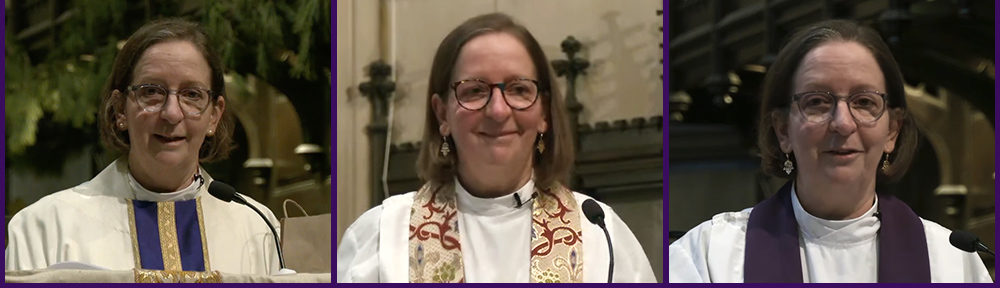
Pentecost C, June 8, 2025. The Very Rev. Pamela L. Werntz
- Genesis 11:1-9. And from there the Lord scattered them abroad over the face of all the earth.
- Acts 2:1-21. All of them were filled with the Holy Spirit.
- John 14:8-17. This is the Spirit of truth…[who] will be among you.
O God of our glorious diversity, grant us the strength, the wisdom and the courage to seek always and everywhere after truth, come when it may, and cost what it will.
A couple of Friday evenings ago, I had the honor and delight to preach at Central Reform Temple’s Shabbat service. I preached about how the Jewish and Christian liturgical calendars are so similar (like cousins) when it comes to the observances of Passover and Easter and the 50th day after each, which is the celebration of Pentecost (or in Hebrew, Shavuot). After the service I was having a conversation with one of the members of the Temple, who was asking me about the Christian story of Pentecost. I said that the traditional teaching for Christians is that the story in Act 2 is understood to be a reversal of what happened at the Tower of Babel. We heard the two stories a few minutes ago, about how the Holy One confused (or mixed or mingled) the language of the ancient Hebrew people, but on the 50th day after the resurrection brought people of all languages together to unite them.
But even as I was speaking, I was thinking, wait a minute; I’m repeating something that doesn’t make any sense to me. The people’s various languages didn’t stop being their languages after the Holy Spirit blew through and set their hair on fire. They still were all speaking different languages; and anyone who has ever translated from one language to another knows that some words and meanings just don’t translate. Besides, in Genesis, just before the Tower of Babel story, Noah’s many descendants are described as becoming “lands, families, tongues, and nations.” All the people of God weren’t speaking the same language before this Tower of Babel story. It was just a group who built the tower; and a complete reversal of many languages would have been for the Holy One to fix the diversity of languages so that everyone was speaking the same language again. That never happened!
I began to wonder if there’s another way to understand the Tower of Babel story more positively and a way to understand the Christian Pentecost story not as a reversal or a correction, but as a reaffirmation of the Tower of Babel story. I started with my Torah commentaries. Robert Alter writes, “Although there is a long…tradition that imagines the building of the Tower as an attempt to scale the heights of heaven, the text does not really suggest that.” [1] Furthermore, he points out that making a name for oneself (and one’s people) is a recurrent and positive notion in ancient Hebrew culture. The Union of American Hebrew Congregations’ commentary also notes that no actual transgression is specified in the Genesis text. It’s possible that the problem was that this group of tower builders were reluctant to “fill the earth,” which was the blessing and instruction of the Holy One just prior to this story in Genesis 9:1 and repeated in 9:7.
Interpreted this way, perhaps the generation of people in the Babel story was not arrogant, but anxious. They didn’t have a desire to reach the heavens so much as they had a need to fortify themselves, to build a fortress, a tall defensive tower, and to settle in spite of God’s specific instruction to spread out. The word for settle (יָשַׁב yashab) primarily means to sit or to dwell, but it can carry negative connotations, too, just like in English. Yashab can mean compromise or accept less. It can imply mindless affluence and ease. In the Talmud, Rabbi Helbo taught, “Whenever you find contented satisfaction, [evil inclination] is active.” [2]
Then I found a sermon (D’var Torah) on this Torah text by Rabbi Shai Held, President and Dean at the Hadar Institute in New York City. [3] Rabbi Held begins by asserting that the story of the tower of Babel is neither a morality tale about people trying to displace the Divine, nor is it about an insecure Divinity Who is easily threatened by a building project. Instead, Rabbi Held reads this tale as a teaching about “the importance of individuals and the horrors of totalitarianism.” How does he get there? Rabbi Held explains that God’s foundational instruction in the creation stories and in the aftermath of the flood, is a path of blessing: to be fruitful and multiply, and to spread out and fill the world. The people, however, are afraid of being scattered and afraid of difference. What alarms the Holy One, then, is the people’s desire for total uniformity, for enforced consensus, in which everyone says the same words and thinks the same thoughts, a society in which there is no room for difference, for individuality.
Perhaps what the people in the Tower of Babel story were doing was striving to control all aspects of their society by speaking the same words and language. Then this is a morality tale about the suppression of dissenting voices and distinction that results in coerced anonymity. This is particularly apparent if we read the story of the Tower of Babel in its context, between two long lists of genealogies, that is, long lists of names. The first list ends with Noah’s son Shem and the second list of names begins with Noah’s son Shem. Shem is the Hebrew word for name. That bracketing makes it all the more striking that the people in the story of the Tower of Babel have no names. This is particularly ironic because of the people’s desire to make a name for themselves.
Rabbi Held teaches that 19th-century Rabbi Netziv observed that even though the beginning of this story says that the builders all had “the same words,” it never tells us anything about what those words actually were. That, he argues, is the whole point: “God was not distressed by what they said, but by the fact that their words [and by implication, their thoughts] were all the same.” The uniformity alarmed the Holy One, because total uniformity is a sign of totalitarian control. Held says, “After all, absolute consensus does not happen naturally on any matter, let alone on every matter.” By scattering the people and multiplying their languages, The Holy One was getting the people back onto a path of blessing. A large variety of languages and a rich diversity of cultures, is a godsend that we are called to celebrate and honor. In the light of the Torah, we might see that the story in Acts is not a correction, but a recapitulation of the call to a path of blessing and for Christians, a teaching about the love of God in Jesus being accessible in many the languages and many cultures of the world.
In our Gospel lesson from John, Jesus is teaching about how to make sense of times framed by high anxiety (think of Jesus’ disciples hiding in a locked room). Here Jesus is responding to Philip’s request for confirmation that they are on the right path on the night when Jesus was arrested. “Show us God,” Philip says, “and we will be satisfied” (because it’s hard to believe in something that we cannot see at all, and we are so scared). So here Jesus is showing us God. Jesus says “This is what God looks like. God looks like loving presence advocating for community.” Here Jesus’ response does not deny the anxiety at all but it offers a promise of presence and sense of meaning to be found in sharing the hard work of loving actions, of actions that center compassion and right relation in the world (cost what it will). Jesus’ focus is on teaching how to be the change that his followers want to see in the world, on expanding the initiative of loving which comes from God, which is God. Offering loving presence and works, Jesus says this is what God looks like; you have seen it. And Jesus offers help.
The word advocate (in Greek paracletos) can be translated: Helper, Advocate, Counselor, Comforter, Intercessor, a Spirit of Truth, the Holy Spirit. According to Jesus, the focus of the Spirit is presence; a Holy Spirit is available to all for the work of glorifying God, of doing God’s work, which is the work of spreading God’s Love. It’s not about spreading doctrine, dogma, platitudes, or propaganda. In fact, Jesus says, it’s not about believing. If you don’t believe in him, that’s okay he says; just believe in his work of spreading love. Believe in the work of feeding people who are hungry, of freeing people who are stuck. This is how we are to behave in our own times framed by high anxiety, with the assurance that the Spirit will be with us, even in the midst of danger and degradation.
Toward the end of our Gospel passage for today, Jesus says, “You know the Spirit because the Spirit has a deep on-going relationship with you and will be in you.” In written English, we use the word you as a singular and plural pronoun. In Greek, the you referred to here is plural. In spoken English we have a way to indicate this, at least in the South we do. Another way to translate the Greek that gives a stronger sense of community is, “Y’all know the Spirit, because the Spirit has a deep on-going relationship with y’all and will continue to be among y’all.”
George MacLeod, founder of the Iona Community in Scotland, said that in order to form community, people must be engaged in a “demanding common task.” It seems to me that this is what we’re focusing on here today, especially as we formally welcome Isabella into the Church. We are focusing on the expansion of the initiative of loving presence in community, which comes from God and is God. We are not celebrating uniformity. We are celebrating Isabella as an individual, by name. The Christian rite of baptism is a naming ceremony.
I don’t know a communal task more demanding than fulfilling our baptismal vows. In a moment Isabella’s parents and godparents will make promises on her behalf, and we will all represent the Church in vowing to support her. Then all of us together will renew our own promises to focus on expanding the Love which comes from God and seeks to fill the whole world. We do this together because we can’t do it alone. We need one another’s unique perspectives and approaches to fulfilling these demanding vows. And we need the help of a Spirit of Truth and Holiness, which none of us receives alone, but all of us can receive together. It’s a gift from God, a godsend; and we are urged to spread it around.
- Robert Alter, The Five Books of Moses: A Translation with Commentary (New York: W.W. Norton & Company, 2004), p. 58.
- The Torah: A Modern Commentary, W.G. Plaut, editor (New York: Union of American Hebrew Congregations, 1981), p. 85.
- Shai Held, https://www.christiancentury.org/article/critical-essay/the-babel-story-is-about-dangers-uniformity.